



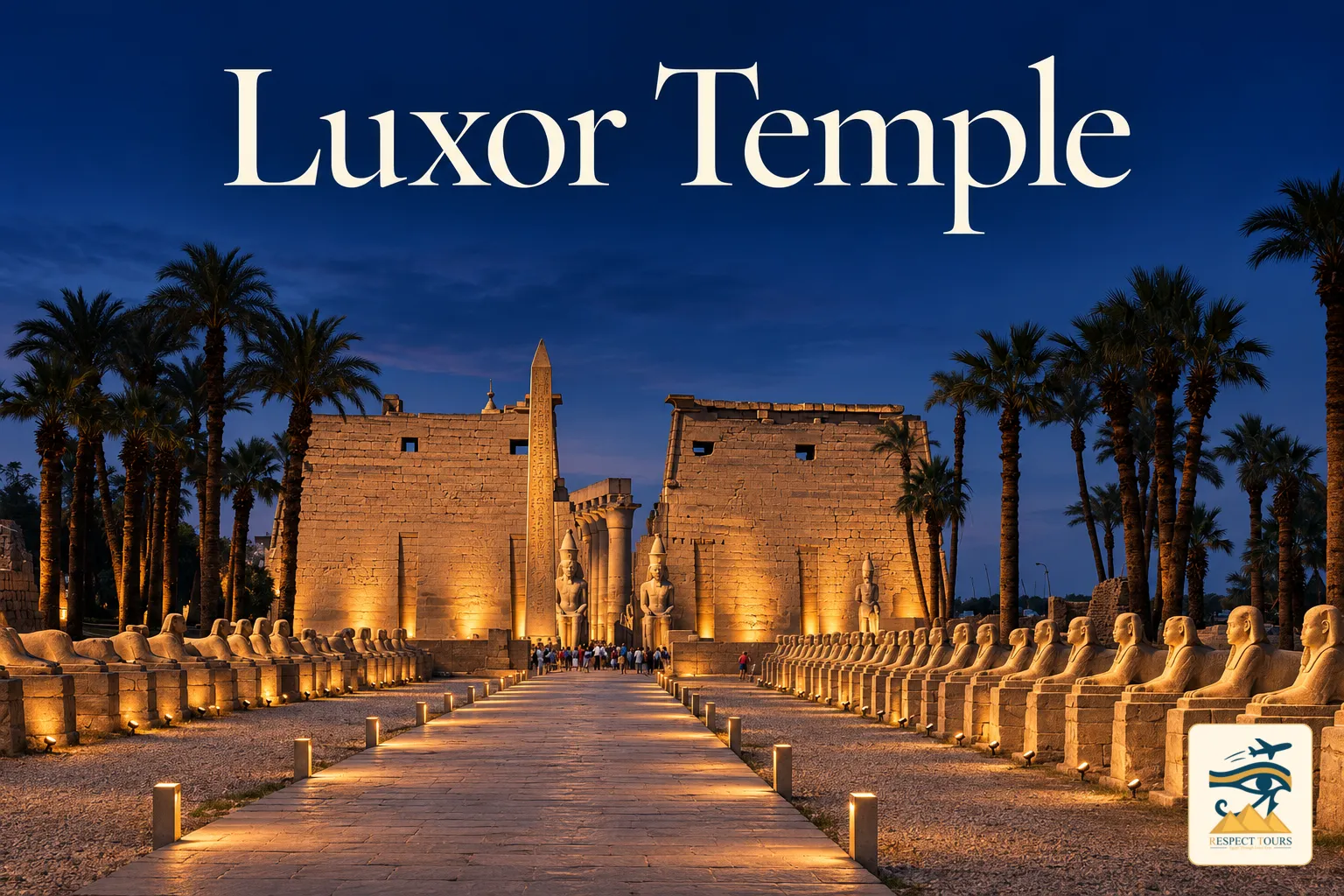
Luxor Temple stands on the east bank of the Nile in the middle of modern Luxor. Amenhotep III built it around 1390 BC, and Ramesses II added its great pylon and obelisks. It was the end point of the Opet Festival, when Amun’s sacred boat sailed here from Karnak. Visitors see colossal statues, a grand colonnade, divine birth scenes and a mosque. Visit in the late afternoon or evening, when the stone is lit.
What Is Luxor Temple?
Luxor Temple is an ancient Egyptian temple of kingship and renewal, not a tomb or the home of a single god. Pharaohs used it to renew their divine authority.
Most Theban temples honoured one main god or served the dead. Luxor Temple linked the king to the gods, especially Amun. During the Opet Festival, the king entered the sanctuary and was symbolically renewed.
This is why its carvings show royal birth, coronation and offerings, and not only the gods.
Where Is Luxor Temple Located?
Luxor Temple lies on the east bank of the Nile, in the centre of modern Luxor. It stands close to the river, in the middle of the town.
The temple faces Karnak Temple to the north. The two are joined by the Avenue of Sphinxes, which is about 2.7 km long. Many visitors combine both in one East Bank tour.
- Side of the river: east bank, the side of the living in ancient Thebes
- Setting: inside the modern city, so you can see it from the street
- Link to Karnak: the Avenue of Sphinxes, a processional road
- Best pairing: Karnak in the morning, Luxor Temple later in the day
The History of Luxor Temple
Luxor Temple grew over about 1,500 years. Each ruler added a part, so the temple reads like a timeline in stone.
The Earliest Structures at the Site
An older shrine stood here before the main temple. Hatshepsut built a triple barque shrine for Amun, Mut and Khonsu, and Thutmose III later took it over. Read about her temple at Deir el-Bahari on the west bank. You can still see it in the northwest corner of the Court of Ramesses II.
Amenhotep III and the Main Temple
Amenhotep III built the core of Luxor Temple around 1390 to 1352 BC. He enlarged an older shrine into a temple for Amun’s southern “ipet”, often explained as the god’s private residence.
He added the sun court, the sanctuary rooms and the birth room. He also planned the great colonnade.
Tutankhamun and Horemheb’s Additions
Tutankhamun decorated the walls of the colonnade with scenes of the Opet Festival. Horemheb later replaced the boy king’s name with his own on some of them.
The reliefs are the best record of the festival you can still see on site.
Ramesses II and the Monumental Entrance
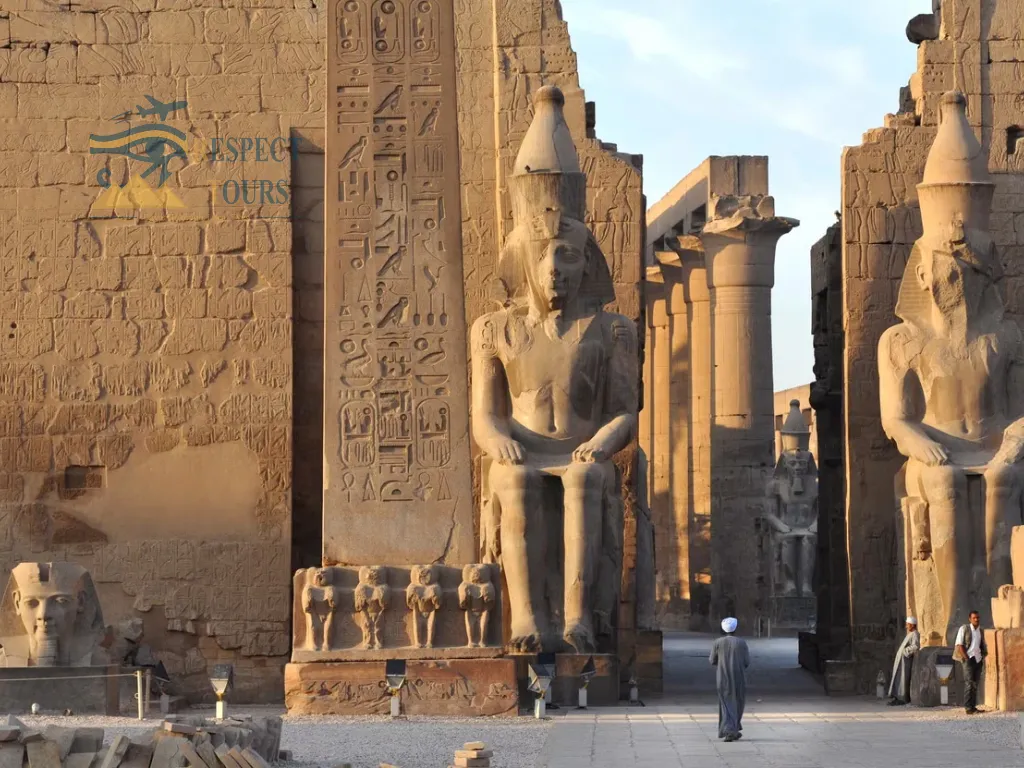
Ramesses II added the first pylon, a large open court and 2 obelisks during his long reign. Our guide to 10 fun facts about Ramses II tells more of his story. Colossal statues of the king stood in front of the entrance.
His court is set at an angle. This kept Hatshepsut’s older shrines in place, which tells you he respected the earlier work.
Alexander the Great’s Sanctuary
Alexander the Great rebuilt the barque shrine of Amun in the heart of the temple. Its walls show him as an Egyptian pharaoh making offerings to the gods.
He ruled Egypt for a short time, but the shrine shows how foreign kings used local tradition to look legitimate.
Luxor Temple During the Roman Period
The Romans turned part of the temple into a legionary fortress around AD 300. A chapel for the imperial cult was painted with figures of Roman emperors, and traces of those paintings survive.
Parts of the temple were later used as churches.
Christian Churches and Abu Haggag Mosque
The Abu Haggag Mosque was built on top of the temple, and it dates to the Middle Ages. It is still a place of prayer.
Sand and houses covered the temple over the centuries. The mosque sits above the old ground level, so its doorway hangs high above today’s floor.
Who Built Luxor Temple?
Luxor Temple was not built by one king. Amenhotep III built the core, and several rulers added to it.
| Ruler | What they added |
|---|---|
| Amenhotep III | Main temple, sun court, sanctuary and birth room |
| Tutankhamun | Opet Festival scenes on the colonnade |
| Horemheb | Completed the decoration and added his name |
| Ramesses II | First pylon, court, obelisks and colossal statues |
| Alexander the Great | Barque shrine of Amun |
| Roman rulers | Fortress, imperial chapel and wall paintings |
Why Was Luxor Temple Built?
Luxor Temple was built to renew the king’s divine power and to host Amun during the Opet Festival. It tied the pharaoh to the gods.
It served 4 main purposes:
- Renewal of kingship: the king was shown as the child and chosen heir of Amun.
- Home for the Opet visit: Amun, Mut and Khonsu stayed here during the festival.
- Link between king and gods: the reliefs show the king receiving life and power.
- Royal ceremonies: processions and offerings gave the king a public stage.
Architecture and Layout of Luxor Temple
The temple runs north to south in a clear line. You pass the pylon, 2 courts, the colonnade and the halls before you reach the sanctuary.
The First Pylon of Ramses II
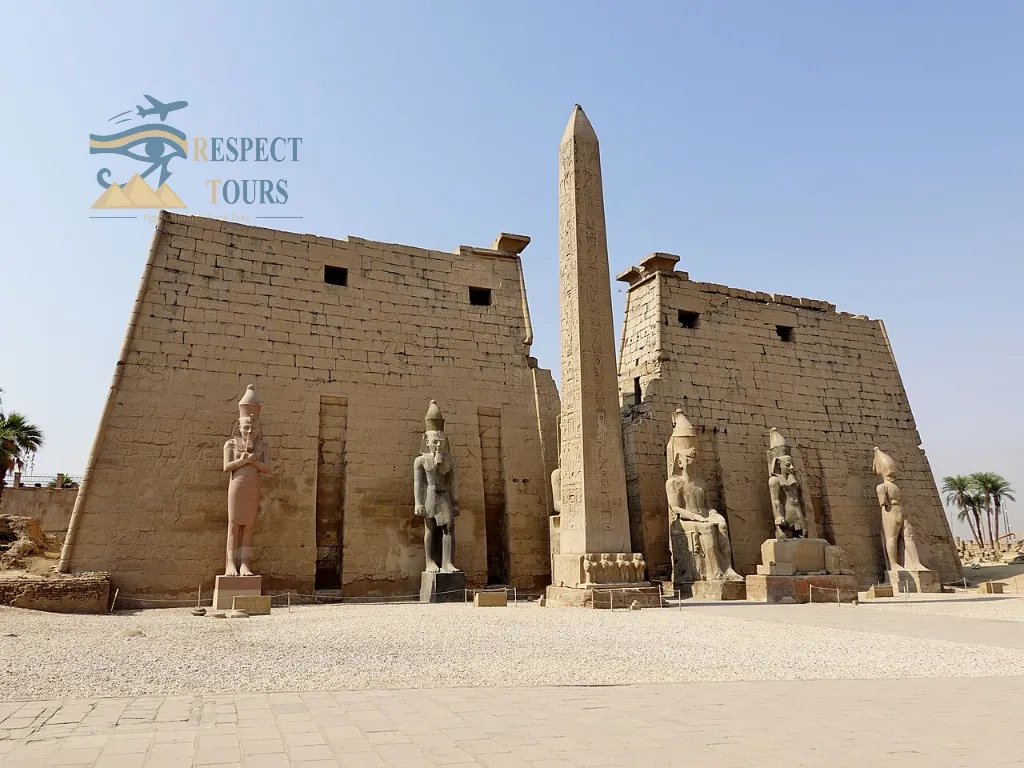
The first pylon is the huge gateway at the front. Ramesses II built it as a grand entrance, and its walls show scenes of his reign.
Stand back across the square to see its full height. It looks best in the evening light.
The Obelisks and Colossal Statues
Two obelisks once stood at the entrance. See what an obelisk is and where it began for background. One remains in Luxor, and the other stands in the Place de la Concorde in Paris. The Paris obelisk is about 23 m high and was raised there in 1836.
Muhammad Ali Pasha gave both obelisks to France in the 1830s, but only one was taken. Seated and standing statues of Ramesses II also guard the entrance.
The Court of Ramses II
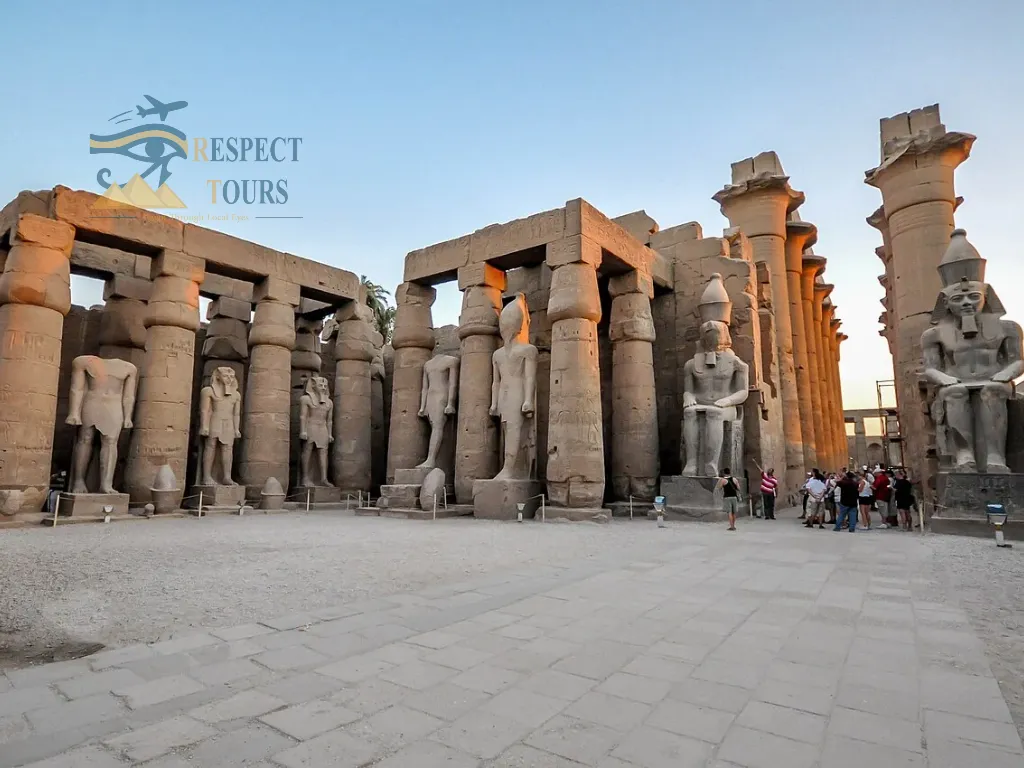
This open court has columns on all sides and statues of the king between them. It is set at an angle to the temple.
In the northwest corner you will find the older barque shrine of Hatshepsut. The Abu Haggag Mosque rises above the east side.
The Colonnade of Amenhotep III
The colonnade is a processional avenue of huge papyrus columns. It was begun by Amenhotep III and decorated under Tutankhamun and Horemheb.
The walls show the Opet procession, with boats, priests, musicians and crowds. This is the best place to understand the festival.
The Court of Amenhotep III
Beyond the colonnade lies a court with double rows of papyrus columns. It was a sun court, open to the sky.
Beneath this court, workers found a hidden cache of statues in 1989.
The Hypostyle Hall
The hypostyle hall is a room of columns that leads to the inner sanctuaries. It marks the move from the public courts to the sacred core.
The light is lower here, and the columns stand close together.
The Birth Room and Divine Birth Scenes
The birth room shows the divine birth of Amenhotep III. The reliefs present Amun as the divine father of the king.
This story supported the king’s right to rule. It is easy to miss, so ask your guide to point it out.
The Barque Shrine of Alexander the Great
This shrine held the sacred boat of Amun. Alexander rebuilt it, and the walls show him as a pharaoh.
The Inner Sanctuary
The inner sanctuary was the most sacred space. Only priests and the king entered it, and the god’s statue stayed here when it was not on procession.
The Roman Chapel and Imperial Paintings
A Roman chapel preserves painted figures of emperors in a faded red and blue. The paintings date from about AD 300.
They look unlike the Egyptian reliefs around them, which makes them easy to spot.
Abu Haggag Mosque
The Abu Haggag Mosque is a historic mosque that people still use for prayer. Please be respectful when you pass.
Do not treat it only as a monument. Dress modestly, keep your voice low and follow the guide’s advice.
What to See at Luxor Temple
Use this checklist for a 1 to 2 hour visit:
- Ramesses II’s pylon and statues
- The remaining obelisk
- The Court of Ramesses II
- Amenhotep III’s colonnade
- The divine birth scenes
- The barque sanctuary
- The Roman wall paintings
- The Abu Haggag Mosque
- The start of the Avenue of Sphinxes
The Avenue of Sphinxes Between Luxor and Karnak
The Avenue of Sphinxes, also called The King’s Festivities Road, is a 2.7 km processional road between Luxor and Karnak. Egypt reopened it in November 2021.
Why Was the Avenue of Sphinxes Built?
The avenue was built as the road for the Opet Festival. It linked the 2 temples and gave the sacred boats a protected route.
It was developed over many centuries. The late work is linked with Nectanebo I, who ruled around 380 to 362 BC.
Processions and Shrine Stations Along the Route
The processions stopped at barque shrines on the way. These rest stations let the priests set down the boats and make offerings.
The statues along the road include ram-headed and human-headed sphinxes. The ram represents Amun.
The Avenue of Sphinxes Today
The avenue is now open to walk, and more than 1,000 statues line it. You can reach the Luxor end from the temple entrance.
Many visitors walk it at sunset. Check the current opening times before you go.
The Opet Festival at Luxor Temple
The Opet Festival was an annual celebration in which Amun’s boat travelled from Karnak to Luxor. It renewed the king’s power.
What Was the Opet Festival?
The Opet Festival was a yearly feast of Thebes, held during the Nile flood season. The statues of the gods left Karnak and visited Luxor.
Its length changed over time, from days to a few weeks. Crowds lined the route.
The Procession From Karnak to Luxor Temple
Priests carried the sacred boats on their shoulders at first. In later periods the gods also travelled by river, and the Avenue of Sphinxes marked the land route.
The boats rested at shrines along the way and arrived at Luxor Temple, where the gods were received.
Amun, Mut and Khonsu During the Festival
The festival honoured the Theban triad: Amun, his wife Mut and their son Khonsu. Their statues travelled together and stayed in the temple.
How the Festival Renewed the King’s Authority
The king entered the inner rooms with the god and was renewed by the divine presence. The ritual confirmed that Amun had chosen him.
This is the real function of the temple, and it explains the scenes on the colonnade walls.
Gods Worshipped at Luxor Temple
Luxor Temple honoured Amun, Mut and Khonsu. It also linked the king to Amun in the form of Amun-Min.
Amun-Ra
Amun-Ra was the king of the gods in Thebes. At Luxor he is shown as the divine father of the king.
Mut
Mut was Amun’s wife and a mother goddess. She is often shown in a vulture crown.
Khonsu
Khonsu was the son of Amun and Mut, a moon god. His name means “traveller”.
Amun-Min and the Renewal of Kingship
Amun-Min is a form of Amun linked to fertility and renewal. This idea suited a temple focused on the renewal of royal power.
Mythology and Divine Kingship at Luxor Temple
Luxor Temple tells one story: the king is the child of a god. The reliefs make this point again and again.
- Divine birth: Amun is shown fathering the king.
- Link to Amun: the king is the god’s chosen son and heir.
- Renewal and fertility: the festival came with the Nile flood.
- Royal legitimacy: the gods confirm the king’s rule.
Read more about the people of this age in our guide to the names of ancient Egyptian pharaohs and what a pharaoh was in ancient Egypt.
Excavation and Conservation of Luxor Temple
Luxor Temple spent centuries partly buried. Clearing and conservation have continued into modern times.
Luxor Temple Beneath the Modern Town
Houses and a village grew inside and on top of the temple. The ground rose with sand and rubble, which is why the mosque sits so high.
Gaston Maspero and Early Excavation Work
Gaston Maspero, a French Egyptologist who led the Egyptian Antiquities Service, began clearing the temple in the 1880s. The work freed the courts and columns from the houses.
Discovering the Luxor Temple Statue Cache
Workers found a cache of statues beneath the sun court on 22 January 1989. About 26 statues were uncovered, and they include figures of Amenhotep III and the goddess Hathor.
The best pieces are now in the Luxor Museum. Scholars still discuss when and why the statues were buried.
Modern Conservation of the Temple
Conservation continues. The work includes cleaning the stone and protecting the columns and the reliefs.
Why Is Luxor Temple Important?
Luxor Temple is important because it shows how kingship worked and how a site changed over 3,000 years. It is also a living place of worship.
- A centre of royal ritual
- A main stop of the Opet Festival
- An architectural record of several eras
- A site that joins Egyptian, Greek, Roman, Christian and Islamic history
- A direct link to Karnak Temple
Luxor Temple vs Karnak Temple
Luxor Temple is smaller and focused on kingship, while Karnak is a vast religious complex. Visit both if you can.
| Point | Luxor Temple | Karnak Temple |
|---|---|---|
| Main role | Kingship and Opet rituals | Major religious complex |
| Main builders | Amenhotep III and Ramesses II | Many kings across centuries |
| Location | Central Luxor | North of Luxor Temple |
| Recommended time | Late afternoon or evening | Morning |
| Time needed | Around 1 to 2 hours | Around 2 to 3 hours |
Read more in our Karnak Temple guide, or see our list of famous temples of Egypt.
How to Visit Luxor Temple
You can visit Luxor Temple on foot from the centre of town or with a guide on an East Bank tour. A guide helps you read the reliefs.
Best Time of Day to Visit
The best time is late afternoon or early evening. The heat is lower, the stone turns golden and the temple is lit after dark.
Morning is quieter, but Karnak is a better fit for the morning.
How Long Do You Need?
Allow 1 to 2 hours. With a guide you can cover the main points in about 1 hour, and you may stay longer to enjoy the lights.
Can You Visit Luxor and Karnak on the Same Day?
Yes, you can visit both on the same day. Go to Karnak first, then Luxor Temple in the afternoon or evening.
Our Luxor East Bank tour follows this plan. It visits Karnak Temple, the Luxor Museum and Luxor Temple, with lunch at a local restaurant. For an evening at Karnak, see our Karnak Sound and Light Show tour.
Visiting Luxor Temple on a Nile Cruise
Many Nile cruises include Luxor Temple with Karnak and the Valley of the Kings. Our 4-day Aswan to Luxor Nile cruise lists Luxor Temple among its stops.
Read more about the Valley of the Kings in Luxor before you go. For sunrise views over the Theban hills, see our Luxor hot air balloon tour.
What to Wear and Bring
Wear comfortable shoes and light, modest clothes. Bring water, sunglasses and a hat for the day, and a light layer for winter evenings.
Is Luxor Temple Suitable for Children and Older Travelers?
Yes, it suits most visitors. The site is compact and mostly flat, but the stone paths are uneven and there is little shade by day.
Children enjoy the giant statues. Older travellers can choose the evening, when it is cooler. Tell your guide about mobility needs.
Tickets and Opening Hours
These details change, so confirm them on the day of your visit.
| Item | Detail |
|---|---|
| Foreign adult ticket | About EGP 500 (2026 price lists) |
| Opening hours | Roughly 6:00 AM to 9:00 PM in winter, later in summer |
| Lighting | The temple is lit after dark |
Interesting Facts About Luxor Temple
- Several rulers built and expanded it over about 1,500 years.
- It was central to the annual Opet Festival.
- One of its 2 obelisks now stands in Paris.
- A Roman military camp once occupied part of the temple.
- Churches were built inside the complex.
- The Abu Haggag Mosque is still in use.
- The temple was once partly buried beneath the town.
- A cache of royal statues was found beneath its sun court in 1989.
Explore Luxor Temple With Respect Tours
Discover Luxor Temple with a private Egyptologist. Explore Luxor Temple, Karnak and the Avenue of Sphinxes with a licensed local guide who explains the rituals, rulers and stories behind every monument. View our Luxor tours or contact Respect Tours to create a private East Bank itinerary.
- Browse our Luxor day tours
- Plan a 4-day Luxor city break
- Compare Nile cruise options from Luxor to Aswan
- Request a private East Bank itinerary
FAQs About Luxor Temple
What is Luxor Temple famous for?
Luxor Temple is famous for its Opet Festival role, its colossal statues and its grand colonnade. It also holds divine birth scenes, a Roman chapel and a mosque that is still in use, all in one compact site.
Who built Luxor Temple?
Amenhotep III built the core around 1390 BC. Tutankhamun and Horemheb decorated the colonnade, and Ramesses II added the pylon, court and obelisks. Alexander the Great rebuilt the barque shrine, and Roman rulers added a fortress and chapel.
Is Luxor Temple included in Nile cruise excursions?
Often, yes. Several of our Nile cruise itineraries list Luxor Temple together with Karnak and the Valley of the Kings. Check the programme for your own trip, because the order and the timing change by route and season.
Is Luxor Temple better during the day or at night?
Both are good, but the evening is better for most visitors. It is cooler, the temple is lit and the crowds are smaller. Visit Karnak in the morning, then come to Luxor Temple in the late afternoon.


