


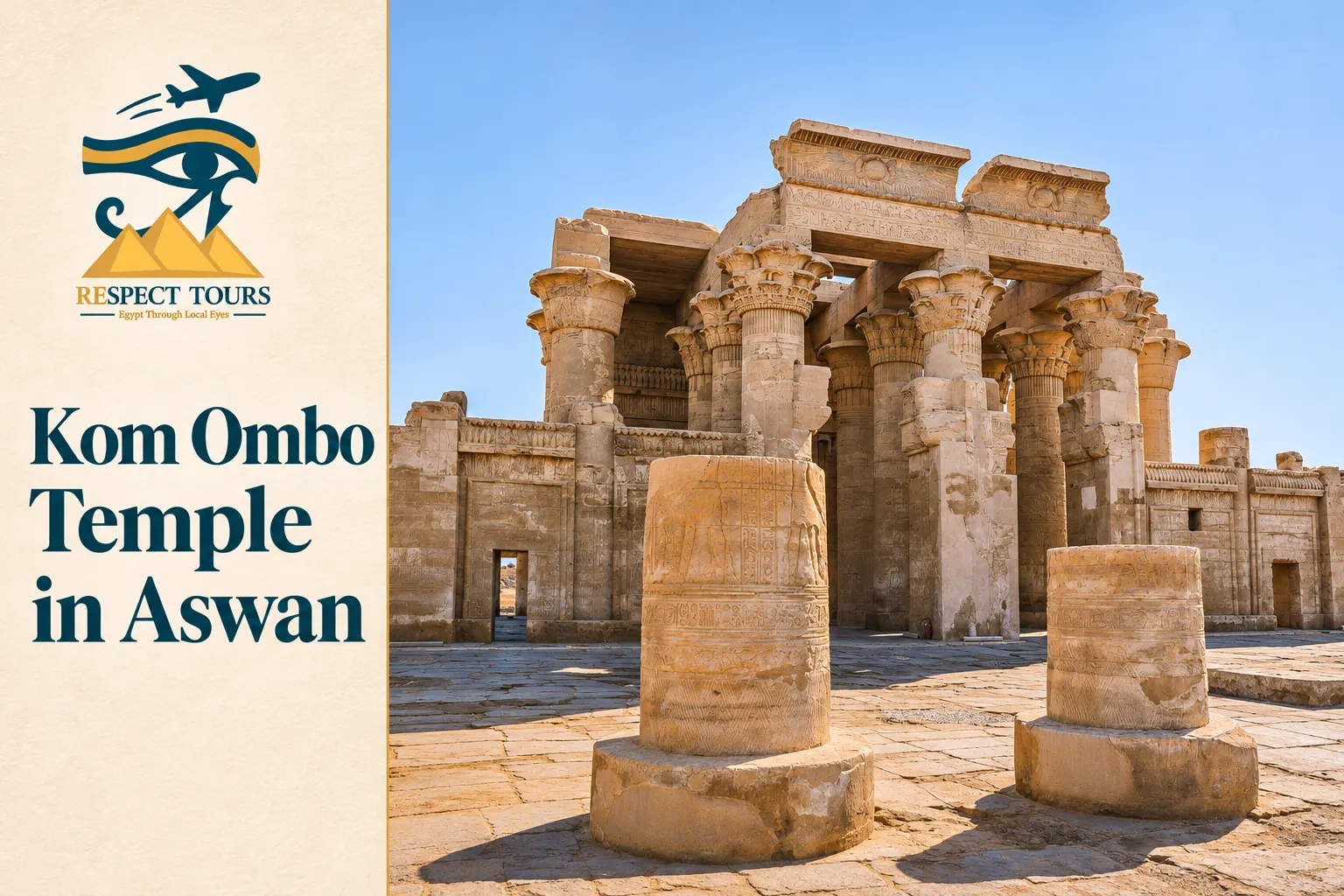
Kom Ombo Temple is a Graeco-Roman double temple on the Nile, about 45 km north of Aswan, built for two gods: Sobek, the crocodile god, and Haroeris, the falcon-headed sky god. It has 2 parallel entrances, 2 sets of halls, and 2 sanctuaries, so each god had his own path of worship.
It also holds a carving believed to show surgical instruments and a Crocodile Museum next door. This guide covers what to see in order, what the carvings mean, and how to plan a visit of about 1.5 to 2 hours, by cruise or by road from Aswan.
At Respect Tours, a local operator since 1978, we include Kom Ombo in private Aswan tours and Nile cruise itineraries. A licensed Egyptologist explains the twin sanctuaries and reliefs, and the timing is planned around your day, so you see what matters without rushing.
What Is Kom Ombo Temple? A Quick Answer
Kom Ombo Temple is a Graeco-Roman double temple on the Nile, about 45 km north of Aswan, dedicated to the gods Sobek and Haroeris.
Sobek was the crocodile god of the Nile. Haroeris, also called Horus the Elder, was a falcon-headed sky god. The temple has 2 parallel entrances, 2 sets of halls, and 2 sanctuaries, so each god had his own path of worship. It also holds a carving believed to show surgical instruments, a festival calendar, and a Crocodile Museum. Most visitors arrive on a cruise or a day trip from Aswan, and a visit takes about 1.5 to 2 hours.
Kom Ombo Temple at a Glance
| Fact | Detail |
| Location | East bank of the Nile, about 45 km north of Aswan |
| Why it is famous | A double temple with two axes and two sanctuaries |
| Gods | Sobek (crocodile) and Haroeris (falcon, Horus the Elder) |
| Built | Graeco-Roman period; the earliest royal name is Ptolemy VI (180 to 145 BC). |
| Typical visit | About 1.5 to 2 hours, including the Crocodile Museum |
| Foreign adult ticket | EGP 450 for the temple and the museum (student EGP 225) |
| Opening hours | 7:00 AM to 9:00 PM on the Ministry page; last ticket at 8:00 PM |
| Best for | Nile cruise passengers and Aswan day trips |
Why Should a First-Time Visitor See Kom Ombo Temple?
Kom Ombo is worth a stop for 4 reasons: its double design, the crocodile cult, its unusual carvings, and its setting above the Nile.
| Reason | What you will notice |
| The double design | Most Egyptian temples serve one god. Here you can stand between 2 parallel halls and see 2 sanctuaries ahead of you. |
| The crocodile cult | Sobek was honored with real crocodiles, and the museum next door shows the mummified animals. You see why the Nile was both feared and loved. |
| The carvings | A relief believed to show surgical instruments and a calendar of festivals makes the walls feel like a working temple, not a ruin. |
| The setting | The temple stands on a rise above the river. From the ship, it is one of the most photogenic stops between Aswan and Luxor. |
Kom Ombo is also compact. It is smaller than Karnak, so you can see it properly in 1.5 hours and still reach the next stop on the route.
Who Were Sobek and Haroeris?
Sobek was the crocodile god of fertility and water, and Haroeris was Horus the Elder, a falcon-headed sky god. Each had a divine family and his own half of the temple.
| Sobek | Haroeris | |
| Form | A crocodile or a man with a crocodile head | Falcon, or a man with a falcon’s head |
| Domain | Fertility, water, and vegetation | Sky and kingship |
| Family | Wife Hathor and son Khonsu, the moon god | Wife Tasenetnofret and son Panebtawy |
| Side of the temple | South (right-hand) axis | North (left-hand) axis |
Do not confuse Haroeris with Horus, the son of Isis and Osiris. That Horus has his own great temple at Edfu, covered in our Temple of Horus at Edfu guide.
What Is the History of Kom Ombo Temple?
Kom Ombo was sacred long before the present temple. The standing building dates to the Graeco-Roman period, when the Ptolemies and later Roman rulers built and decorated it.
| Period | What happened |
| New Kingdom (about 1550 to 1069 BC) | An earlier temple stands on the site. The ancient town was called Nubt, “the golden city.” |
| 180 to 145 BC | Ptolemy VI Philometor is the earliest king named in the present temple. |
| 80 to 51 BC | Most of the decoration is completed under Ptolemy XII Neos Dionysos. |
| Roman period | The complex stays in use, and Roman rulers add to it. |
| 2nd century AD | A carving believed to show surgical instruments is added. |
| Later centuries | The Nile, earthquakes, and re-use of the stone damage the temple. |
| Late antiquity | Parts of the temple are used as a church, and some reliefs are defaced. |
| 1893 | The French archaeologist Jacques de Morgan clears and restores the site, revealing its double layout and many inscriptions. |
| 2012 | The Crocodile Museum opens next to the temple. |
The Ptolemies also used big temples to show they were legitimate Egyptian kings. A great temple to local gods won support from priests and people.
The name has a simple meaning. Kom is Arabic for “mound,” and Ombo comes from the ancient name Nubt, roughly “the golden city.”
Why Is Kom Ombo Known as a Double Temple?
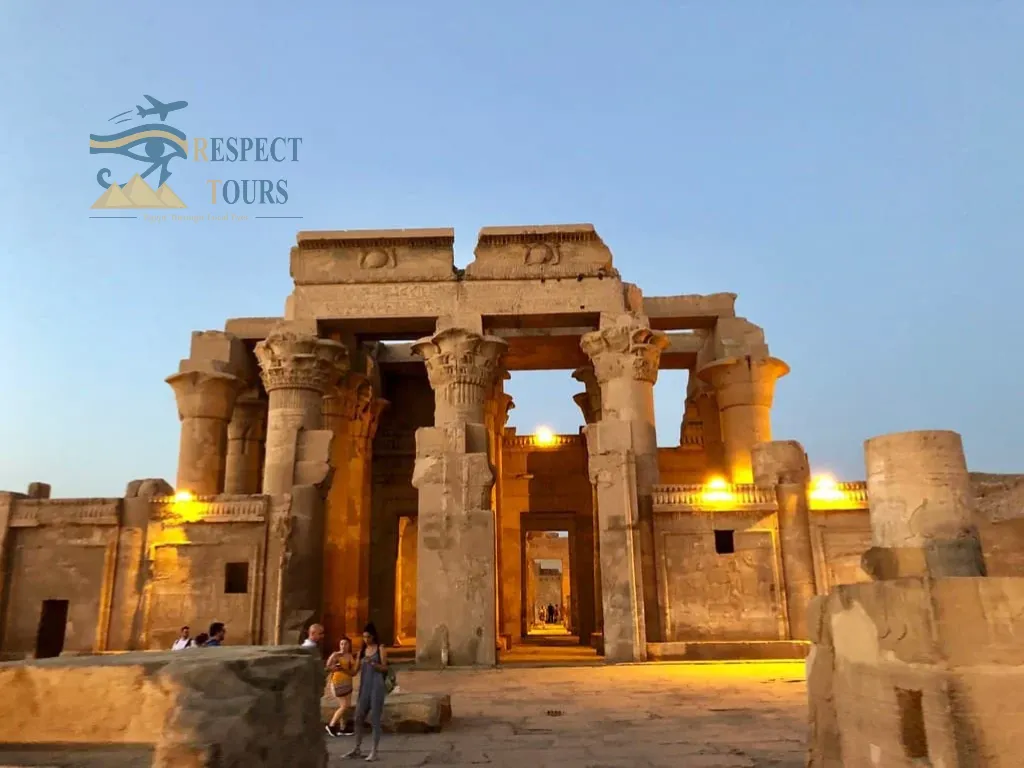
Kom Ombo is a double temple because it is built as 2 mirrored halves along parallel axes. Each half has its own entrance, halls, and sanctuary for one god.
Look for these doubled features as you walk:
- Two entrances and two axes through the columned halls
- Two main sanctuaries, one for each god
- A separate path of worship for each divine family
- A symbolic scene at the rear showing Sobek and Haroeris on their own sides
The double plan is easiest to see in the halls, where the twin doorways line up ahead of you.
What Should You See at Kom Ombo Temple? Stop by Stop?
Walk Kom Ombo in 8 stops. The order below is common, but your guide may adjust it to your cruise timing and the crowds.
- The Crocodile Museum. If you can choose, go first. A selection of the roughly 300 crocodile mummies found nearby is on display, and they explain why Sobek mattered before you read the reliefs.
- The Nile view and the approach. Pause at the top of the rise. The river below shows why the site was chosen.
- The columned halls. Decorated capitals top the columns. Look for the twin doorways and the paint that survives on some surfaces.
- The Sobek side (south, right). Reliefs show kings offering to the crocodile god, with Hathor and Khonsu beside him.
- The Haroeris side (north, left). Compare it with the other half. The art is mirrored, but the details differ.
- The twin sanctuaries. The walls are ruined, but you can still read the double plan. These were the most sacred rooms.
- The calendar and the surgical relief. The calendar lists festivals and rituals. The relief, believed to show surgical instruments, such as scalpels, forceps, and cups, is on the inner side of the rear wall, so you walk around the back to see it. Ask your guide to point both out.
- The Nilometer. A circular, stepped well measured the height of the Nile. The result told priests and officials what kind of harvest to expect.
How Do You Read the Reliefs at Kom Ombo?
The walls show kings offering to gods. Look for these 4 things as you walk:
- The king before two gods: the same king offers to Sobek on one side and Haroeris on the other, which shows the shared purpose of the temple.
- Traces of color: paint survives on some columns and ceilings, so look up as well as ahead.
- The calendar: it shows how the temple’s year followed religious festivals and offerings.
- Defaced figures: some faces and figures were cut away when the temple served as a church, so not every scar is natural damage.
A guide helps here. The site has little signage, and the reliefs are hard to read without someone naming each figure.
How Do You Visit Kom Ombo Temple?
You can visit Kom Ombo by Nile cruise, by private car from Aswan, or on a road trip between Aswan and Edfu. A cruise is the easiest, and a car gives you control over timing.
| Option | Best for | What to know |
| Nile cruise | Most travellers | The ship stops at Kom Ombo, and the visit is part of the program. Time on site is set by the sailing schedule. |
| Day trip from Aswan | Travellers staying in Aswan | About 45 km and 45 minutes by car. A private car and guide can combine Kom Ombo with Edfu in about 8 hours. |
| From Luxor | Travellers with a full day | About 170 to 180 km, usually via Edfu. Plan 3 or more hours of driving each way. |
What Do You Need to Know Before You Go?
| Topic | What to know |
| Ticket | A foreign adult ticket costs EGP 450, and a student ticket costs EGP 225. One ticket covers the temple and the Crocodile Museum. |
| Shade | There is very little on the riverbank. Bring a hat, sunglasses, and water. |
| Terrain | Uneven stone, some steps, and a raised bank. See the FAQ on mobility. |
| Photography | Phone photos are generally fine. Tripods, professional gear, or filming may need a permit or fee, so ask at the ticket office. |
| Facilities | There is no restaurant on site, only small stalls near the exit. Bring small notes for tips. |
When Is the Best Time to Visit Kom Ombo Temple?
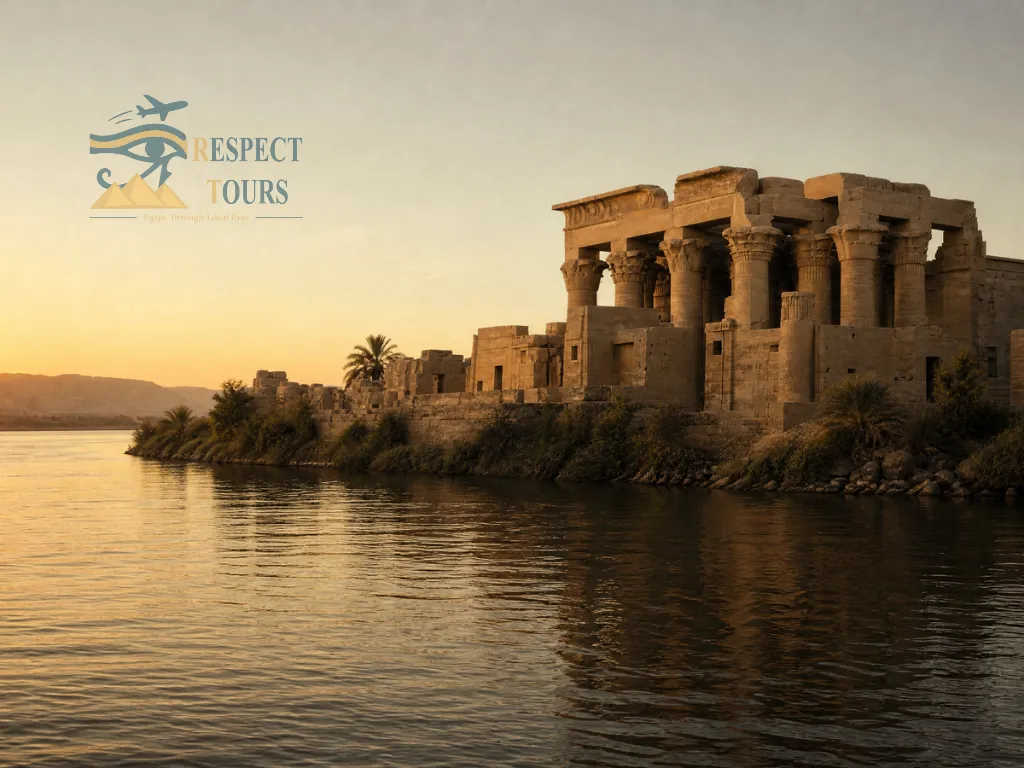
Visit Kom Ombo Temple early in the morning or in the late afternoon, when the light is soft and the heat is lower.
| Time | What it is like |
| 7:00 AM to 9:00 AM | Cooler, softer light and fewer people. Best for photos of the columns. |
| 11:00 AM to 3:00 PM | Busiest and hottest, with little shade. |
| Late afternoon | Warm light on the stone and a good sunset view over the Nile, if your schedule allows. |
The cooler months from October to April are the most comfortable. In summer, the morning slot matters even more. A cruise visit follows the ship’s schedule, so ask your operator when you will be on site.
Can You Combine Kom Ombo With Other Sites?
Yes, Kom Ombo pairs well with the other temples on the Nile. Pick based on the time you have.
| Combine with | Why | How |
| Edfu | The best-preserved temple on the route | Day trip from Aswan or a cruise stop. Edfu is covered in the Horus guide linked above. |
| Philae Temple | Isis temple moved by UNESCO. | Aswan morning visit. See our Philae Temple guide. |
| Aswan High Dam | Why the Nubian temples moved | Short Aswan stop. See our Aswan High Dam guide. |
| Abu Simbel | Rameses II’s rock temples | Separate day trip. See our Abu Simbel day trip. |
Is Kom Ombo Part of a Nile Cruise?
Most cruises between Aswan and Luxor stop at Kom Ombo, and the ship usually moors close to the temple.
Our 4-day cruise from Aswan to Luxor visits the temple on day 2, and our 5-day Luxor to Aswan cruise visits it in the other direction. To pick a ship, see our guide on how to choose the best Nile cruise. If you are staying in Aswan, browse our Aswan day tours for road options.
What Are the Common Mistakes When Visiting Kom Ombo?
Most problems come from timing, not from the site. Avoid these 5:
- Skipping the Crocodile Museum, which is included in your ticket and takes about 30 minutes.
- Visiting at midday in summer, when the bank has almost no shade.
- Rushing the temple in 45 minutes and missing the calendar and the surgical relief.
- Not asking your operator how long the cruise stop lasts.
- Forgetting a hat and water.
Is Kom Ombo Temple Worth Visiting?
Yes, Kom Ombo is worth visiting for its double design, its unusual carvings, and the Crocodile Museum. It is compact, so it fits easily into a cruise day or a day trip.
It suits visitors who like stories more than size. It is smaller than Karnak, so do not expect a huge site. Think of it as a 1.5-hour stop with a lot to see. Visitors with serious mobility limits may find the steps and uneven ground hard, so tell your guide in advance.
Explore Kom Ombo Temple With Respect Tours
Explore the temple’s twin sanctuaries, unusual reliefs, and sacred crocodile collection with a licensed Egyptologist. Respect Tours, a local operator since 1978, can include Kom Ombo in your private Aswan tour or Nile cruise itinerary, with the timing planned for your day.
Discover Kom Ombo on a Nile Cruise | Ask for a Private Kom Ombo and Edfu Day Trip | Plan a Custom Aswan and Nile Itinerary
FAQs About Kom Ombo Temple
What is Kom Ombo Temple famous for?
Kom Ombo is famous for its double design. It has 2 entrances, 2 sets of halls, and 2 sanctuaries, one for the crocodile god Sobek and one for the falcon god Haroeris. It also has a carving believed to show surgical instruments and a Crocodile Museum next door.
Who is Kom Ombo Temple dedicated to?
It is dedicated to 2 gods: Sobek, the crocodile god of fertility and water, and Haroeris, also called Horus the Elder, a falcon-headed sky god. Each god has his own half of the temple, with his own divine family.
How long does a visit to Kom Ombo Temple take?
Plan about 1.5 to 2 hours. Allow about 1 hour for the temple and 30 minutes for the Crocodile Museum. Rushing the temple in 45 minutes means missing the calendar and the surgical relief.
How far is Kom Ombo from Aswan?
Kom Ombo is about 45 km north of Aswan, roughly 45 minutes by car. From Luxor, it is about 170 to 180 km, usually via Edfu, so plan 3 or more hours of driving each way.
Why is Kom Ombo called a double temple?
It is built as 2 mirrored halves along parallel axes. Each half has its own entrance, halls, and sanctuary, so each god had a separate path of worship under one roof.
Is the Crocodile Museum included in the Kom Ombo ticket?
Yes. The museum is next to the temple and is covered by the same ticket. It displays a selection of the roughly 300 crocodile mummies found nearby, which explains why Sobek mattered. If you can choose, visit it first.
Was Kom Ombo Temple a hospital?
No clear evidence says so. A carving believed to show surgical instruments dates to the 2nd century AD, and scholars disagree about its meaning. The temple may have had a link with healing, but historians do not call it a hospital or a medical school.
Is Kom Ombo Temple part of a Nile cruise?
Yes. Most cruises between Aswan and Luxor stop at Kom Ombo, and the ship usually moors close to the temple. Time on site follows the sailing schedule, so ask your operator how long the stop lasts.


