


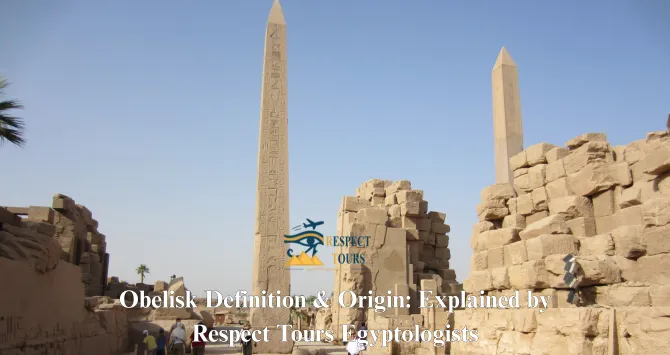
The obelisk definition most people know is simple: a tall, four-sided stone monument with a pointed top. In ancient Egypt, however, obelisks were far more than architectural landmarks. They were powerful religious symbols connected to the sun god Ra, expressions of royal authority, and some of the most impressive engineering achievements of the ancient world.
This guide explains what an obelisk is, where the tradition originated, what these monuments symbolized, how they were carved and transported, and where you can still see them today in Egypt and around the world. From the temples of Karnak and Luxor to famous obelisks in Rome, Paris, London, and New York, their story spans more than 4,000 years of history.
At Respect Tours Egypt, we’ve been guiding travelers through Egypt’s ancient sites since 1978. Drawing on decades of experience at Luxor, Karnak, Aswan, and other historic locations, we’ve created this guide to help you understand the history, symbolism, and legacy of one of ancient Egypt’s most iconic monuments.
Quick Definition
An obelisk is a four-sided, tapering monolithic stone monument topped with a pyramid-shaped cap called a pyramidion. The ancient Egyptian word was “Tehen,” meaning “to shine” or “to dazzle.”
Obelisks represented a petrified ray of sunlight, and they first appeared in Heliopolis around 2400 BCE as physical expressions of solar worship and royal power.
What Is an Obelisk? Definition and Basic Structure
Every true ancient Egyptian obelisk shares the same basic anatomy. A long, square shaft tapers gradually from base to top, where it ends in a small pyramid called the pyramidion. The whole thing is cut from a single block of stone, usually red granite from the quarries near Aswan.
The height-to-base ratio is typically 9:1 or 10:1. That’s what gives them the characteristic needle profile, slender enough to look weightless from a distance, despite some weighing several hundred tons.
The pyramidion at the top was often coated in electrum, a naturally occurring gold-silver alloy. At sunrise, it caught the first light before anything else in the temple complex. That wasn’t incidental; it was the whole point. The obelisk was designed to interact with the sun daily, not to sit passively in a courtyard.
The shaft was covered in hieroglyphic inscriptions. These weren’t ornamental. They recorded specific information: the pharaoh who commissioned the monument, the deity it was dedicated to, military victories, and religious declarations. An obelisk was simultaneously a monument, a text, and a ritual object.
The Origin of the Obelisk: Heliopolis and the Benben Stone
The origin of the obelisk can be traced to Heliopolis, ancient Egypt’s center of sun worship and the home of the god Ra. Around 2400 BCE, the first obelisks emerged from religious beliefs connected to creation and the power of the sun.
Their design was inspired by the Benben Stone, a sacred stone associated with the primordial mound that rose from the waters of chaos at the beginning of creation. The pyramid-shaped top of an obelisk, known as the pyramidion, was a direct reflection of this symbol.
The earliest obelisks were relatively small, but over time they grew into the towering granite monuments that became some of the most recognizable symbols of ancient Egypt.
📋 Historical Record
The oldest surviving obelisk in the world was erected by Pharaoh Senusret I around 1950 BCE. It still stands in Cairo at Al-Masalla Obelisk Park in the Heliopolis district, over 3,900 years old and in remarkably good condition. Most visitors to Cairo never see it.
Obelisk Meaning and Symbolism in Ancient Egypt
The Egyptians called an obelisk Tehen, a word that means “to shine” or “to dazzle.” That name alone tells you most of what you need to know about its purpose.
Most obelisks were placed in pairs at temple entrances, representing balance and the unity of Upper and Lower Egypt. Their hieroglyphic inscriptions recorded the achievements, religious devotion, and divine authority of the pharaoh who commissioned them.
The hieroglyphs covering the shaft added a fourth layer of meaning. They were permanent records of a pharaoh’s divine right to rule, their relationship to specific deities, and their military and religious achievements. Walking around an obelisk and reading its inscriptions was, in a sense, reading the pharaoh’s official theological biography.
A Brief History of Egyptian Obelisks
Obelisks span over three thousand years of Egyptian history. They started small and theological in the Old Kingdom, reached their architectural peak during the New Kingdom, and eventually ended up scattered across Rome, Paris, London, and New York.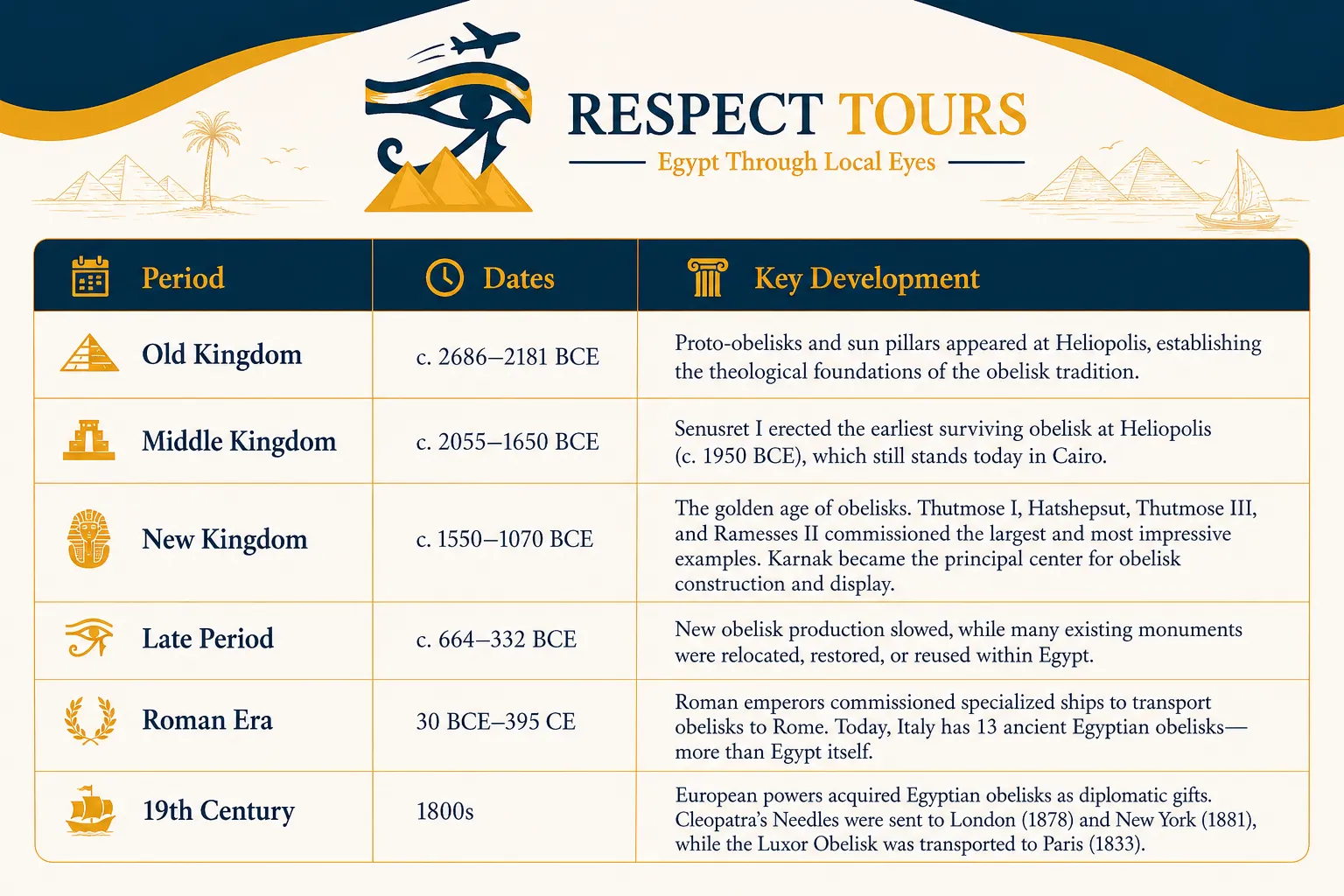
The New Kingdom pharaohs turned obelisk construction into competitive architecture. Hatshepsut erected two obelisks at Karnak; one still stands at nearly 30 meters. Thutmose III, who initially tried to hide Hatshepsut’s obelisks behind a wall after her death, commissioned more obelisks than any other pharaoh in history.
How Were Obelisks Built? Quarrying, Transport, and Raising
Every true ancient Egyptian obelisk was carved from a single block of stone. No sections bolted together, no internal framework, one piece, from base to pyramidion. At the scale of the largest obelisks, this was a genuinely extraordinary technical achievement.
How Were Obelisks Built?
The stone of choice was red granite from the quarries near Aswan, hard, dense, and with a reddish color that caught the light well. Workers used dolerite pounders (hard, round stones) to strike the granite surface repeatedly in a technique called percussion grinding.
This gradually fractured the rock along the intended outline.
The process involved carving channels along all four sides of the obelisk shape, then working on the underside last. A thin bridge of stone kept the obelisk connected to the bedrock until the final series of strikes freed it. The whole operation, for a large obelisk, could take months.
💡 The Unfinished Obelisk in Aswan
The best way to understand obelisk construction is to stand in the Aswan quarry and look at the Unfinished Obelisk, still lying in the bedrock where it was abandoned, likely when a crack appeared mid-carving around 1475 BCE.
It would have been 41 meters tall and weighed an estimated 1,200 tons. You can see the percussion marks, the carved channels, and the exact point where the project stopped. Nothing explains ancient quarrying methods more clearly.
Transport Along the Nile
Once freed from the bedrock, the obelisk was loaded onto a flat-bottomed barge and transported north along the Nile. Reliefs at Hatshepsut’s mortuary temple at Deir el-Bahri show two of her obelisks on a single barge, pulled by 27 smaller boats.
The journey from Aswan to Luxor, roughly 215 kilometers, required careful timing around the Nile flood seasons and the management of a stone weighing hundreds of tons on water. The logistics were significant enough that they were considered worth recording on temple walls.
Raising the Obelisk
Erecting an obelisk upright was the most technically complex stage. The exact method isn’t fully documented, but the most widely accepted reconstruction involves a sand-funnel system:
- The obelisk was dragged up a sloping earthen ramp on wooden sledges
- It was positioned over a sand-filled funnel built above the prepared foundation pit
- Sand was slowly released from the funnel, gradually lowering the base into position
- Ropes and levers guided the upper section upright as the base settled
The base was set into a prepared stone socket, and the obelisk was leveled precisely. Egyptian obelisks that have stood for 3,000 years are still plumb; the foundations were accurate to a degree that modern engineers find impressive.
Obelisk vs Pyramid: What’s the Difference?
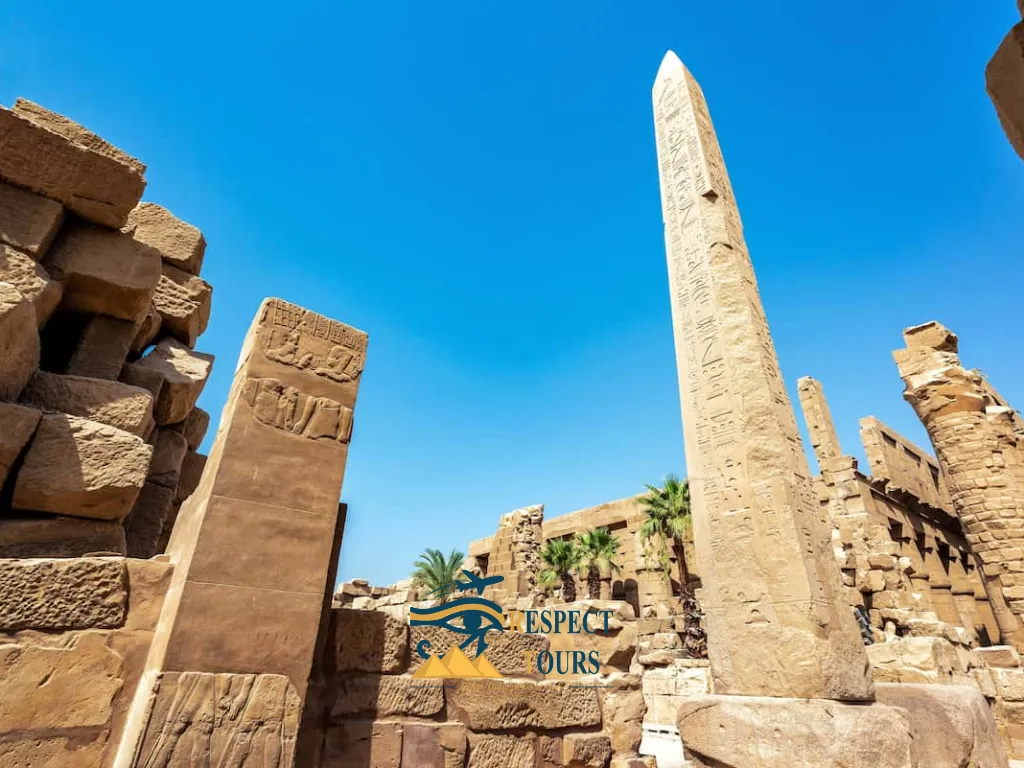
Both are ancient Egyptian stone monuments. Beyond that, they have almost nothing in common: different purposes, different constructions, different theologies.
Obelisk
- Single monolithic block of granite
- Tall and slender: 9:1 to 10:1 ratio
- Placed at temple entrances, in open use
- Built for solar worship and royal proclamation
- Interacted with the sun daily: a living ritual object
- Carved at the quarry and transported whole
- Associated with life and divine power
Pyramid
- Thousands of separate stone blocks
- Broad base, massive volume
- Built at royal necropolises, away from settlements
- Built as a royal tomb and a vehicle for the afterlife
- Static: designed for permanence in death
- Assembled block by block on site
- Associated with death, resurrection, and eternity
The simplest way to put it: a pyramid was built for the pharaoh’s death. An obelisk was built to function in the pharaoh’s life and to continue functioning after it.
Where to See Obelisks in Egypt Today
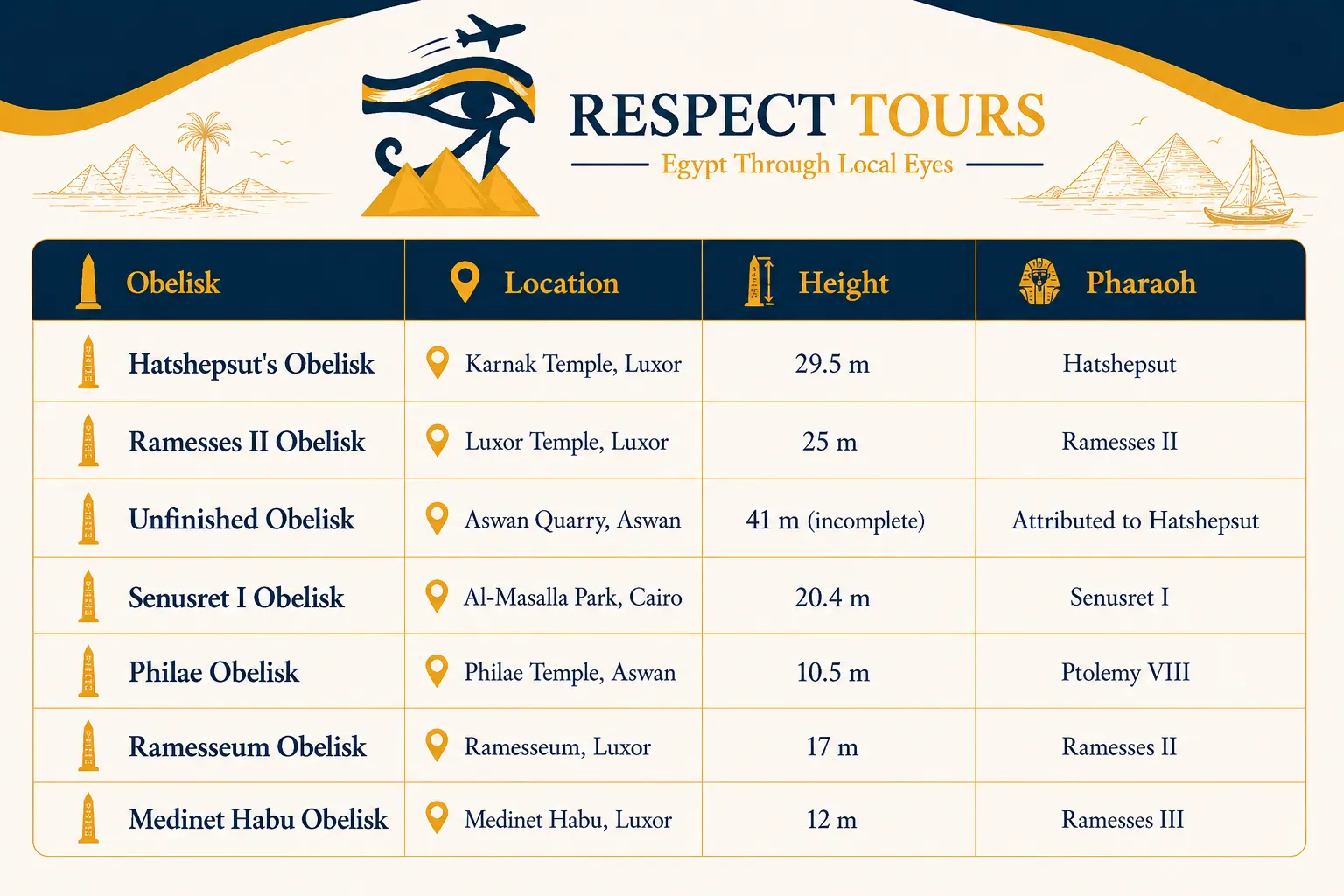
Egypt retains eight ancient obelisks in its original country. The best are still standing at the temple sites where they were placed, in Luxor and Aswan specifically.
Karnak Temple, Luxor: The Best Obelisks in Egypt
Karnak is where to go if obelisks are your primary interest. Hatshepsut’s obelisk in the central court stands nearly 30 meters tall, one of the largest still standing anywhere. It’s been in that spot for roughly 3,500 years.
The temple complex covers 200 acres and requires at least three to four hours to explore properly. The density of monuments is unlike anywhere else, with multiple pylons, colossal statues, a sacred lake, and dozens of sanctuaries. Karnak was continuously expanded for nearly 2,000 years.
Luxor Temple, Luxor: The Lone Ramesses Obelisk
Luxor Temple originally had two obelisks flanking its entrance, both commissioned by Ramesses II around 1250 BCE. One was gifted to France in 1833 and now stands in Paris at the Place de la Concorde. The remaining obelisk, still in its original position, is one of the most photogenic monuments in Egypt, particularly at night when the temple is lit.
Walking the restored Avenue of Sphinxes between Luxor Temple and Karnak at dusk is worth building into your itinerary if you’re in the city.
Aswan: The Unfinished Obelisk
The Unfinished Obelisk at the Aswan granite quarry is a different kind of experience from a completed temple obelisk. You’re looking at the moment the project stopped, a 41-meter monument still embedded in the bedrock, with ancient percussion marks clearly visible on the surface, and the crack that ended the work still running through the stone.
It’s the clearest window into how obelisks were actually made. Pair it with Philae Temple and the Aswan High Dam for a full day. Full-Day Guided Aswan City Tour: High Dam, Philae & Obelisk
What the Unfinished Obelisk teaches us:
- Clearly reveals the percussion technique used to separate stone from bedrock
- Shows the channels carved around all four sides before separation
- Preserves the marks left by dolerite pounders used as carving tools
- Proves that even the greatest pharaonic projects could be stopped by nature
Al-Masalla Obelisk Park, Cairo: The Oldest Surviving Obelisk
In the Heliopolis district of Cairo, the Senusret I obelisk dates to around 1950 BCE, the oldest surviving obelisk in the world.
It stands alone; its twin was lost long ago. Very few Cairo visitors make the trip out to see it, which means you’ll often have it to yourself. For anyone seriously interested in obelisk history, it’s a straightforward addition to a Cairo day.
Luxor Day Tours
Karnak Temple, Luxor Temple, and Valley of the Kings, with a licensed Egyptologist guide.
Aswan Day Tours
Unfinished Obelisk, Philae Temple, and the High Dam: a full day with an expert guide.
Egyptian Obelisks Around the World: Who Has Them and How They Got There
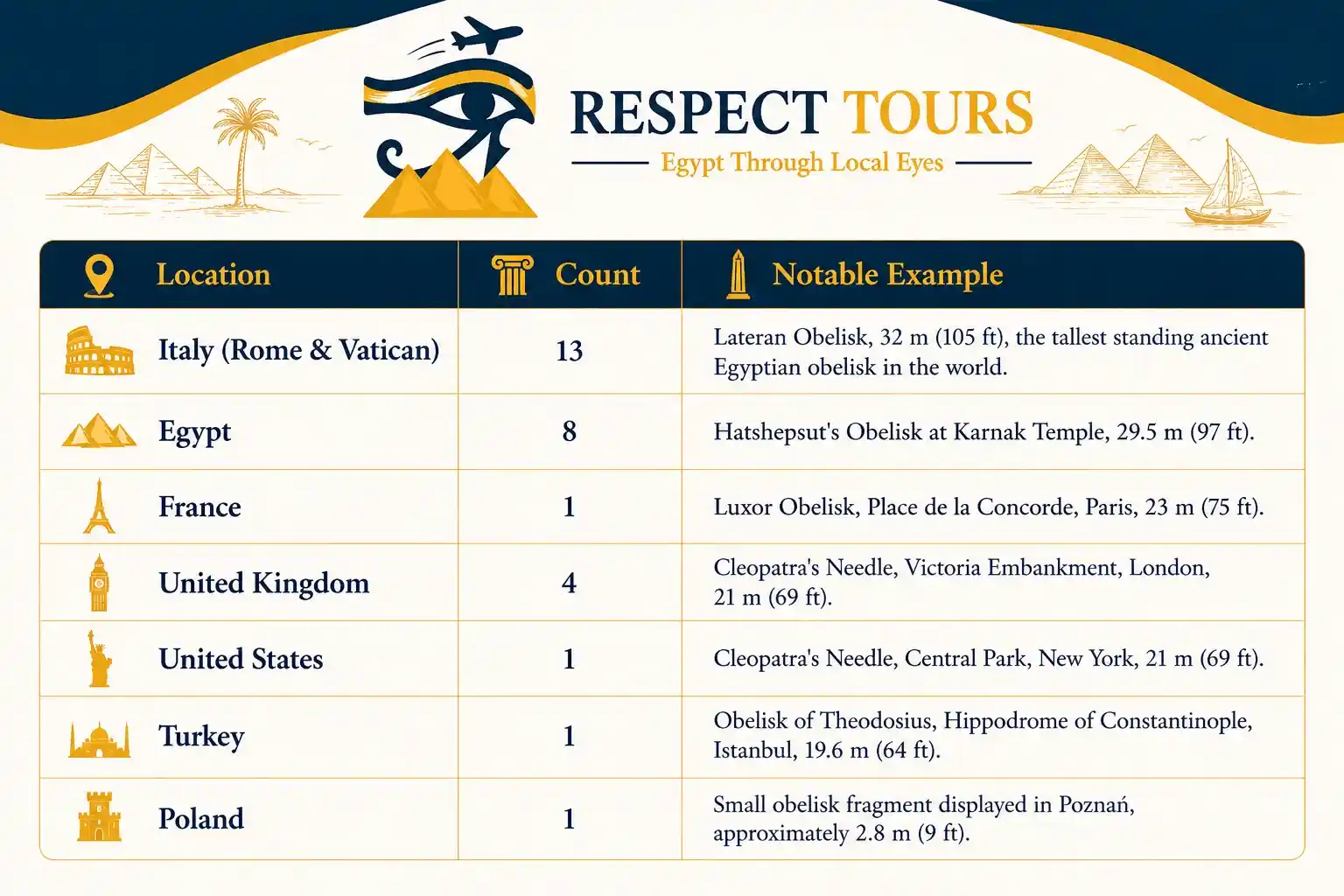
Today, around 30 ancient Egyptian obelisks survive worldwide. While Egypt still preserves several important examples, many were moved abroad during the Roman period and later centuries.
Rome is home to the largest collection, including the Lateran Obelisk, the tallest ancient Egyptian obelisk still standing. Other famous examples can be found in Paris, London, New York, and Istanbul.
Among the most well-known are the two “Cleopatra’s Needles” in London and New York. Despite their name, they were built by Thutmose III more than a thousand years before Cleopatra’s time.
Obelisk Facts Worth Knowing
- Rome holds 13 ancient Egyptian obelisks, more than Egypt itself
- The Unfinished Obelisk in Aswan would have been the largest ever at 41 meters and an estimated 1,200 tons. It was abandoned when a crack appeared mid-carving
- The Washington Monument (169 metres) is an obelisk shape, but not an ancient Egyptian obelisk; it’s a modern construction made from many blocks, not a single stone
- Cleopatra’s Needles in London and New York were built by Thutmose III, not Cleopatra; the name stuck despite being historically inaccurate
- The electrum coating on the pyramidion was visible from miles away in direct sunlight
- Every true ancient Egyptian obelisk is a single piece of stone; no modern quarrying project has replicated this at the same scale
- The hieroglyphs on obelisks are historical records, not decoration; they document specific reigns, military campaigns, and religious dedications
- Obelisks were almost always erected in pairs; most of the lone obelisks standing today lost their twin to transport or damage
The Major Obelisks Still Standing in Egypt
FAQs About Obelisk Definition and Origin
What is the definition of an obelisk?
An obelisk is a four-sided, tapering monolithic stone monument ending in a pyramid-shaped cap called a pyramidion. The ancient Egyptian term was “Tehen,” meaning “to shine.” Obelisks were carved from a single block of granite and placed at temple entrances to channel solar energy and proclaim pharaonic power.
Why did ancient Egyptians build obelisks?
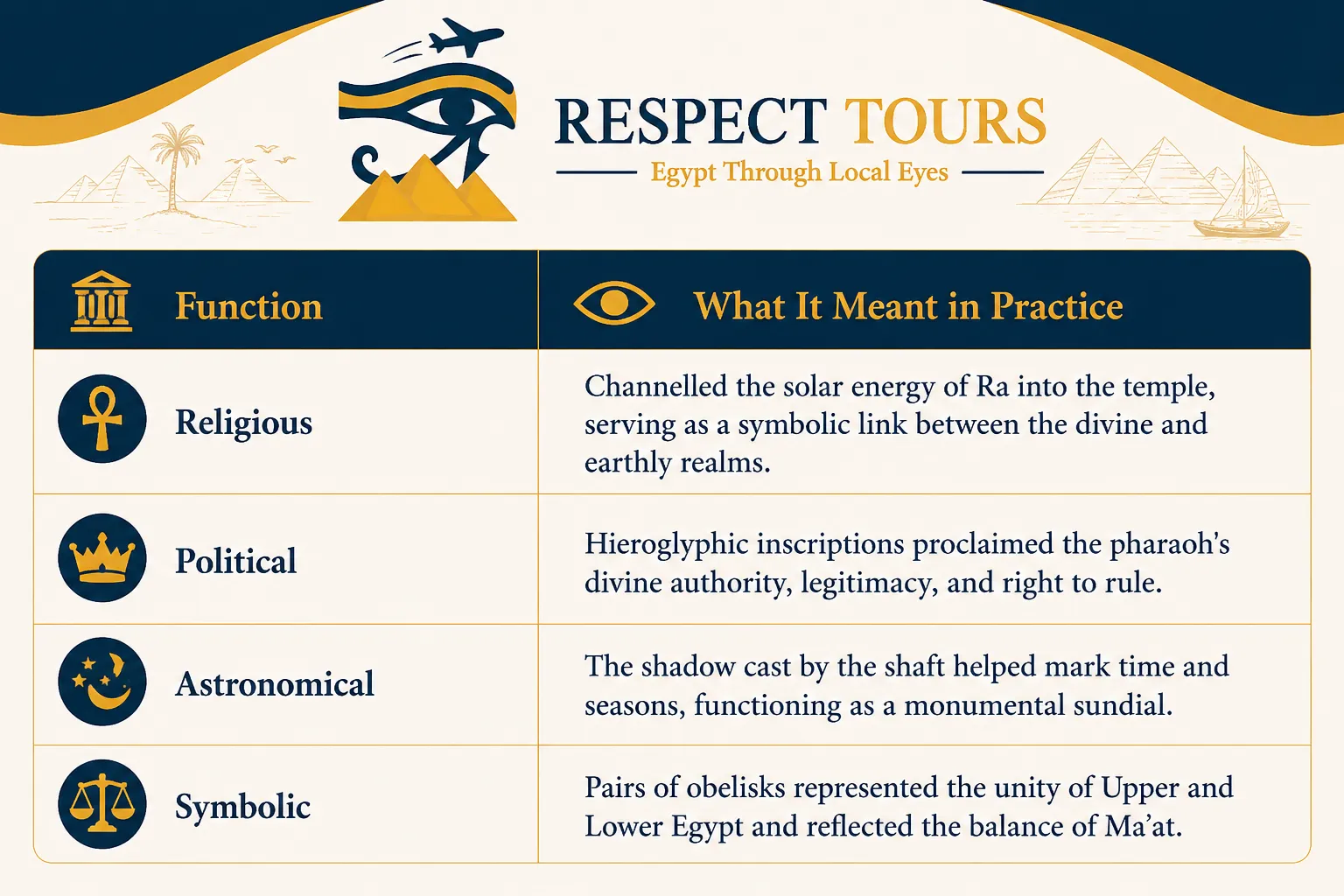
Obelisks served four connected purposes: religious (channelling solar power into temple spaces), political (recording pharaonic authority in permanent hieroglyphic inscriptions), astronomical (marking time through their shadows), and symbolic (representing the duality of Upper and Lower Egypt and the balance of Ma’at when erected in pairs).
What was the pyramidion on top of an obelisk?
The pyramidion was the small pyramid-shaped cap at the top of an obelisk. It was typically coated in electrum, a naturally occurring gold-silver alloy, so it caught and reflected the first rays of sunrise. The gleam was visible from a considerable distance and formed part of the daily solar ritual the obelisk was designed to enact.
Where can you see Egyptian obelisks today?
In Egypt: Karnak Temple and Luxor Temple in Luxor, the Unfinished Obelisk in Aswan, and Al-Masalla Park in Cairo. Outside Egypt: 13 obelisks stand across Rome and the Vatican, one in Paris (Place de la Concorde), one in London (Victoria Embankment), and one in New York City (Central Park).
Which is the largest ancient Egyptian obelisk in the world?
The Lateran Obelisk in Rome stands 32 meters tall and is the largest ancient Egyptian obelisk still standing. It was originally commissioned by Thutmose III at Karnak and transported to Rome by Emperor Constantius II in 357 CE. The Unfinished Obelisk in Aswan would have surpassed it at 41 meters, but was abandoned before completion.
See Ancient Egyptian Obelisks in Person
Understanding the history of Egyptian obelisks is one thing. Standing beside one is something entirely different. The scale, craftsmanship, and inscriptions are difficult to appreciate until you’re standing beneath monuments that have survived for thousands of years.
Today, some of the finest examples can still be seen at Karnak Temple in Luxor, the Unfinished Obelisk in Aswan, and the ancient sites that helped shape Egypt’s religious and architectural history. These monuments remain among the most impressive achievements of the ancient world and offer a fascinating insight into Egyptian engineering, religion, and royal power.
At Respect Tours, we’ve been helping travelers explore Egypt since 1978. Whether you’re visiting Luxor or Aswan or planning a complete Egypt itinerary, our licensed Egyptologist guides help bring these ancient monuments to life through the stories, history, and symbolism behind them.
Luxor Tours: Karnak & Luxor Temple
See Hatshepsut’s obelisk and the remaining Ramesses II obelisk with a licensed Egyptologist.
Aswan Tours: Unfinished Obelisk
The ancient quarry, Philae Temple, and the High Dam, a full day from your hotel.
Egypt Tour Packages
Cairo, Luxor, and Aswan combined, planned and managed end-to-end since 1978.