



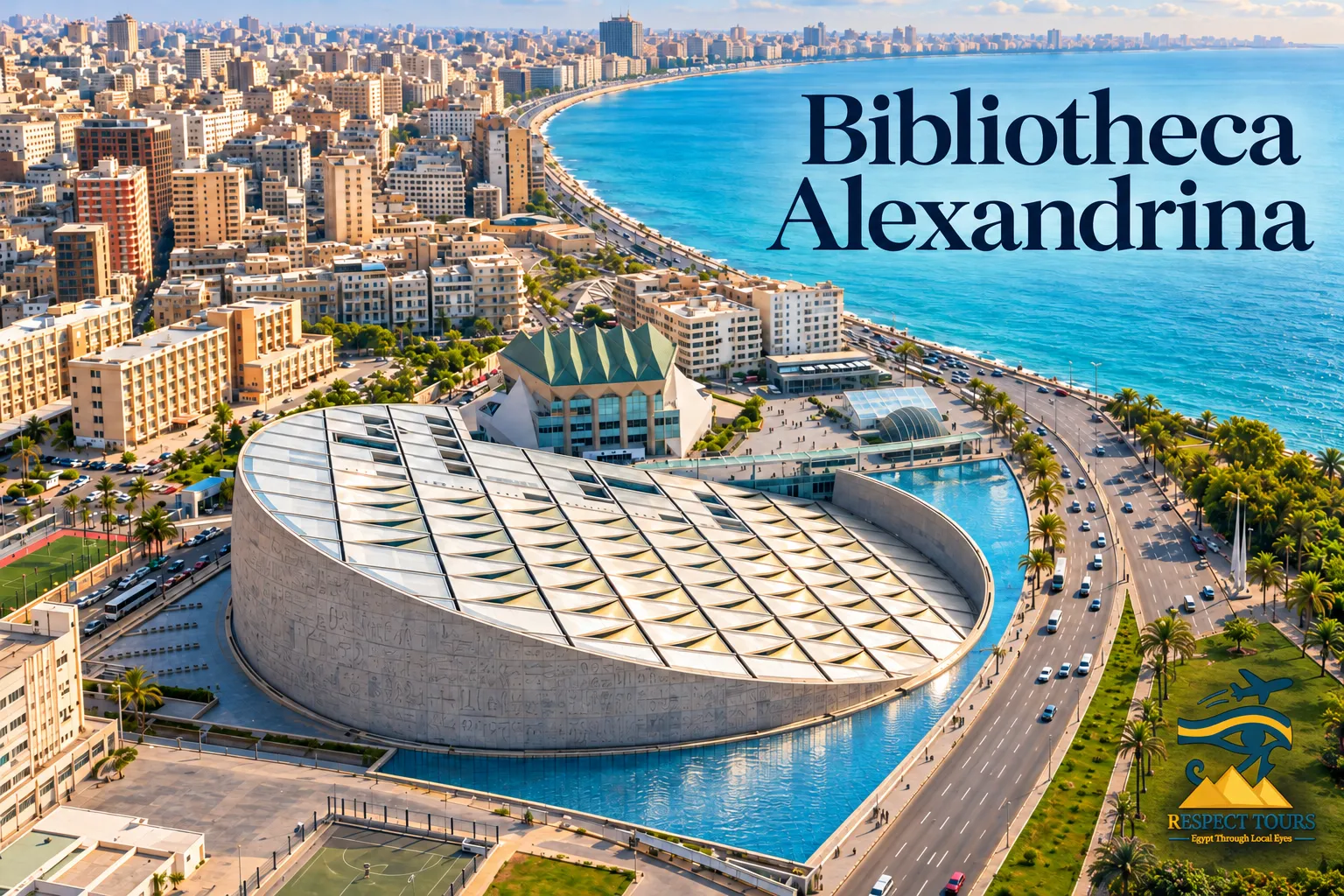
The Bibliotheca Alexandrina is Alexandria’s modern library and cultural centre on the Corniche, opened on 16 October 2002. It is not the ancient Library of Alexandria, which disappeared centuries ago, but a modern tribute to it. Inside, you’ll find a huge reading hall, four museums, exhibitions and a planetarium. Allow 1 to 1.5 hours for a quick visit, or half a day if you add the museums and a show.
What Is the Bibliotheca Alexandrina?
The Bibliotheca Alexandrina is a working library, research centre and cultural complex on Alexandria’s seafront, not just a building for storing books.
It was created to recall the scholarly spirit of the ancient library. Today it holds shelf space for 8 million books and hosts conferences, lectures and school programmes.
For visitors, it works like a small cultural district. You can walk through the reading hall, see antiquities and manuscripts, visit exhibitions and book a planetarium show.
Where Is the Bibliotheca Alexandrina Located?
The Bibliotheca Alexandrina stands on the Alexandria Corniche, beside the Eastern Harbour, next to Alexandria University.
The main ticket office for visitors is on Port Said Street, and the library entrance is in the plaza underneath the elevated walkway. Look for the large tilted disc and you’ll find it easily.
It sits close to the city centre, so it fits well into a day of sightseeing. On the same trip, many visitors also see:
- The Corniche walk beside the Mediterranean
- Qaitbay Citadel
- Alexandria National Museum
- The Catacombs of Kom El Shoqafa
- Pompey’s Pillar
The Ancient Library of Alexandria vs the Modern Bibliotheca Alexandrina
The ancient library was a Ptolemaic institution that no longer survives. The modern Bibliotheca Alexandrina is an open library and cultural centre inspired by it.
| Point | Ancient Library of Alexandria | Bibliotheca Alexandrina |
|---|---|---|
| Period | Ptolemaic era, from the 3rd century BC | Modern period, opened 2002 |
| Main purpose | Scholarship and collecting knowledge | Library, research and cultural centre |
| Exact location | Not conclusively established | Alexandria Corniche |
| Current status | No longer survives | Open to visitors |
| Connection | Historical inspiration | Modern revival of the ancient idea |
Think of the modern building as a tribute, not a reconstruction. You won’t see ancient shelves here, but you will see why the idea still matters.
The History of the Ancient Library of Alexandria
The ancient library grew in Ptolemaic Alexandria, a city founded by Alexander the Great in 331 BC. Its story mixes firm facts with long-running debate, so we’ll separate the two.
The Founding of the Ancient Library
The library was founded by the early Ptolemaic rulers of Egypt in the 3rd century BC. Sources differ on exactly which ruler began it and when.
The aim was ambitious. The rulers wanted to gather the writings of the known world in one place, in Alexandria.
The Mouseion and Alexandria’s Scholars
The library belonged to the Mouseion, a scholarly institution that hosted researchers, writers and scientists in Alexandria.
Two names help bring it to life. Callimachus is linked to an early catalogue of the library’s works, and Eratosthenes, a later head of the library, is remembered for estimating the size of the Earth.
What Happened to the Ancient Library?
The ancient library did not vanish in a single fire. Most historians describe a gradual decline over several centuries, and the details are still debated.
Several events are often mentioned, including the fire during Julius Caesar’s war in Alexandria in 48 BC, later unrest in the Roman period and the end of the Serapeum in AD 391. Historians disagree about how much each event destroyed.
A good guide will tell you plainly: nobody can name one day or one culprit with certainty.
The History of the Modern Bibliotheca Alexandrina
The modern library took roughly 13 years from the 1989 design competition to the 2002 opening, with international support from UNESCO and Egypt.
Reviving the Idea of the Ancient Library
The idea was to give Alexandria a major centre of knowledge again, in the spirit of the ancient one. Egypt and UNESCO supported the project, together with international donors.
Planning and Constructing the New Library
The Norwegian architecture firm Snøhetta won the international competition. Archaeological excavations were carried out before construction began in 1995.
Hamza Associates of Giza handled the structural design.
The Opening of the Bibliotheca Alexandrina
The complex opened officially on 16 October 2002. In 2004, it received the Aga Khan Award for Architecture.
Its Role in Modern Alexandria
Today the library is a place for study, events and public culture. Local students, researchers and families use it, and visitors from abroad come for the architecture and the museums.
Architecture and Design of the Bibliotheca Alexandrina
The building is a tilted disc about 160 m across, designed to look like a sun rising from the Mediterranean.
The Tilted Circular Building
The disc tilts toward the sea like a sundial. Its aluminium cladding reflects the sun and the moon, two symbols that matter in Egyptian mythology.
From the Corniche, the shape looks simple. Walk closer and you see how large it really is.
The Granite Exterior and World Scripts
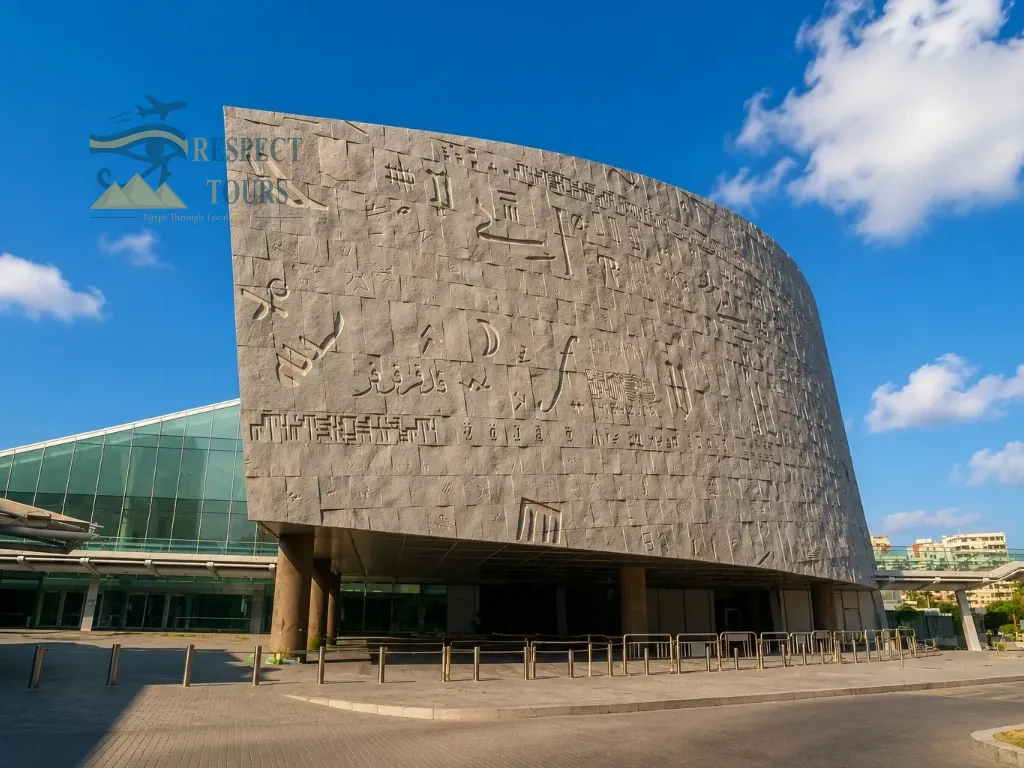
The curved outer wall is made of grey Aswan granite carved with characters from about 120 scripts. Sources give slightly different counts, so treat the figure as approximate.
This is the detail most visitors photograph. Take a moment to touch the stone and look for letters you recognise.
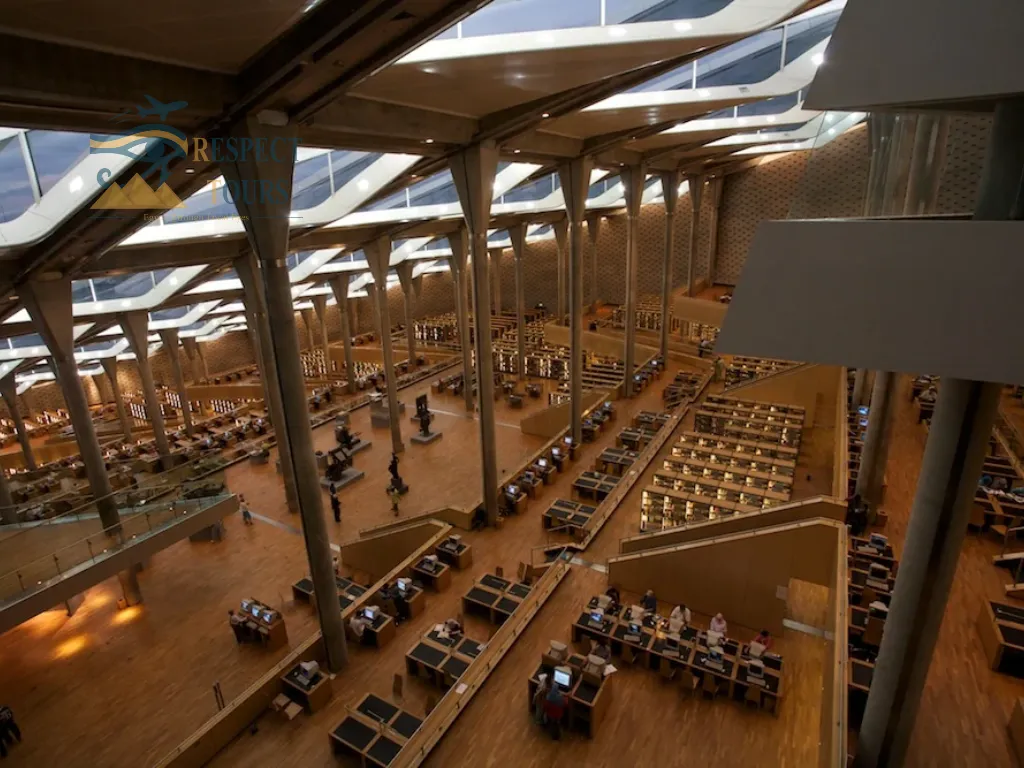
The Main Reading Hall
The main reading hall covers 20,000 square metres on 11 cascading levels. It sits beneath a glass-panelled roof that rises about 32 m.
It is a working space, so keep your voice low. Students and researchers use it every day.
Natural Light and Interior Design
Light enters through north-facing skylights. This gives the hall a soft, even light without strong direct sun on the desks.
The building was also designed to be accessible to visitors with disabilities.
The Library’s Position Beside the Mediterranean
A pool surrounds part of the building, and the sea lies just beyond the Corniche. A raised walkway links the seafront with the university side.
Spend 10 minutes outside before you go in. The view back at the disc is as good as the view from inside.
What to See Inside the Bibliotheca Alexandrina
Most visitors see the reading hall, one or two museums and an exhibition. The best order is usually the one the building suggests.
- Main Reading Hall
- Permanent museums
- Temporary exhibitions
- Manuscript collections
- Planetarium
- Cultural and conference spaces
- Exterior architecture and Corniche views
Upon entering the library, the official route takes you down the stairs on the right to the B1 level. There you reach the museums, exhibitions and shows.
The free tour path on the B1 level runs one way. It starts with the Antiquities Museum and ends with the Sadat Museum, and the exit is by the Planetarium gate.
Museums Inside the Bibliotheca Alexandrina
The Bibliotheca Alexandrina has four museums: Antiquities, Manuscripts, Sadat and the History of Science. Some need a separate ticket.
Antiquities Museum
The Antiquities Museum holds around 1,316 objects, from Pharaonic times through the Greek and Roman periods. It is one of the few museums that displays pieces found at its own site.
Tickets are sold at the booth opposite the museum on the B1 level, not online.
Manuscript Museum
The Manuscript Museum displays ancient texts, antiquarian books and maps. It also has a separate ticket.
It suits visitors who enjoy books, writing and the history of the written word more than monuments.
Sadat Museum
The Sadat Museum focuses on President Anwar Sadat. According to the official ticket page, the Main Library ticket covers it.
History of Science Museum
The History of Science Museum follows scientific discovery through 3 eras: Pharaonic Egypt, Hellenistic Alexandria and the Arab-Muslim period. It belongs to the Planetarium Science Center side of the complex.
Exhibitions and Cultural Collections
Exhibitions change, so treat this list as examples. Always check what is on show on the day.
The Shadi Abdel Salam Collection
“The World of Shadi Abdel Salam” is listed on the official flyer. Shadi Abdel Salam was an Egyptian film director, best known for the film The Mummy.
The Coptic and Islamic Art Collections
The Antiquities Museum collection covers several periods, and sources disagree on how far into the Coptic and Islamic eras it goes. Ask at the booth if this period matters to you.
Contemporary Art Exhibitions
The flyer lists “Impressions of Alexandria: The Awad Collection” and “The Artist’s Book”. These show how artists have seen the city and how books themselves become art.
Rare Books and Manuscripts
The Manuscript Museum is the place for rare texts. The library also runs a manuscript restoration laboratory behind the scenes.
The Planetarium and Science Experiences
The Planetarium Science Center offers full-dome and IMAX shows, the History of Science Museum and a science space for children.
Planetarium Science Center
The planetarium is a round building on the plaza. It needs a separate ticket, sold at the Planetarium entrance.
ALEXploratorium and Children’s Activities
The ALEXploratorium introduces children to science through hands-on activities. It works best for school-age children.
Planetarium Shows and Languages
Show times and languages change. Ask for the schedule before you plan the day, because the planetarium runs on its own timetable and booking, separate from the library.
Bibliotheca Alexandrina Opening Hours, Tickets and Entry Rules
Rules and prices change, so confirm everything on the official Bibliotheca Alexandrina pages or at the ticket office on the day.
| Visitor information | Details |
|---|---|
| Opening days | Confirm before visiting; some official pages show Friday closed for museum ticket windows |
| Library hours | Confirm before visiting |
| Main library ticket | Check the current official rate; covers guided tours, Culturama shows, the Sadat Museum and exhibitions |
| Museum tickets | Antiquities and Manuscripts are separate; a combo ticket also exists |
| Planetarium shows | Separate ticket and schedule |
| Photography | Restrictions or fees may apply in some areas |
| Identification | Bring ID; visitors may be asked for it |
Travel agencies should arrive early, because guided tours are first come, first served.
How Long Do You Need at the Bibliotheca Alexandrina?
You need 1 to 1.5 hours for a quick visit and about half a day for the museums, exhibitions and planetarium.
| Visit type | Time needed |
|---|---|
| Quick visit | 1 to 1.5 hours |
| Library and one museum | About 2 hours |
| Museums, exhibitions and planetarium | About half a day |
Add time for security checks and the queue at the ticket office.
Is the Bibliotheca Alexandrina Worth Visiting?
Yes, the Bibliotheca Alexandrina is worth visiting for architecture, museums, books and history, but it is not a literal rebuild of the ancient library.
The advantages are clear: a striking building, an easy Corniche location and several museums under one roof. The limits are just as clear. Museums and the planetarium need separate tickets, and you won’t find ancient scrolls.
It suits curious travellers who enjoy ideas as much as monuments. If you only have a few hours in Alexandria, you might prefer Qaitbay Citadel or the Catacombs of Kom El Shoqafa first.
Tips for Visiting the Bibliotheca Alexandrina
A few small steps make the visit smoother.
Check Museum and Planetarium Schedules
Look at the official schedule before you go. The planetarium and the museums run to different timetables.
Bring Identification
Carry your passport or a copy. Visitors may be asked for ID.
Allow Time for Security Checks
Security is standard at major sites. Arrive 20 to 30 minutes before you want to enter.
Ask About Photography Rules
Ask at the entrance. Rules and fees can differ for the building, the museums and special exhibitions.
Choose the Museums That Match Your Interests
You don’t need to see all four. Pick the Antiquities Museum for objects, the Manuscript Museum for books, or the History of Science Museum for science.
Combine the Visit With the Alexandria Corniche
Walk the Corniche afterwards. It is the easiest way to feel the sea air that shaped the city.
Is the Bibliotheca Alexandrina Suitable for Families?
Yes, the Bibliotheca Alexandrina suits families, especially those with school-age children who enjoy science and stories.
The ALEXploratorium and the planetarium are the strongest points for children. The building is also designed to be accessible, which helps with strollers and wheelchairs.
Don’t try to see every museum with young children. Choose one museum and one show, and check the age guidance for each show.
Attractions Near the Bibliotheca Alexandrina
Most nearby sights are reachable by a short drive along the Corniche, which makes them easy to combine in 1 day.
Alexandria Corniche
The Corniche is the seafront road that runs along the Mediterranean. A walk here costs nothing and takes as long as you like.
Qaitbay Citadel
Qaitbay Citadel is a 15th century fortress on the site linked to the ancient Pharos lighthouse. See Alexandria historical sites for more on this area.
Alexandria National Museum
The Alexandria National Museum shows the city’s history across several eras. Our Alexandria National Museum and Corniche day tour includes it.
The Catacombs of Kom El Shoqafa
These Roman era tombs mix Egyptian, Greek and Roman styles. They are one of the best examples of Alexandria’s blended culture.
Pompey’s Pillar
Pompey’s Pillar is a tall Roman column near the Serapeum area. Despite its name, it was raised for Emperor Diocletian, not for Pompey.
The Greco-Roman Museum
The Greco-Roman Museum holds finds from Alexandria’s Greek and Roman past. Check that it is open before you plan it into your day.
For a full list, see things to see in Alexandria.
Interesting Facts About the Bibliotheca Alexandrina
- The modern library opened on 16 October 2002.
- Its disc measures about 160 m across and tilts toward the sea.
- The outer wall carries characters from about 120 scripts.
- The library has shelf space for 8 million books.
- The Antiquities Museum shows objects found on the same site.
- The building won the Aga Khan Award for Architecture in 2004.
- The modern library is not a replica of the ancient one.
Visit the Bibliotheca Alexandrina With Respect Tours
Discover Alexandria’s history and modern culture with a local operator that has run Egypt tours since 1978.
Our one-day Alexandria trip from Cairo includes hotel pickup, an English-speaking Egyptologist guide and entry tickets to the listed sites, with the Library of Alexandria among the stops. Always check the live tour page for the current programme.
- Book a private day trip from Cairo to Alexandria
- Compare our Alexandria day tours
- See the Cairo and Alexandria cultural itinerary
- Ask us to tailor your Alexandria day
For a one-day plan, read what to see in one day in Alexandria.
FAQs
What is the Bibliotheca Alexandrina famous for?
The Bibliotheca Alexandrina is famous for its tilted-disc architecture and for reviving the idea of the ancient Library of Alexandria. It combines a large reading hall, museums and a planetarium. The carved granite wall with characters from about 120 scripts is its best known detail.
Is the Bibliotheca Alexandrina the original Library of Alexandria?
No, the Bibliotheca Alexandrina is a modern library, not the original. The ancient library was a Ptolemaic institution that declined gradually and no longer survives. The modern building opened in 2002 as a tribute to that tradition of learning and research.
When was the modern Bibliotheca Alexandrina opened?
The modern Bibliotheca Alexandrina officially opened on 16 October 2002. Construction began in 1995, after archaeological work on the site. It later won the Aga Khan Award for Architecture in 2004, which many visitors mention when they discuss its design.
Which museums are inside the Bibliotheca Alexandrina?
The complex has four museums: Antiquities, Manuscripts, Sadat and the History of Science. The Antiquities and Manuscripts museums use separate tickets, bought near the museums. The History of Science Museum sits with the Planetarium Science Center, so check which ticket covers it.
Do you need a separate ticket for the museums?
Yes, for the Antiquities and Manuscripts museums. Official pages say these tickets are bought at the booth by the Antiquities Museum, and a combo ticket also exists. The Main Library ticket covers guided tours, Culturama shows, the Sadat Museum and exhibitions, so confirm the current rules on the day.
Is the Planetarium included in the library ticket?
No, the library ticket does not include the Planetarium Science Center. The official guidelines state that the planetarium needs a separate ticket, sold at its own entrance. Shows have their own timetable, so check the schedule before you plan the rest of your day.
Can tourists enter the main reading hall?
Tourists can usually see the main reading hall with a Main Library ticket. It is a working study space, so keep your voice low. Access can change during events or busy study periods, so ask at the entrance if you want a specific viewpoint.
Is photography allowed inside the library?
Photography rules differ by area, and fees or limits may apply in some museums and exhibitions. Outside, the building and the carved granite wall are easy to photograph. Ask staff at the entrance before you lift your camera inside, especially in the museum areas.
Is the Bibliotheca Alexandrina suitable for children?
Yes, especially for school-age children who like science. The ALEXploratorium and the planetarium are the main attractions for them. Choose one museum and one show rather than the full route, and check the age guidance for each show before you buy tickets.
Can you visit the library on a day trip from Cairo?
Yes, many visitors see it on a one-day Alexandria trip from Cairo or Giza. Respect Tours lists the Library of Alexandria among the highlights of its private day trip. The journey depends on traffic, so confirm the pickup time and programme on the live tour page.


