



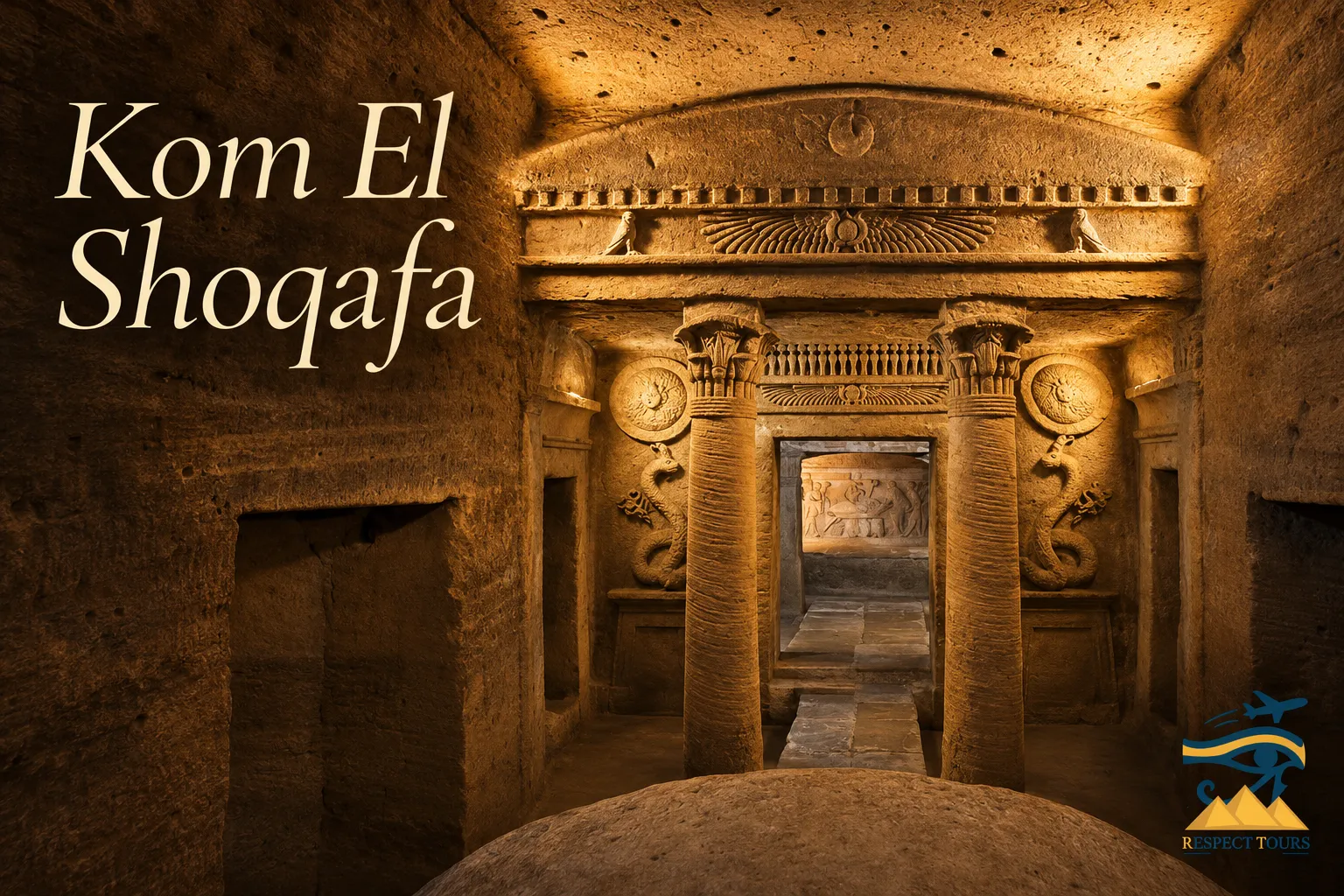
The Catacombs of Kom El Shoqafa are an underground Roman burial complex in Alexandria’s Karmouz district, mainly dating to the 2nd century AD. They are cut into solid rock on several levels and blend Egyptian, Greek and Roman styles. Most visitors spend 45 to 75 minutes here. The site has a spiral staircase and narrow passages, so it suits most visitors but not everyone. Respect Tours includes it in its Alexandria day trip from Cairo.
What Are the Catacombs of Kom El Shoqafa?
The Catacombs of Kom El Shoqafa are a Roman era tomb complex carved underground in Alexandria, where Egyptian, Greek and Roman burial traditions meet.
The complex, often called the Catacombs of Alexandria, has several levels cut into the rock. It began, most likely, as a rich family tomb and grew over time to take more burials.
This mix is the reason to visit. You will see Egyptian gods wearing Roman clothes, in a tomb built for people who lived between 3 cultures.
Where Are the Catacombs of Kom El Shoqafa Located?
The Catacombs of Kom El Shoqafa lie in Alexandria’s Karmouz district, in the south west of the city, close to Pompey’s Pillar.
How to Reach the Catacombs
The easiest way to get there is by car or as part of a private tour. A driver can drop you at the entrance and wait.
Pompey’s Pillar and the Serapeum site are close by, so many visitors see them in the same morning. Sources describe the walk between the two as roughly 10 minutes.
Don’t plan to walk from the Corniche. The distance and the traffic make a car the better choice.
Why Are They Called Kom El Shoqafa?
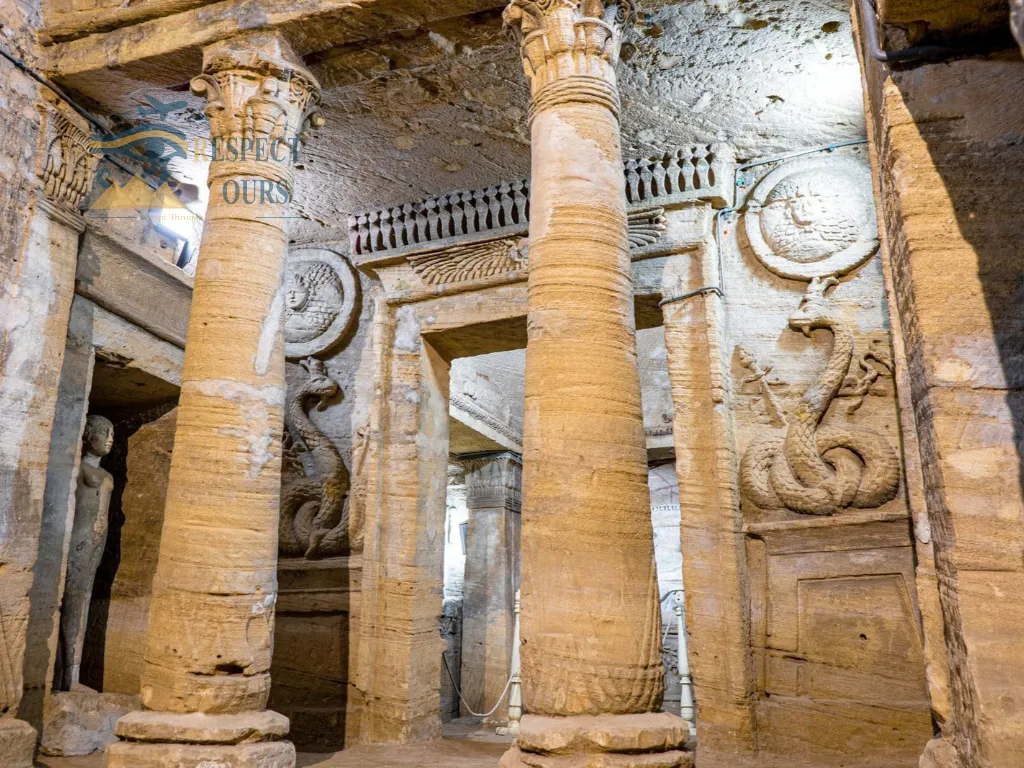
Kom El Shoqafa means “Mound of Shards” in Arabic. The name comes from the heaps of broken pottery that once covered the area.
The mound was made of pieces of clay jars and other terracotta objects. The catacombs were hidden beneath this unremarkable hill until 1900.
The History of the Catacombs of Kom El Shoqafa
The catacombs were built in Roman Alexandria and used for burials for several centuries, until they were forgotten and then found again in 1900.
Alexandria During the Roman Period
Alexandria became part of the Roman Empire in 30 BC, but it stayed a Greek speaking city with strong Egyptian traditions.
That mix explains the tomb. Families wanted Roman status, Greek taste and the protection of Egyptian gods all at once.
When Were the Catacombs Built?
The catacombs were first cut in the 2nd century AD. Many sources say they were used for burials from the 2nd to the 4th century.
Exact dates vary between sources, so treat these as the usual range, not a fixed answer.
From a Private Tomb to a Larger Burial Complex
The original part was probably a family tomb, with a staircase, a rotunda, a banquet hall and one main burial chamber.
Over time, more passages and burial niches were added. Estimates for the total number of burials are around 300.
How the Catacombs Were Rediscovered
A donkey reportedly fell into the access shaft in 1900 and revealed the tomb. Treat this as a famous story, not a proven fact.
What is certain is that the site was discovered in 1900. A team of German archaeologists began excavating soon afterwards.
Excavation and Preservation of the Site
Groundwater is the biggest problem. The lowest level has faced flooding, and a protection project was inaugurated in 2019.
Work on the site continues. Visitor facilities and access are being improved, so conditions can change from one year to the next.
Who Was Buried in the Catacombs?
The names of the original owners are unknown. Historians think the first tomb belonged to a wealthy family, and more burials were added later.
Many of the small burial niches held more than one body. Each niche was sealed with a plaster slab after the burial.
Layout and Architecture of the Catacombs
The route follows a simple order: stairs down, the rotunda, the banquet hall, the main burial chamber and the side passages.
The Spiral Staircase
You enter by a spiral staircase wound around a circular shaft. Bodies were lowered down the middle of this shaft on ropes.
Look at the walls as you go down. Small niches along the shaft may once have held lamps.
The Rotunda
The rotunda is the circular hall at the foot of the stairs. It acts as the hub of the complex.
From here, passages lead to the banquet hall, the main chamber and other galleries. Take a moment to get your bearings.
The Central Well and Lower Levels
A central well drops from the rotunda into the lower levels. It links the upper rooms with the deeper ones.
The lowest level has had groundwater problems and is generally not part of the visitor route. Confirm what is open on the day.
The Triclinium or Banquet Hall
The triclinium is a Roman style dining room on the left of the rotunda. It has stone benches along its sides.
We cover how this room was used in its own section below.
The Main Burial Chamber
The main burial chamber is the centrepiece. It has an entrance with columns, an antechamber and an inner room.
The next section covers it in detail, because this is where the cultural mix is easiest to see.
Side Passages and Burial Niches
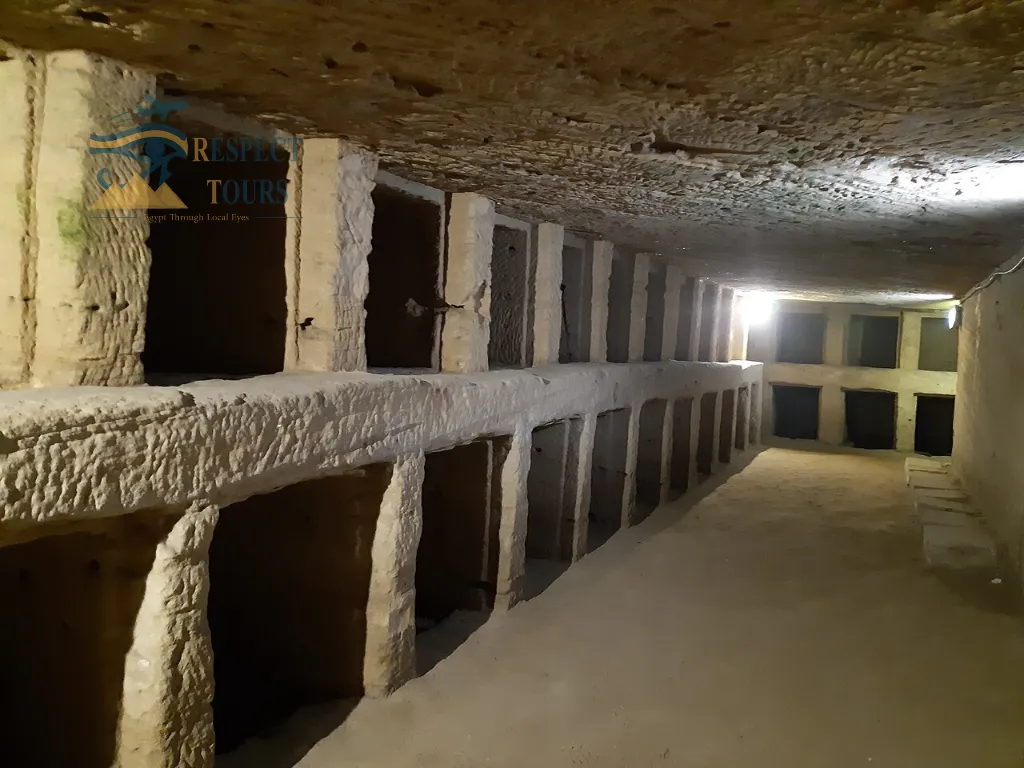
The side passages hold rows of small niches cut into the walls. Each niche was made to hold one or more bodies.
These passages are narrow and quiet. They are where the catacombs feel most like a real Roman burial site.
The Hall of Caracalla
The Hall of Caracalla is a part of the complex where human and animal bones were found. Its use is still debated.
You’ll find more on it further down.
The Main Burial Chamber and Its Reliefs
The main burial chamber is where Egyptian religion and Roman style meet in the same carvings.
The Egyptian-Style Entrance
The chamber is entered through a doorway with Egyptian style decoration. Columns and a pediment frame the way into the inner room.
Anubis in Roman Military Dress
Anubis, the Egyptian god of the dead, appears dressed as a Roman soldier beside the inner doorway. He also has a serpent’s tail.
That tail belongs to Agathos Daimon, a Greek protective spirit. One figure, 3 cultures.
Agathodaemon Serpents and Protective Symbols
The Agathodaemon serpents act as guardians. In Greek belief, they brought good fortune and protection.
Look for them near the doorway of the inner chamber. They are easy to miss if your group moves quickly.
Egyptian Gods in a Greco-Roman Setting
Some figures stand in the traditional Egyptian pose, but they wear Roman clothing or have Roman hairstyles.
This is the clearest example of Alexandria’s blended culture. It also shows how art can follow the beliefs of the people who ordered it.
Sarcophagi Carved Into the Chamber
The sarcophagi in the main chamber are carved into the rock itself, not placed as separate coffins.
This was a way to make the burial place permanent and part of the tomb.
Egyptian, Greek and Roman Influences
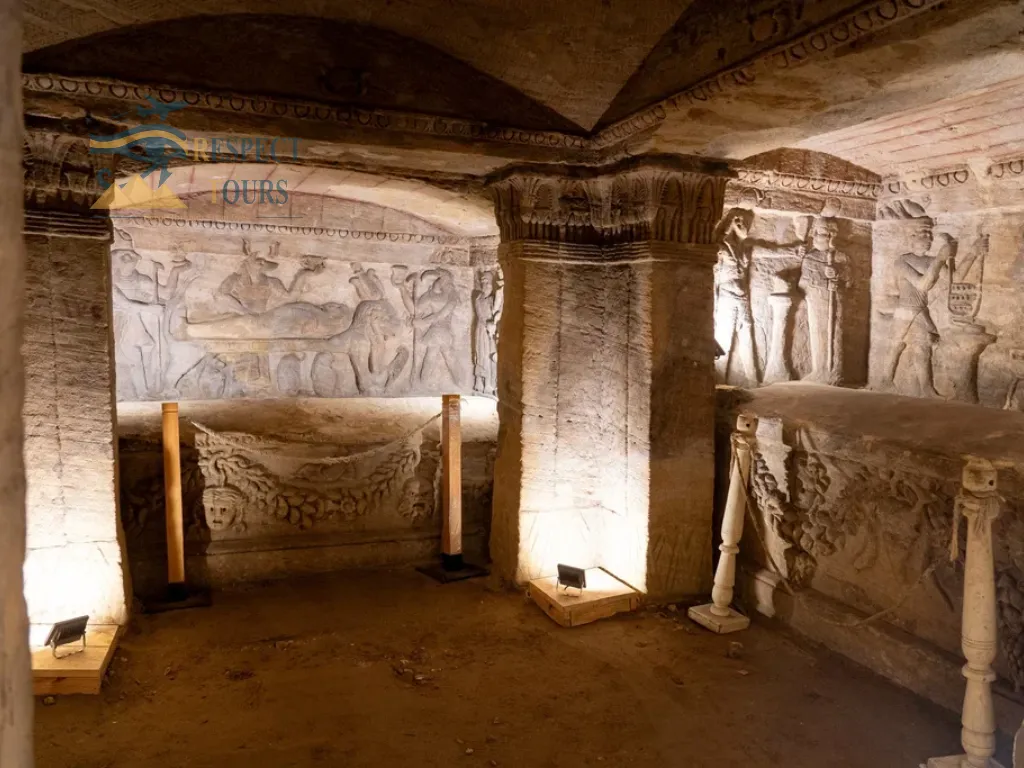
Each culture left a clear mark. The table shows what to look for.
| Influence | What the Visitor Can Notice |
| Egyptian | Deities, funerary symbols and traditional poses |
| Greek | Decorative forms and Alexandrian cultural elements |
| Roman | Clothing, armour and architectural details |
| Combined style | Egyptian gods represented with Roman features |
If you only have time to look for one thing, look for Anubis in his Roman uniform.
The Triclinium and Roman Funerary Meals
The triclinium was probably used by relatives to gather for funeral meals and memorial rituals.
Roman families held meals at the tomb to honour the dead. The benches around the walls would have let guests recline, as they did at dinner.
Pause here for a moment. Families once sat in this room beside their dead.
The Hall of Caracalla
The Hall of Caracalla is a section of the catacombs, linked by tradition to Emperor Caracalla, where human and horse bones were found.
Its name comes from a story that connects the bones to events in Alexandria under Caracalla, in AD 215. Historians do not agree on this explanation.
The bones may point to a separate burial or a later use. Nobody can say for certain, so a good guide will present the theories and not choose one.
What to See at the Catacombs of Kom El Shoqafa
Follow the route in this order and you will see the main points without backtracking.
- Spiral staircase
- Rotunda and central shaft
- Triclinium
- Main burial chamber
- Carved sarcophagi
- Anubis reliefs
- Agathodaemon serpents
- Hall of Caracalla
- Greco-Roman architectural details
How to Visit the Catacombs of Kom El Shoqafa
Most visits are short and simple, but a few practical details matter.
How Long Does the Visit Take?
The visit takes about 45 to 75 minutes. A specialist guide can add time, because there is a lot to explain.
Add 15 minutes for the security check and the ticket queue.
Best Time to Visit
Morning is usually the better time for the Alexandria Catacombs. Alexandria’s summer afternoons can be hot, and the site gets busier around midday.
Underground, the air can feel humid in any season. Plan for that, not for the weather outside.
What to Wear
Wear closed shoes with grip, because the stairs and floors can be uneven or damp. Light layers work well.
Bring a small bottle of water. A hat helps for the walk from the car to the entrance.
Stairs, Heat and Underground Conditions
Expect a spiral staircase, narrow passages and low ceilings in places. There is limited space, and groups can queue at the stairs.
The air may be warm and humid, depending on the season.
Photography Rules
Ask at the ticket office about photography. Rules and fees can differ for phones and cameras, and some areas may restrict it.
Never use flash on the reliefs.
Tickets and Opening Hours
Prices and hours change, so confirm them on the day or with your guide.
| Visitor information | Details |
| Opening days | Confirm before visiting |
| Opening hours | Confirm before visiting; sources differ and Ramadan hours may be shorter |
| Ticket price | Check the current official rate for foreign visitors |
| Photography | Check the rules at the ticket office |
| Lower level | May be closed because of groundwater |
| Best time | Morning |
Are the Catacombs Suitable for Every Visitor?
No, the Catacombs of Kom El Shoqafa are not suitable for every visitor, because of the stairs, narrow passages and enclosed spaces.
Be honest with yourself before you go. Consider the following:
- A spiral staircase takes you down
- The passages are underground and narrow
- Some spaces feel tight
- The air can be humid or warm, depending on the season
- Access for wheelchair users is limited
- Anyone with claustrophobia may find parts of the visit hard
The Ministry of Tourism and Antiquities announced work to improve accessibility at the site in 2025. Confirm the current situation before you book.
Older visitors who can manage stairs slowly will usually be fine. If in doubt, ask us before you travel.
Are the Catacombs Worth Visiting?
Yes, the catacombs are worth visiting for people who enjoy archaeology, funerary architecture and Greco-Roman history.
They show a side of Alexandria that is very different from the seafront landmarks and the modern library. The cultural mix is the real attraction.
There is one honest trade-off. Much of the original paint has faded, so if you have already seen the painted tombs of Luxor, you will find these plainer. Go for the ideas and the architecture, not for colour.
Attractions Near the Catacombs
Most of these sights are a short drive away, so you can combine several in 1 day.
Pompey’s Pillar and the Serapeum
Pompey’s Pillar is a tall Roman column, raised for Emperor Diocletian despite its name. It stands on the Serapeum site, a short distance from the catacombs.
Alexandria National Museum
The Alexandria National Museum tells the story of the city across several eras. Our Alexandria National Museum and Corniche tour includes it.
Greco-Roman Museum
The Greco-Roman Museum holds finds from Alexandria’s Greek and Roman past. Check that it is open before you add it to your plan.
Bibliotheca Alexandrina
The Bibliotheca Alexandrina is the modern library on the Corniche. Read our Bibliotheca Alexandrina visitor guide for tickets and museums.
Qaitbay Citadel
Qaitbay Citadel is a 15th century fortress on the seafront. See historical sites in Alexandria for how it fits with the older monuments.
Alexandria Corniche
The Corniche is the seafront road beside the Mediterranean. It is a good place to end the day with a walk and a coffee.
For more ideas, see things to see in Alexandria.
Interesting Facts About the Catacombs
- The catacombs date mainly to the Roman period.
- They were carved beneath the ground on several levels.
- The original complex may have begun as a private family tomb.
- Egyptian gods appear with Greek and Roman artistic features.
- The main chamber contains sarcophagi carved into the rock.
- A spiral staircase leads visitors into the complex.
- Kom El Shoqafa means approximately “Mound of Shards”.
- The site was rediscovered in 1900.
- Parts of the lowest level have faced groundwater problems.
Visit Kom El Shoqafa With Respect Tours
Explore Alexandria beneath the surface with a local operator that has run Egypt tours since 1978.
Our one-day Alexandria trip from Cairo lists the Catacombs of Kom El Shoqafa among its highlights, with Pompey’s Pillar, the Citadel of Qaitbay, the Roman Theatre and the Library of Alexandria. It includes hotel pickup, an English-speaking Egyptologist guide and entry tickets to the listed sites. Check the live tour page for the current programme.
- Book a private day trip from Cairo to Alexandria
- Compare our Alexandria day tours
- See the Cairo and Alexandria cultural itinerary
- Ask us to tailor your Alexandria day
If you only have 1 day, read what to see in one day in Alexandria first.
FAQs
Where are the Catacombs of Kom El Shoqafa?
The Catacombs of Kom El Shoqafa are in the Karmouz district of Alexandria, close to Pompey’s Pillar. Most visitors arrive by car or on a private tour. The Corniche is too far to walk comfortably, so plan a driver and combine both sites in one morning.
When were the Catacombs of Kom El Shoqafa built?
The catacombs were first cut in the 2nd century AD and used for burials into the 4th century. Sources give slightly different dates. The original part was probably a family tomb, and later passages were added as the number of burials grew over time.
Who was buried in the Catacombs?
The original owners are unknown. The first tomb was probably made for a wealthy family, and more burials were added later. Estimates reach around 300 in total. Many niches held more than one body and were sealed with a plaster slab afterwards.
How many levels do the Catacombs have?
The catacombs have 3 levels cut into solid rock. Visitors usually see the upper levels only. The lowest level has faced groundwater problems and may be closed, so ask at the site or confirm with your guide about what is open on your day.
How long does it take to visit the Catacombs?
Most visits take 45 to 75 minutes. With a specialist guide it may take longer, because there is more to explain at each stop. Add around 15 minutes for the security check and the ticket queue before you go down the stairs.
Is photography allowed inside?
Photography rules depend on the area and the type of camera, and fees may apply. Ask at the ticket office before you take your phone out. Flash can damage the reliefs, so avoid it everywhere, and follow the staff’s instructions if they ask you to stop.
Are the Catacombs suitable for children?
Yes, for children who can manage stairs and enclosed spaces. The spiral staircase and narrow passages can be tiring for small ones. Hold hands on the stairs, keep the visit short and ask your guide to focus on Anubis and the serpents.
Are the Catacombs wheelchair accessible?
Access is limited because of the spiral staircase and narrow passages. The Ministry of Tourism and Antiquities announced accessibility work at the site in 2025, but conditions can change. Ask us for the current situation before booking, and we will check it for you.
Are they suitable for visitors with claustrophobia?
They may not be. The route goes down a spiral staircase and through narrow, enclosed passages. If you feel uneasy in tight spaces, tell your guide first. You can stay in the larger rotunda, or skip the visit and see Pompey’s Pillar instead.
Can you visit Kom El Shoqafa on a day trip from Cairo?
Yes, many visitors see it on a one day Alexandria trip from Cairo or Giza. Respect Tours lists the catacombs among the highlights of its private day trip. Journey times depend on traffic, so confirm the pickup time and programme on the live tour page.