

You’re trying to piece together a map of ancient Egypt in your head, but the names keep shifting. Memphis, Thebes, Akhetaten, Alexandria… were they all capitals? Which ones can you actually visit today? You see them mentioned in tour itineraries, but it’s hard to grasp the timeline and understand why one city was important in one era and gone in the next. You want to connect the places you’ll see to the grand story of ancient Egypt, to understand not just the temples and tombs, but the living, breathing cities they once belonged to.
This guide provides that clarity. We’ll journey through the major cities of ancient Egypt, from the first capitals of a unified kingdom to the great religious centres and bustling trade hubs. We’ll explore what these cities were like, why they rose and fell, and most importantly, which of these incredible ancient urban centres you can still explore today.
What Were the Major Cities in Ancient Egypt?
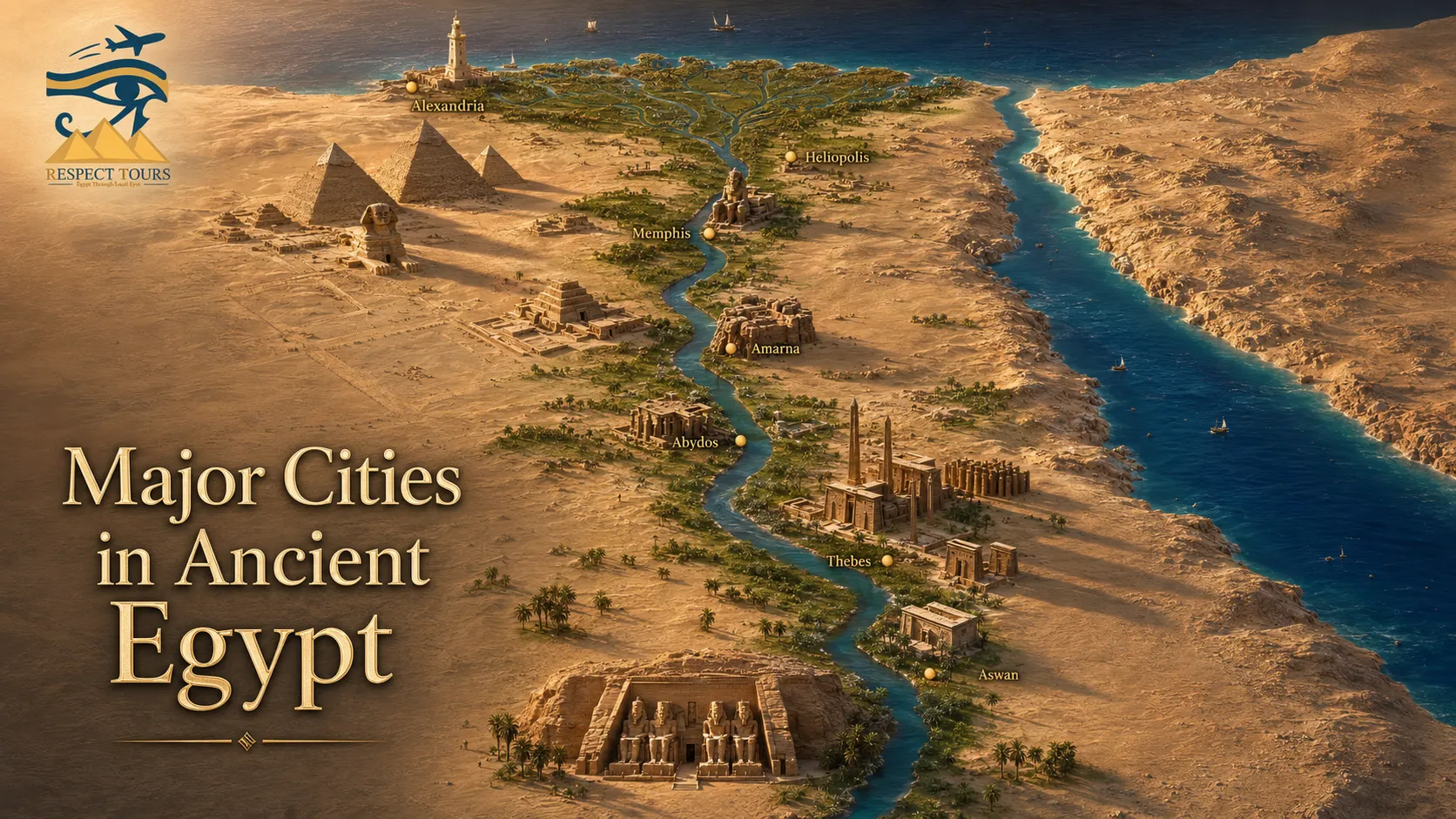
The most significant cities in ancient Egypt included the political capitals of Memphis and Thebes (modern Luxor), the revolutionary city of Akhetaten (Amarna), and the later Greco-Roman capital of Alexandria. Other vital centres were the religious hubs of Heliopolis and Abydos, and the trade gateway of Elephantine (modern Aswan). The importance of each city shifted dramatically across Egypt’s 3,000-year history, with different locations rising to prominence as capitals, religious centres, or strategic forts.
Quick Facts: Key Ancient Egyptian Cities
| Feature | Details |
|---|---|
| Old Kingdom Capital | Memphis (Ineb-Hedj) |
| New Kingdom Capital | Thebes (Waset) |
| Ptolemaic Capital | Alexandria |
| Major Religious Centres | Abydos, Heliopolis and Karnak (within Thebes) |
| Key Southern Trade Hub | Elephantine (Aswan) |
| Primary Building Material | Mudbrick for homes; stone for temples and tombs |
| Lifeline | The Nile River |
What Were Ancient Egyptian Cities Like?
Ancient Egyptian cities were complex centres of life, built primarily from sun-dried mudbrick, which is why many have vanished. Only the stone-built temples and tombs—the “houses of eternity”—have survived so well.
A typical city was a hive of activity. Houses were packed together along narrow, winding streets. Larger villas for nobles might have multiple floors and private courtyards, while workers’ homes were simpler, single-storey dwellings. Markets bustled with traders selling grain, fish, pottery, and linen. At the city’s heart, both physically and spiritually, stood the massive temple complex dedicated to the local god. This was not just a place of worship but also a major landowner, employer, and administrative centre, surrounded by high walls. Surrounding the urban core were the fields and workshops that sustained the population, from farmers to sculptors and scribes.
Why Were Most Cities Built Near the Nile?
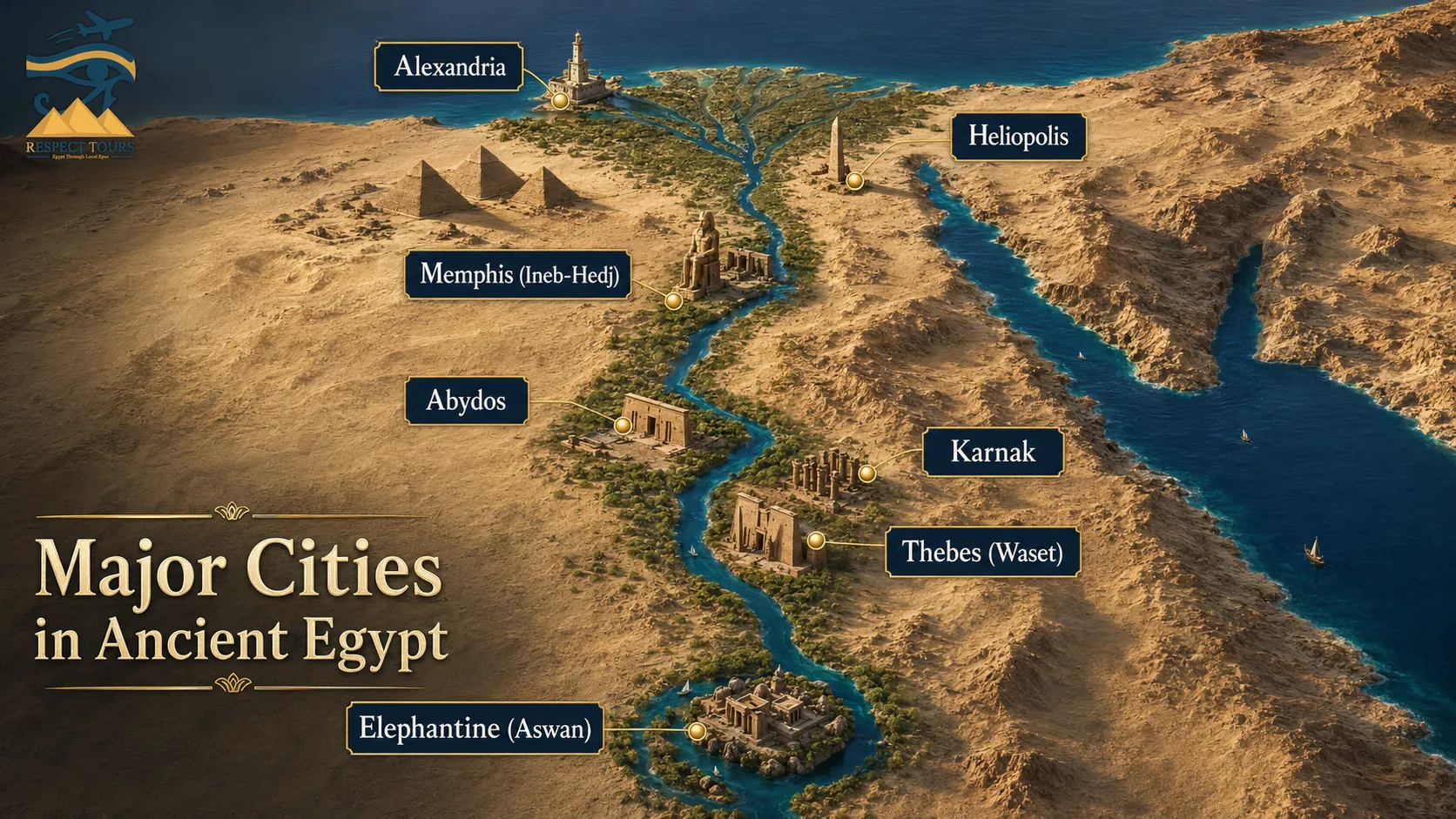
Most ancient Egyptian cities were built along the Nile River because it was the civilization’s absolute lifeline. The river provided the essential water for drinking, cooking, and bathing. Crucially, its predictable annual flood deposited fertile black silt, creating the farmland necessary to feed the population. The Nile was also Egypt’s main highway, enabling efficient transport of goods, building materials (like granite from Aswan), and armies by boat. While the majority of settlements hugged the river valley, communities also existed in desert oases and along trade routes in Sinai, established for mining and frontier defence.
Major Capitals of Ancient Egypt by Historical Period
The capital of ancient Egypt was not fixed; it moved according to the ruling dynasty’s origins, political strategy, or religious beliefs.
Memphis: Capital of the Old Kingdom
For much of its early history, Egypt was ruled from Memphis (ancient Egyptian: Ineb-Hedj, “The White Walls”). Located near modern Cairo, its strategic position at the apex of the Nile Delta made it the perfect spot to control both Upper (southern) and Lower (northern) Egypt. While very little of the ancient city itself remains, its vast necropolis—including the pyramids of Giza and the tombs of Saqqara—testifies to its immense wealth and power.
Thebes: Capital of the New Kingdom
Thebes (ancient Egyptian: Waset), now the site of modern Luxor, rose to become the religious and royal capital during the New Kingdom. This was Egypt’s golden age, and the pharaohs lavished their wealth on the city. They built the immense temple complexes of Karnak and Luxor on the East Bank and carved their elaborate tombs in the Valley of the Kings on the West Bank. For centuries, Thebes was one of the world’s most magnificent cities.
Akhetaten (Amarna): A Revolutionary Capital
For a brief, radical period, Pharaoh Akhenaten abandoned Thebes and its powerful priesthood. He built a completely new capital city called Akhetaten (“Horizon of the Aten”) in the desert at modern-day Amarna. Designed from scratch, it was dedicated solely to his preferred deity, the sun disc Aten. The city was abandoned shortly after Akhenaten’s death, and its stone was repurposed, but its ruins provide a unique snapshot of ancient Egyptian city planning.
Pi-Ramesses and Tanis: Delta Capitals
During the Ramesside period, pharaohs like Ramesses II moved their primary residence to the Nile Delta to be closer to their interests in the Near East. Pi-Ramesses became a huge, cosmopolitan royal city, though its location was later lost. Power then shifted to Tanis, another Delta city that became a capital during the Third Intermediate Period. The treasures from its royal tombs are among the highlights of the Egyptian Museum in Cairo.
Alexandria: Capital of Ptolemaic Egypt
Founded by Alexander the Great in 331 BCE, Alexandria became the capital of the ensuing Ptolemaic Dynasty. It was a beacon of Greek culture, science, and learning, famed for its Great Library and the Pharos lighthouse, one of the Seven Wonders of the Ancient World. Architecturally and culturally distinct from older Egyptian cities, it was Egypt’s window to the Mediterranean.
Ancient Egypt’s Most Important Religious Cities
While the pharaoh ruled from the capital, the gods were believed to reside in their own sacred cities.
- Heliopolis (Iunu): The centre of the sun cult and the worship of Ra, located in a suburb of modern Cairo.
- Abydos (Abdju): The sacred cult centre of Osiris, god of the underworld. It was a major pilgrimage site where early pharaohs were buried and later kings built magnificent temples, like the one by Seti I.
- Dendera (Iunet): Home to the stunningly preserved Temple of Hathor, the goddess of love, music, and joy.
- Edfu (Behdet): The cult centre of the falcon-god Horus, whose temple is the most complete surviving example in all of Egypt.
Workers’ Towns and Everyday Life
Beyond the grand capitals, unique settlements give us insight into the lives of ordinary people. The most famous is Deir el-Medina, the village where the artisans and craftsmen who built the tombs in the Valley of the Kings lived. Excavations here have revealed their houses, personal letters, and even their work attendance records, providing an incredibly detailed picture of daily life.
What Happened to the Cities of Ancient Egypt?
Many of ancient Egypt’s great cities have vanished or exist only as ruins for several key reasons:
- Shifting Capitals: When a new dynasty moved the capital, the old one often declined in importance and population.
- Changing Nile: The course of the Nile and its b ranches shifted over millennia, leaving some cities without their vital water source.
- Building Materials: Most homes and palaces were built of mudbrick, which dissolves over time, leaving only the stone temples and tombs.
- Recycling: Rulers often dismantled the monuments of their predecessors to reuse the stone for their own projects. Akhetaten was a major victim of this.
- New Cities: Modern towns and agricultural land have often been built directly on top of ancient sites, making excavation impossible.
Ancient Egyptian Cities You Can Visit Today
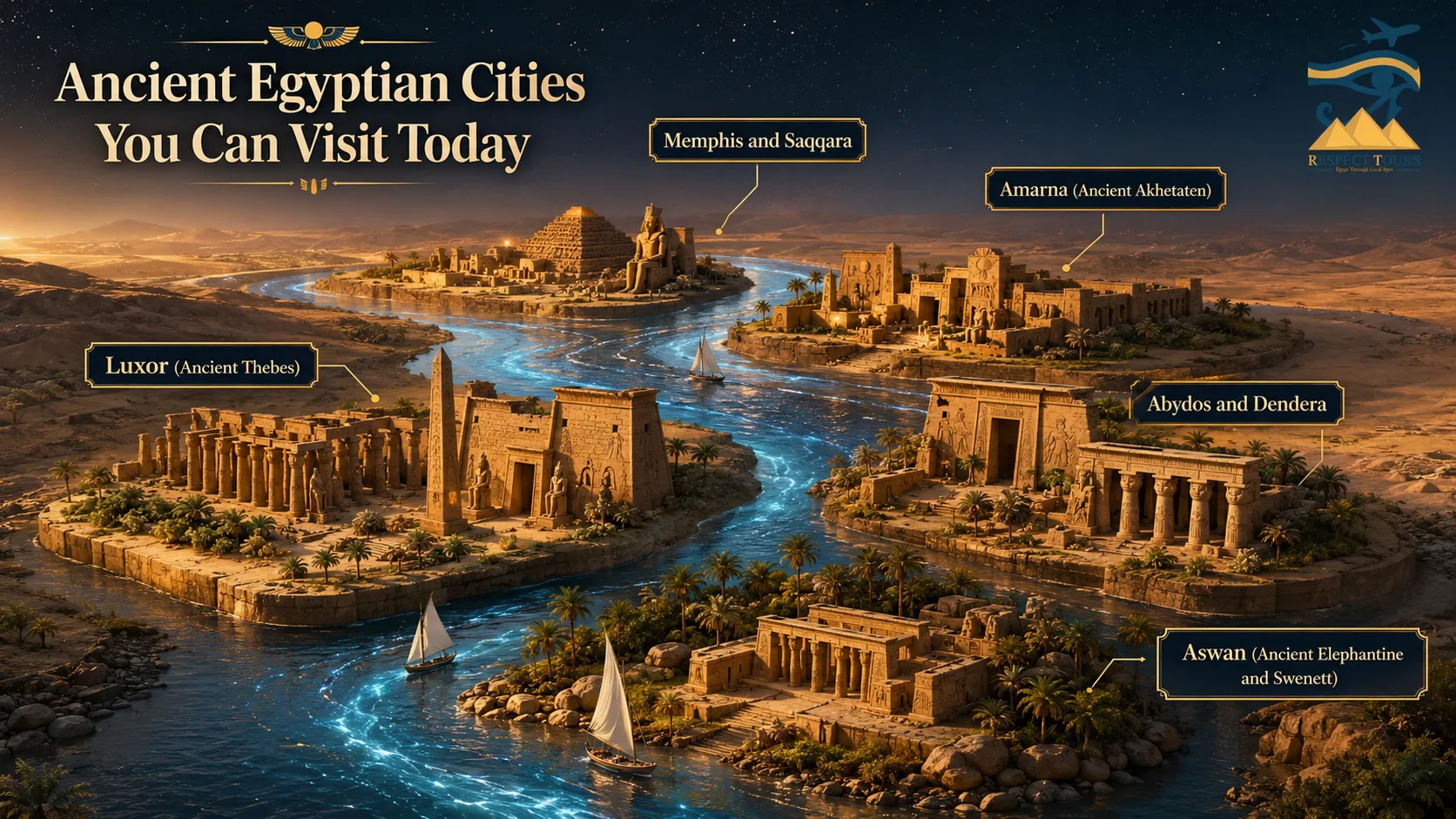
While some cities are lost to time, the sites of many of ancient Egypt’s most important urban centres are among the world’s most impressive archaeological destinations. Visiting them isn’t just about seeing ruins; it’s about walking through the very places where history was made.
Luxor (Ancient Thebes)
This is the world’s greatest open-air museum. You can explore the vast temple complexes of Karnak and Luxor, visit the tombs of pharaohs in the Valley of the Kings, and see the mortuary temples of rulers like Hatshepsut. It’s the most vivid place to experience the scale of a New Kingdom capital.
Memphis and Saqqara
A short trip from Cairo takes you to the heart of the Old Kingdom. While the city of Memphis is now a small open-air museum, its necropolis at Saqqara is home to the Step Pyramid of Djoser and countless tombs that showcase the dawn of pyramid building.
Amarna (Ancient Akhetaten)
For the truly dedicated history enthusiast, a visit to Amarna is a unique experience. The site is remote and the ruins are subtle, but standing in the empty desert where Akhenaten built his revolutionary city is a powerful feeling.
Abydos and Dendera
Often visited as a day trip from Luxor, these two sites contain some of the most beautiful and well-preserved temples in Egypt. The reliefs in the Temple of Seti I at Abydos and the vibrant ceilings of the Temple of Hathor at Dendera are must-sees.
Aswan (Ancient Elephantine and Swenett)
Modern Aswan sits on the site of ancient Swenett, a crucial frontier town. You can explore the archaeological site of Elephantine Island and see the granite quarries that supplied stone for obelisks and temples up and down the Nile. This is a key stop on any Egypt Nile cruise itinerary.
How Respect Tours Egypt Helps You Explore
Connecting these historical dots is what transforms a holiday into a meaningful journey. Instead of just visiting a list of sites, our guides help you understand the story of why they are there. A tour package can handle all the logistics, from comfortable transport between Cairo, Luxor, and Aswan to securing knowledgeable local guides who can bring the history of Thebes and Memphis to life.
For example, our 8 Days Egypt Highlights tour is structured around these ancient capitals. It begins in Cairo with visits to Giza and the ruins of Memphis and Saqqara. You then fly south to Luxor to explore the temples and tombs of ancient Thebes, the magnificent capital of the New Kingdom. By combining these key locations in a logical flow, the history clicks into place. The package includes:
- Guided tours of Memphis, Saqqara, and the Giza Pyramids.
- Guided exploration of Karnak Temple, Luxor Temple, the Valley of the Kings, and Hatshepsut Temple in Luxor (ancient Thebes).
- Domestic flights between Cairo and Luxor.
- All ground transport in private, air-conditioned vehicles.
- Accommodation and the services of a professional Egyptologist guide.
FAQ About Major Cities in Ancient Egypt
What were the three main cities in ancient Egypt?
The three most consistently significant cities across different eras were Memphis, the Old Kingdom capital; Thebes (modern Luxor), the New Kingdom royal and religious heart; and Alexandria, the capital during the Ptolemaic and Roman periods.
What was the first capital of ancient Egypt?
Traditionally, the first capital after unification is cited as Thinis, though its exact location is unknown. The first major, enduring capital of the unified Old Kingdom was Memphis, established around 3100 BCE.
What was the largest city in ancient Egypt? Archaeologists estimate that Thebes, during the height of the New Kingdom (c. 1550–1070 BCE), was likely the largest city in the world at the time. Memphis and later Pi-Ramesses were also massive urban centres, though precise population figures are impossible to confirm.
Were all ancient Egyptian cities built along the Nile?
The vast majority were, as the Nile provided water, food, and transport. However, important settlements also existed in the Western Desert oases, which were vital agricultural and trade centres, and in Sinai and the Eastern Desert for mining and quarrying operations.
Which ancient Egyptian cities can you visit today?
You can visit the sites of many ancient cities. The most popular are Luxor (Thebes), the Memphis/Saqqara complex near Cairo, Aswan (Elephantine), and Alexandria. You can also visit sites like Abydos, Dendera, Edfu, and the remote ruins of Amarna (Akhetaten).
Why was Akhetaten (Amarna) abandoned?
The city was abandoned shortly after the death of its founder, Pharaoh Akhenaten. His religious revolution was rejected by his successors, who returned the royal court and religious authority to Thebes. Later pharaohs systematically dismantled Akhetaten to erase the memory of this “heretical” period.
Is Luxor built on the site of ancient Thebes?
Yes, the modern city of Luxor, along with the surrounding villages and archaeological sites on both banks of the Nile, is located on the site of ancient Thebes. The temples of Luxor and Karnak are integrated into the modern city’s East Bank.
Was Alexandria an ancient Egyptian city?
Alexandria was founded by Alexander the Great, a Macedonian Greek, not an Egyptian pharaoh. It became the capital of the Greek-speaking Ptolemaic dynasty that ruled Egypt. While geographically in Egypt, its culture and architecture were Hellenistic, distinct from traditional Egyptian cities like Thebes or Memphis.
Conclusion: Stepping Into History
The story of ancient Egypt is written in the stones of its cities. From the administrative might of Memphis to the spiritual grandeur of Thebes and the intellectual vibrancy of Alexandria, these urban centres were the engines of civilization. Understanding their roles, their geography, and their place in the timeline adds incredible depth to a journey through Egypt. Exploring these sites is more than sightseeing; it’s a direct encounter with the ambition, faith, and daily life of one of history’s greatest cultures. By seeing Egypt through local eyes, you connect not just with the monuments, but with the people who built and lived in them.
Ready to walk the streets of ancient Thebes and discover the secrets of Memphis? Explore our Classic Egypt Tours to find an itinerary that connects you with the legendary cities of the pharaohs.