


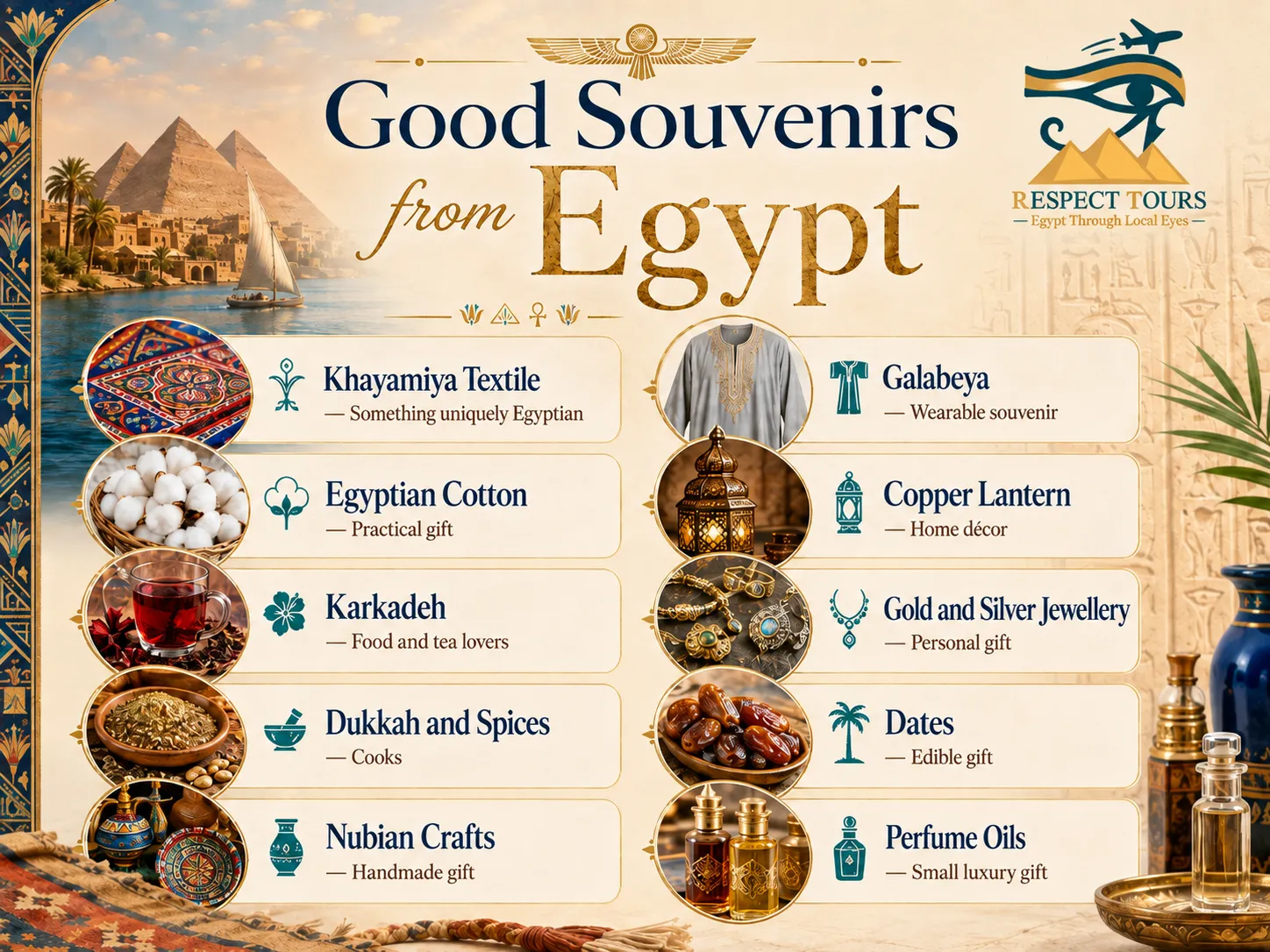
The good souvenirs from Egypt are the ones that still feel connected to the place long after you get home: a handmade textile from Cairo, Nubian craft from Aswan, karkadeh from a spice merchant, a proper galabeya, or something made by an artisan whose work you watched with your own eyes.
At Respect Tours, we’ve been guiding travelers through Egypt since 1978, and we’ve seen which purchases become lasting memories and which tourist-shop buys are forgotten before the suitcase is even unpacked. So we’ve narrowed it down to 15 authentic Egyptian souvenirs we genuinely recommend, with practical advice on what to buy, where to find it, how to recognize the real thing, and what to leave behind.
And save room in your suitcase. #15 is one of our favorite Cairo finds, yet many first-time visitors never see it.
What Are the Good Souvenirs from Egypt?
If you don’t have time to read the whole guide, start here.
| Souvenir | Best For | Best Place to Look | Easy to Pack? |
|---|---|---|---|
| Khayamiya Textile | Something uniquely Egyptian | Tentmakers’ Street, Cairo | ★★★★★ |
| Egyptian Cotton | Practical gift | Reputable textile retailers | ★★★★☆ |
| Karkadeh | Food and tea lovers | Aswan Souk | ★★★★★ |
| Dukkah and Spices | Cooks | Cairo or Aswan spice merchants | ★★★★★ |
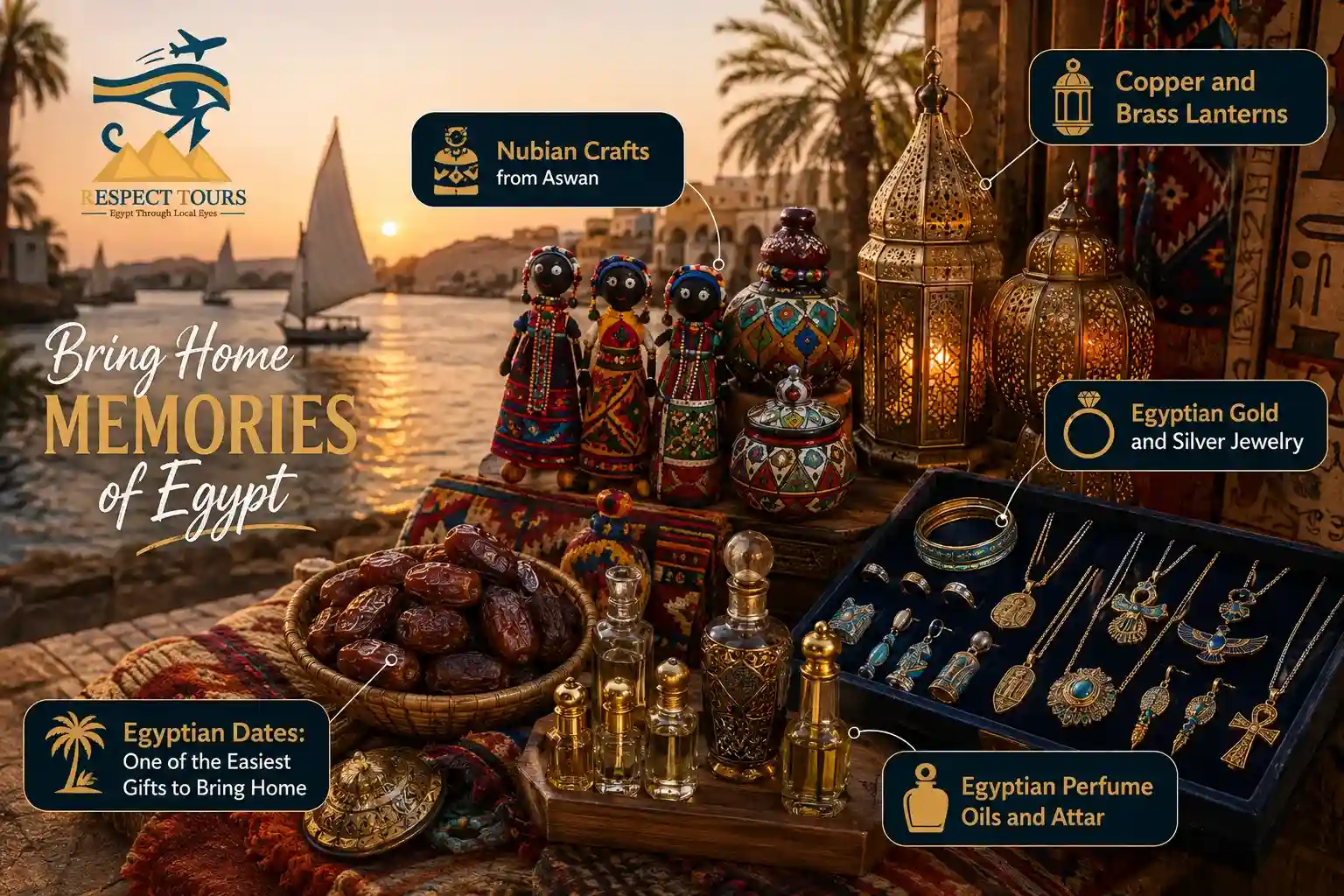
| Nubian Crafts | Handmade gift | Aswan and Nubian villages | ★★★★☆ |
| Galabeya | Wearable souvenir | Local textile and clothing markets | ★★★★☆ |
| Copper Lantern | Home décor | Islamic Cairo | ★★★☆☆ |
| Gold and Silver Jewellery | Personal gift | Established jeweller | ★★★★★ |
| Dates | Edible gift | Siwa or Aswan | ★★★★☆ |
| Perfume Oils | Small luxury gift | Established perfume merchant | ★★★★★ |
Our local pick: If you want something that feels distinctly Egyptian rather than simply Egypt-themed, start with Khayamiya, Nubian crafts, Egyptian cotton, karkadeh, or a well-made galabeya.
1. Khayamiya: Cairo’s Hand-Stitched Tentmaker Art
Best for: Home décor · Art lovers · A genuinely Cairo-specific gift
Where: Sharia al-Khayamiya, behind Bab Zuweila
Packing: Excellent
If we had to recommend one craft that tells a better story than a generic Pharaoh statue, Khayamiya would be near the top.
Traditionally used to decorate large tents for weddings, funerals, and religious celebrations, Khayamiya is one of Historic Cairo’s distinctive living craft traditions. UNESCO-supported heritage projects have documented Khayamiya tentmakers among the traditional crafts being safeguarded in the historic city.
Small Khayamiya pieces such as cushion covers, table runners, and wall hangings are the most practical formats for travelers. The color combinations are often bold, with deep reds, cobalt blues, greens, golds, black, and cream worked into geometric or arabesque patterns.
The experience of buying one is part of the souvenir. Walk through Sharia al-Khayamiya, and you can still see artisans working inside small workshops, cutting and stitching the appliqué by hand.
What Should You Buy?
Skip the enormous wall panels unless you have plenty of luggage space. A cushion cover, small wall hanging, or table runner gives you the craftsmanship without the packing problem.
2. Egyptian Cotton
Best for: Practical gifts · Couples · Parents · Yourself
Buy: Towels, robes, bedding, scarves.
Egyptian cotton is an obvious answer to “what should I buy in Egypt?”, but the words “Egyptian Cotton” on a label aren’t enough.
The Egyptian Cotton Association operates a trademark and accreditation system specifically to protect genuine Egyptian Cotton products, including traceability and testing. Its advice is simple: look for the official Egyptian Cotton™ mark when authenticity matters.
For travelers, towels, pillowcases, robes, and lightweight textiles are usually much easier to bring home than a full bedding set.
How to avoid the mistake tourists make
Don’t buy purely because a shopkeeper says “100% Egyptian cotton.”
Respect Tours Tip: If authenticity matters, look for the official Egyptian Cotton™ trademark rather than relying only on the label or the seller’s description.
3. Karkadeh from Aswan
Best for: Tea drinkers · Affordable gifts · Carry-on luggage
Packing: Excellent
Ask an Egyptian what karkadeh is, and you’ll probably get a much more enthusiastic answer than you expected.
Dried hibiscus is brewed into the deep-red drink served hot or cold across Egypt, and Aswan is one of the best places to shop for it. Egypt’s official tourism information specifically highlights hibiscus among the spices and herbs sold in Aswan Souk.
It is inexpensive, light, and easy to divide into several gifts.
What we look for: dried flowers with a strong, deep color and aroma, bought from a spice merchant rather than a pre-packed souvenir display.
4. Egyptian Dukkah and Fresh Spice Blends
Best for: Food lovers · Home cooks · Easy gifts
Where: Spice merchants in Cairo and Aswan
Packing: Excellent
If you enjoy cooking, Egyptian spices are some of the easiest and most useful souvenirs to bring home. The key is to buy fresh blends from a proper spice merchant, not a generic “Egyptian spice mix” packaged for tourists.
Dukkah
Dukkah is a traditional Egyptian blend made with toasted nuts or seeds, sesame, coriander, cumin, and other spices. Recipes vary from one family and region to another.
It is usually eaten with bread and olive oil, but at home it also works well with eggs, roasted vegetables, salads, and grilled meats.
Baharat
Baharat is a fragrant spice blend commonly used in Egyptian meat dishes, rice, kofta, and stews. The exact mix differs by cook, so buying it freshly blended from a spice merchant gives you a much more interesting result than a standard supermarket version.
Mastic
Mastic (mastika) is an aromatic resin used in some Egyptian sweets, breads, desserts, and ice cream. Only a small amount is needed, so a small packet can last a long time and is easy to pack.
💡 Packing Tip
Keep dry spices sealed and clearly labeled. Food and plant-product rules vary by destination, so check the official customs requirements for the country you’re entering before you fly.
📍 Where to Find It
Cairo: Traditional spice merchants in and around Khan El-Khalili.
Aswan: One of our favorite places to buy karkadeh, especially from traditional spice merchants around the souq.
5. A Proper Galabeya
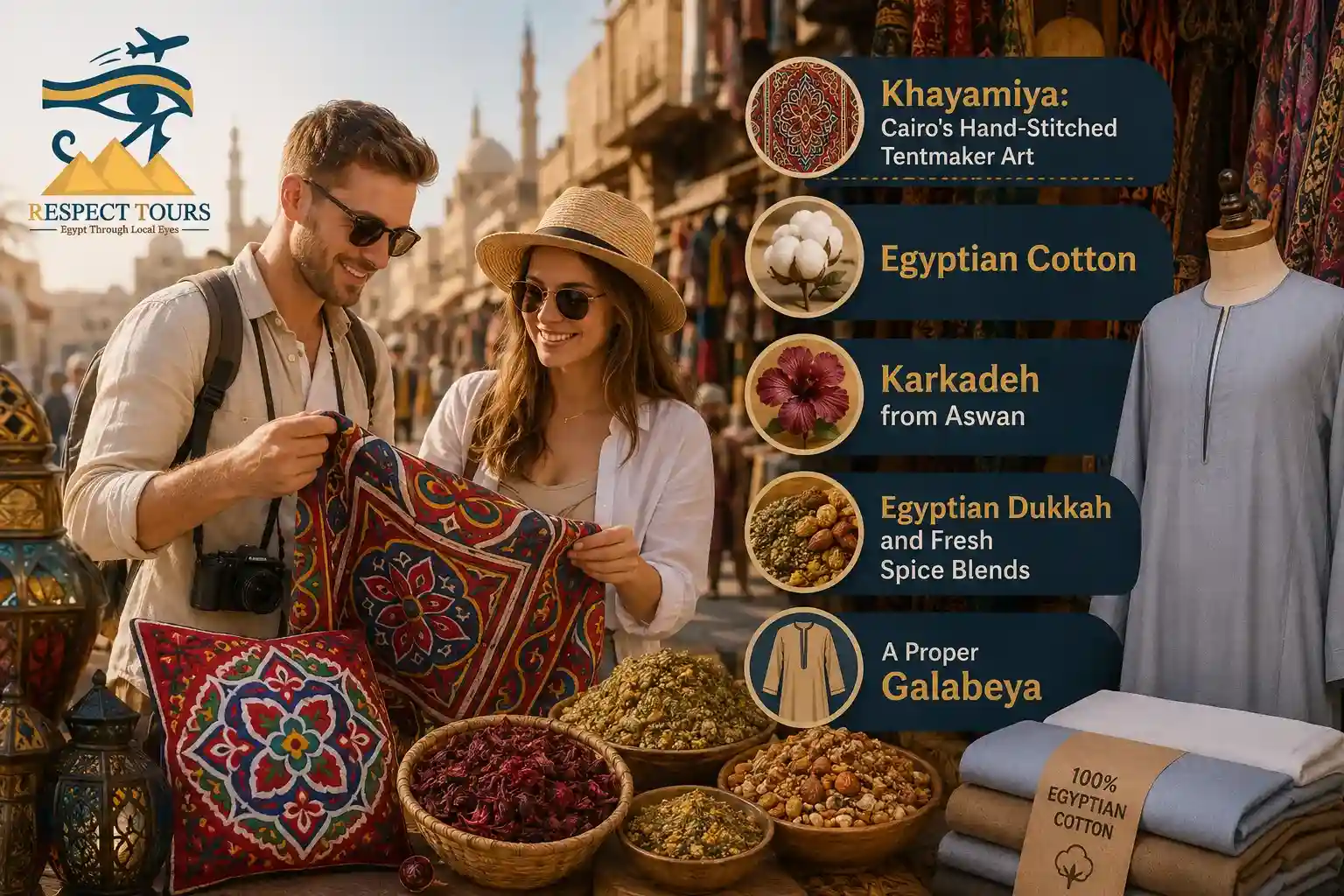
Best for: Wearable souvenir · Comfortable gift · Something genuinely local
If you want a galabeya that actually feels connected to Egypt, look beyond the bright tourist-shop versions and choose one made for everyday wear.
In Upper Egypt, especially around Luxor and Aswan, traditional galabeyas are usually made from heavier cotton or blended fabrics in solid colors such as indigo, brown, black, green, or muted earth tones. They are loose, comfortable, and designed for the local climate rather than for display.
Women’s galabeyas may also feature embroidery around the neckline, cuffs, or front panel, often using geometric or floral patterns. The better pieces feel like real clothing, not costume wear, and many travelers end up using them at home as relaxed robes or cover-ups.
Where to Find It
Luxor: Look around the local fabric and clothing markets behind the train station rather than relying only on shops near the temples.
Cairo: Wakalet El-Balah in Bulaq is known for textiles, while the side streets around Khan El-Khalili can also have better local clothing options away from the most tourist-facing stalls.
Respect Tours Tip: Focus on the fabric first. A good galabeya should feel comfortable, breathable, and well-stitched. If it looks overly shiny or heavily decorated for tourists, it probably isn’t the version locals would normally choose.
6. Nubian Crafts from Aswan
Best for: Colorful handmade gifts · Cultural souvenirs
Look for: baskets, textiles, jewelry, small decorative pieces
Aswan gives you a completely different souvenir palette from Cairo.
Nubian culture maintains distinct traditions, clothing, and crafts, and Egypt’s official tourism site specifically recommends browsing traditional crafts, bags, clothing, and jewelry in Nubian village markets.
The Nubia Museum also documents local traditions and handicrafts, which makes it a useful stop if you want to understand the culture behind what you’re seeing rather than buying purely on appearance.
Respect Tours Tip: If possible, buy directly from a maker or community-based seller. The story of who made something matters more than a “Made in Egypt” sticker.
7. Copper and Brass Lanterns
Best for: Home décor · Handmade gifts
Where: Historic Cairo
Packing: Medium
Copper and brass lanterns are one of Cairo’s most distinctive souvenirs, but quality varies widely. The better pieces are hand-worked, with slight variations in the pierced patterns and visible tool marks rather than perfectly uniform machine-made holes.
For travelers, a small or medium tabletop lantern is usually the best choice. It is easier to pack, less fragile, and still gives you the patterned light and traditional Cairo look.
Where to Find It
Look around Al-Muizz Street and the coppersmith areas of Islamic Cairo, where traditional metalworking is still practiced.
Respect Tours Tip: Check the joins, edges, stability, and quality of the metalwork before buying. Smaller lanterns are much easier to travel with than large hanging pieces.
8. Egyptian Gold and Silver Jewelry
Best for: Partner · Personal keepsake · Premium gift
Packing: Excellent
Gold and silver jewelry are among the easiest high-value souvenirs to bring home from Egypt. They take almost no luggage space, can last for years, and can feel much more personal than a standard tourist souvenir.
Look for designs inspired by Egypt, such as the ankh, scarab, Eye of Horus, Khamsa, or Coptic cross, or choose a simpler piece you’ll actually wear regularly.
Egypt has a long tradition of goldsmithing and silversmithing, and you’ll find everything from delicate rings and pendants to bracelets, earrings, and custom-made pieces.
Where to Find It
Cairo: The gold and jewelry sections around Khan El-Khalili and Souk El-Dahab are among the best-known places to browse.
Aswan: Nubian jewelry workshops and local shops often feature distinctive designs inspired by southern Egyptian culture.
Respect Tours Tip: Buy from an established jeweler, ask about the gold karat or silver purity, check the hallmark, and keep the receipt. Choose a piece for its craftsmanship and meaning, not just because it looks traditionally Egyptian.
Popular Museums in Egypt: Ranked from Unmissable to Optional
9. Egyptian Dates: One of the Easiest Gifts to Bring Home
Best for: Families · Food lovers · Office gifts
Packing: Easy
Egyptian dates make an excellent souvenir because they are local, easy to share, and actually get used once you get home.
Instead of choosing the prettiest tourist box, ask about the variety and where the dates were grown. Siwa and Upper Egypt are especially good places to look.
Varieties Worth Trying
Siwa dates are among the most popular regional choices, usually soft, rich, and naturally sweet.
Semi-dry Egyptian dates are firmer, less sticky, and often easier to pack for travel.
If you are shopping in Luxor or Aswan, you may also find dates sold loose by weight or packed in simple local boxes rather than tourist packaging.
Where to Find Them
Siwa: Local markets and date producers around the oasis.
Luxor & Aswan: Traditional souqs and food markets, especially vendors selling dates by weight.
Respect Tours Tip: Choose well-packed dates for travel and buy an extra box for yourself. This is one souvenir people usually finish long before they wish they had.
10. Egyptian Perfume Oils and Attar
Best for: Couples · Personal gifts · Small luxury souvenirs
Packing: Excellent
Egyptian perfume oils and attar are some of the most distinctive souvenirs you can bring home. These concentrated fragrances are usually applied directly to the skin in small amounts and are known for rich notes such as oud, musk, amber, rose, and sandalwood.
The key is to buy the fragrance for the scent and quality, not for a dramatic story about “Cleopatra’s perfume” or an ancient secret formula.
What to Look For
Try the oil on your skin and give it a few minutes to develop before deciding. A good perfume oil should smell balanced and deepen gradually rather than disappearing quickly.
If pure oud feels too strong, blended attars such as rose and musk or amber and sandalwood are often easier to wear and make excellent gifts.
Where to Find It
Cairo: Perfume and attar shops around Khan El-Khalili.
Alexandria: Al-Attarin district, historically associated with perfume and spice merchants.
Aswan: Traditional perfume and essence shops can also be found around the souq.
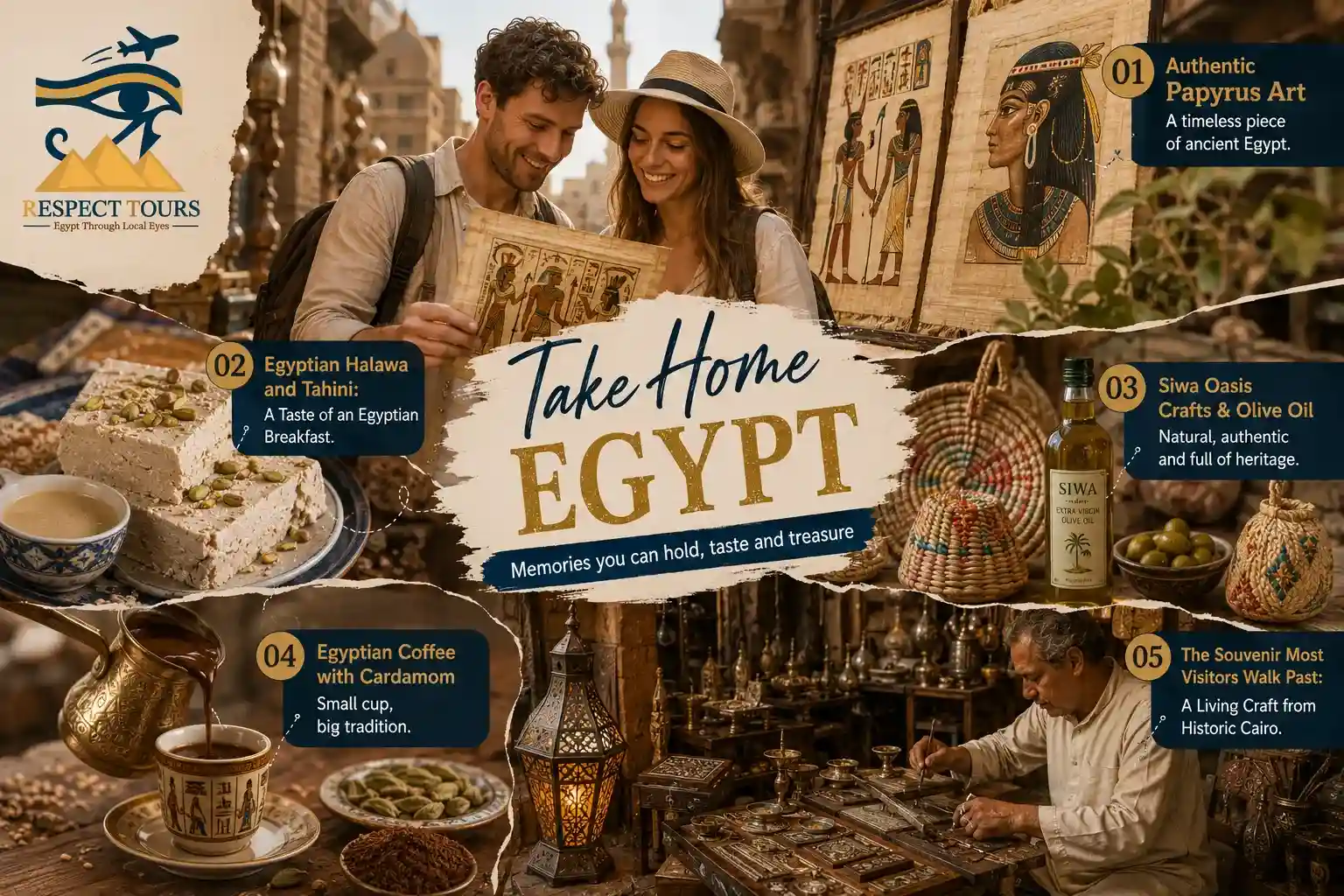
11. Authentic Papyrus Art
Best for: First-time visitors · Lightweight wall art
Packing: Excellent
Papyrus is touristy.
That doesn’t automatically make it bad.
A genuinely made and well-painted papyrus can still be a beautiful Egyptian souvenir. The problem is the huge volume of inexpensive imitations and mass-produced artwork sold simply because visitors expect to buy papyrus in Egypt.
If you want one, buy from a reputable workshop or seller who can explain how the sheet was made and who painted it.
The difference isn’t just the material. A hand-painted piece you genuinely like is worth bringing home; a generic image bought because you felt obligated to buy “something Egyptian” probably isn’t.
12. Egyptian Halawa and Tahini: A Taste of an Egyptian Breakfast
Best for: Food lovers · Families · Edible gifts
Packing: Better in checked luggage
If you want a souvenir that actually tastes like Egypt, bring home halawa and tahini.
Egyptian halawa is a traditional sesame-based sweet with a rich, nutty flavor and a soft, crumbly texture that almost melts in your mouth. You’ll find it plain or mixed with pistachios, nuts, or cocoa. It has been part of Egyptian breakfast tables and simple everyday meals for generations.
Tahini starts with sesame too, but it is savory, creamy, and intensely nutty. Egyptians eat it alongside everything from grilled kofta and kebab to falafel and fish, but there’s another combination every food-loving traveler should try.
Try Tahini with Black Honey & Feteer
Order a warm feteer meshaltet and eat it the Egyptian way: tear off a flaky piece by hand and dip it into tahini mixed with Egyptian black honey (molasses).
The combination is surprisingly good: buttery, flaky feteer with creamy sesame and the deep sweetness of molasses.
Where to Find Them
Cairo: Traditional confectioneries, supermarkets, and established food shops are good places to buy halawa and tahini.
Alexandria: Local sweet shops and food stores around central districts also carry good-quality options.
Respect Tours Tip: Choose sealed packaging for travel, check the expiry date, and place tahini in your checked luggage if the jar exceeds cabin liquid limits. If you are buying for someone else, halawa is usually the easier gift to pack and share.
13. Siwa Oasis Crafts & Olive Oil
Best for: Meaningful gifts · Local crafts · Food lovers
Packing: Excellent for textiles · Easy for sealed products
Siwa is one of those places where a souvenir feels like more than something you bought. Every piece has roots in the oasis, its people, landscape, traditions, and way of life.
Look for Siwan embroidery, woven palm crafts, jewelry, pottery, dates, and local olive oil. The embroidery carries Siwa’s distinctive geometric style, while the olive oil and dates come directly from an agricultural tradition shaped by generations of life in the Western Desert.
What makes these souvenirs special is the story behind them. A handmade textile isn’t just decoration, and a bottle of Siwan olive oil isn’t just food; each one takes a small part of the oasis home with you.
📍 Where to Find It
In Siwa itself, at El Souq Square, buy from artisan workshops rather than the few tourist-facing shops near the main road.
Respect Tours Tip: Don’t leave Siwa with only photos. Buy something locally made, ask who made it or where it came from, and you’ll take home a souvenir with a story you can actually tell.
14. Egyptian Coffee with Cardamom
Best for: Coffee lovers · Affordable gifts · Something genuinely local
Packing: Excellent
Egyptian ahwa is more than coffee; it is part of daily life, conversations, family visits, and long evenings in local cafés.
The traditional version is dark, strong, and aromatic, often blended with cardamom and sometimes a touch of mastic or clove. It is brewed slowly in a small pot and served in tiny cups, creating a flavor that feels completely different from standard Western coffee.
What makes it such a good souvenir is that you can recreate part of Egypt at home. A small bag of freshly roasted coffee takes almost no luggage space, but the smell alone can bring back the memory of Cairo.
Where to Find It
Cairo: Look for traditional coffee roasters around Sayyida Zeinab, Bab El-Khalq, and Ataba.
Luxor: Local markets and traditional roasters around the city center are also good places to look.
Ask for ahwa arabeya with hel if you want the classic cardamom version.
Respect Tours Tip: Buy it freshly ground from a traditional roaster rather than pre-packed from a souvenir shop. For a coffee lover, this is one of the simplest gifts from Egypt and one of the most memorable.
15. The Souvenir Most Visitors Walk Past: A Living Craft from Historic Cairo
Remember the hidden souvenir we promised at the beginning?
Don’t look for it in a souvenir megastore.
Look inside the working streets of Historic Cairo.
Instead of buying another object with Egypt printed on it, go into the old workshops of Historic Cairo and have something made for you.
It could be your name written in Arabic calligraphy, a hand-bound notebook with a personalized cover, a small piece of carved wood, engraved metalwork, or another piece created by a local artisan. Historic Cairo is still home to traditional crafts, including calligraphy, bookbinding, leatherwork, woodwork, metalwork, and other skills that have been practiced in the city for generations.
Why do we rank this above everything else on the list?
Because nobody else will bring home the same souvenir.
You can buy dates again. You can order Egyptian cotton online. You can even find papyrus outside Egypt. But a piece made for you in a workshop in Old Cairo, by someone whose name and face you remember, is difficult to replace.
And it doesn’t need to be expensive or elaborate. Sometimes the best choice is something small enough to fit between the pages of your passport, your name in Arabic, written by hand by a Cairo calligrapher.
That’s the souvenir we’d tell our guests to look for.
Respect Tours Tip: When you explore Historic Cairo, don’t only ask, “What should I buy?” Ask your guide where something can be made or personalized for you. That’s where souvenir shopping becomes part of the trip rather than just another shopping stop.
The best souvenir isn’t always famous. Sometimes it’s the thing you watched being made.
What Souvenirs Should You Avoid Buying in Egypt?
We wouldn’t say every “tourist souvenir” is bad. If a plastic pyramid makes your child happy, buy the pyramid.
But be careful with:
- Objects presented as genuine antiquities
- Precious metals without clear purity information or receipts
- “Egyptian cotton” bought solely on a verbal claim
- Perfume sold with extraordinary historical claims but no useful product information
- Mass-produced objects being represented as handmade
- Wildlife products, shells, coral, or anything whose legality you aren’t certain about
Where Is the Best Place to Buy Souvenirs in Egypt?
Don’t think of Egypt as having one “best souvenir market.”
Think region first.
Cairo: Best for Variety & Traditional Crafts
Khan el-Khalili is more than 600 years old and remains one of Cairo’s major historic markets.
Use it for browsing, spices, jewelry, metalwork, and gifts, but venture beyond the most tourist-facing lanes.
For something more distinctive, combine it with Al-Muizz Street, Tentmakers’ Street, and the craft areas of Historic Cairo.
Aswan: Best for Nubian Crafts, Karkadeh & Spices
This is where we’d prioritize Nubian crafts, baskets, textiles, jewelry, hibiscus, and spices. Egypt’s official tourism resources specifically identify these as key things to browse in Aswan and Nubian communities.
Luxor: Best for Upper Egyptian Products
Look beyond the souvenir stalls directly beside major attractions.
Luxor is a better place to explore galabeyas, textiles, and stone craft when you can visit established local sellers and workshops.
Siwa: Best for Regional Gifts
If you’re actually traveling to Siwa, shop there for oasis-specific food products and textiles rather than trying to recreate the same experience in Cairo.
Khan el-Khalili: How to Shop Without Turning It Into a Battle
Khan el-Khalili is worth visiting even if you buy absolutely nothing.
Treat shopping as conversation, not combat.
Ask the price. Decide what the object is worth to you. If the shop is negotiable, make a reasonable counteroffer. If you don’t agree, smile and walk away.
Not every Egyptian shop requires bargaining. Egyptian government shopping guidance notes that some stores operate with fixed prices while others expect negotiation, and fixed-price shops can sometimes offer more consistent quality.
Our advice to guests
Don’t bargain for ten minutes over an amount that means very little to you but matters to the artisan.
The goal isn’t to “beat” the seller.
It’s to leave with something you like at a price you’re comfortable paying.
Best Egyptian Souvenirs by Traveler
| Buying For… | We’d Choose… |
|---|---|
| Food Lover | Karkadeh with dukkah and spices |
| Coffee Lover | Egyptian coffee with cardamom |
| Partner | Silver jewelry or perfume oil |
| Parents | Genuine Egyptian cotton |
| Home Décor Lover | Khayamiya or a small copper lantern |
| History Lover | Quality papyrus from a reputable workshop |
| Someone Who Hates Souvenirs | Food, coffee or textiles they’ll actually use |
| Children | Small colorful Nubian craft |
| Yourself | Something you saw being made |
| Carry-On-Only Traveler | Karkadeh, textiles, jewelry or coffee |
What Are the Easiest Souvenirs from Egypt to Pack?
If luggage space matters, our top choices are:
Best: textiles, spices, karkadeh, coffee, papyrus, small jewelry.
More difficult: ceramics, glass perfume bottles, stone pieces, and large metal lanterns.
For liquids and food, don’t rely on a blog, including this one, for your final customs decision. Airline security rules and destination-country import rules vary, so check the official rules for the country you’re entering before purchasing.
That is especially important for plant material, seeds, fresh food, and animal products.
FAQs About Good Souvenirs from Egypt
What are the best souvenirs to bring home from Egypt?
Khayamiya textiles, genuine Egyptian cotton, karkadeh, spices, Nubian crafts, silver jewelry, papyrus, galabeyas, and Egyptian coffee are among our strongest recommendations. Choose something made or used locally rather than simply something decorated with Egyptian symbols.
What is Egypt famous for buying?
Travelers commonly shop for Egyptian cotton, papyrus, spices, perfume oils, jewelry, traditional textiles, and handmade crafts. Aswan is particularly good for Nubian products, hibiscus, and spices, while Historic Cairo is stronger for traditional crafts.
What is a good Egyptian souvenir that isn’t touristy?
Try Khayamiya from Tentmakers’ Street, Egyptian coffee from a traditional roaster, Nubian craft from Aswan, or a contemporary piece made in a Historic Cairo workshop.
Is Khan el-Khalili good for souvenirs?
Yes, especially for variety and the experience itself. Khan el-Khalili is one of Cairo’s historic markets, but quality varies, so don’t restrict yourself to the most tourist-facing stalls.
Take Home More Than a Souvenir
The best souvenir from Egypt isn’t necessarily the most expensive one or the one with the biggest pyramid on it. It’s the one that still has a story when someone asks you, “Where did you get that?”
Maybe it’s Khayamiya you found while watching an artisan stitch in Historic Cairo. Karkadeh from a spice merchant in Aswan. Olive oil from Siwa. Or the personalized piece from #15 that nobody else will bring home.
That’s also how we believe Egypt should be experienced.
At Respect Tours, we’ve been showing travelers Egypt since 1978. Our licensed local guides don’t simply take you from one famous monument to the next.
We help you discover the markets, neighborhoods, craftspeople, local foods, and everyday traditions that give those places their character, while helping you understand what’s authentic, what’s worth your time, and what you might otherwise walk straight past.
Whether you’re exploring Khan El-Khalili and Islamic Cairo, meeting Nubian communities in Aswan, walking the markets of Luxor, or traveling deeper into Siwa, we can build those local experiences naturally into your journey.
Ready to See Egypt Through Local Eyes?
Explore Egypt with people who have been showing travelers the country for generations, or tell us what you want to experience, and we’ll help you build the trip around it.
Plan Your Egypt Trip with Respect Tours