


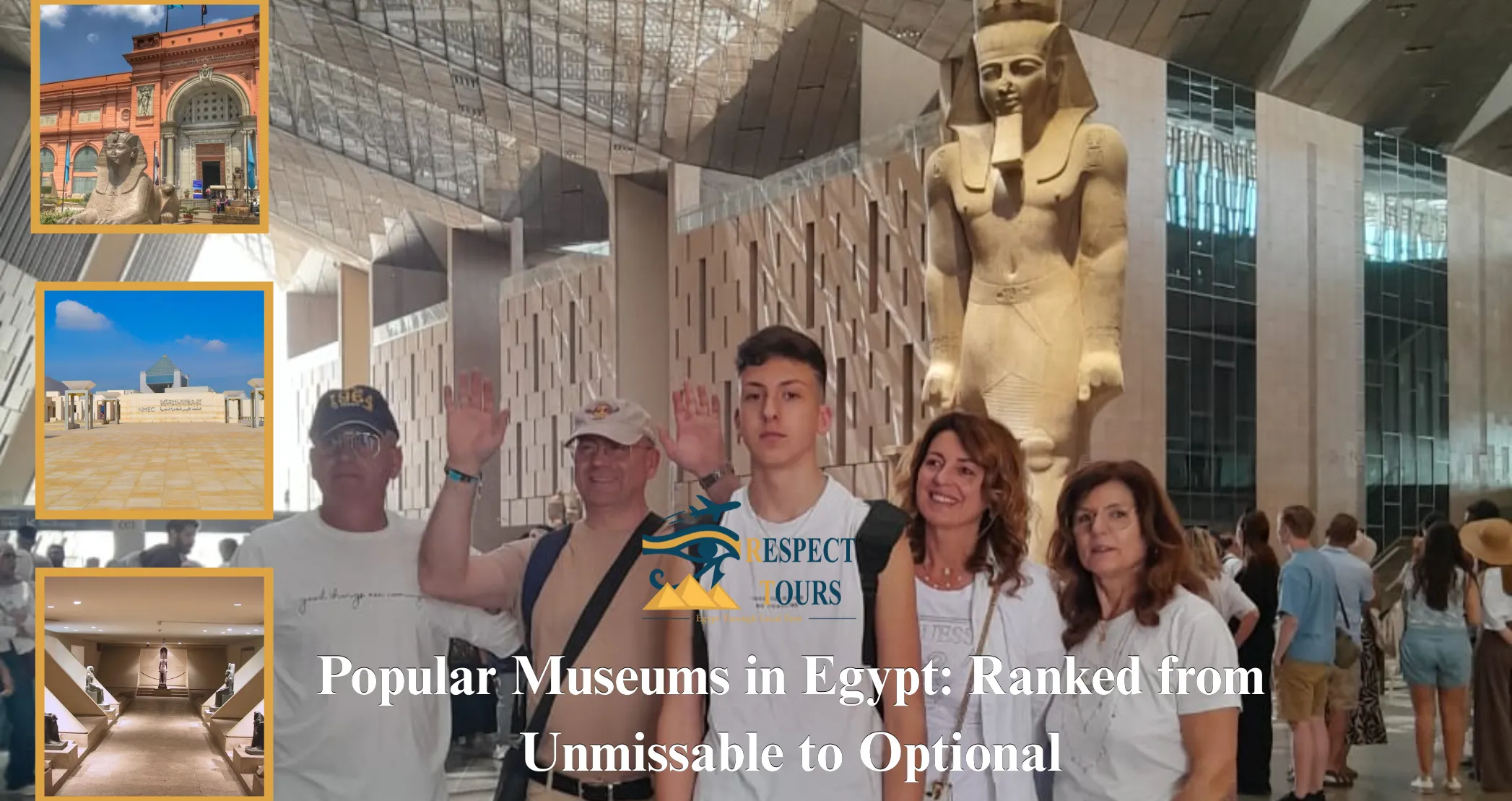
The popular museums in Egypt offer far more than collections of ancient artifacts. Each museum tells a different part of Egypt’s story, from the pharaohs and Tutankhamun to Coptic Christianity, Islamic civilization, and the rich heritage of Nubia. But with so many museums across Cairo, Luxor, Aswan, and Alexandria, deciding which ones deserve your time can be challenging.
This guide ranks Egypt’s most popular museums from unmissable to optional, helping you choose the right ones based on your itinerary, interests, and the time you have available. Whether you’re visiting Egypt for the first time or returning to explore beyond the famous highlights, you’ll discover which museums are truly worth prioritizing and how to plan your visit more efficiently.
At Respect Tours, we’ve been guiding travelers through Egypt’s museums since 1978 with licensed Egyptologists who bring every collection to life. This guide combines our local experience with practical travel advice to help you make the most of every museum visit in Egypt.
Egypt’s Most Popular Museums at a Glance
| Museum | City | Priority | Time Needed |
|---|---|---|---|
| Grand Egyptian Museum (GEM) | Giza / Cairo | 🔴 Must-visit | 3–5 hours |
| Egyptian Museum (Tahrir) | Cairo | 🔴 Must-visit | 2–3 hours |
| National Museum of Egyptian Civilisation (NMEC) | Old Cairo | 🟠 Highly recommended | 2–3 hours |
| Coptic Museum | Old Cairo | 🟠 Highly recommended | 1.5–2 hours |
| Museum of Islamic Art | Cairo | 🟠 Highly recommended | 1.5–2 hours |
| Luxor Museum | Luxor | 🟠 Highly recommended | 1.5–2 hours |
| Nubian Museum | Aswan | 🟠 Highly recommended | 1.5–2 hours |
| Mummification Museum | Luxor | 🟡 Worth visiting | 45–60 mins |
| Alexandria National Museum | Alexandria | 🟡 Worth visiting | 1.5 hours |
| Gayer-Anderson Museum | Cairo | 🟡 Worth visiting | 1 hour |
Egyptian Museum vs Grand Egyptian Museum: Which One Should You Visit?
This is the question we get most often now from visitors planning a Cairo museum day. The honest answer: if you can only visit one, visit the GEM. But if you have time for both, they offer genuinely different experiences, and both are worth your time.
GEM vs Egyptian Museum: The Core Difference
The Grand Egyptian Museum is organized, spacious, well-lit, and designed to be understood. The Egyptian Museum in Tahrir is chaotic, dense, labyrinthine, and more alive. The GEM tells the story of ancient Egypt clearly.
The Egyptian Museum lets you stumble across a 3,500-year-old statue in a dim corridor with no one else around. Both have value. Neither replaces the other.
| Factor | Grand Egyptian Museum (GEM) | Egyptian Museum (Tahrir) |
|---|---|---|
| Opened | Full opening 2025 | 1902 |
| Size | 480,000 m², the largest archaeological museum in the world | Approximately 15,000 m² of exhibition space |
| Tutankhamun Collection | Complete, with all 5,398 objects displayed together for the first time | Some pieces remain; most have moved to GEM |
| Organisation | Chronological, clearly labelled and bilingual | Dense and room-based; a guide helps you navigate it effectively |
| Location | Next to the Giza Pyramids, making both attractions easy to combine | Tahrir Square, central Cairo |
| Crowds | Growing rapidly, but still manageable with an early arrival | Moderate; less visited since GEM opened |
| Time Needed | 3–5 hours minimum for the highlights | 2–3 hours |
| Best For | First-time visitors, families and anyone who wants to understand what they’re seeing | Return visitors and history enthusiasts who want the old-Cairo atmosphere |
The Most Popular Museums in Cairo
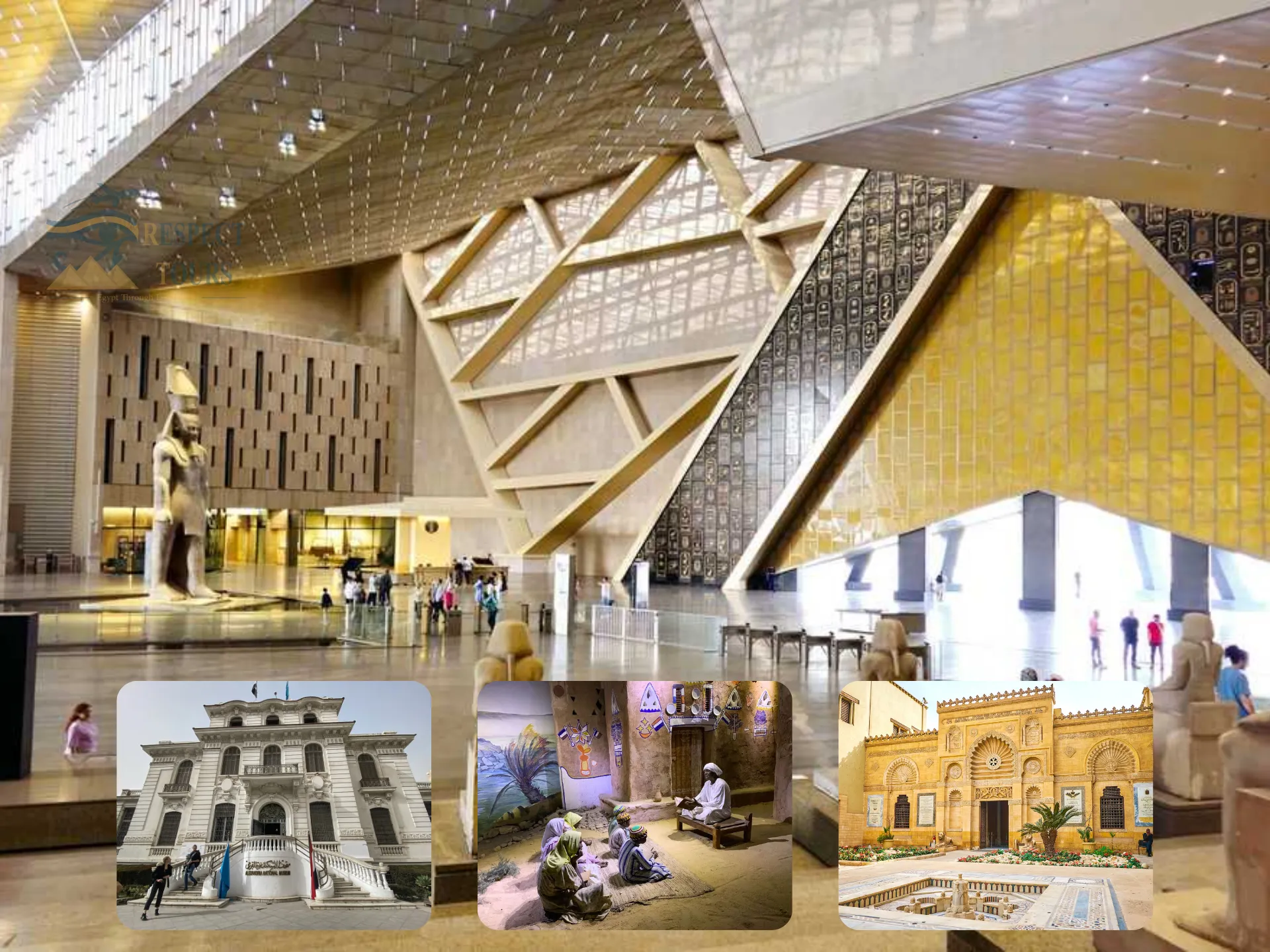
🏛️ 1. Grand Egyptian Museum (GEM)
🔴 Unmissable | 📍 Giza | ⏱️ 3–5 Hours
The GEM is the largest museum in the world dedicated to a single civilization. After several years of phased and trial openings, it officially opened in full in 2025.
The main draw is the complete Tutankhamun collection, with thousands of objects from the tomb displayed together in dedicated galleries for the first time since Howard Carter discovered it in 1922. The gold death mask, coffins, throne, canopic shrine, jewelry, chariots, and personal belongings are all displayed in a modern setting with clear explanations.
Beyond Tutankhamun, the Grand Staircase displays 59 monumental artifacts, including royal statues, columns, stelae, and sarcophagi. The colossal statue of Ramesses II anchors the Grand Hall, while the main galleries take visitors through ancient Egyptian history in a clear chronological and thematic layout. For a first-time visitor to Egypt with an interest in ancient history, this is the country’s most important museum experience.
Family & Accessibility Note: The Grand Egyptian Museum is also highly suitable for children, as it includes a dedicated Children’s Museum designed to make ancient Egyptian history interactive and engaging for younger visitors.
In addition, the museum is fully accessible for visitors with disabilities, with ramps, elevators, and facilities designed to accommodate wheelchair users throughout the main exhibition areas.
Location: Adjacent to the Giza Plateau, only a short drive from the Pyramids.
Hours: Galleries are generally open from 9:00 AM to 6:00 PM, with extended hours until 9:00 PM on Wednesdays and Saturdays. Always check the official schedule before visiting.
Tip: Arrive when the galleries open to explore the Tutankhamun collection before larger groups arrive. A licensed Egyptologist guide can transform the experience from impressive to extraordinary. For a deeper visit, consider a full-day Grand Egyptian Museum tour with a private expert guide.
Tickets: Entrance fees may vary by visitor category and ticket type. Check the latest Grand Egyptian Museum ticket prices before planning your visit.
Combine With: Visit the Pyramids of Giza in the morning, followed by the GEM from late morning to the afternoon. You can explore the plateau through a private Pyramids of Giza tour before continuing to the museum. It is the most logical single-day combination in Cairo.
Why It’s Ranked #1: The Grand Egyptian Museum brings together Egypt’s greatest archaeological treasures in a world-class setting. If you visit one museum in Egypt, make it this one. If you visit two, this should still come first.
🏛️ 2. The Egyptian Museum, Tahrir Square
🔴 Unmissable | 📍 Downtown Cairo | ⏱️ 2–3 Hours
The Egyptian Museum opened in 1902 and is the oldest archaeological museum in the Middle East. Its distinctive pink neoclassical building is part of the experience, housing a vast collection of ancient Egyptian artifacts spanning from the Predynastic Period to the Greco-Roman Era.
Since many major objects were transferred to the Grand Egyptian Museum and the royal mummies moved to the National Museum of Egyptian Civilization, the museum’s role has changed.
However, it still contains thousands of important statues, coffins, papyri, jewelry, funerary objects, and treasures displayed across more than 100 halls.
Something is compelling about its dense and slightly chaotic layout. You may find a monumental sarcophagus in one room, rows of ushabti figures in another, and beautifully detailed royal jewellery inside historic display cases. It feels very different from the modern, carefully organized experience of the GEM, and that contrast is exactly what makes it worth visiting.
Location: Tahrir Square in Downtown Cairo, close to the Nile and easily reached by metro or private transfer.
Hours: Generally open from 9:00 AM to 5:00 PM daily. Always verify the current schedule before visiting.
Tip: A licensed Egyptologist guide is particularly valuable here. The museum’s dense collection and traditional layout can make it difficult to identify the most important objects without expert direction.
Combine With: Explore the museum as part of a wider Cairo itinerary that includes the Giza Plateau. This private Egypt Pyramids trip is a practical option for travelers who want to experience Cairo’s most important ancient highlights with a licensed guide.
Why It’s Ranked #2: The Egyptian Museum no longer holds all the headline collections it once did, but its historic atmosphere and enormous range of antiquities remain irreplaceable. Visit the GEM first for the clearest overview of ancient Egypt, then come here for a more traditional museum experience.
🏛️ 3. National Museum of Egyptian Civilization (NMEC)
🟠 Highly Recommended | 📍 Old Cairo / Fustat | ⏱️ 2–3 Hours
The National Museum of Egyptian Civilization opened in 2021 and immediately became one of Cairo’s most important museums. Its main highlight is the Royal Mummies Hall, created after 22 royal mummies were transferred from the Egyptian Museum in Tahrir during the Pharaohs’ Golden Parade.
Today, 20 royal mummies are displayed in a purpose-built underground gallery designed to resemble a journey through the Valley of the Kings. The hall includes famous rulers such as Ramesses II, Hatshepsut, Thutmose III, and Seqenenre Taa II, with clear information explaining who they were and when they ruled.
The rest of the museum tells the wider story of Egyptian civilization from prehistoric times to the modern era. Its main galleries cover the Pharaonic, Greco-Roman, Coptic, Islamic, and modern periods, making it one of the best museums for understanding Egypt beyond ancient temples and tombs.
Location: El-Fustat Road beside Ain Al-Sira Lake in Old Cairo, a short drive from the Coptic Museum.
Hours: Saturday to Thursday from 9:00 AM to 5:00 PM. On Fridays, the museum opens from 9:00 AM to 5:00 PM and again from 6:00 PM to 9:00 PM. Always verify the current schedule before visiting.
Tip: Visit the Main Gallery before entering the Royal Mummies Hall. It provides useful historical context and makes the final part of the visit more meaningful.
Combine With: The Coptic Museum, the Hanging Church, and the historic churches of Old Cairo. You can also explore the museum as part of this Islamic Cairo, NMEC Museum, Citadel & Mosques Day Tour.
Why It’s Ranked #3: The Royal Mummies Hall alone makes NMEC worth visiting, but the museum’s real strength is how it presents Egypt as one continuous civilization rather than focusing only on the Pharaonic period.
⛪ 4. The Coptic Museum, Old Cairo
🟠 Highly Recommended | 📍 Old Cairo | ⏱️ 1.5–2 Hours
The Coptic Museum has one of the most important collections of Coptic art in the world, including icons, textiles, manuscripts, woodwork, and stone carvings from churches and monasteries across Egypt.
Its exhibits highlight the transition from ancient Egyptian art to early Christian traditions, showing how styles and symbols evolved.
The museum also displays parts of the Nag Hammadi manuscripts, a major discovery of early Christian texts found in Upper Egypt.
Location: In the heart of Old Cairo, beside the Roman fortress of Babylon and within walking distance of the Hanging Church.
Hours: Generally open daily from 9:00 AM to 5:00 PM, with the ticket window closing at 4:00 PM. Always check the current schedule before visiting.
Tip: Allow time to explore the museum slowly. Many of the most interesting details are found in small textiles, manuscripts, wooden panels, and architectural fragments rather than large monuments.
Combine With: The Hanging Church, the Church of Saints Sergius and Bacchus, and the Ben Ezra Synagogue, all located within the historic Old Cairo district. For a broader museum experience, consider this private Cairo Museums Day Tour, which combines the Egyptian, Coptic, and Islamic Art museums with Abdeen Palace.
Why It’s Ranked #4: The Coptic Museum is the best place in Egypt to understand the country’s early Christian history and artistic heritage. It is especially valuable for travelers who want to explore the periods between ancient Pharaonic Egypt and the Islamic era.
🕌 5. Museum of Islamic Art, Cairo
🟠 Highly Recommended | 📍 Bab El Khalq | ⏱️ 1–1.5 Hours
The Museum of Islamic Art holds one of the world’s most important collections of Islamic art, with objects covering more than 1,000 years of history.
Its galleries include ceramics, metalwork, glass, textiles, carved wood, manuscripts, and decorative objects from Egypt and across the Islamic world. The famous Fountain of the 1001 Nights is one of the museum’s best-known pieces.
Location: Port Said Street, near Islamic Cairo.
Hours: Generally open daily from 9:00 AM to 5:00 PM. Check the current schedule before visiting.
Tip: Focus on the metalwork, glass lamps, manuscripts, and wooden panels, which are among the collection’s strongest highlights.
Combine with Al-Muizz Street, Bab Zuweila, and Khan el-Khalili. You can also visit it as part of this private Cairo Museums Day Tour.
Why It’s Ranked #5: It is one of Cairo’s most overlooked major museums and an excellent choice for travelers interested in Islamic art, architecture, and medieval history.
🏠 6. Gayer-Anderson Museum, Cairo
🟡 Worth Visiting | 📍 Near Ibn Tulun Mosque | ⏱️ 1 Hour
The Gayer-Anderson Museum is made up of two historic houses connected by a bridge. The buildings were later home to British officer John Gayer-Anderson, who filled them with antiques, Islamic art, furniture, and decorative objects.
The museum is one of Cairo’s most atmospheric small museums, with tiled courtyards, carved wooden ceilings, mashrabiya screens, and rooms decorated in Persian, Ottoman, and European styles.
It was also used as a filming location in the James Bond movie The Spy Who Loved Me.
Location: Next to Ibn Tulun Mosque in Islamic Cairo.
Tip: Take time to look at the ceilings, wooden screens, and room details, not just the objects on display.
Combine with Ibn Tulun Mosque for a quiet half-day away from Cairo’s busiest tourist areas.
Why It’s Ranked #6: It is smaller and less important historically than Cairo’s major museums, but it offers one of the city’s most unique and peaceful museum experiences.
Popular Museums in Egypt Beyond Cairo
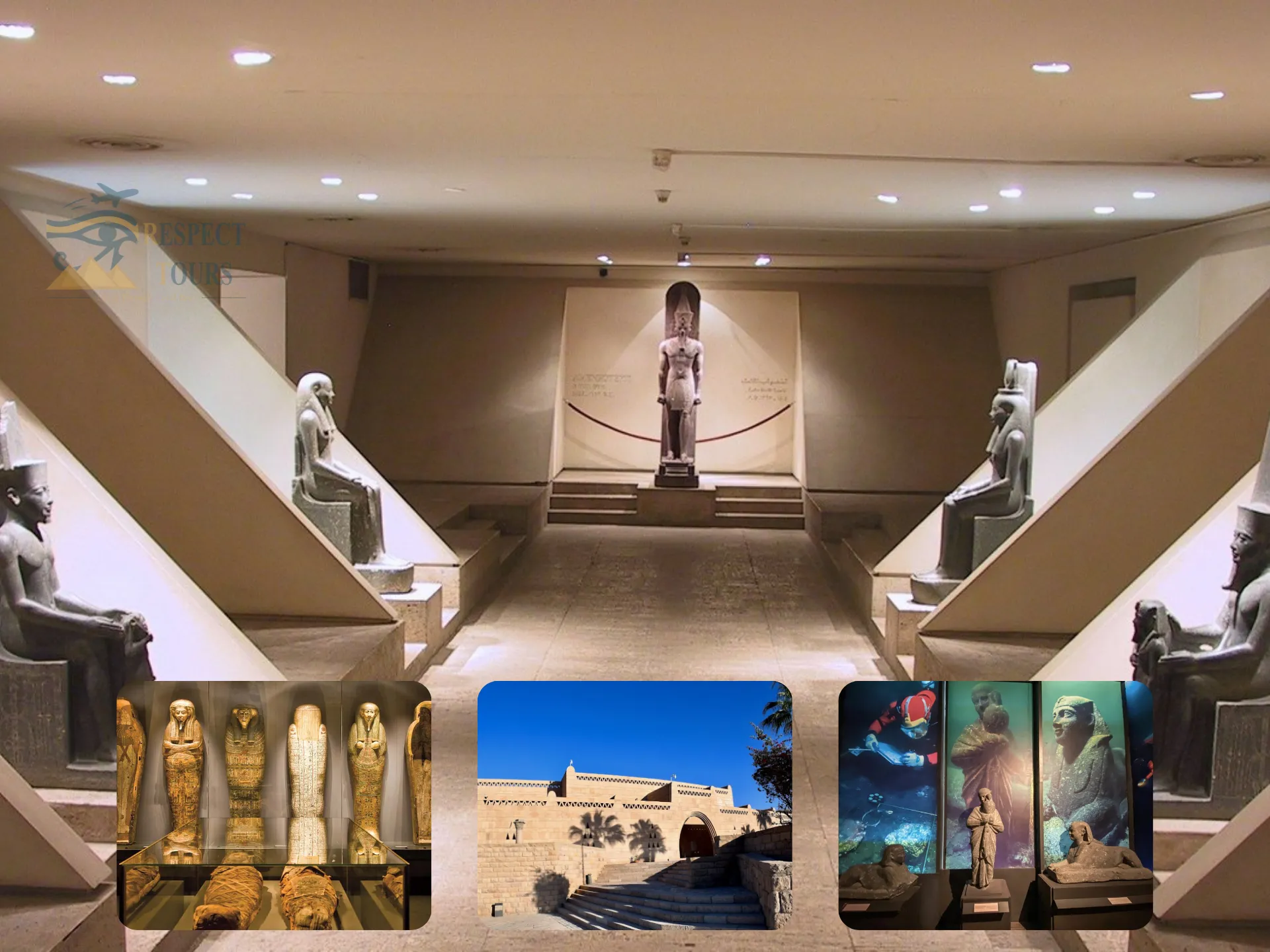
🏺 7. Luxor Museum
🟠 Highly Recommended | 📍 East Bank, Luxor | ⏱️ 1–1.5 Hours
Luxor Museum is one of the best-curated museums in Egypt. Rather than displaying thousands of objects, it focuses on a smaller collection presented with good lighting, clear labels, and plenty of space.
Highlights include statues discovered at Luxor Temple, a striking image of Amenhotep III, reconstructed blocks from Akhenaten’s temple, and the royal mummies of Ahmose I and Ramesses I.
Location: Corniche El Nile on Luxor’s East Bank, within walking distance of Luxor Temple.
Hours: Opening times may include separate morning and evening sessions, so check the current schedule before visiting.
Tip: Visit in the evening when the galleries are quieter, and the lighting creates a more atmospheric experience.
Combine with Luxor Temple or this guided Full-Day Luxor East Bank Tour: Karnak, Luxor Temple & Museum
Why It’s Ranked #7: It is smaller than Cairo’s major museums, but its carefully selected collection makes it one of the most enjoyable museum visits in Upper Egypt.
🧟 8. Mummification Museum, Luxor
🟡 Worth Visiting | 📍 East Bank, Luxor | ⏱️ 45–60 Minutes
The Mummification Museum is a small but fascinating museum dedicated to the ancient Egyptian process of preserving the dead. Its collection explains each stage of mummification, from embalming techniques and sacred rituals to canopic jars, amulets, funerary tools, and burial beliefs.
Among its highlights are a mummified crocodile, several animal mummies, and the mummy of a high priest, offering visitors a closer look at one of ancient Egypt’s most remarkable traditions.
Location: Corniche El Nile on Luxor’s East Bank, a short walk from Luxor Temple.
Hours: Opening times may include separate morning and evening sessions. Check the current schedule before your visit.
Combine With: Luxor Museum, located just a few minutes away, or explore both museums on this guided Luxor Museum and Mummification Museum tour.
Why It’s Ranked #8: Small but highly informative, it’s the best place in Egypt to understand the science, beliefs, and rituals behind ancient Egyptian mummification.
🌍 9. Nubian Museum, Aswan
🟠 Highly Recommended | 📍 Aswan | ⏱️ 1.5–2 Hours
The Nubian Museum is one of the most beautiful and meaningful museums in Egypt. It was created to preserve Nubian history and culture after the construction of the Aswan High Dam changed the region and forced many Nubian communities to relocate.
Its collection traces Nubian civilization from prehistoric times to the modern era through archaeological objects, traditional clothing, jewellery, household items, music, architecture, and recreated village scenes. The museum building and gardens are also part of the experience, with rescued rock carvings and monuments displayed outdoors.
Location: Fanadek Road in Aswan, around 10 minutes from the Corniche.
Hours: Opening times may include separate daytime and evening sessions. Check the current schedule before visiting.
Tip: Allow time for the outdoor garden as well as the indoor galleries.
Combine With: Philae Temple, the Aswan High Dam, or this guided Aswan tour including the Aga Khan Mausoleum and Nubian highlights.
Why It’s Ranked #9: It is one of the best museums in Egypt for understanding Nubian identity, heritage, and the human story behind the transformation of southern Egypt.
🌊 10. Alexandria National Museum
🟡 Worth Visiting | 📍 Alexandria | ⏱️ 1–1.5 Hours
Housed inside a beautifully restored Italian-style villa, the Alexandria National Museum tells the story of the city from the Pharaonic period through the Greco-Roman, Coptic, and Islamic eras.
One of its highlights is the collection of underwater artefacts recovered from Alexandria’s Eastern Harbour, including objects linked to the city’s ancient royal quarter. Together with sculptures, mosaics, jewellery, and everyday objects, the museum offers an excellent introduction to Alexandria’s rich history.
Location: Al Hurriya Road in central Alexandria.
Hours: Generally open daily, but check the current schedule before visiting.
Tip: Visit the museum early in the day before exploring Alexandria’s archaeological sites.
Combine With: The Catacombs of Kom El Shoqafa, the Roman Amphitheatre, the Bibliotheca Alexandrina, or this guided Alexandria National Museum Day Tour.
Why It’s Ranked #10: While smaller than Egypt’s major museums, it provides one of the best introductions to Alexandria’s unique blend of Egyptian, Greek, Roman, Coptic, and Islamic history.
Can You Visit Cairo’s Popular Museums in One Day?
You can’t visit all of them properly in one day. The GEM alone deserves a dedicated morning. The Egyptian Museum deserves at least two hours. Combining both in one day is achievable but leaves both visits feeling rushed.
Here are three realistic one-day museum options depending on your priorities:
Option A: Ancient Egypt Highlights
- Morning: Pyramids of Giza
- Late Morning – Afternoon: Grand Egyptian Museum (GEM)
- Late Afternoon: Egyptian Museum, Tahrir Square
Best for: First-time visitors who want to see Egypt’s most famous archaeological treasures.
Option B: Cairo’s Cultural Heritage
- Morning: Coptic Museum and Old Cairo
- Midday: National Museum of Egyptian Civilization (NMEC)
- Afternoon: Museum of Islamic Art and Al-Muizz Street
Best for: Travelers interested in Egypt’s Christian, Islamic, and modern history beyond the Pharaonic period.
Option C: The Complete GEM Experience (Recommended)
- Morning: Pyramids of Giza
- Late Morning – Afternoon: Grand Egyptian Museum
- Evening: Nile Dinner Cruise or free time in Cairo
Best for: Travelers who prefer a relaxed visit and want enough time to fully explore the GEM without rushing.
How to Visit Egypt’s Popular Museums in One Week
One week gives you enough time to explore Cairo’s major museums before traveling south to Luxor and Aswan, where the museum experience becomes smaller, quieter, and more closely connected to the surrounding archaeological sites.
Here is a practical seven-day plan:
Day 1: Pyramids and Grand Egyptian Museum
Visit the Giza Plateau early in the morning, then spend the late morning and afternoon exploring the Grand Egyptian Museum.
This is the most logical combination because both attractions are located in Giza.
Day 2: Egyptian Museum and Old Cairo
Start with the Egyptian Museum in Tahrir Square, then continue to Old Cairo for the Coptic Museum, the Hanging Church, and the Church of Saints Sergius and Bacchus.
Day 3: Islamic Cairo and NMEC
Visit the Museum of Islamic Art, followed by Al-Muizz Street, the Citadel, and the Mosque of Muhammad Ali.
Add the National Museum of Egyptian Civilization if you want to see the Royal Mummies Hall.
Day 4: Travel to Luxor and the West Bank
Travel to Luxor and explore the Valley of the Kings, the Temple of Hatshepsut, and the Colossi of Memnon.
Visit Luxor Museum in the evening if time allows.
Day 5: Luxor’s East Bank
Explore Karnak Temple in the morning and Luxor Temple later in the day.
Finish with the Mummification Museum, which is located close to Luxor Temple and the Corniche.
Day 6: Aswan and the Nubian Museum
Travel to Aswan and visit the Nubian Museum, followed by Philae Temple and the Aswan High Dam.
Day 7: Return or Extend to Abu Simbel
Return to Cairo for your departure, or extend your trip to Abu Simbel to see one of Egypt’s most impressive ancient temple complexes.
Planning Tip: This itinerary is achievable, but it involves frequent travel. Adding one or two extra days will make the journey more relaxed and give you more time at each museum.
Practical Information for Visiting Museums in Egypt
Tickets and Booking
Most museums in Egypt sell tickets at the entrance. However, booking Grand Egyptian Museum tickets online is recommended during the peak travel season from October to April, when queues can be longer.
Photography is allowed in most museums without flash, although some galleries and individual objects may have restrictions. Always follow the signs or instructions from museum staff.
Do You Need a Guide?
A guide is not essential at every museum, but it can greatly improve the experience.
The Grand Egyptian Museum, Luxor Museum, and Nubian Museum have clear displays and useful English information, making them suitable for independent visits.
A licensed Egyptologist is especially valuable at the Egyptian Museum in Tahrir, where the layout can be confusing, and many objects need additional historical context. Guided visits are also helpful at the Coptic Museum and Museum of Islamic Art.
Museum Opening Hours
Most museums are generally open from morning until late afternoon, while some museums in Luxor and Aswan also offer evening sessions.
Opening hours, weekly closing days, and ticket policies can change during public holidays, Ramadan, or special events. Always confirm the current schedule through the official museum website before visiting.
What to Wear
There is no strict dress code at most museums, but comfortable and modest clothing is recommended.
Museum galleries can feel cool because of the air conditioning, particularly inside the Grand Egyptian Museum, so carrying a light jacket may be useful.
FAQs About Popular Museums in Egypt
What are the most popular museums in Egypt?
The most popular museums include the Grand Egyptian Museum, Egyptian Museum in Tahrir, NMEC, Coptic Museum, Museum of Islamic Art, Luxor Museum, and Nubian Museum.
Is the Grand Egyptian Museum worth visiting in 2026?
Yes. The GEM displays the complete Tutankhamun collection alongside thousands of ancient Egyptian objects. Allow at least three to four hours for your visit.
What is the difference between the Egyptian Museum and the GEM?
The GEM is larger, modern, and home to the Tutankhamun galleries. The Egyptian Museum is older, more compact, and valued for its historic atmosphere and remaining archaeological collections.
Can you visit Cairo’s museums in one day?
You can visit two or three museums, but not all of them properly. For first-time visitors, combine the GEM with the Pyramids and explore Cairo’s other museums on another day.
Which museum has the Tutankhamun collection?
The complete Tutankhamun collection is displayed at the Grand Egyptian Museum in Giza, including his golden mask, throne, coffins, jewellery, and personal belongings.
Where can you see the royal mummies in Egypt?
The Royal Mummies Hall is located inside the National Museum of Egyptian Civilization. It displays 20 royal mummies, including famous kings and queens such as Hatshepsut and Thutmose III.
Is the Nubian Museum worth visiting?
Yes. It offers an excellent introduction to Nubian history, traditions, architecture, and the communities affected by the construction of the Aswan High Dam.
Visit Egypt’s Museums with Respect Tours
Egypt’s museums become far more meaningful when explored with a licensed Egyptologist. The objects stay the same, but the stories, historical context, and connections between them completely change the experience.
Respect Tours has been guiding international travellers through Egypt’s museums and archaeological sites since 1978. Our licensed Egyptologists know how to structure each visit, explain the most important objects clearly, and help you explore without feeling rushed or overwhelmed.
Whether you want to visit the Grand Egyptian Museum, the Egyptian Museum, NMEC, Luxor Museum, or the Nubian Museum, we can create a private museum tour around your schedule and interests.
Explore Egypt’s museums with local experts who bring every collection to life.