
You’re planning your trip to Luxor, piecing together an itinerary of tombs and temples. You see photos of two enormous, weathered statues sitting alone in a field on the West Bank. You wonder: are they just a quick roadside photo stop? Or is there a deeper story behind them worth more of your time? These ancient giants have witnessed millennia of history, from pharaohs to Roman emperors, and even had a reputation for singing at dawn. Understanding their true purpose is the key to appreciating their silent vigil over the Theban Necropolis.
A Quick Guide to the Colossi of Memnon
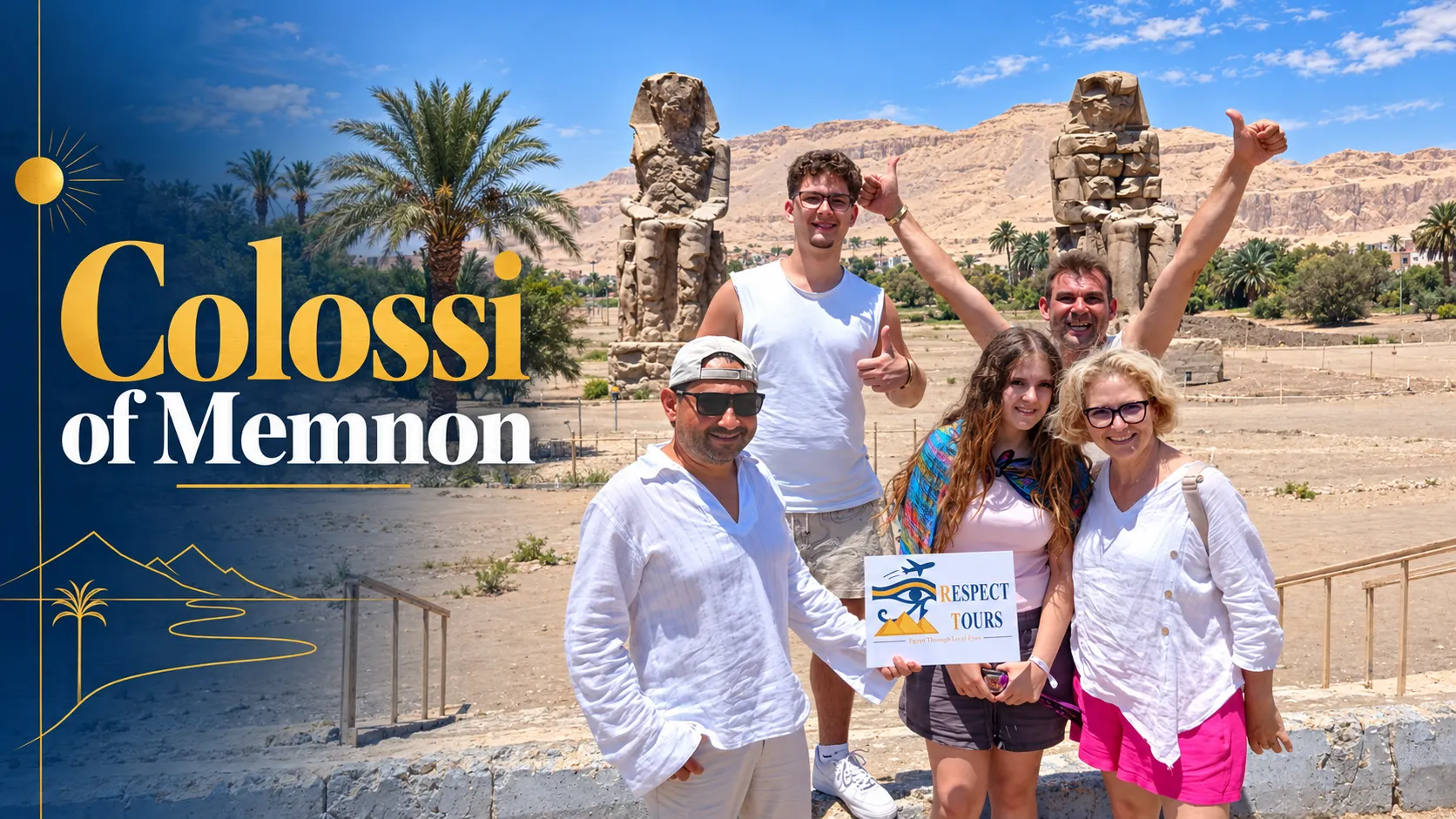
The Colossi of Memnon are two massive stone statues of the 18th Dynasty Pharaoh Amenhotep III, located on the West Bank of Luxor. Originally, they stood as sentinels at the entrance to the king’s mortuary temple, one of the largest and most magnificent temples in ancient Egypt. Although the temple itself has long since vanished, the statues remain, famous for their sheer size and the ancient legend of the northern statue “singing” at sunrise.
Colossi of Memnon
| Feature | Detail |
|---|---|
| Location | Luxor West Bank, Egypt, near the main road to the necropolis |
| Original Owner | Pharaoh Amenhotep III |
| Dynasty | 18th Dynasty, New Kingdom |
| Date | Circa 1350 BC |
| Monument Type | Two colossal seated royal statues |
| Original Function | Guarded the entrance to Amenhotep III’s mortuary temple |
| Material | Single blocks of quartzite sandstone |
| Approximate Height | 18 metres (60 ft) including their stone platforms |
| Facing | East, towards the River Nile and the rising sun |
| Famous For | The ancient phenomenon of the “singing” northern statue |
| Recommended Visit | A short, essential stop on any Luxor West Bank tour |
| Nearby Attractions | Valley of the Kings, Temple of Hatshepsut, Medinet Habu |
What Are the Colossi of Memnon?
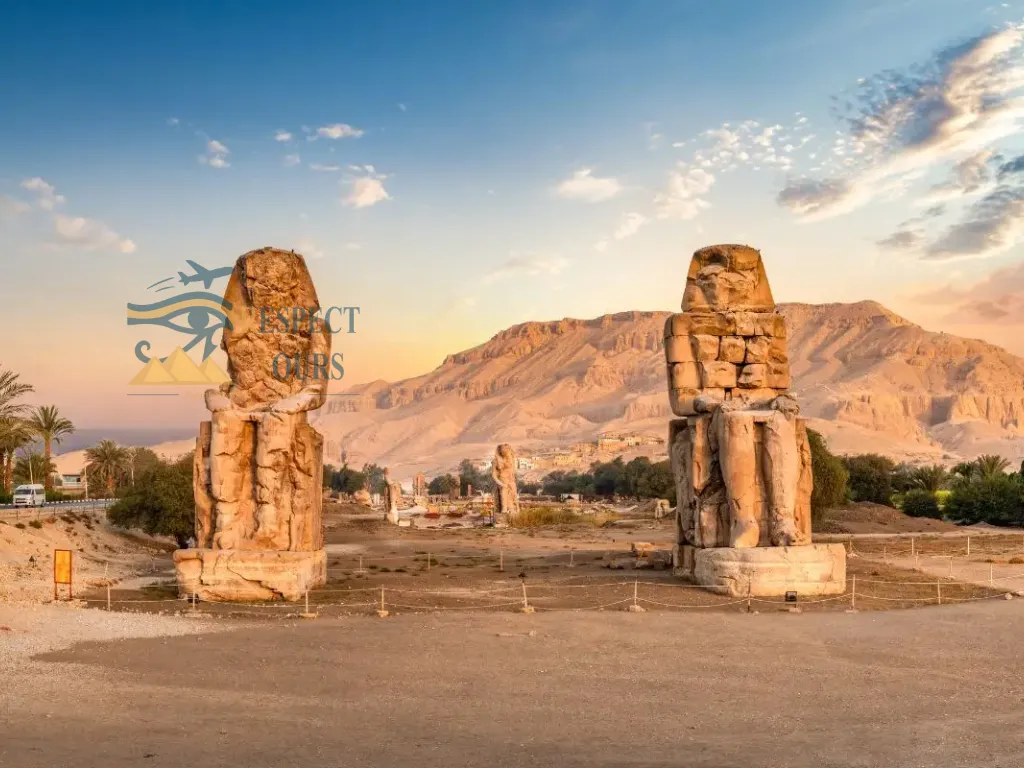
The Colossi of Memnon are two monumental seated statues of Pharaoh Amenhotep III on Luxor’s West Bank. For over 3,400 years, they have sat facing east, watching the sunrise over the Nile. Each statue was carved from a single block of quartzite sandstone, quarried near modern-day Cairo and transported over 675 km (420 miles) overland to Thebes.
Think of them not just as statues, but as the last visible remnants of the pharaoh’s enormous mortuary temple, known in ancient times as the “Temple of Millions of Years”. While the temple, built largely of mudbrick, was destroyed by annual Nile floods and later quarried for its stone, the sheer mass and durable material of the Colossi allowed them to endure. They are the first major ancient monument you encounter when crossing to the West Bank, setting the stage for the wonders of the Theban Necropolis that lie beyond.
The History of the Colossi of Memnon
Who Was Pharaoh Amenhotep III?
Amenhotep III was one of the most powerful and prosperous pharaohs of the 18th Dynasty, ruling during a period of unprecedented peace and artistic refinement. He was the father of the famous Akhenaten and grandfather of Tutankhamun. His reign was marked by extensive diplomatic relations and a massive building program throughout Egypt and Nubia. His mortuary temple, guarded by the Colossi, was the largest and most opulent of its kind ever built.
Why Were They Named After Memnon?
The name “Colossi of Memnon” is historically incorrect but has stuck for centuries. It comes from Greek and Roman visitors who associated the statues with Memnon, a mythical king of Ethiopia and a hero of the Trojan War.
According to Greek legend, Memnon was slain by Achilles. After his death, his mother, Eos (the goddess of the dawn), wept tears of dew for him each morning. When the northern statue began to make a sound at sunrise, Greek travellers connected it to the cries of Memnon calling to his mother. They named the statues in his honour, and the entire Theban Necropolis was often referred to as the Memnonium.
Did the Colossi of Memnon Really Sing?
Yes, for a period in antiquity, the northern statue was famous for emitting a sound at or shortly after sunrise.
When Did the Sound Begin?
The phenomenon is believed to have started after a major earthquake in 27 BC, which is documented by the Greek geographer Strabo. The earthquake shattered the northern colossus, cracking it from the waist up and dislodging several blocks.
What Did the Singing Statue Sound Like?
Ancient accounts vary. Strabo described it as a sound like a “blow”. The Greek traveller Pausanias compared it to the sound of a breaking lyre or harp string. Others described it as a whistling or a sad cry. This “Vocal Memnon” became one of the greatest tourist attractions of the Roman world.
What Caused the Sound?
The leading scientific theory is that the sound was caused by the increase in temperature at sunrise. Dew that had collected overnight in the statue’s cracks would begin to evaporate as the sun’s rays hit the stone. The resulting vibration of air and moisture escaping through the narrow fissures is thought to have produced the audible acoustic effect.
Why Did the Colossus Stop Singing?
The singing stopped around 199 AD. The Roman Emperor Septimius Severus, intending to honour the oracle, ordered the statue to be repaired. His engineers reassembled the upper sections using several new blocks of stone. This well-intentioned act altered the internal structure of the statue, permanently silencing the voice of Memnon.
The inscriptions left by ancient visitors provide a clear timeline. Early visitors write of hearing the sound, while later ones express their disappointment at the silence after the Roman repairs.
What to Look for When Visiting the Colossi of Memnon
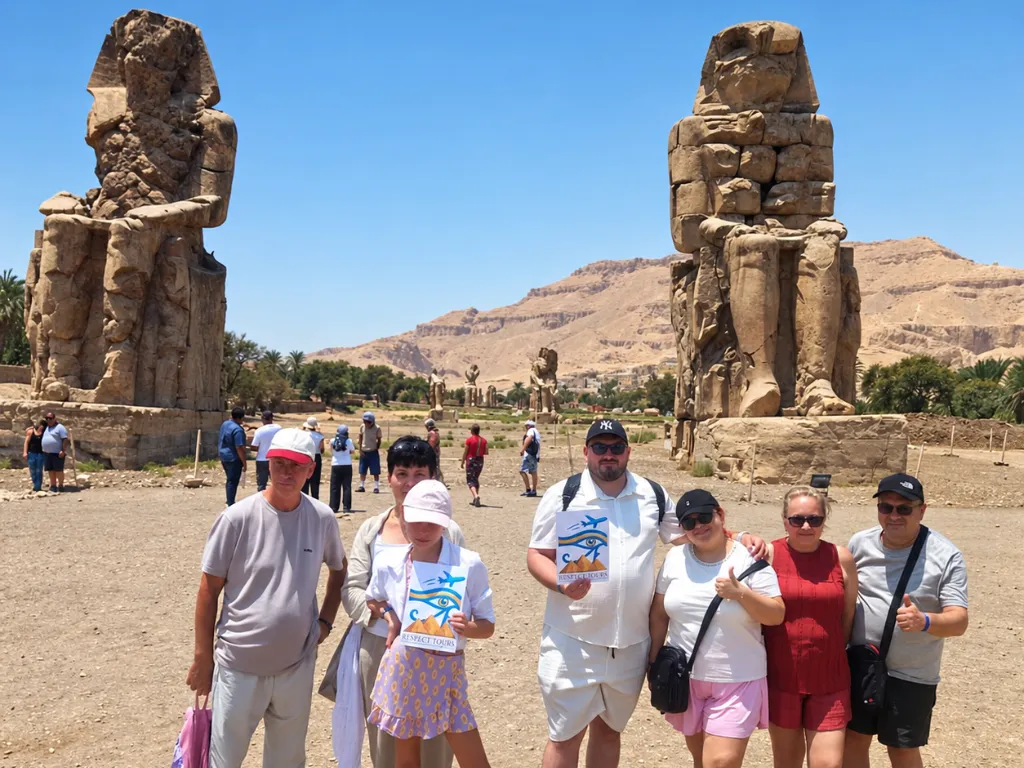
At first glance, the statues appear as two identical, heavily weathered figures. But a closer look reveals intricate details that tell a richer story.
- Amenhotep III Seated on His Throne: Both statues show the pharaoh seated, his hands resting on his knees, wearing the royal nemes headdress. The southern statue is better preserved.
- Queen Tiye and Mutemwiya: Carved at the front of the throne, between the pharaoh’s legs, are two smaller standing figures. These represent his wife, the Great Royal Wife Queen Tiye, and his mother, Mutemwiya. Their inclusion on such a monumental scale is a testament to their importance.
- The Nile Gods and the Union of Egypt: The sides of the thrones feature beautifully carved reliefs of the Nile god Hapi. Two Hapi figures are shown tying together the lotus (symbolising Upper Egypt) and the papyrus (symbolising Lower Egypt), a powerful depiction of the unification of the kingdom, known as sema-tawy.
- Ancient Graffiti: The legs and base of the northern statue are covered in inscriptions, mostly in Greek and Latin. These are the “guestbook” entries of ancient Roman tourists, including governors, officials, and even the Emperor Hadrian and his wife. One of the most famous was by a female poet, Julia Balbilla.
Look Beyond the Front: Some of the most meaningful details are carved beside the king’s legs and on the sides of the thrones. Take a moment to walk around the bases to see the reliefs of Hapi and appreciate the scale from different angles.
One-Day Tour to Luxor East and West Banks
The Lost Mortuary Temple of Amenhotep III
The Colossi were not standalone monuments; they were the grand entrance to a vast temple complex that has now almost entirely disappeared. This mortuary temple was built to serve the funerary cult of Amenhotep III after his death.
The temple was constructed on the Nile’s floodplain. While this allowed for a dramatic entrance via a canal system, it also doomed the structure. The annual inundation of the Nile, combined with earthquakes and the later quarrying of its stone for other building projects (notably by Merneptah and Ramesses III), led to its gradual destruction.
Recent work by the Colossi of Memnon and Amenhotep III Temple Conservation Project has begun to uncover the temple’s true scale. Archaeologists have excavated hundreds of statues, including many of the lioness-headed goddess Sekhmet, and even raised new colossal statues of the pharaoh further back from the road, hinting at the grand processional ways that once existed.
Names of Ancient Egyptian Pharaohs
Planning Your Visit to the Colossi of Memnon
Where Are the Colossi of Memnon?
The statues are located in the open air on the main road of Luxor’s West Bank, just a short drive from the public ferry terminal or the bridge from the East Bank. They are impossible to miss and are the first major monument visitors encounter on their way to the Valley of the Kings.
Do You Need an Entrance Ticket?
No, the Colossi of Memnon are free to visit. It is an open, unfenced site accessible to everyone. You can walk right up to the bases of the statues.
How Long Should You Spend There?
For most visitors, 15 to 30 minutes is enough time. This allows you to take photographs from different angles, walk around the statues to see the side reliefs, and listen to your guide explain their history and significance.
Best Time to Visit
Early morning is the best time to visit. The light is soft and golden, illuminating the front of the statues as they face east. It’s also much cooler, and you can appreciate the site before the main crowds and tour buses arrive. A visit at sunrise evokes the legend of the singing statue, even though the sound can no longer be heard.
Fly Over the Past: Hot Air Balloon Luxor, Egypt
Are the Colossi of Memnon Worth Visiting?
Yes, but they are best experienced as a meaningful stop within a Luxor West Bank tour rather than as a standalone destination.
Their value isn’t in walking through halls or deciphering tomb paintings. It lies in their immense scale, their survival against all odds, and the story they tell of what is now lost. They are a powerful introduction to the grandeur of the New Kingdom and a crucial piece of the West Bank puzzle. On their own, they might seem like just a photo stop, but with a guide to explain their context—the singing legend, the lost temple, and the figures of the royal women—they become a fascinating and essential part of your Luxor experience.
What to Visit Near the Colossi of Memnon
The statues are the perfect starting point for a day on the West Bank. Here are some popular combinations:
| If You Have… | Recommended Route |
|---|---|
| 15–30 Minutes | A classic photo and history stop on any West Bank tour. |
| Half a Day | Combine the Colossi with the Valley of the Kings and the Temple of Hatshepsut. |
| A Full Day | A comprehensive West Bank tour including the Colossi, major tombs and temples, and a local lunch. |
| Interest in Temples | Pair the Colossi with the grand temples of Hatshepsut and Medinet Habu. |
| Interest in Queens | Visit the Colossi (seeing Queen Tiye), then the Temple of Hatshepsut and the Valley of the Queens. |
Respect Tours: See the Colossi with a Local Expert
A quick photo stop at the Colossi of Memnon leaves you with just a picture. A visit with a qualified Egyptologist guide leaves you with a story. On a private tour of Luxor’s West Bank with Respect Tours, the Colossi become the first chapter of your day, not just a footnote.
Your guide won’t just point out the statues; they will:
- Bring the story of the “singing” statue and its Roman visitors to life.
- Show you the detailed carvings of Queen Tiye and explain her powerful role in Egyptian history.
- Explain the sema-tawy symbol and its importance.
- Help you visualise the immense, lost temple that once stood behind the giants.
This is the difference local knowledge makes—turning a monument into a memory. It’s a core part of how we deliver our promise of seeing Egypt Through Local Eyes.
Conclusion
The Colossi of Memnon are much more than two weathered statues in a field. They are the solemn gatekeepers to the Theban Necropolis and the last public testament to the largest mortuary temple ever built in Egypt. They represent the power of Amenhotep III, the importance of his queen, and a fascinating chapter in Greco-Roman travel history. While their famous song has fallen silent, their immense presence continues to capture the imagination. To truly understand the wonders of the West Bank, your journey should always begin here, in the shadow of these ancient giants.
Ready to explore the stories behind the stones? Browse our Luxor Day Tours and let our expert guides show you the history and legends of the Colossi of Memnon and beyond.
FAQ
What are the Colossi of Memnon?
The Colossi of Memnon are two massive 3,400-year-old statues of Pharaoh Amenhotep III on Luxor’s West Bank. They once guarded the entrance to his now-destroyed mortuary temple. They are famous for their colossal size and the ancient legend of the northern statue “singing” at sunrise.
Who built the Colossi of Memnon?
The statues were commissioned by Pharaoh Amenhotep III of the 18th Dynasty, who reigned around 1350 BC. They were part of his vast mortuary temple complex, the largest of its kind in ancient Thebes (modern Luxor).
How old are the Colossi of Memnon?
The Colossi of Memnon are approximately 3,400 years old. They were carved during the reign of Amenhotep III, which dates to the mid-14th century BC, during the New Kingdom period of ancient Egypt.
Did the Colossi of Memnon really sing?
Yes, for a period in antiquity, the northern statue was known to emit a sound, often described as a whistle or a sad cry, shortly after sunrise. This phenomenon began after an earthquake in 27 BC damaged it and ended when it was repaired by the Romans around 199 AD.
Why did the Colossi stop singing?
The singing stopped after the Roman Emperor Septimius Severus ordered repairs to the statue around 199 AD. The reconstruction of the statue’s upper portion altered its physical structure, preventing the natural acoustic phenomenon—likely caused by evaporating dew in the cracks—from occurring.
Are the Colossi of Memnon free to visit?
Yes, visiting the Colossi of Memnon is completely free. The site is open and unfenced, allowing visitors to walk directly up to the statues without needing an entrance ticket. It’s a popular and accessible stop on all West Bank tours.
How long do you need at the Colossi of Memnon?
A visit typically takes 15 to 30 minutes. This provides enough time to take photographs, admire the scale of the statues, examine the reliefs on the sides of the thrones, and hear the historical context from a guide.
Who are the women carved beside Amenhotep III?
The smaller female figures carved on the front of the thrones are the pharaoh’s wife, Queen Tiye, and his mother, Mutemwiya. Their prominent placement on these colossal monuments highlights their exceptionally high status and importance during Amenhotep III’s reign.
Why is Queen Tiye so important?
Queen Tiye was the Great Royal Wife of Amenhotep III and a formidable political figure in her own right. She exerted significant influence over state affairs and diplomacy, as evidenced by her correspondence with foreign rulers. Her depiction on the Colossi and other monuments underscores her power and partnership with the king.
Is visiting the Colossi of Memnon safe for solo female travellers?
Yes, the site is considered very safe for solo female travellers. It is a busy, open-air public space on a main road, constantly visited by tourists and tour buses. As with any tourist site, maintaining general awareness is advised, but there are no specific safety concerns here.