


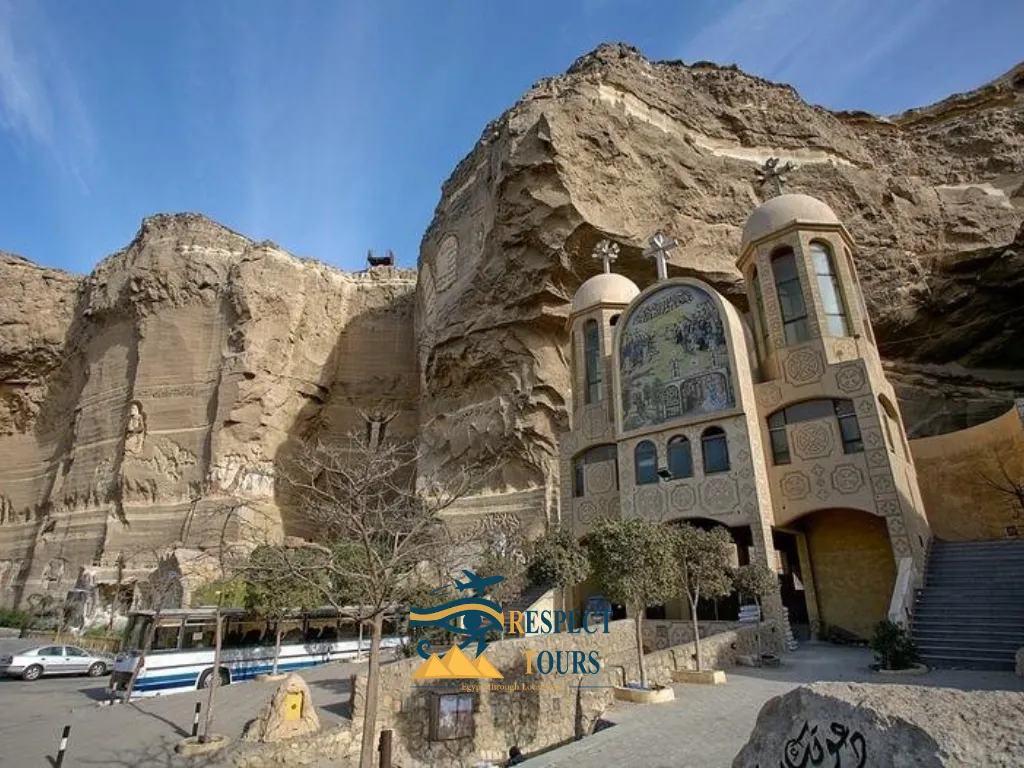
The Cave Church, officially the Monastery of Saint Simon the Tanner, is a rock-hewn church complex carved into the limestone cliffs of Mokattam Mountain in southeast Cairo. It seats over 20,000 people, making it the largest church in the Middle East.
It was built by hand, starting in the 1970s, by Cairo’s Zabbaleen community, Coptic Christians who have managed the city’s waste recycling for generations. Most visitors who plan a quick stop end up staying two hours.
In this guide, you’ll discover everything you need to know before visiting the Cave Church in Cairo, including its history, location, opening hours, what to see, how to get there, and practical travel tips.
At Respect Tours, we’ve been introducing travelers to Cairo’s hidden gems since 1978, and the Cave Church remains one of the most memorable cultural and spiritual experiences in the city.
Where Is the Cave Church Located?
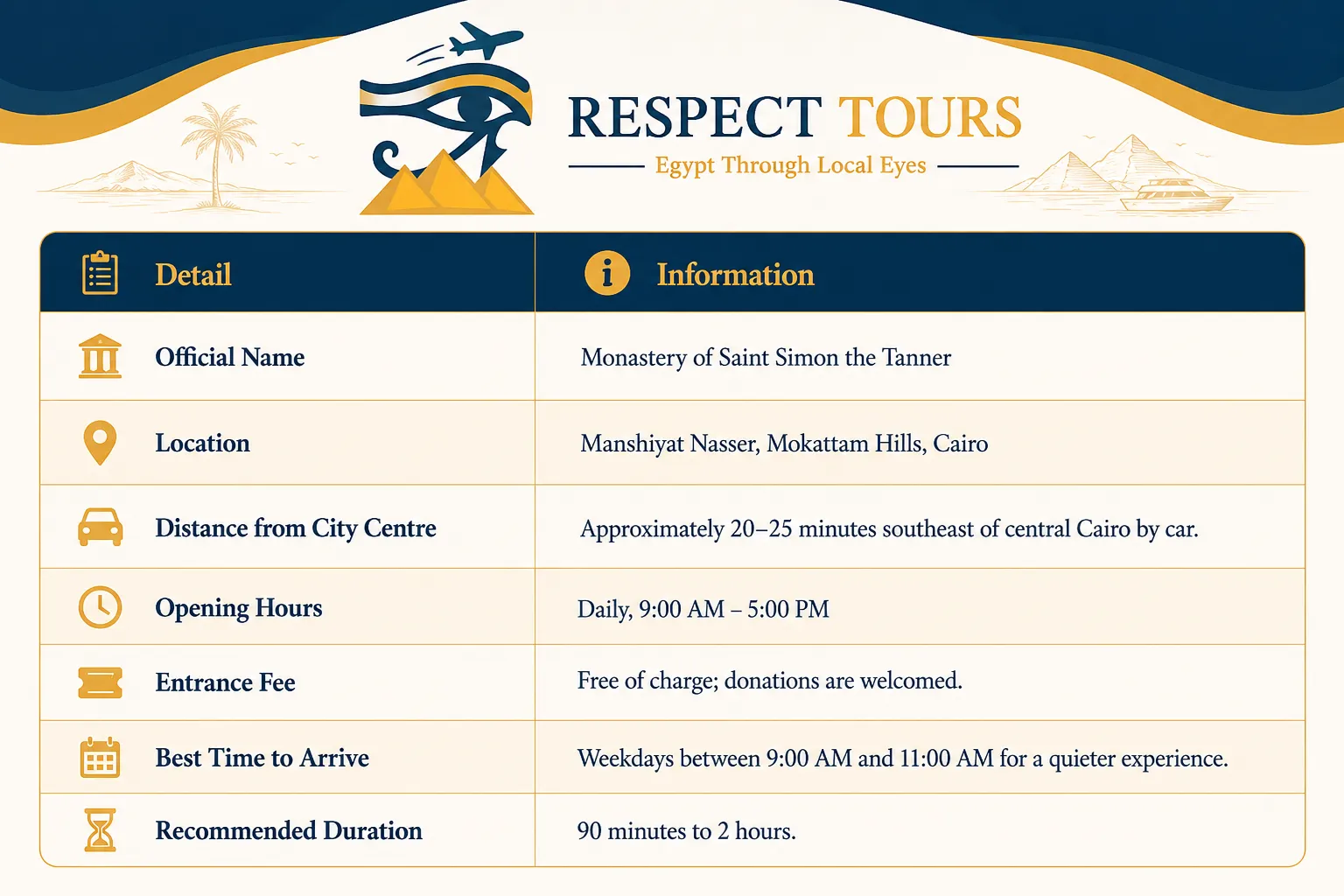
The Cave Church, officially known as the Monastery of Saint Simon the Tanner, is located in the Manshiyat Nasser district on the Mokattam Hills in southeastern Cairo. The church complex is carved directly into the limestone cliffs overlooking the city and can be reached in approximately 20 to 25 minutes by car from Downtown Cairo, depending on traffic.
The site sits within the neighborhood of the Zabbaleen community, a predominantly Coptic Christian community known for operating one of the world’s most efficient urban recycling systems.
While the area is sometimes referred to as “Garbage City,” visitors quickly discover that the Cave Church is one of Cairo’s most remarkable religious and cultural landmarks.
Once you arrive, you’ll find much more than a single church. The complex includes a vast open-air amphitheater, several rock-cut chapels, prayer halls, and panoramic viewpoints carved into the Mokattam cliffs.
Because many sections are spread across different levels of the hillside, it’s worth allowing enough time to explore the entire site rather than just the main church auditorium.
Saint Simon the Tanner: The Story Behind the Name
The church is named for Saint Simon the Tanner, a Coptic saint from 10th-century Cairo. Simon was a leather worker, a humble trade low in the social order.
According to Coptic tradition, he was chosen by God to fulfill a prophecy from the Gospel of Matthew: that faith the size of a mustard seed could move a mountain.
The story goes that Simon, through prayer and fasting, caused the Mokattam Mountain to visibly rise and fall three times before the Fatimid Caliph Al-Muizz. The miracle was witnessed by the Caliph’s court as proof of the faith of Egypt’s Christian community at a moment of serious political tension.
Al-Muizz, witnessing it, is said to have guaranteed the safety of Cairo’s Coptic Christians in return.
Whether you approach that story as history, theology, or legend, it’s the reason the church stands where it does, in the cliff face of that same mountain. The Zabbaleen community built it here deliberately. The location is the meaning.
History of the Cave Church: How It Was Built
The Cave Church has no ancient origins. It started in the 1970s when the Zabbaleen community, long denied formal places of worship and marginalized within the city, began carving rough prayer spaces into the limestone caves of Mokattam.
Simple grottoes became chapels. Chapels became halls. Halls expanded into the sprawling complex that exists today.
It was built largely by hand, with basic tools, over several decades. There was no single architect, no master plan. Different sections were added as the community grew and as resources allowed.
The result is an organic, layered space, which is part of why it feels so different from polished historical monuments.
The main St. Simon Cave Church amphitheater, the largest single space in the complex, seats over 20,000 worshippers. It has hosted major Coptic Christian gatherings, Easter services that fill every seat, and visits from international religious delegations.
For context: this is a church built by a community that collects other people’s rubbish for a living, on a cliff, without government funding, that now ranks as the largest church auditorium in the Middle East.
Interested in Egypt’s Spiritual Heritage?
Our Egypt Spiritual Tours combine the Cave Church, Coptic Cairo, and other sacred sites into a deeply curated itinerary – ideal for travelers who want more than sightseeing.
What to See Inside the Cave Church Complex
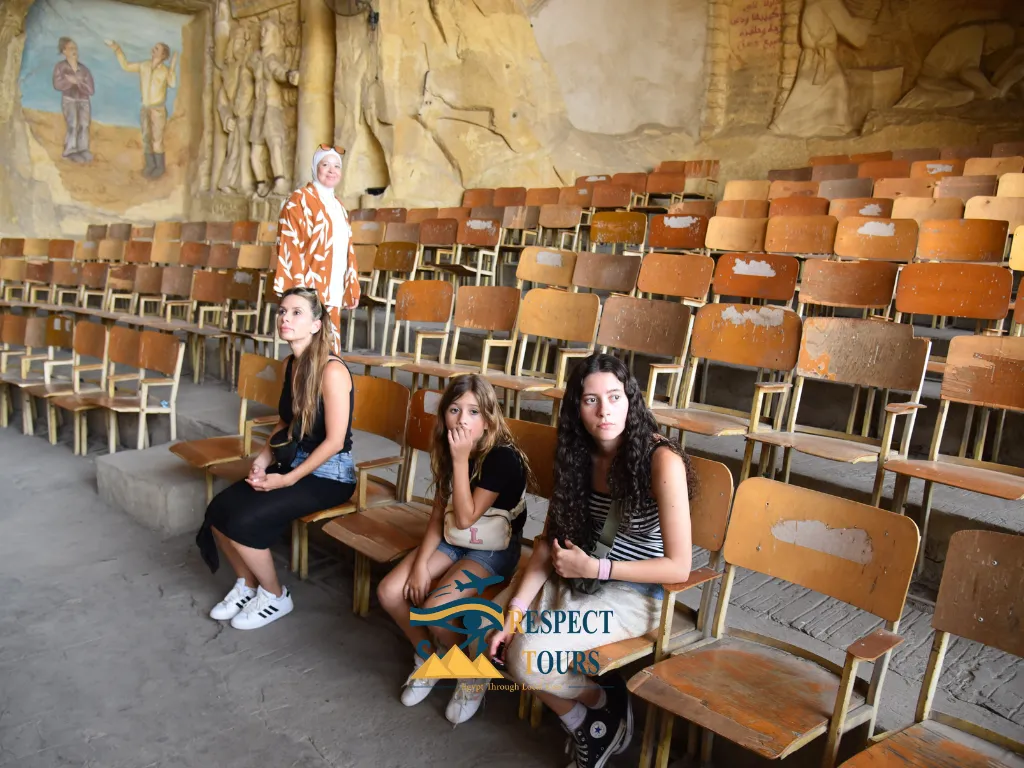
Allow at least 90 minutes. The site is considerably larger than it appears from the entrance, and it takes time to navigate properly. Here’s what’s inside.
The Main Amphitheatre
The centerpiece of the complex is an open-air auditorium carved into the cliff, seating over 20,000 people. The scale is the first thing that hits you. Most visitors expect something chapel-sized and walk in to find a space that holds more people than many concert venues.
At Easter, it fills. On a weekday morning, it’s almost empty, which is when the carvings on the surrounding walls are easiest to study.
The Biblical Rock Carvings
The entire cliff face surrounding the amphitheater is covered in monumental relief carvings, scenes from the Old and New Testaments, the life of Saint Simon, and portraits of Coptic saints.
They were created by Polish sculptor Mario Dobrescu, who worked directly with the rock rather than against it.
The natural contours of the limestone were incorporated into the compositions: a crack becomes a valley floor, and a ridge becomes a figure’s arm. At full size, some panels span 15 to 20 meters; the effect is genuinely striking.
These aren’t decorative additions. For the Zabbaleen community, these are their scriptures made permanent in the rock of the mountain; they were told their faith could move it.
📷 Photography Tips
- Best light for the carvings: 9:00 AM – 11:00 AM, when natural light enters from above the cliff face
- A wide-angle lens is useful: many panels are too large to capture without stepping well back
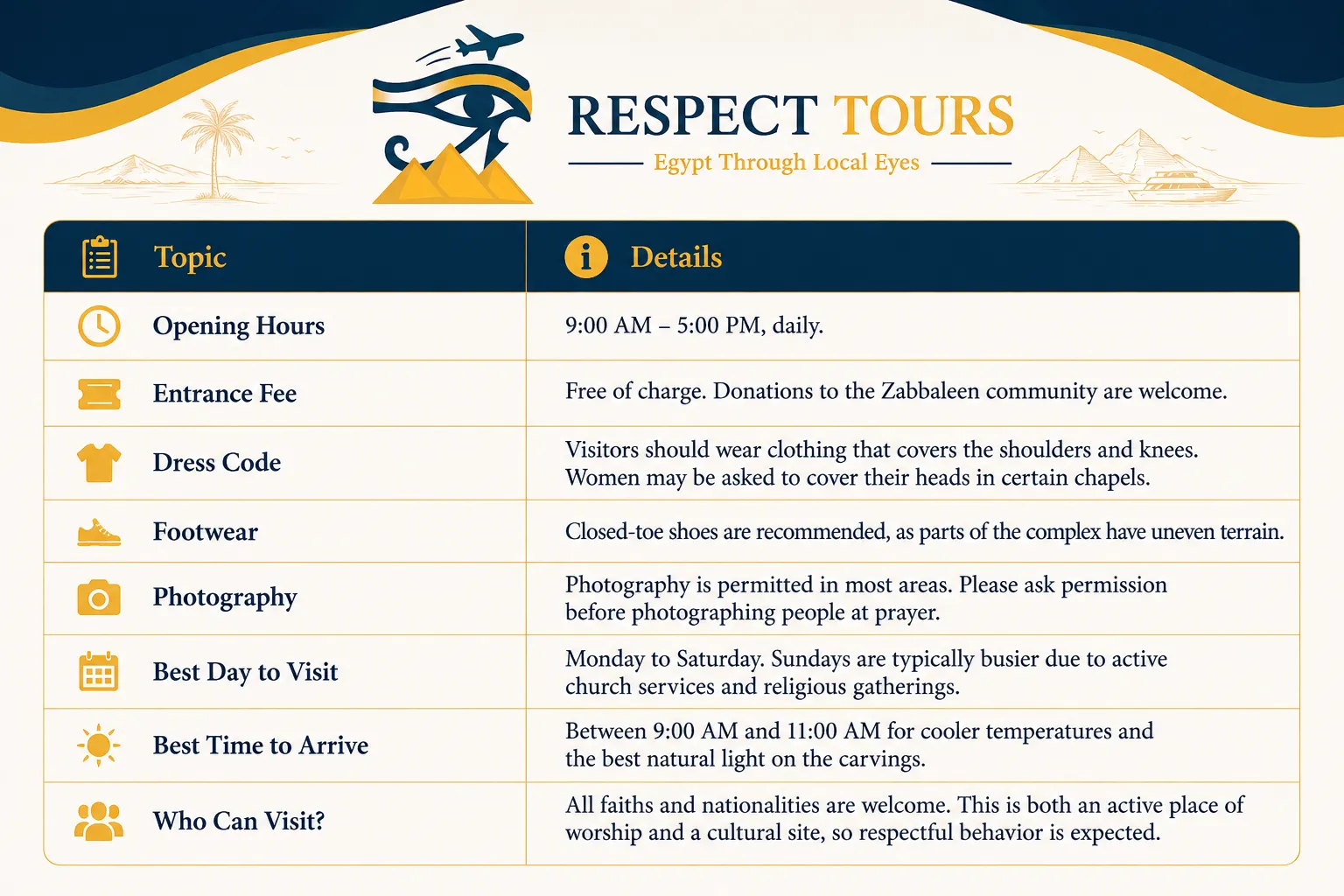
- Always ask before photographing anyone at prayer
- The upper viewpoint gives panoramic shots across Cairo’s rooftops and the Mokattam Hills
The Samaan Church
A smaller, more enclosed chapel cut directly into the rock. Quieter and more intimate than the main amphitheater, it’s better for looking closely at the carvings and spending time in a space that feels genuinely contemplative rather than spectacular.
The Cave of Paul the Simple
A grotto chapel dedicated to Paul the Simple, an early Coptic desert father. It’s one of the calmest sections of the entire complex, small, low-ceilinged, with a single candlelit altar.
Many visitors describe it as the moment the site shifts from tourist attraction to something else.
Secondary Chapels and Upper Viewpoint
Several smaller chapels are cut into the hillside at different levels, each with distinct iconography. Above them, a viewpoint at the top of the complex gives a broad view over Cairo’s eastern rooftops and the desert plateau of the Mokattam Hills.
Worth the climb, particularly in the early morning before the heat builds.
What to Know Before You Visit the Cave Church
Is the Cave Church Safe to Visit?
Yes. The Cave Church and the surrounding Manshiyat Nasser neighborhood are safe for tourists. The Zabbaleen community receives international visitors regularly and is known for treating them well.
Combining the Cave Church with Coptic Cairo: A Full-Day Itinerary
The Cave Church works best as part of a day that also covers Old Cairo; the two areas tell complementary stories about Egyptian Christianity, separated by fifteen centuries. Here’s how the day typically runs:
9:00 AM
Arrive at the Cave Church
Early morning is quieter, and the light on the rock carvings is better. Allow 90 minutes to two hours to cover the main amphitheater, the Samaan Church, and the Cave of Paul the Simple. Climb to the upper viewpoint before leaving.
12:30 PM
Lunch in Old Cairo
Head to Old Cairo for lunch at a local Coptic restaurant, a 20-minute drive. This is a genuinely good midday break before the afternoon sites.
1:30 PM
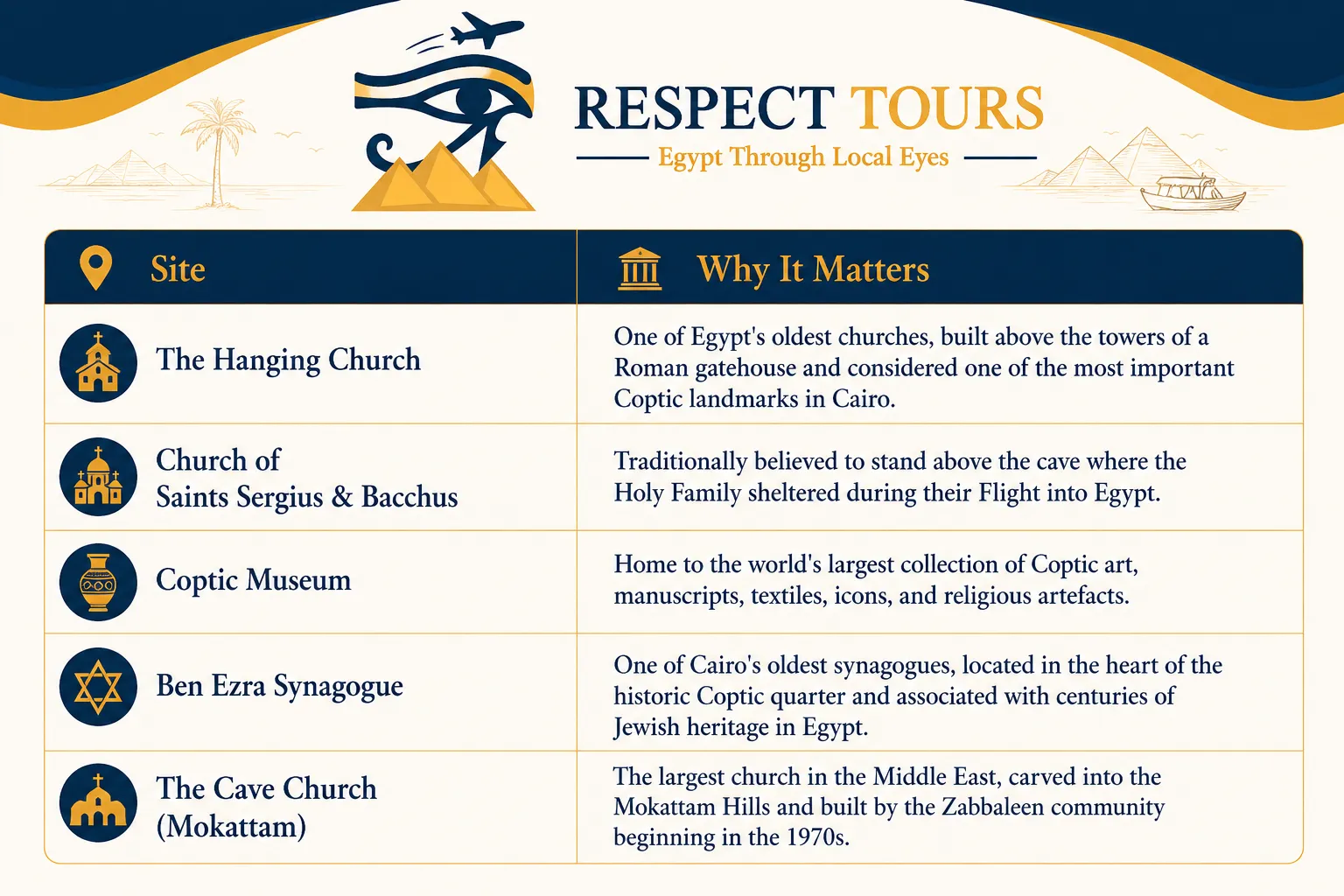
Old Cairo: Hanging Church, Saints Sergius & Bacchus, Coptic Museum
If you’re combining visits, the most significant sites are all within walking distance of each other in the Old Cairo district:
4:30 PM (Optional)
Islamic Cairo Extension: Al-Muizz Street and Khan El Khalili
For travellers wanting a full cultural contrast: Al-Muizz Street in the afternoon light, ending at Khan El Khalili for the early evening. This turns a half-day into a complete Cairo day, covering two thousand years of the city’s history.
Cairo Day Tours
Private, expert-led itineraries including the Cave Church, Old Cairo, and more. Pick-up from your hotel. Explore Cairo Tours
Egypt Spiritual Tours
Multi-day itineraries through Egypt’s Coptic, Islamic, and ancient heritage are designed for travellers who want depth. View Spiritual Tours
Visiting the Cave Church with Respect Tours Egypt
We’ve been guiding travellers to the Cave Church since the complex was still being built. Our guides know the community, speak to the site’s history in detail, and handle the logistics, transport, timing, and cultural etiquette, so you can focus on the experience rather than the navigation.
What visiting with us includes:
- Private, air-conditioned transport door to door from your Cairo hotel
- A dedicated English-speaking guide with detailed knowledge of Coptic history
- The Cave Church is integrated into a full Cairo day, Coptic Cairo, Islamic Cairo, or both
- Community introductions and context that aren’t available on a self-guided visit
The Ministry of Tourism is licensed, IATA-affiliated, and trusted by over 140,000 international travellers since 1978.
Cairo Day Tours
The Cave Church, Old Cairo, and the Pyramids are private, expert-led, and built around your schedule. Explore Cairo Tours
Egypt Spiritual Tours
Cairo’s Coptic and Islamic heritage are combined in a multi-day itinerary for travellers who want depth. View Spiritual Tours
Tailor-Made Egypt Tours
Build your itinerary around your interests, and put the Cave Church exactly where it belongs in your trip.
Tailor-Made Tours | Design Your Dream Trip with Respect Tours
FAQs About the Cave Church in Cairo
Is the Cave Church in Cairo free to visit?
Yes. There is no entrance fee. The site is open to all visitors free of charge. Donations are welcome and go directly to the Zabbaleen community.
Is the Cave Church safe for tourists?
Yes. The Cave Church and Manshiyat Nasser are safe. The Zabbaleen community receives international visitors regularly and is welcoming to respectful travellers.
The main practical challenge for solo visitors is navigation; the streets are complex, and the complex has multiple entrances. A guide is recommended for that reason, not safety concerns.
Can non-Christians visit the Cave Church?
Yes. The Cave Church welcomes visitors of all faiths and backgrounds. Respectful behavior and modest dress are the only requirements. It functions as both an active place of worship and a cultural and historical site open to everyone.
What is the best time to visit the Cave Church in Cairo?
9:00 AM to 11:00 AM on a weekday. Arriving early means better natural light on the rock carvings, fewer visitors, and cooler temperatures. Sundays have active services and are busier and more devotional in atmosphere; they are fine to visit but different.
Why is it called the Cave Church?
Because it’s built inside the caves and cliff face of Mokattam Mountain, not constructed as a freestanding building but carved directly into living rock. The main amphitheater, chapels, and grottoes are all cut into the limestone. The name is informal; the official name is the Monastery of Saint Simon the Tanner.