


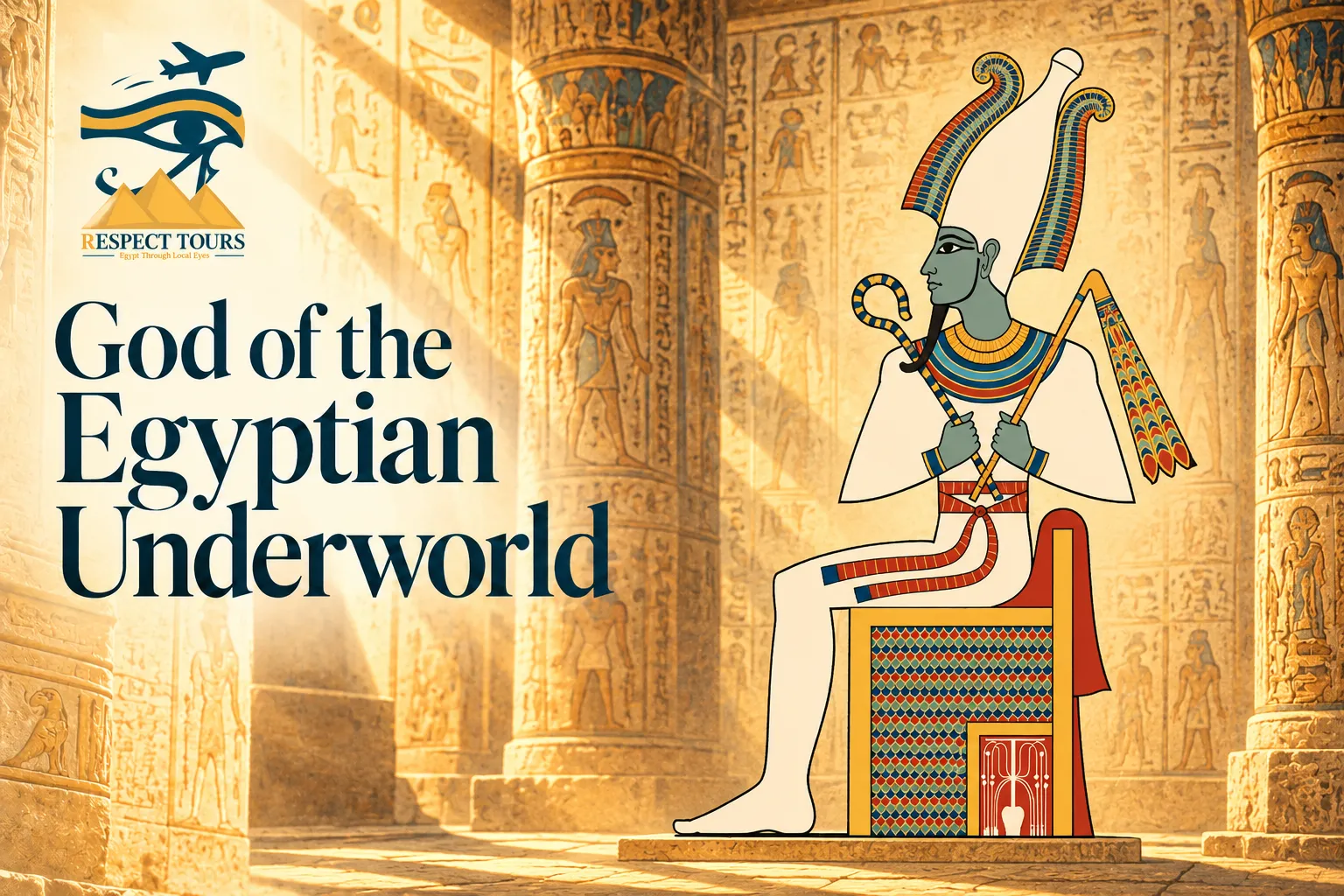
You step into a cool, dim hall at Abydos. On the wall, a figure wrapped like a mummy, with green skin, holds a crook and a flail. Beside him stand a winged woman, a falcon-headed god and a jackal-headed god. Your guide points to the first figure and says one name: Osiris. His story explains why the dead were mummified, why hearts were weighed and why pilgrims travelled to Abydos for thousands of years. This guide explains who Osiris was, how he became lord of the dead and where you can follow his story in Egypt today.
Who Was the Egyptian God of the Underworld?
Osiris was the main ruler of the Egyptian underworld, the Duat, while Anubis guided the dead and oversaw mummification.
Anubis is also tied to death because he ruled the dead first. In the Early Dynastic Period and the Old Kingdom he was the main lord of the dead. As the Osiris myth grew, Osiris took over that role, and Anubis became his helper.
So both gods belong to the afterlife, but they do different jobs. Osiris rules and judges. Anubis embalms, guides and weighs.
| Quick Fact | Detail |
|---|---|
| Egyptian Name | Written wsjr, spelled Asar, Wesir or Usire today |
| Greek Form | Osiris |
| Domain | The dead, rebirth and the fertile Nile floodplain |
| Family | Husband and brother of Isis, father of Horus, brother of Seth and Nephthys |
| Main Symbols | Atef crown, crook and flail, mummy wrapping, green skin, djed pillar |
| Main Cult Centre | Abydos |
| Other Sacred Place | Philae Temple near Aswan |
| Fullest Story | Told by the Greek writer Plutarch, around AD 120 |
Who Was Osiris in Ancient Egypt?
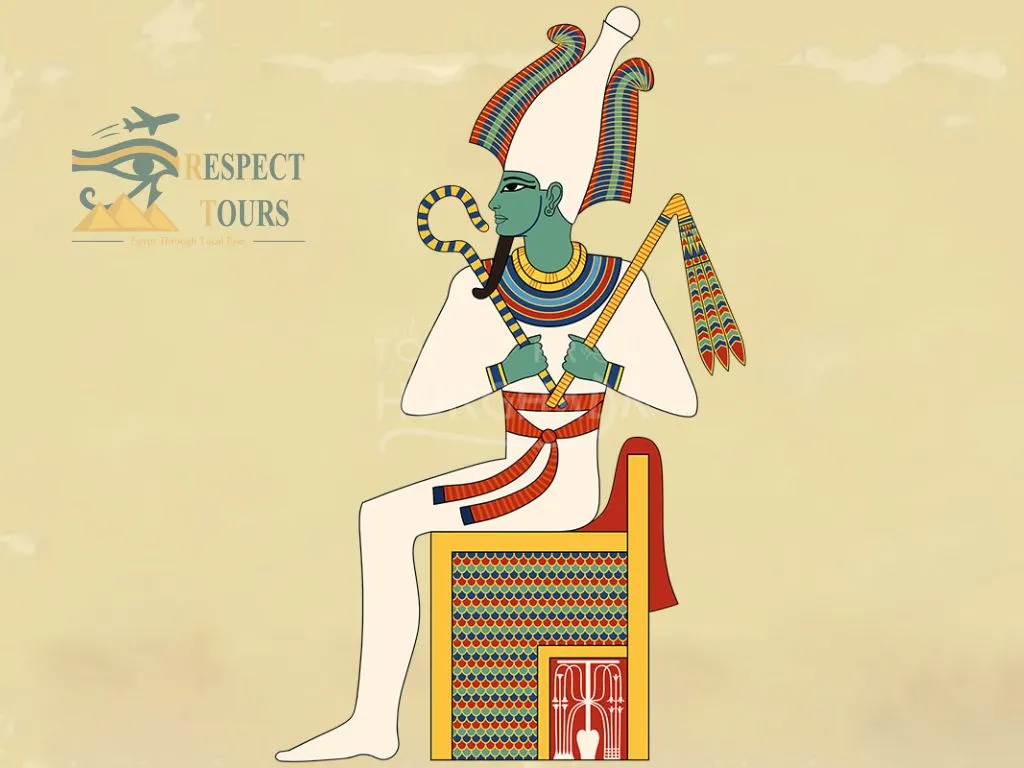
Osiris was the Egyptian god of the dead, rebirth and the fertile Nile floodplain, and the husband of Isis.
Egyptians also remembered him as one of Egypt’s earliest kings. The first clear evidence of his worship dates to the middle of the Fifth Dynasty, around the 25th century BCE. He was probably worshipped earlier.
The Meaning and Origin of the Name Osiris
Osiris is the Greek form of an Egyptian name written wsjr. Hieroglyphs do not record vowels, so modern spellings vary: Asar, Ausar, Wesir or Usire.
The meaning is still debated. Scholars have proposed “The Mighty One” and “engendering principle”, and none is fully convincing.
One of his old titles was Khenti-Amentiu, “Foremost of the Westerners”. The “Westerners” were the dead, who were buried on the west side of the Nile.
How Ancient Egyptians Portrayed Osiris
Artists showed Osiris as a king wrapped like a mummy from the chest down. His arms are free, and he holds a crook and a flail.
He wears the atef crown and a pharaoh’s beard. His skin is green or black, and each colour carries a meaning, explained below.
Osiris’s Symbols and Their Meanings
Five symbols appear again and again in Osiris scenes. The table below gives the short version.
| Symbol | Meaning |
|---|---|
| Atef Crown | Royal rule, built on the White Crown of Upper Egypt |
| Crook and Flail | Kingship and authority |
| Green Skin | Rebirth and new growth |
| Black Skin | The dark, fertile soil of the Nile floodplain |
| Djed Pillar | Stability, linked to the backbone of Osiris |
The section on the most important symbols of Osiris gives more detail on each one.
The Story of Osiris, Isis and Seth
The story of Osiris is a tale of murder, magic and rebirth, but no single Egyptian text tells it from start to end.
Pieces appear in the Pyramid Texts, which are among the oldest religious writings in the world. The fullest version comes from Plutarch, a Greek writer who drew on several Egyptian traditions around AD 120. Details such as the chest and the tree at Byblos come from his account, so other versions differ.
The Murder of Osiris
Seth killed his brother Osiris out of jealousy and to take the throne. In Plutarch’s version, Seth tricks Osiris into lying in a chest, seals it and throws it into the Nile.
Egyptian sources agree that Seth killed Osiris. They differ on how.
How Isis Brought Osiris Back to Life
Isis searched for the body. In Plutarch’s version it drifted to Byblos, where it became part of a tree, and she brought it home.
Seth then cut the body into pieces and scattered them across Egypt. The number of pieces changes by source: 14 in Plutarch’s account, and other counts elsewhere.
Isis and her sister Nephthys gathered the pieces. Anubis wrapped and embalmed the body, which gave Egypt its first mummy. Isis then revived Osiris by magic for long enough to conceive Horus.
Horus and the Battle for the Throne of Egypt
Horus grew up and challenged Seth for the throne. A New Kingdom text, The Contendings of Horus and Seth, tells how the two gods fought and argued before the other gods.
In the end, Horus was awarded the kingship. Egyptian kings saw themselves as Horus in life and as Osiris in death. You can see Horus’s best-preserved home at the Edfu Temple of Horus.
Why Did Osiris Become God of the Underworld?
Osiris became god of the underworld because he died, was restored by magic and then ruled the dead as a king.
His story offered hope. If a god could be killed, restored and rebuilt, so could a human being. The Pyramid Texts already identify the dead king with Osiris.
Over time ordinary people shared that hope. The dead were called “Osiris” followed by their own name, and they asked for his protection in death. By the Middle Kingdom, around 2040 to 1782 BCE, Osiris had replaced Anubis as ruler of the dead.
His link to the Nile also mattered. Each year the river flooded and crops grew again, so Osiris stood for renewal as much as for death.
Osiris and the Ancient Egyptian Afterlife
The Egyptian afterlife began in the Duat, a dark underworld the dead crossed before judgment, with Osiris as its lord.
Funerary texts such as the Amduat describe the Duat as 12 regions, matching the 12 hours of the night. Those who passed judgment could reach an afterlife of plenty called the Field of Reeds.
The Hall of Judgment
The Hall of Judgment is where the dead faced a final test. Egyptian texts call it the Hall of Truth, or Hall of Two Truths.
Osiris presided. Before him stood 42 divine assessors of Ma’at, each linked to one wrong act. The deceased spoke a list of denials, such as “I have not stolen”, known as the negative confession. The Book of the Dead preserves this text as Spell 125.
The Weighing of the Heart Ceremony
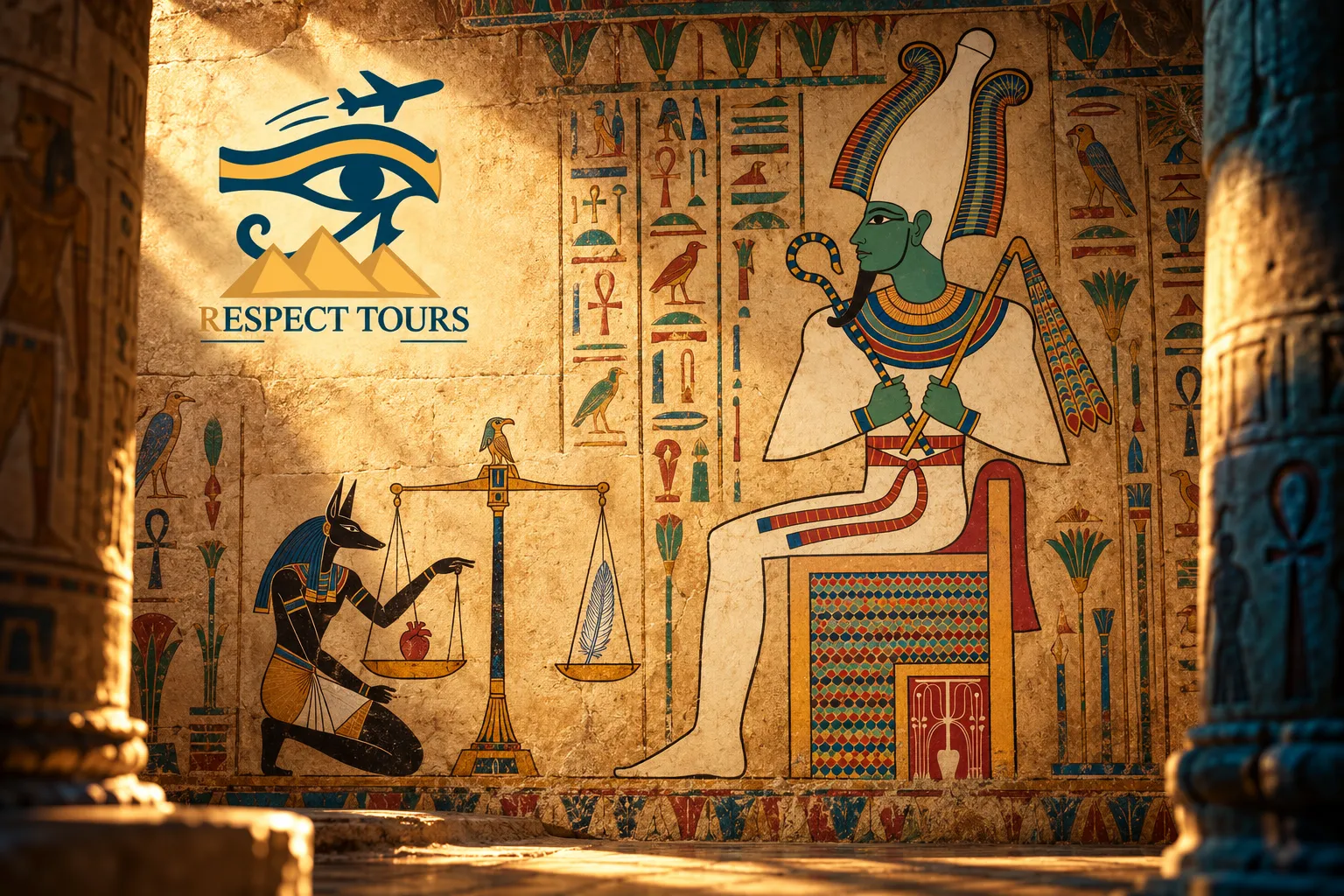
The weighing of the heart decided whether the dead person reached the afterlife. Painted papyri show the scene in detail.
- Anubis leads the dead person into the Hall of Truth.
- The person recites the negative confession before the 42 assessors.
- Anubis places the person’s heart on one side of a scale and the feather of Ma’at on the other.
- Thoth, the scribe of the gods, records the result.
- If the heart balances or is lighter, Osiris welcomes the person into the afterlife.
- If the heart is heavier, it is eaten by Ammit, and the person is denied an afterlife.
The lists of assessors and sins vary between texts. Egyptians never fixed one single version.
The Field of Reeds
The Field of Reeds, also called Aaru, was the realm of plenty where the justified lived as they had on earth, without pain. Scenes show harvests and an eternal spring.
Reaching it required a pure heart. Egyptians pictured the dead farming and living with loved ones there, much as they had in life.
Osiris vs. Anubis: Who Was the True God of the Underworld?
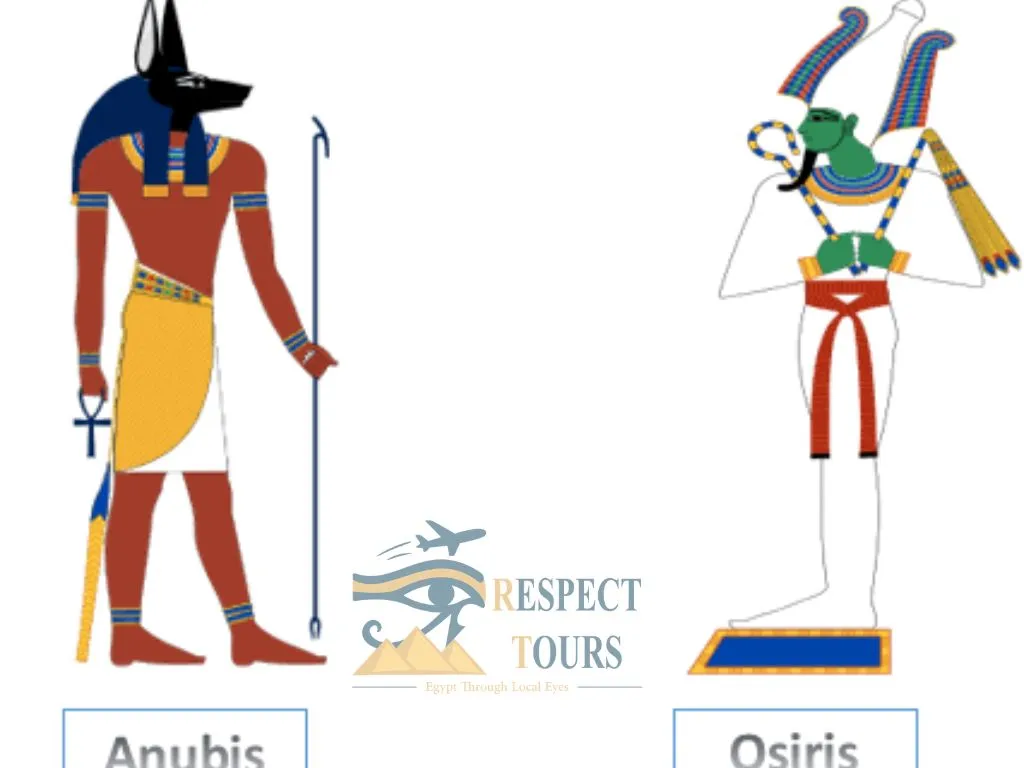
Osiris was the true ruler of the underworld in later Egyptian belief, while Anubis was its guardian, embalmer and guide.
| Feature | Osiris | Anubis |
|---|---|---|
| Role | King and judge of the dead | Embalmer, guide and guardian of the dead |
| Form | Mummified king with green or black skin | Black jackal, or a man with a jackal head |
| Symbols | Atef crown, crook and flail, djed pillar | Jackal, black colour, embalming links |
| Link to the Dead | Rules the Duat and offers rebirth | Protects tombs and leads souls |
| Role in Judgment | Presides and welcomes the justified | Weighs the heart in the scale |
Anubis was the older lord of the dead. Later tradition made him the son of Osiris and Nephthys, adopted by Isis. Some sources do not agree on his parentage.
Other Egyptian Gods Connected to Death and the Afterlife
Four other deities appear in nearly every afterlife scene: Anubis, Ma’at, Thoth and Ammit. Each has a clear job.
Anubis: God of Mummification
Anubis was the patron of embalmers. One of his titles was “He Who is in the Place of Embalming”. He protected tombs, guided souls and presided over the scales in the Hall of Truth.
Ma’at: Goddess of Truth and Justice
Ma’at stood for truth, justice and cosmic balance. Her feather is the standard against which the heart is weighed. The 42 assessors in the judgment hall are called the assessors of Ma’at.
Thoth: Recorder of the Final Judgment
Thoth, the god of writing and wisdom, wrote down the result of the weighing. Papyri show him as an ibis-headed scribe beside the scales.
Ammit: Devourer of the Dead
Ammit devoured the hearts of those who failed. She has the face of a crocodile, the mane and front of a lion and the hindquarters of a hippopotamus. Being eaten by her ended any chance of an afterlife.
The Most Important Symbols of Osiris
Four symbols identify Osiris in tomb paintings and temple reliefs: the atef crown, the crook and flail, the mummified form and the djed pillar.
The Atef Crown
The atef crown is similar to the White Crown of Upper Egypt, with an ostrich feather on each side. It shows that Osiris is a king, even in death.
The Crook and Flail
The crook and the flail are the old tools of royal power. The crook is linked to herding. The meaning of the flail is uncertain, and scholars still debate it.
Green Skin and Mummified Form
Green skin stands for rebirth and growth. Black skin stands for the dark, fertile silt of the Nile. The mummy wrapping recalls the first mummy made after his death.
Egyptians even grew Osiris “beds”: soil moulds sown with seed. The sprouting grain symbolised his return to life, and an Osiris bed was found in Tutankhamun’s tomb.
The Djed Pillar
The djed pillar stands for stability and is linked to the backbone of Osiris. In New Kingdom scenes, Horus or the king raises the pillar to help Osiris rise.
A yearly Djed Pillar Festival raised a real pillar at the start of the harvest season. Raising it came to mean that Osiris returned from the dead and that the kingdom stood firm.
Temples and Sacred Places Associated With Osiris
The two best places to follow Osiris are Abydos, his main cult centre, and Philae, where Isis was worshipped.
Abydos and the Cult of Osiris
Abydos was the centre of the Osiris cult for thousands of years. Pilgrims came to take part in his festival and to leave stelae and chapels.
At a site called Umm el-Qa’ab, the tomb of King Djer was later treated as the tomb of Osiris, from at least the Middle Kingdom onward. A Twelfth Dynasty stela records a five-day public festival with a procession, mourning, a night vigil and a rebirth at dawn.
The Temple of Seti I is the best-preserved major building here. Its seven sanctuaries include chapels for Osiris, Isis and Horus, and its wall of kings lists 76 rulers from Menes to Seti I.
Abydos lies about 165 km north of Luxor, roughly a 2.5 to 3 hour drive. It is usually paired with Dendera in one long day, so plan for a full day with a private driver or an organised tour. The 10-day sacred sites tour covers Abydos, Dendera and Abu Simbel and is listed from $1,780 (price checked 25 October 2026).
Philae Temple and the Story of Isis and Osiris
Philae is the temple of Isis near Aswan, where pilgrims honoured Isis and Osiris. From the Ptolemaic period it was a pilgrimage site tied to the tomb of Osiris.
The cult of Isis and Osiris lasted at Philae until at least the 450s AD. The last known hieroglyphic inscription, dated AD 394, is also here.
The temple no longer stands on its original island. In the 1970s UNESCO moved it, in about 40,000 blocks, to higher ground on Agilkia Island, around 500 m away. Visitors reach it by boat.
Philae is a standard stop on Aswan sightseeing, so see our Aswan day tours or compare the Luxor to Aswan Nile cruises if you prefer to sail between the two cities.
The Osireion at Abydos
The Osireion is a deep stone structure behind the Temple of Seti I. It is often described as a cenotaph, a symbolic tomb, of Seti I, and some say it represents the tomb of Osiris.
It is built from huge blocks of rose granite below ground level. Its age and exact purpose are debated, and entry is limited, so many visitors view it from above.
Interesting Facts About the Egyptian God of the Underworld
These facts show how widely Osiris shaped Egyptian life and belief.
- Osiris is a Greek form of his name. Egyptians wrote wsjr.
- Anubis was the main lord of the dead before Osiris took over that role.
- The dead were called “Osiris” plus their own name, so every justified person shared his title.
- Osiris was believed to be the first mummy.
- His green skin stood for rebirth, and his black skin stood for the Nile’s fertile soil.
- The cult of Isis and Osiris at Philae lasted longer than many other Egyptian cults, continuing until at least the 450s AD.
- The fullest version of his story was written by a Greek author, not an Egyptian priest.
Discover the World of Ancient Egyptian Gods With Respect Tours Egypt
Walk through the temples and sacred sites where the story of Osiris shaped ancient Egyptian beliefs. Explore Egypt through local eyes with a private itinerary designed by Respect Tours Egypt, a licensed local company that has welcomed travellers since 1978.
Our team can build a trip around the Osiris story:
- Abydos and Dendera, with the Osireion, in the 10-day sacred sites tour
- Philae by boat from Aswan, in our Aswan day tours
- More faith-focused journeys in our Egypt Spiritual Tours
Abydos is a long day, and access to some areas such as the Osireion is limited, so confirm the plan with us before you book.
Explore the sacred sites tour Tailor your Egypt trip Request a quote
FAQs About Osiris and the Egyptian Underworld
Who is the Egyptian god of the underworld?
Osiris is the Egyptian god of the underworld and ruler of the dead. He presided over the judgment of the dead, while Anubis embalmed and guided them. Osiris also stood for rebirth, which is why many Egyptians hoped to share his fate.
Is Anubis or Osiris the god of the underworld?
Osiris is the god of the underworld in later Egyptian belief. Anubis ruled the dead earlier, then became their embalmer, guide and weigher of hearts. By the Middle Kingdom, Osiris had taken the title Foremost of the Westerners.
What did Osiris look like?
Osiris looked like a mummy-wrapped king with green or black skin. He wears the atef crown and a false beard and holds a crook and flail. Only his hands and face are free of the wrapping.
Why was Osiris killed by Seth?
Seth killed Osiris out of jealousy and a wish to take the throne. In the best-known account, Seth traps Osiris in a chest and throws it into the Nile, then later cuts the body into pieces.
How did Osiris become ruler of the dead?
Osiris became ruler of the dead after Isis and Nephthys gathered his body and Anubis embalmed it. Revived by magic, he went on to rule the dead, while his son Horus later claimed the throne of the living.
What powers did Osiris have?
Osiris had power over rebirth, fertility and the judgment of the dead. He presided in the Hall of Truth, welcomed the justified into the afterlife and linked the Nile’s yearly renewal to life after death.
Who was the wife of Osiris?
Isis was both the wife and the sister of Osiris. She searched for his body, helped restore it by magic and later conceived Horus. Her sister Nephthys helped her gather the pieces of his body.
Was Osiris the father of Horus?
Yes, in the main myth Horus is the son of Osiris and Isis. Isis conceives him by magic after Osiris is killed. Horus later contests the throne with his uncle Seth and is awarded the kingship.
What was the ancient Egyptian underworld called?
The ancient Egyptian underworld was called the Duat. It was a dark, subterranean realm the dead crossed before judgment. Texts such as the Amduat divide it into 12 regions, matching the 12 hours of the night.
What happened during the weighing of the heart?
During the weighing of the heart, the dead person’s heart was balanced against the feather of Ma’at. Thoth recorded the result. A balanced heart earned entry to the afterlife, while a heavier heart was eaten by Ammit.
Where was Osiris worshipped?
Osiris was worshipped across Egypt, and Abydos was his main cult centre. Pilgrims also honoured him at Philae near Aswan, where the cult of Isis and Osiris continued until at least the 450s AD, long after other cults had faded.
Can tourists visit the Temple of Osiris?
Yes, tourists can visit the Temple of Seti I at Abydos, which is dedicated to Osiris and other gods. It lies about 165 km north of Luxor and is usually paired with Dendera. Access to the Osireion is limited, so confirm details first.