
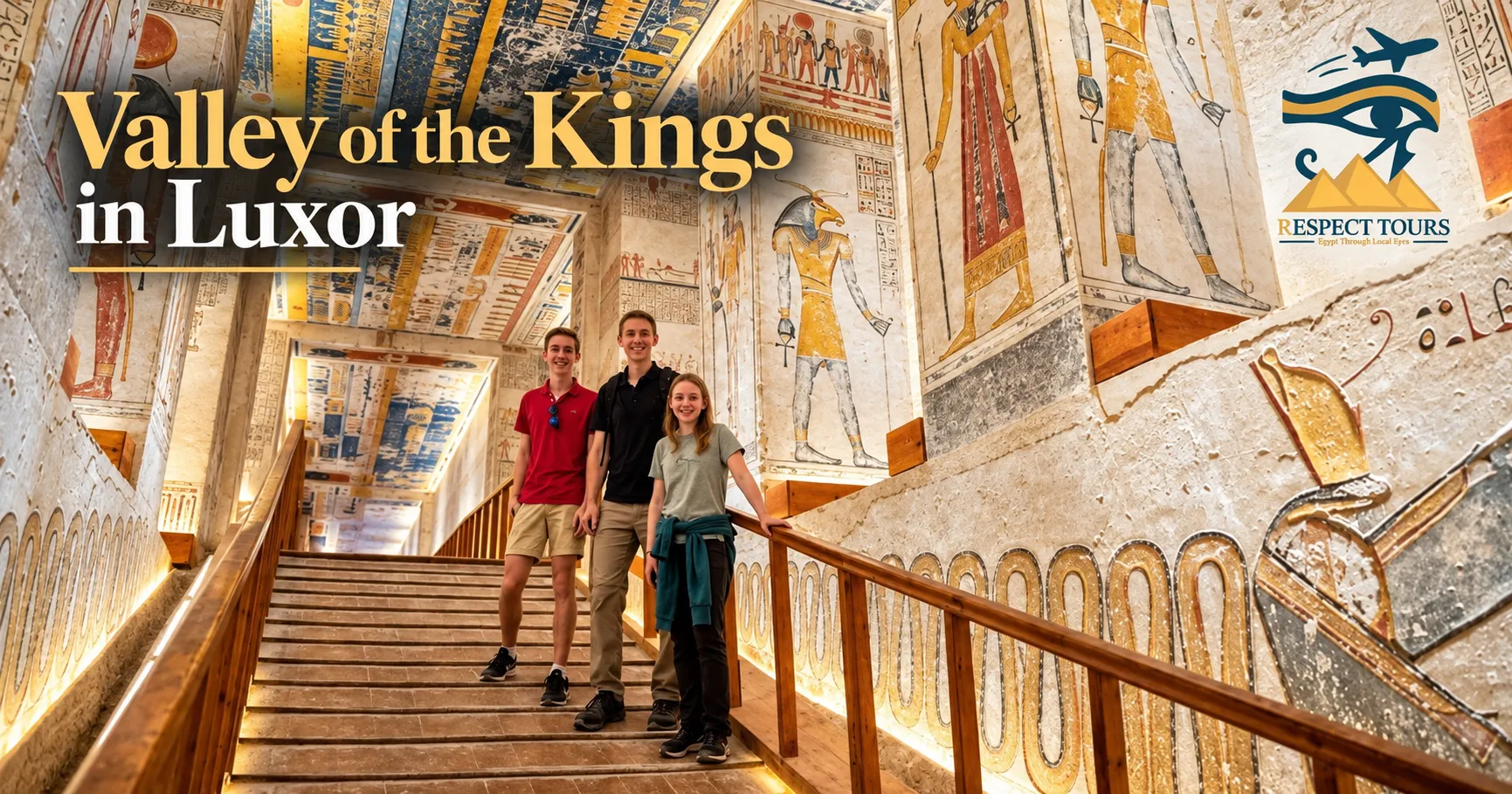
You’re staring at a map of Luxor’s West Bank, a list of strange codes in front of you: KV17, KV9, KV62. You know the Valley of the Kings is a must-see, but how do you choose just three tombs from over sixty? Which ones are worth the extra ticket? How do you avoid the midday heat and make the most of your limited time? Planning a visit can feel as complex as deciphering hieroglyphs. This guide is here to help you navigate the choices and unlock the stories behind the stone.
Valley of the Kings
The Valley of the Kings is an ancient royal burial ground on the West Bank of Luxor, used for nearly 500 years by the pharaohs of the New Kingdom (c. 1550–1070 BCE). Instead of pyramids, they were buried in rock-cut tombs to protect against robbery. A standard ticket allows you to visit three tombs from a rotating selection. The world-famous tombs of Tutankhamun, Seti I, and Ramesses V & VI currently require separate, additional tickets to enter.
Valley of the Kings at a Glance
| Feature | Details |
|---|---|
| Location | West Bank of the Nile, Luxor, Egypt. Part of the Theban Necropolis. |
| Historical Period | New Kingdom (approx. 1539 BCE to 1075 BCE) |
| Main Dynasties | 18th, 19th, and 20th Dynasties |
| Number of Known Tombs | 65 designated tombs (KV1–KV65) and several other pits |
| Most Famous Tomb | Tutankhamun (KV62) |
| Typical Visit Duration | 2–3 hours |
| Standard & Extra Tickets | Standard ticket includes 3 tombs; Tutankhamun, Seti I, and Ramesses V/VI typically require extra tickets. |
| Best Time to Visit | Early morning (8:00 AM) to avoid heat and crowds, especially from October to April. |
| Physical Difficulty | Moderate. Involves walking in the sun, plus stairs and ramps inside tombs. |
| Important Note | Tomb openings, photography rules, and ticket requirements can change. Always check official sources on the day. |
What Is the Valley of the Kings?
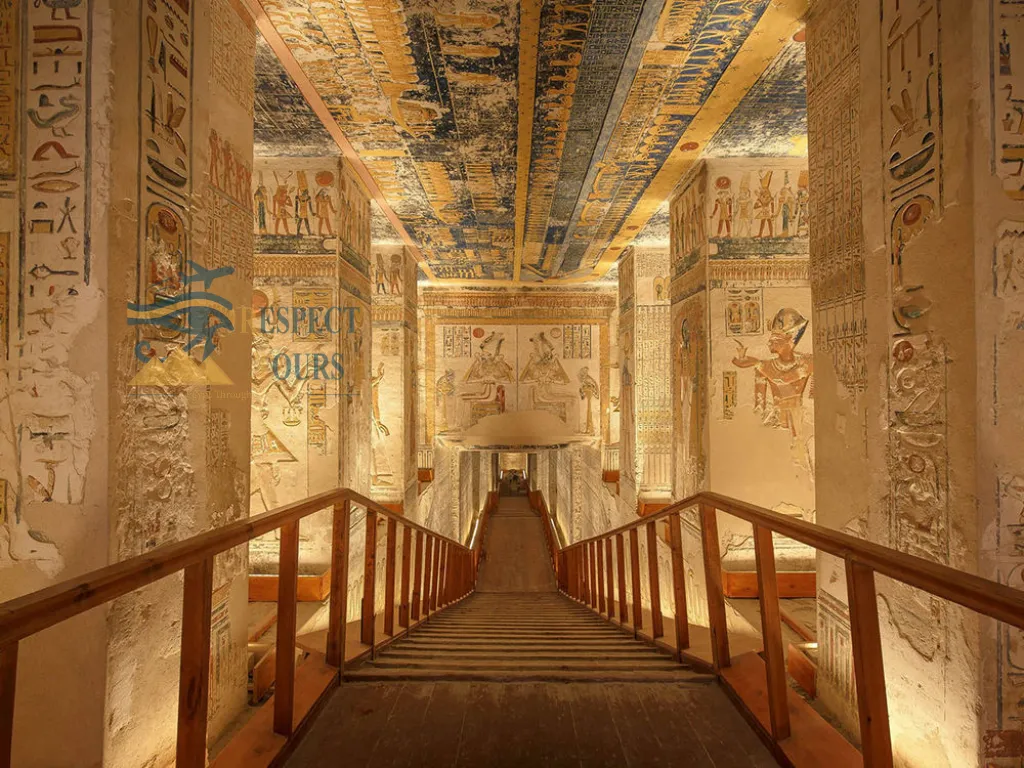 The Valley of the Kings (Wadi el-Bibân el-Mulûk in Arabic) is a vast city of the dead, a royal cemetery carved deep into the limestone hills of the Theban Necropolis. For almost five centuries, this was the final resting place for the most powerful men in ancient Egypt: the pharaohs of the New Kingdom.
Full-Day Luxor West Bank Tour: Valley of the Kings & Hatshepsut
A Royal Cemetery for New Kingdom Pharaohs
This was the burial site for pharaohs like Tutankhamun, Seti I, and the great Ramesses II. It also contains the tombs of powerful nobles and, in a separate nearby valley, their wives and children (the Valley of the Queens). Each tomb was a meticulously constructed “eternal house” designed to guide the pharaoh on his perilous journey through the underworld to be reborn with the gods.
Why Did Pharaohs Stop Building Pyramids?
The shift from the grand pyramids of the Old and Middle Kingdoms to the hidden tombs of the Valley was a practical one. The pyramids, while monumental, were impossible to hide. They acted as giant beacons for tomb robbers, and by the time of the New Kingdom, it’s likely that most had already been plundered. Pharaohs chose this remote, desolate valley for its seclusion and the ability to conceal the tomb entrances, hoping to protect their mummified bodies and funerary treasures for eternity.
Where Is the Valley of the Kings Located?
The Valley of the Kings is situated on the West Bank of the Nile River, opposite the modern city of Luxor (ancient Thebes). It takes around 45–60 minutes to drive there from the East Bank, depending on traffic at the bridge.
The Valley of the Kings on Luxor’s West Bank
The site is the heart of the Theban Necropolis, a UNESCO World Heritage site that encompasses a vast network of mortuary temples and tombs. It lies a few kilometres inland from the river, nestled in a barren wadi (a dry valley). Its location is close to other major West Bank sites, including the Temple of Hatshepsut at Deir el-Bahari, the Colossi of Memnon, and Medinet Habu.
Why Was This Remote Valley Chosen?
The location was chosen for both practical and religious reasons.
- Seclusion: The rugged, isolated landscape offered better protection from tomb robbers.
- Geology: The local limestone, while variable in quality, was suitable for quarrying the deep, complex tombs.
- Symbolism: The West Bank of the Nile was associated with death and the afterlife, as the sun “died” in the west each evening. The dominant peak overlooking the valley, el-Qurn, has a natural pyramid shape, which may have been seen as a sacred symbol, linking the new burial style with the traditions of the past.
How Do Valley of the Kings Tickets Work?
Navigating the ticket system is a key part of planning your visit. You buy tickets at the main entrance’s ticket office; be aware that online purchasing systems have been trialled but are not always consistently operational for all sites.
What Does the Standard Ticket Include?
Your general entrance ticket to the Valley of the Kings allows you to enter three tombs from a list of currently open tombs. This list changes periodically for conservation reasons. Your guide, or the guards at the tomb entrances, can tell you which tombs are included in the standard ticket on the day of your visit. This rotation system helps manage visitor traffic and preserve the delicate tomb paintings.
Which Tombs Require Additional Tickets?
Some of the most famous and exceptionally well-preserved tombs are not included in the standard ticket and require you to purchase a separate, extra ticket. As of late 2023/early 2024, these typically include:
- Tomb of Tutankhamun (KV62): To see the boy king’s actual mummy and burial chamber.
- Tomb of Seti I (KV17): Considered by many to be the most beautiful tomb in the valley.
- Tomb of Ramesses V and VI (KV9): Famous for its stunning astronomical ceilings.
You must buy these extra tickets at the main ticket office before you proceed into the valley. You cannot buy them at the individual tomb entrances.
Why Are Some Tombs Temporarily Closed?
The tomb environments are incredibly fragile. The moisture from visitors’ breath, dust, and temperature changes can cause irreparable damage to the ancient plaster and paint. To protect them, the Ministry of Tourism and Antiquities operates a rotation system. Tombs are closed for:
- Conservation and Restoration: To repair damage and stabilise the decorations.
- Rest Periods: To allow the internal climate to return to a stable state.
- Ongoing Archaeological Work: New research is always underway.
This means a tomb you read about might not be open when you visit. This is where the local knowledge of a good Egyptologist guide becomes invaluable, as they will know the current situation and can suggest the best available alternatives.
How to Choose the Best Tombs to Visit
With a standard ticket allowing access to three tombs, the choice can be daunting. A good strategy is to aim for variety. Your Egyptologist guide will provide the best on-the-day advice, but here’s a general approach:
- Choose one large, classic Ramesside tomb: These often have long, straight corridors and vibrant, detailed illustrations of funerary texts. The tomb of Ramesses IV (KV2) or Ramesses IX (KV6) are excellent examples often included on the general ticket.
- Choose a tomb with unique features: Look for something different. The tomb of Tausret/Setnakht (KV14) is fascinating as it was started for a female pharaoh and usurped by a male one. The tomb of Merenptah (KV8) is very deep and features a colossal sarcophagus lid.
- Choose a well-preserved or less-crowded option: Your guide might recommend a tomb that is in particularly good condition or receives fewer visitors, allowing for a more personal experience.
If your budget allows, adding one of the extra-ticket tombs elevates the experience. For breathtaking art, Seti I (KV17) is unmatched. For sheer “wow” factor and completeness, Ramesses V/VI (KV9) is a superb choice.
The Most Famous Tombs in the Valley of the Kings
Here is a guide to some of the most significant tombs. Remember, not all will be open at any one time, and ticket requirements can change.
Tomb of Tutankhamun – KV62
- Owner: Tutankhamun (18th Dynasty)
- Why it matters: It’s the only royal tomb ever discovered largely intact, providing an unparalleled glimpse into the wealth and ritual of a pharaonic burial.
- Highlights: While small and sparsely decorated compared to others, its significance is immense. You can see the boy king’s mummified remains, the outer quartzite sarcophagus, and a replica of the famous golden shrines. The wall paintings depict his funeral procession and journey to the afterlife.
- Physical Difficulty: Easy. It’s a very short tomb with few steps.
- Ticket: Requires a separate, additional ticket.
Tomb of Seti I – KV17
- Owner: Seti I (19th Dynasty)
- Why it matters: Often called “the Sistine Chapel of Ancient Egypt,” it is one of the longest, deepest, and most beautifully decorated tombs in the valley.
- Highlights: Every wall and ceiling is covered in exquisite, high-quality raised reliefs. It features the first complete version of the Book of Gates, stunning astronomical scenes on the burial chamber ceiling, and colours that remain remarkably vivid.
- Physical Difficulty: High. It’s very long and descends deeply via multiple staircases. Not recommended for those with mobility issues or claustrophobia.
- Ticket: Requires a separate, expensive additional ticket.
Tomb of Ramesses V and VI – KV9
- Owner: Ramesses V, usurped and completed by his uncle Ramesses VI (20th Dynasty)
- Why it matters: It contains one of the most complete and well-preserved collections of funerary texts and a breathtaking astronomical ceiling.
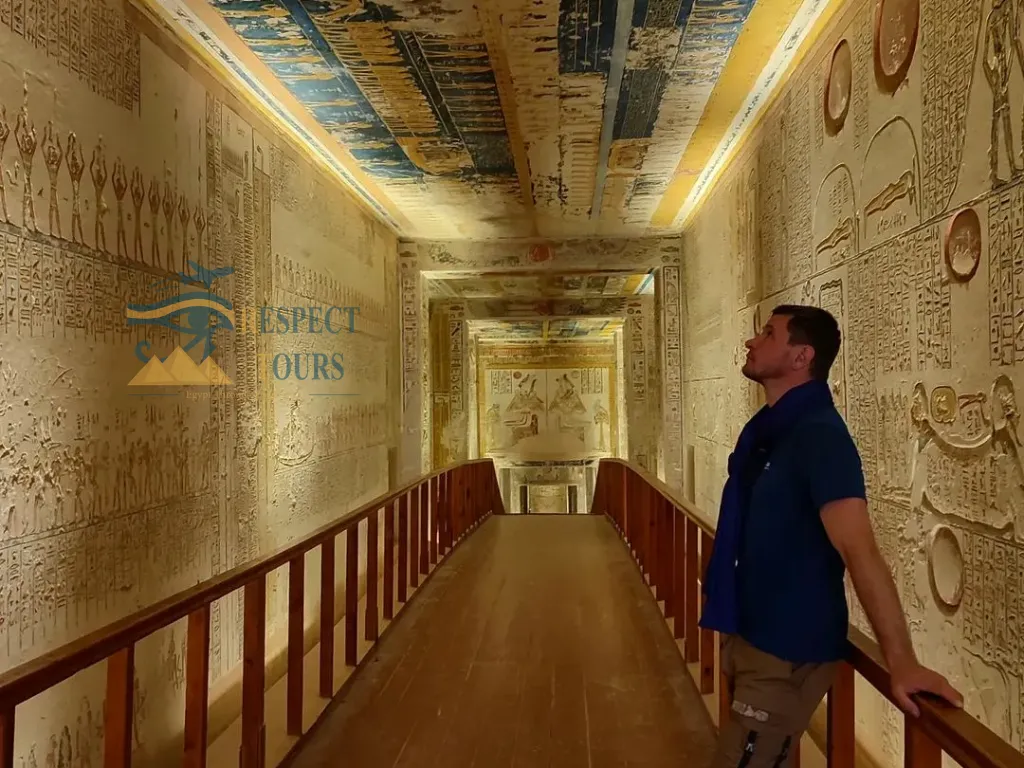
- Highlights: The star is the burial chamber’s ceiling, a double image of the sky goddess Nut swallowing and rebirthing the sun. The walls are covered with complete versions of the Book of Gates and Book of Caverns in vibrant detail.
- Physical Difficulty: Moderate. A long, straight corridor with a gentle slope and some stairs.
- Ticket: Requires a separate, additional ticket.
Tomb of Ramesses III – KV11
- Owner: Ramesses III (20th Dynasty)
- Why it matters: Known as “Bruce’s Tomb” or “The Harper’s Tomb,” it is notable for its side chambers depicting scenes from daily life, not just religious texts.
- Highlights: Look for the chambers showing bakers, brewers, boat-makers, and the famous scenes of two blind harpists. It has a unique bent-axis design for the first part of the tomb before straightening out.
- Physical Difficulty: Moderate. It’s long, but the descent is mostly gradual.
Tomb of Ramesses IV – KV2
- Owner: Ramesses IV (20th Dynasty)
- Why it matters: One of the most accessible and well-preserved tombs, often on the standard ticket. Its plan was inscribed on a papyrus which still survives in Turin.
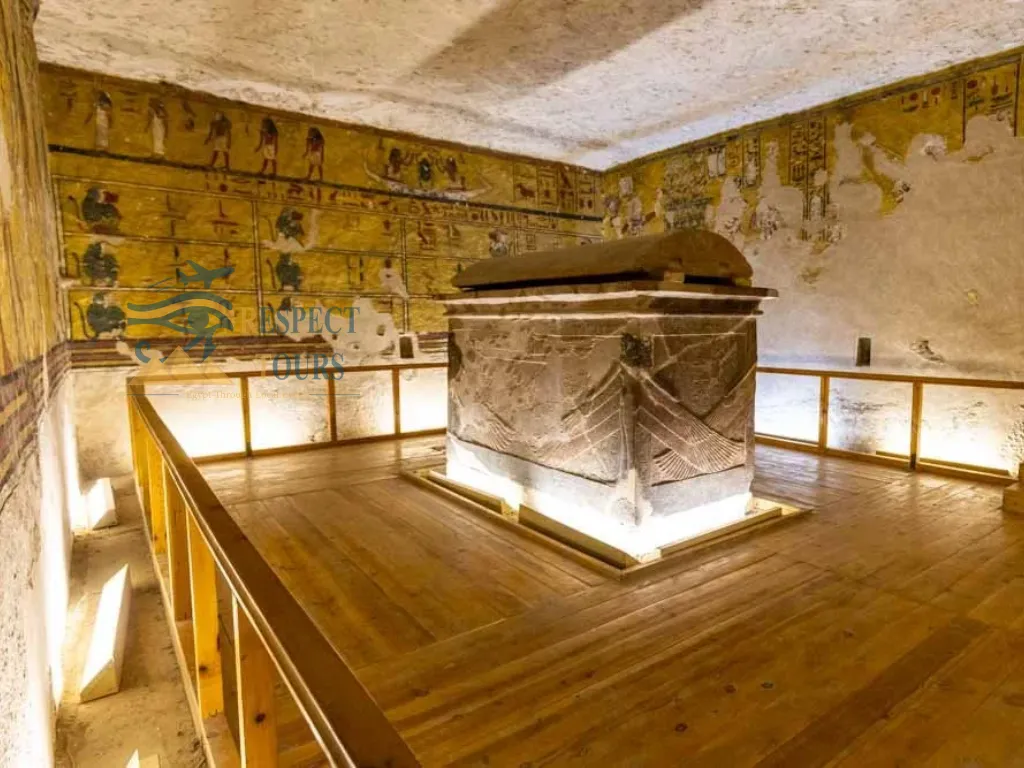
- Highlights: Wide corridors and vibrant yellow-dominant decoration. It contains the second-oldest known map. The huge granite sarcophagus is still in place in the burial chamber.
- Physical Difficulty: Low to moderate. Relatively short and straightforward.
Planning Your Valley of the Kings Visit
A little planning goes a long way to ensuring a comfortable and rewarding experience.
Opening Hours and the Best Time to Arrive
The Valley of the Kings is typically open from 6:00 AM to 5:00 PM in winter and slightly longer in summer, but hours can change. The best time to visit is right at opening time. By arriving early, you avoid the worst of the midday sun (there is very little shade) and the large tour bus crowds that arrive from 9:30 AM onwards. An afternoon visit after 3:00 PM can also be quieter.
How Long Do You Need at the Valley of the Kings?
Plan for at least 2 to 3 hours. This gives you enough time to travel from the visitor centre to the tombs on the electric shuttle (taf-taf), see your chosen three tombs without rushing, and perhaps add an extra-ticket tomb. If you are a serious Egyptology enthusiast, you could easily spend half a day here.
Photography Rules Inside the Tombs
Photography rules have changed in recent years. Currently, you can take photos with your mobile phone inside the tombs on the standard ticket without flash. Using a professional camera (DSLR, etc.) requires a separate photography pass, which can be expensive. Flash photography is strictly forbidden everywhere as it causes irreversible damage to the paintings. These rules are subject to change without notice.
What to Wear and Bring
- Comfortable shoes: You will be doing a lot of walking on uneven ground and climbing stairs.
- Breathable clothing: Lightweight, loose-fitting clothes made of cotton or linen are best. Shoulders and knees should be covered out of respect and for sun protection.
- Sun protection: A wide-brimmed hat, sunglasses, and high-SPF sunscreen are essential.
- Water: Bring more than you think you will need. You can buy it at the visitor centre, but it’s cheaper to bring your own.
- Small cash: For tips for washroom attendants or buying drinks.
Heat, Shade, Toilets, and Visitor Facilities
The Valley is an exposed, sun-baked wadi. Shade is almost non-existent outside of the visitor centre and the tombs themselves. The modern visitor centre has clean toilets, a small museum exhibit, a 3D model of the valley, and a cafe. An electric shuttle train (the taf-taf) transports visitors from the centre to the tomb area for a small fee, which is highly recommended to save energy.
Accessibility, Stairs, and Claustrophobia
The Valley of the Kings presents challenges for visitors with mobility issues. The site itself is expansive, and while the taf-taf helps, there is still walking involved. Every tomb has a ramp or staircase of varying length and steepness. Some, like KV2 (Ramesses IV), are relatively flat and accessible. Others, like KV17 (Seti I), are extremely deep with hundreds of steps.
For those with claustrophobia, the long, narrow corridors descending deep underground can be triggering. If this is a concern, stick to shorter, wider tombs and avoid the busiest times of day.
Is the Valley of the Kings Safe for Solo Female Travellers?
Yes, the Valley of the Kings is generally a safe and well-policed tourist site. However, as with any major attraction in Egypt, taking some sensible precautions will ensure a more comfortable experience.
- Visit with a Guide: Hiring a qualified guide or joining a small tour, like those offered by Respect Tours on the West Bank, is highly recommended. A guide provides invaluable historical context and also acts as a cultural buffer, helping to manage interactions with vendors and deflecting unwanted attention.
- Dress Conservatively: While Luxor is a tourist hub, dressing modestly (covering shoulders and knees) shows respect for the local culture and will help you feel more comfortable and less conspicuous.
- Pre-arranged Transport: Arrange your taxi or tour vehicle in advance. This avoids having to negotiate prices on the street and ensures you have a reliable driver waiting for you.
- Dealing with Vendors: You may encounter persistent vendors or individuals offering unofficial “help” at the site entrance. A polite but firm “No, thank you” (or “La, shukran”) is usually sufficient. Your guide will handle this for you.
Valley of the Kings vs. Valley of the Queens
While both are royal necropolises on the West Bank, they served different purposes and offer different experiences.
| Feature | Valley of the Kings | Valley of the Queens |
|---|---|---|
| Primary Burials | New Kingdom Pharaohs (e.g., Tutankhamun, Ramesses II, Seti I). | Wives of Pharaohs, princes, princesses, and some high-ranking nobles. |
| Scale & Size | Larger valley with over 60 known tombs; tombs are generally longer and deeper. | Smaller site with around 90 known tombs; tombs are typically smaller and less complex in layout. |
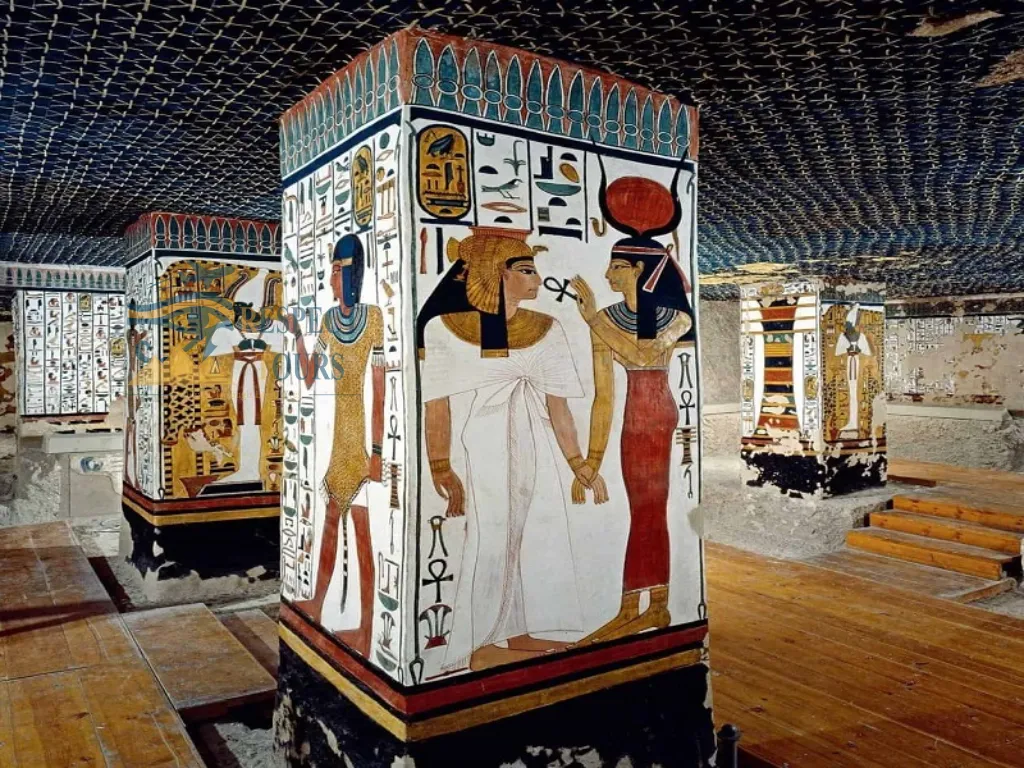
| Star Attraction | The historically significant Tomb of Tutankhamun (KV62) and the artistic Tomb of Seti I (KV17). | The breathtakingly beautiful Tomb of Nefertari (QV66), often considered the finest tomb in all of Egypt. |
| Recommendation | Essential for anyone interested in the pharaohs and the grandeur of royal afterlife beliefs. | A must-visit if you appreciate exceptional art and want to see Nefertari’s tomb (requires a very expensive extra ticket). |
What Else Can You Visit Near the Valley of the Kings?
A visit to the Valley of the Kings is usually part of a full-day exploration of Luxor’s West Bank. Other essential sites include:
- Temple of Hatshepsut: A stunning terraced mortuary temple dedicated to one of Egypt’s few female pharaohs.
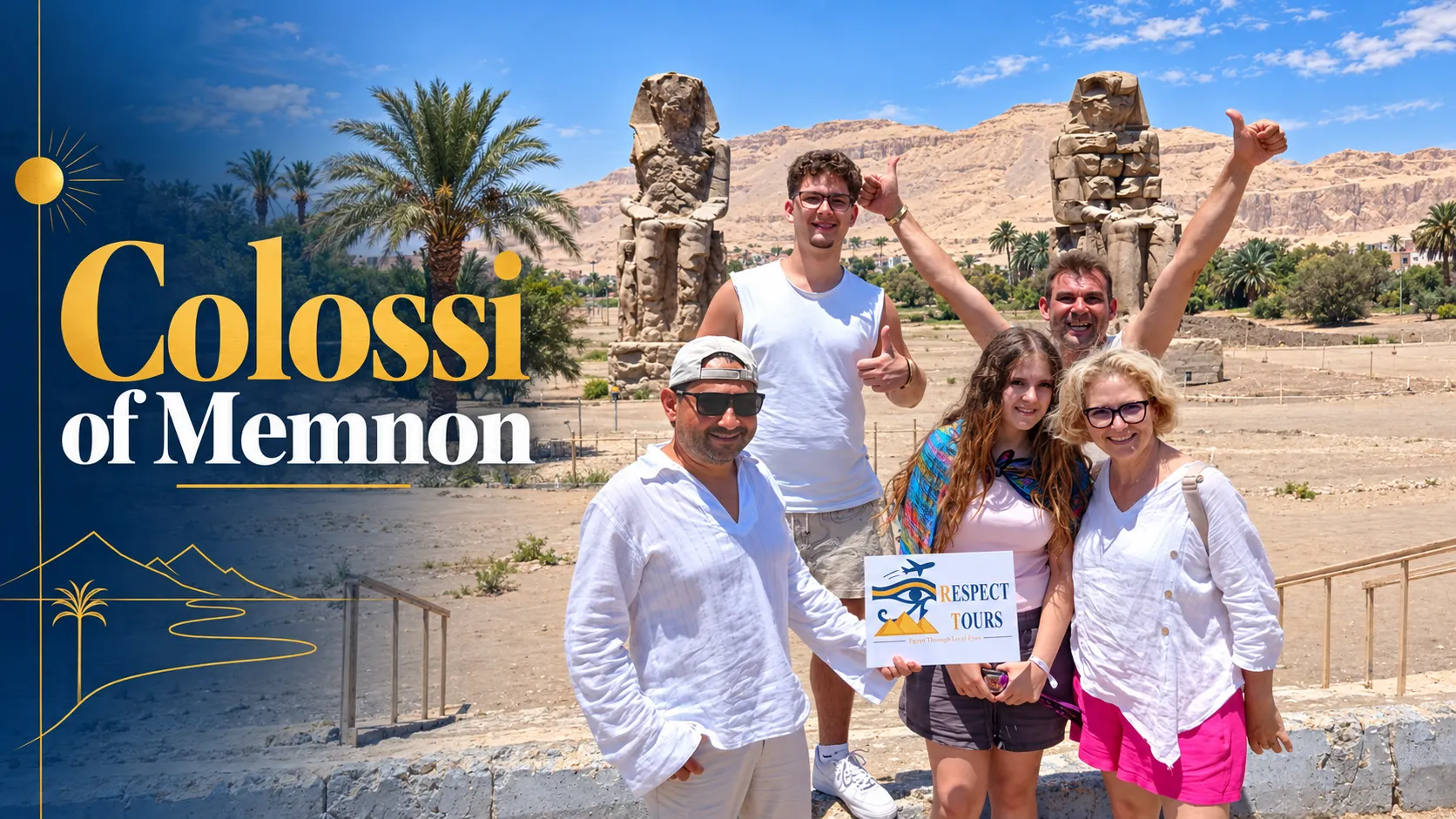
- Colossi of Memnon: Two massive stone statues of Pharaoh Amenhotep III that once guarded his now-vanished mortuary temple. They are the first monument you’ll see when crossing to the West Bank.
- Medinet Habu: The mortuary temple of Ramesses III, known for its massive scale and well-preserved military reliefs.
- Deir el-Medina: The village where the artisans and craftsmen who built the royal tombs lived. You can visit their own beautifully decorated (and often humorous) tombs.
Is the Valley of the Kings Worth It?
Absolutely. It is one of the most important archaeological sites on the planet. Walking down into the tombs, you are not just looking at ancient art; you are stepping directly into the pharaoh’s concept of eternity. The vibrant colours, the detailed hieroglyphs telling stories of gods and monsters, and the sheer scale of the undertakings are awe-inspiring. No visit to Egypt is complete without experiencing the profound history and artistry of the Valley of the Kings.
See the Tombs with an Expert Eye: A Respect Tours Option
Simply seeing the tombs is one thing; understanding them is another. The stories behind the paintings—the journey through the twelve hours of the night, the judgement of the soul, the rebirth with the sun god Ra—come alive with an expert Egyptologist.
Our popular private tour of Luxor’s West Bank includes a dedicated visit to the Valley of the Kings. With this package, you can expect:
- An accredited Egyptologist guide: To explain the history, help you choose the best three tombs open on the day, and decipher the complex art and hieroglyphs.
- Private, air-conditioned transport: We pick you up from your hotel or cruise ship and handle all the logistics, so you can focus on the experience.
- A flexible itinerary: The tour also includes visits to the Temple of Hatshepsut and the Colossi of Memnon, with timings adjusted to your pace.
- Entrance fees included: We handle the standard entry tickets for all scheduled sites. (Note: Extra-ticket tombs like Tutankhamun’s or Seti I’s can be added upon request).
Conclusion
The Valley of the Kings is more than a collection of tombs; it’s a library of ancient belief, a testament to royal power, and an art gallery hidden beneath the desert. Descending into these corridors, you walk the same path the pharaoh’s soul was believed to take on its journey to eternal life. To fully appreciate the layers of meaning in every scene and symbol, exploring with an expert who can bring the stories to life is essential. Let a local guide show you the secrets of the pharaohs and experience Egypt through local eyes.
Ready to walk in the footsteps of pharaohs? Browse our expertly guided Luxor day tours and secure your journey into the ancient world.
Frequently Asked Questions About the Valley of the Kings
Which three tombs should I choose in the Valley of the Kings?
A great strategy is to choose a variety. On the standard ticket, aim for one large Ramesside tomb like Ramesses IV (KV2) for its classic layout, a tomb with unique art like Tausret/Setnakht (KV14), and a third recommended by your guide for its good preservation. An Egyptologist will know the best options open on the day of your visit.
Is Tutankhamun’s tomb included in the standard ticket?
No, the Tomb of Tutankhamun (KV62) is not included in the standard Valley of the Kings ticket. It requires a separate, additional ticket that must be purchased at the main ticket office before you enter the valley.
Is the Tomb of Seti I worth the additional ticket?
For those deeply interested in ancient Egyptian art, the Tomb of Seti I (KV17) is absolutely worth the high price of its extra ticket. The quality, detail, and preservation of its reliefs are considered the peak of New Kingdom artistry. However, it is very long and deep, so consider the physical demand and your budget.
Which tomb has the best paintings?
This is subjective, but many experts agree the Tomb of Seti I (KV17) has the most artistically refined and beautiful paintings (technically raised reliefs). For vibrant colours and dramatic celestial scenes on a single ticket, the Tomb of Ramesses V and VI (KV9) is another top contender. Both require special tickets.
Is the Valley of the Kings worth visiting?
Yes, unequivocally. It is one of the world’s most significant archaeological sites. Standing inside a 3,000-year-old tomb, surrounded by vibrant art detailing the journey to the afterlife, is a profound experience that connects you directly to the beliefs and grandeur of ancient Egypt.
Can I buy Valley of the Kings tickets online?
The Egyptian government has been implementing an online ticketing system, but its availability and reliability can be inconsistent. It is currently safest and most common to buy tickets in person at the site’s official ticket office upon arrival. Your tour operator, like Respect Tours, will handle this for you.
How long does a visit to the Valley of the Kings take?
Plan to spend approximately 2 to 3 hours. This allows enough time for the shuttle ride from the visitor centre, exploring your three chosen tombs at a comfortable pace, and taking photos. If you add extra-ticket tombs or are a history enthusiast, you might need longer.
Is the Valley of the Kings suitable for seniors or those with knee problems?
It can be challenging. While the site is mostly flat, every tomb involves a ramp or staircase, some of which are very long and steep. Tombs like Ramesses IV (KV2) are shorter and more accessible. It’s best to consult with your guide to select the least strenuous tombs and take the electric shuttle to save energy.