
Siwa Oasis is one of Egypt’s most extraordinary destinations. Located around 750 kilometers west of Cairo and just 50 kilometers from the Libyan border, this remote desert oasis feels completely different from anywhere else in the country. Here, you’ll find the ancient Oracle Temple consulted by Alexander the Great, crystal-clear salt lakes, historic mud-brick settlements, and a unique Amazigh (Berber) culture that has preserved its language, traditions, and architecture for generations.
Surrounded by palm groves, natural springs, salt lakes, and the vast dunes of the Western Desert, Siwa offers a side of Egypt that many travelers never experience. It’s a destination where history, nature, and local culture come together in a way that feels both authentic and unforgettable.
In this Siwa Oasis travel guide, you’ll discover the best things to do, the most important historical sites, when to visit, how to get there from Cairo, where to stay, what to pack, and practical travel tips to help you plan your trip. At Respect Tours, we’ve been helping travelers explore Egypt since 1978, and this guide brings together the local knowledge and recommendations we share with our guests before they visit Siwa.
Where Is Siwa Oasis Located?
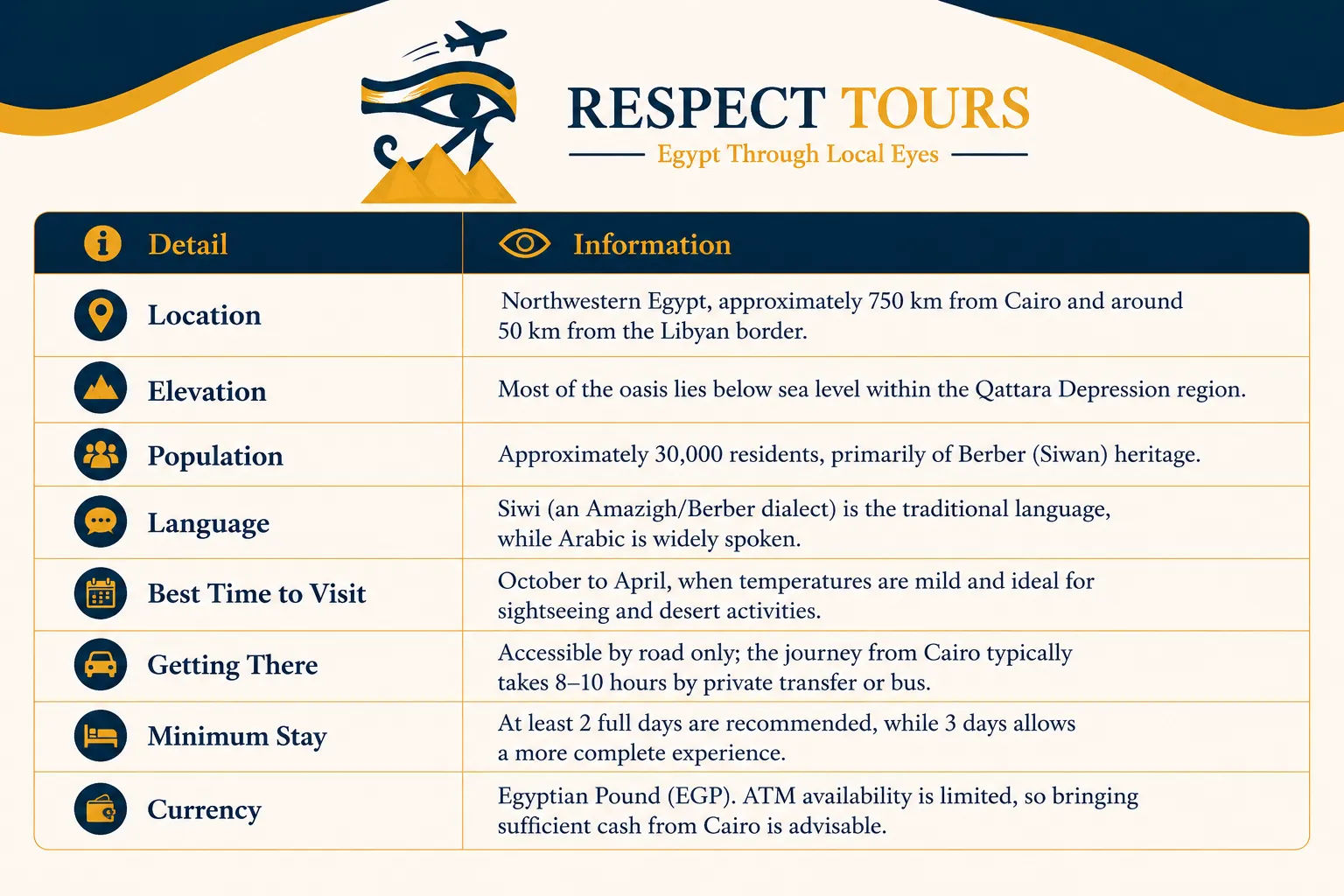
Siwa sits in the northwestern corner of Egypt’s Western Desert, in a depression that runs below sea level for much of its area. This geological position, inside the Qattara Depression, one of the lowest points in Africa, is what drives the abundance of natural springs.
There are over 200 freshwater springs across the oasis, and the combination of underground water and desert heat creates an agricultural pocket surrounded by hundreds of kilometres of open sand.
The nearest significant city is Marsa Matruh, about 300 kilometers north on the Mediterranean coast. Cairo is 750 kilometers east. There are no commercial flights. The paved road connecting Siwa to the rest of Egypt was only completed in 1926, which explains, better than anything else, why the culture here developed so differently from the rest of the country.
Is Siwa Oasis Worth Visiting? An Honest Assessment
Yes, but Siwa rewards specific kinds of travellers and frustrates others. It’s not a resort. There’s no nightlife in the conventional sense. The roads in and around the oasis are mostly unpaved. The Wi-Fi at some lodges is slow or nonexistent.
What Siwa offers instead: some of the clearest skies in Africa for stargazing, a desert landscape that changes character hour by hour, ancient ruins with almost no crowds, salt lakes you can float in, a community whose culture is genuinely distinct from anywhere else in Egypt, and the kind of quiet that’s become difficult to find in most places.
Reasons to Visit Siwa
- Ancient history: The Oracle Temple was consulted by Alexander the Great
- Turquoise salt lakes with effortless floating
- Great Sand Sea desert safari: dunes exceeding 100 metres
- Shali Fortress at sunset: one of Egypt’s most photogenic ruins
- The living Berber culture is found nowhere else in Egypt
- Dakrur Mountain panoramic views and sand baths
- Temple of Umm Ubayd and other rarely visited ruins
- Night sky with no light pollution: Milky Way clearly visible
- Cleopatra’s Spring: natural freshwater swim
- El Souq Square for local craft shopping
Reasons to Think Twice
- 8–10 hour road journey from Cairo, no flights
- Very few ATMs; cash must be brought from Cairo
- Patchy internet in outlying areas and the desert
- No conventional nightlife or entertainment venues
- Not suited to travellers with fewer than 2 full days
- Requires conservative dress outside the oasis pools
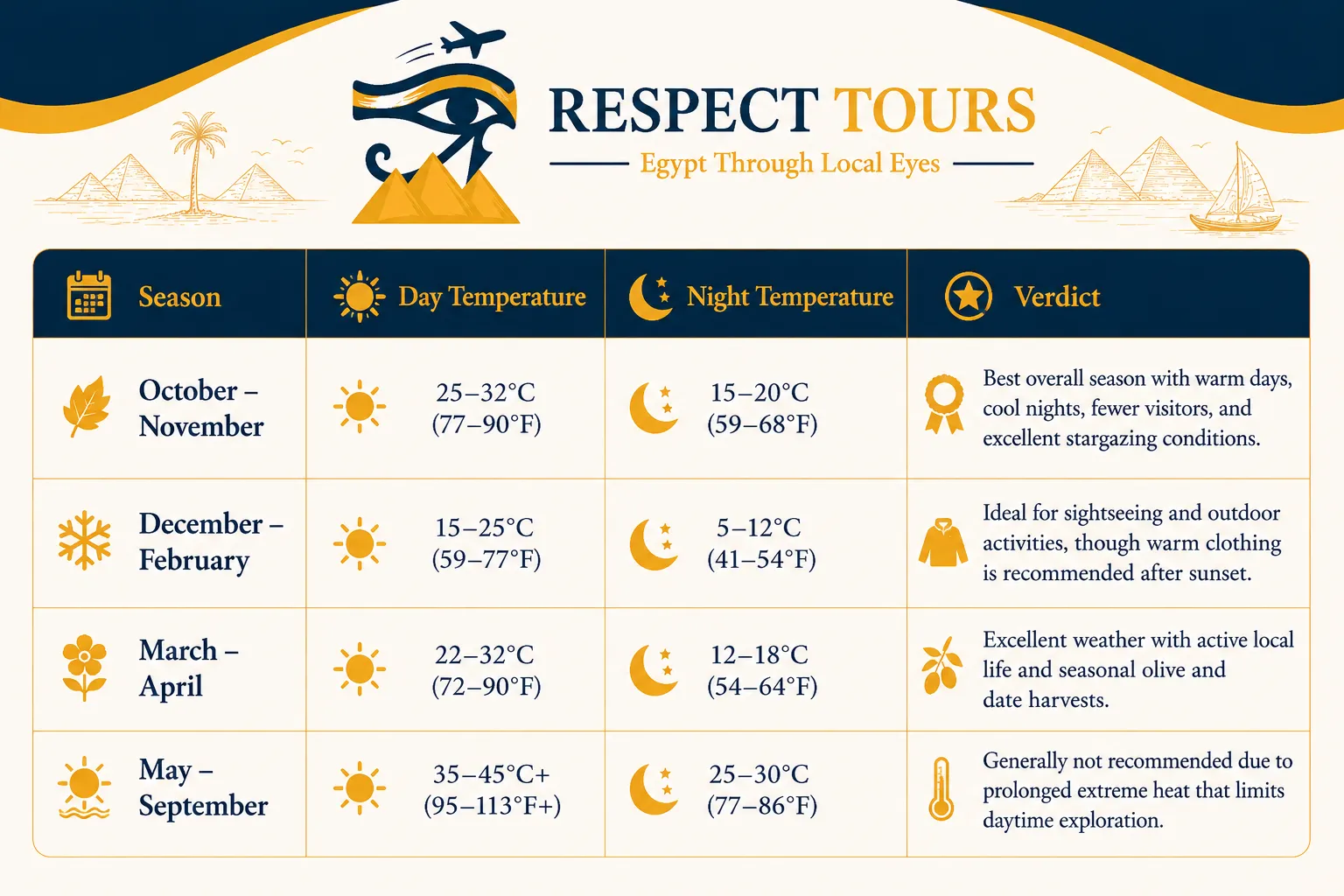
When Is the Best Time to Visit Siwa Oasis?
💡 Booking Note
Siwa has a limited number of quality lodges and eco-camps. Adrère Amellal, the most-requested property in the oasis, books out months ahead in peak season. If accommodation matters to you, book it before you book flights.
What Is Siwa Oasis Famous For?
Siwa is known internationally for several things, most of which are genuinely unusual:
- The Oracle of Amun: the temple where Alexander the Great received confirmation of his divine destiny in 331 BCE; one of the most historically significant sites in the Western Desert
- The Shali Fortress: a 13th-century mud-brick old town dissolving slowly back into the earth, extraordinary at sunset
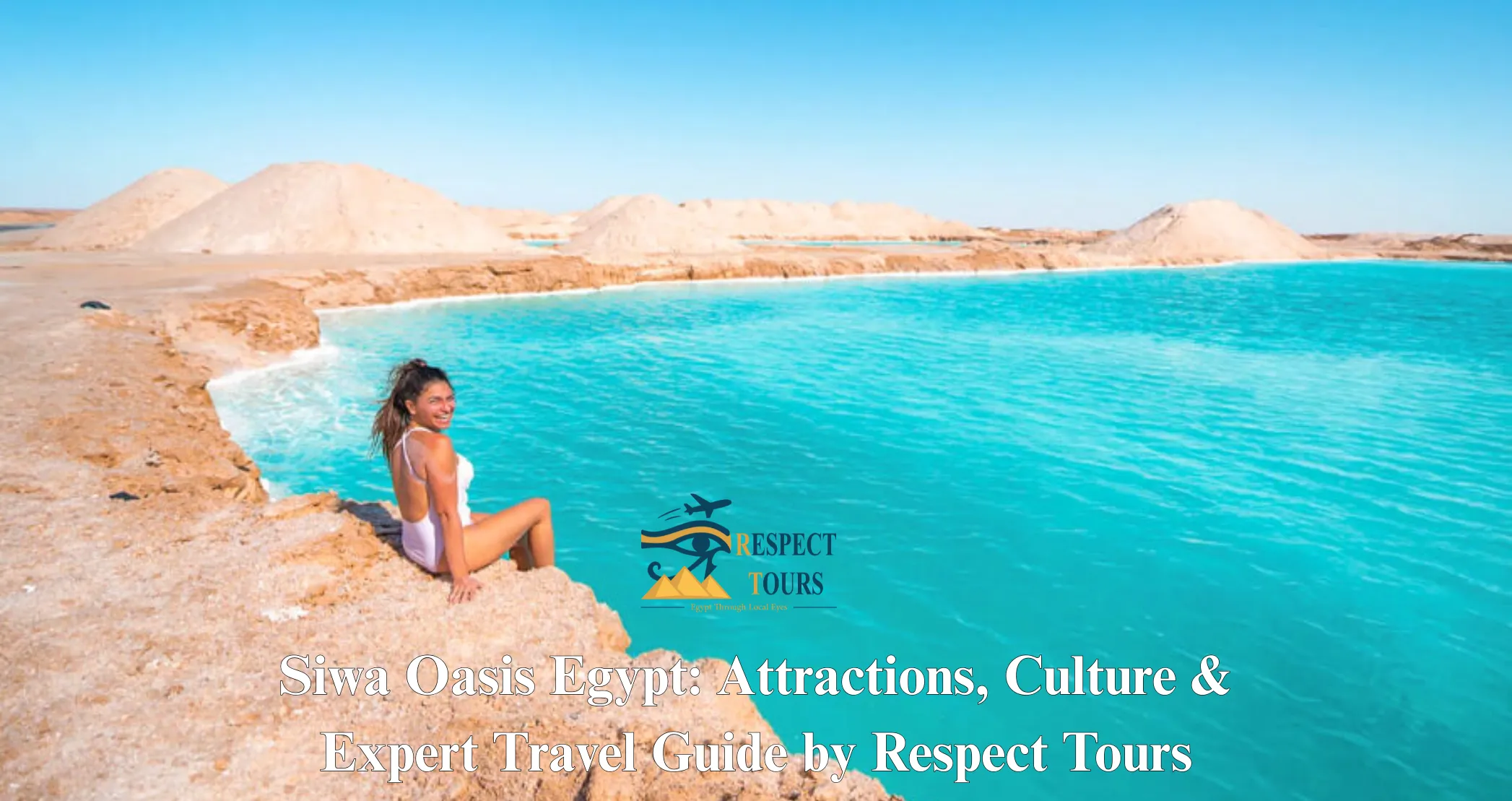
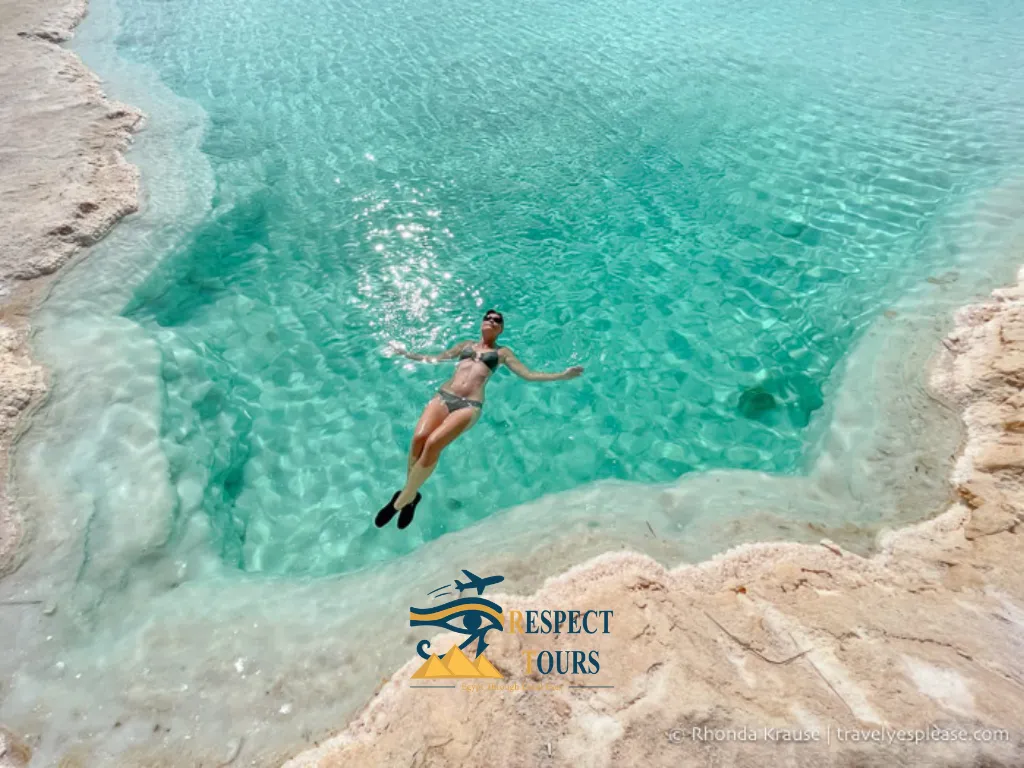
- The salt lakes: hyper-saline turquoise water that makes you float without effort, surrounded by desert
- The Great Sand Sea: one of the largest continuous dune fields on Earth, stretching across the Egypt-Libya border
- Cleopatra’s Spring (Ain Guba): a natural freshwater pool surrounded by palms, cool even in summer
- Living Berber culture: the Siwi language, traditional embroidery, and Amazigh customs that survived intact because the town was inaccessible until less than a century ago
- The Mountain of the Dead (Gabal al-Mawta): a hill riddled with rock-cut tombs from the 26th Dynasty, with some of the best-preserved wall paintings in the Western Desert
Top Things to Do in Siwa Oasis
The Shali Fortress
The Shali is the medieval heart of Siwa, a 13th-century mud-brick citadel built from karsheef, a local material made from salt-rich mud and rock found only in this region. At its peak, it housed thousands of residents. Heavy rains in 1926 collapsed much of it.
What remains rises above the modern town like a salt-mud sculpture, part ruin, part geological formation.
Arrive 30 minutes before sunset. The amber light at that hour turns the walls a color that photographs struggle to capture. Climb the accessible sections for a panoramic view over the oasis, the salt lakes, and the dunes beyond.
Temple of the Oracle (Temple of Amun): Aghurmi
The ruins of the Oracle Temple sit on Aghurmi hill, elevated above the surrounding oasis with views across the salt lakes and palms. Alexander arrived here in 331 BCE after a week-long desert crossing from the Mediterranean coast.
The oracle’s chamber is partially intact. Standing inside it, knowing who stood there before you, is one of those moments that makes the 750-kilometer journey feel immediately worthwhile.
📋 Practical Info
Entrance: approximately 100 EGP for foreign visitors. Open daily 9:00 AM – 5:00 PM. Verify current fees locally; they change periodically.
Temple of Umm Ubayd
A short walk from the Oracle Temple, the Temple of Umm Ubayd is a largely overlooked site from the same ancient complex at Aghurmi. Only one decorated wall survives, but the inscriptions and reliefs on it are well-preserved.
Most visitors walk straight past it on the way to the main oracle, which means you’ll often have it to yourself. For anyone interested in archaeology, it’s worth 20 minutes.
Cleopatra’s Spring (Ain Guba)
Ain Guba is a natural freshwater spring enclosed in a stone pool surrounded by date palms. The water is cool and clear.
Whether Cleopatra actually bathed here is unverifiable, but the spring is genuinely pleasant, and the combination of a morning swim here followed by a visit to the Shali makes for a good half-day. Several small cafes nearby serve fresh juice and light food.
The Salt Lakes: Siwa’s Turquoise Pools
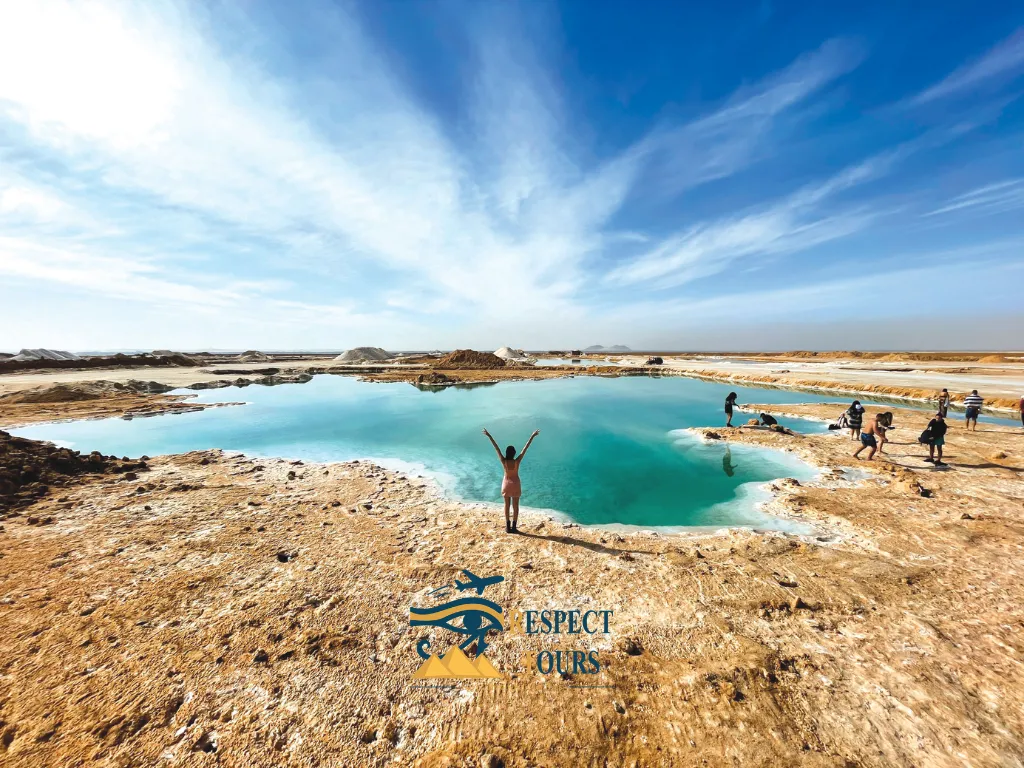
Siwa’s salt lakes are some of the most visually striking natural features in Egypt. The water is a brilliant turquoise, the salinity is high enough to float in without effort, and the surrounding landscape of sand and palms makes the setting unusual enough that photos from here rarely look like they were taken in Egypt.
Fatnas Island, accessible by a short causeway, is the best vantage point for sunset over the lakes. Bring water to rinse off afterwards; the salt dries on the skin. Mid-morning and late afternoon offer the best light.
Dakrur Mountain (Gabal Dakrur): Panoramic Views and Sand Baths
Dakrur Mountain is a sandstone hill on the eastern edge of the oasis, with broad views over Siwa and the surrounding desert. It’s known locally for two things: the panorama from the top and sand baths, a traditional Siwan therapy in which you’re buried up to the waist in the hot desert sand.
Local guides offer this at the base of the hill. Whether or not you want to try the sand bath, the climb is worth it for the views.
Mountain of the Dead (Gabal al-Mawta)
A conical hill on the northern edge of the oasis, riddled with rock-cut tombs from the 26th Dynasty (664–525 BCE) and the Greco-Roman period.
The Tomb of Si-Amun has some of the best-preserved painted ceiling reliefs in the Western Desert, Egyptian motifs alongside Greek influence, which tells you something about Siwa’s position at the intersection of cultures.
Great Sand Sea Desert Safari
The Great Sand Sea begins just outside the oasis and stretches west across the Egypt-Libya border, one of the largest dune fields on Earth. A full-day 4WD safari into this landscape is the defining outdoor activity in Siwa. The dunes in some areas exceed 100 meters. The drive involves a lot of dune-crossing, which is more dramatic than it sounds.
Most full-day safari itineraries include sandboarding on the steep dune faces, a stop at Ein Dakrour (desert hot and cold springs), and a Bedouin camp dinner as the evening temperature drops. The night sky out there has no competition from artificial light in any direction.
El Souq Square: Shopping in Siwa
El Souq Square is the central market area of Siwa town, the best place to buy local crafts directly from the people who make them. What to look for:
- Siwan embroidery: intricate needlework by local women, in patterns specific to Siwa; buy directly from artisan workshops rather than tourist shops
- Traditional silver jewellery: handmade, with Siwan geometric motifs distinct from mainstream Egyptian styles
- Cold-pressed olive oil and dates: Siwa’s olive oil is among Egypt’s finest; dates here are a serious agricultural product, not a tourist item
- Salt crystals and bath products: from the salt lakes, widely available
Polite haggling is acceptable in the smaller shops. Approach it with goodwill; this is a community, not a market for bargaining sports.
Siwa House Museum
A traditional Siwan home converted into a small cultural museum covering local dress, jewelry, tools, agricultural practices, and customs. It’s a useful first stop to build context before visiting the sites. Allow 45 minutes.
7-Day Cairo, Alexandria & Siwa Oasis Tour
Cairo, the Mediterranean coast, and Siwa combined in one complete itinerary. Private transport and expert guide throughout.
What to Do at Night in Siwa Oasis
Siwa has no bars, no clubs, and very little artificial light outside the town center. The nights here are genuinely dark. That’s not a limitation; it’s one of the main reasons to come.
- Camp under the Milky
Way in the Great Sand Sea: the desert sky here is among the clearest in Africa. A Bedouin camp dinner followed by two hours of stargazing is an experience most travellers rank as a highlight of their entire Egypt trip. No telescope needed.
- Watch the sunset from the Shali Fortress.
The salt-mud walls turn amber and gold as the sun drops behind the dunes. The light lasts about 20 minutes. Get there early enough to climb to the upper section.
- Desert safari evening with Bedouin camp dinner
Most full-day safari itineraries end at a camp in the open desert, with dinner cooked over a fire and a sky that’s genuinely impossible to ignore.
Top 10 Best Places to Visit in Egypt in Summer
Siwa Oasis Culture and Traditions
The Siwan people are primarily of Amazigh (Berber) origin. Their language, Siwi, is a distinct Berber dialect, unrelated to Arabic, and is still the first language of most residents. It survived because Siwa spent most of its history cut off from the surrounding world.
A few things worth understanding before you arrive:
- Language: Siwi (Amazigh) is spoken at home; Arabic is used with outsiders. Very little English outside the tourist lodges.
- Crafts: Women’s embroidery, basket-weaving, and rug-making are living traditions, not tourist reconstructions. The patterns are specific to Siwa and serve as markers of community identity.
- Festivals: The date and olive harvests (March–April) are genuine community events. If you’re there during this period, ask your guide about local celebrations.
- Family structure: Extended family ties are strong. Community decisions are made collectively. Visitors who show awareness of this tend to receive a very different quality of welcome.
- Architecture: Traditional Siwan homes are built from karsheef, the same salt-mud material as the Shali Fortress. Modern construction has replaced most of it in the town center, but older neighborhoods and outlying villages still use it.
- Alcohol: Not available in Siwa. The community is conservative in this respect. Don’t ask for it.
Cultural Etiquette
- Dress conservatively outside the oasis pools and your lodge, with covered shoulders and knees for everyone.
- Ask permission before photographing people; many residents are uncomfortable with cameras, particularly women.
- Don’t approach Bedouin camps or private family homes without a guide introduction.
Food in Siwa
Siwan cooking uses what the oasis produces: slow-cooked lamb or chicken tagines with local herbs, fresh-baked flatbreads, dates from the palms immediately outside town, and olive oil pressed from local groves.
The quality of both is high; Siwa’s olives and cold-pressed oil are among the best in Egypt.
- Tagine: the standard meal at most local restaurants; slow-cooked stew with bread or rice
- Date juice: fresh, naturally sweet, served cold at local cafes; try it at least once
- Siwan olives and olive oil: available in the souq; an excellent thing to bring home if you can pack it carefully
Is Siwa Oasis Safe for Tourists?
Yes. Siwa is consistently one of Egypt’s lowest-risk destinations for international travellers. Its location, 750 kilometers from Cairo, deep in the Western Desert, places it far outside any areas flagged in US State Department, UK FCDO, or Global Affairs Canada travel advisories.
Tourism is central to the local economy, and visitors are treated accordingly. Solo female travellers do visit Siwa successfully; the key factor is conservative dress outside the oasis pools, which changes the quality of interactions noticeably.
💬 From Our Clients
“We felt more at ease here than in some major European cities. The Siwan people are genuinely kind and respectful.” Sarah & Michael, Toronto
Standard travel precautions apply:
- Bring enough cash: ATMs are scarce and not always working
- Download offline maps before leaving Cairo; mobile data is patchy outside the main town
- Book a licensed guide for desert excursions: the landscape is disorienting without local knowledge
Siwa Oasis 3-Day Itinerary
Three days is the minimum for a complete experience, two full days of sightseeing plus the Great Sand Sea safari. Four days allow for a genuinely unhurried pace.
Below is a practical framework; your guide will adjust for season and personal priorities.
Day 1: Arrival + Old Town
Cairo Departure → Siwa → Shali at Sunset
Depart Cairo by 7:00 AM. The drive takes you through the Qattara Depression and into the Western Desert; it’s worth staying awake for the last two hours as the landscape shifts into oasis territory.
Arrive at Siwa by 4–5 PM. Check in, then walk to the Shali Fortress for the last 30 minutes of light. Evening tea on Fatnas Island overlooking the salt lakes.
Day 2 — History + Water
Oracle Temple → Mountain of the Dead → Springs → Salt Lakes
Start early at the Temple of the Oracle at Aghurmi (9:00 AM, before the heat builds). Continue to the nearby Temple of Umm Ubayd, 20 minutes away, and usually empty.
Cross to the Mountain of the Dead for the tomb paintings. Afternoon: swim at Cleopatra’s Spring, then drive to the salt lakes for a float. Sunset from Fatnas Island.
Day 3 — Desert
Full-Day Great Sand Sea Safari + Bedouin Camp Dinner
Full day in the Great Sand Sea by 4WD. Sandboard on the large dunes, stop at Ein Dakrour (desert hot and cold springs), and have lunch in the open desert.
As the afternoon cools, have a Bedouin camp dinner under the open sky. The night sky out here, with no artificial light in any direction, is the finale most travellers remember longest. Return to Siwa or depart for Cairo.
7-Day Cairo, Alexandria & Siwa Tour
The full Western Desert and Mediterranean circuit, private transfers, expert guide, and hand-picked accommodation.
Tailor Your Siwa Itinerary
Tell us your dates and priorities, and we’ll build the trip around you.
What to Pack for Siwa Oasis
Clothing
- Loose, breathable fabrics: linen or cotton; essential in any season
- Long trousers and long skirts for site visits and walking in the town
- Light scarf or shawl: for entering sites and cooler evenings
- Warm layer: winter nights drop to 5–10°C; spring evenings can be cool
- Closed shoes or trainers for dune walking and uneven terrain at ruins
- Swimwear: for the salt lakes, Cleopatra’s Spring, and the Oasis Hotel pools
Practical Essentials
- Cash in EGP: Siwa has very few ATMs; bring what you’ll need for the entire stay from Cairo
- High-SPF sunscreen: Desert sun is intense even in October and March
- Refillable water bottle: hydration is critical; bottled water is available everywhere
- Offline maps: download Google Maps or Maps. Me for the Siwa area before leaving Cairo
- Powerbank: Adrère Amellal has no electricity; other lodges may have limited charging
- Camera with extra batteries: the desert safari and night sky are the obvious targets; charge everything before going into the Great Sand Sea
- Reef-safe insect repellent: mosquitoes around the springs and salt lakes in spring and autumn
⚠️ ATM Warning
Siwa has very limited banking infrastructure. The few ATMs in town are unreliable and sometimes empty. Bring all the Egyptian Pounds you’ll need for accommodation, food, entrance fees, guides, and shopping from Cairo. Cards are not widely accepted outside the larger lodges.
Plan Your Siwa Oasis Trip with Respect Tours Egypt
The 750-kilometer drive from Cairo is not a barrier. It’s the beginning of the experience. By the time you arrive, the distance has already separated Siwa from the rest of Egypt, physically and atmospherically. That separation is the point.
We’ve been organizing Siwa trips since before the oasis appeared on most international travellers’ radars. We handle the private transfer, the licensed local guide, the accommodation (including Adrère Amellal bookings), the Great Sand Sea safari with vetted operators, and the itinerary, adjusted for your dates, pace, and interests.
Ministry of Tourism licensed. IATA-affiliated. Trusted by over 140,000 travellers from the US, UK, and Canada since 1978.
7-Day Cairo, Alexandria & Siwa Tour
The full Western Desert circuit, Cairo highlights, Mediterranean coast, and Siwa. Private and fully managed.
Tailor-Made Siwa Itinerary
Tell us your dates and what matters to you, and we’ll build the trip around that.
All Egypt Tour Packages
Nile cruises, Cairo, Luxor, Aswan, and Siwa combined itineraries from 5 to 14 days.
📞 Contact Us Directly
Phone/WhatsApp: +20 100 448 2045
Email: info@respecttours.com
FAQs About Siwa Oasis
Is Siwa Oasis safe for tourists?
Yes. Siwa is consistently regarded as one of Egypt’s safest destinations. Its remote location places it far from any areas covered by travel advisories. The local community is welcoming and protective of visitors.
How far is Siwa Oasis from Cairo?
Approximately 750 km (466 miles) by road – a journey of 8 to 10 hours depending on stops. There are no commercial flights. Respect Tours Egypt provides private air-conditioned transfers with English-speaking drivers.
What is the best time to visit Siwa Oasis?
October to April. Spring (March-April) and Autumn (October-November) offer the best balance of comfortable temperatures and atmosphere. Avoid June through August – temperatures regularly exceed 40°C.
Is there WiFi in Siwa Oasis?
Most guesthouses and eco-lodges have WiFi, though speeds vary. Adrère Amellal has none – and no electricity either. Mobile data is available in the main town but is limited in the desert. Download offline maps before you arrive.
Is Siwa Oasis worth visiting?
For the right traveler – yes, absolutely. If you value ancient history, raw desert landscapes, and genuine cultural immersion over infrastructure and convenience, Siwa will be one of the most memorable experiences of your time in Egypt.