


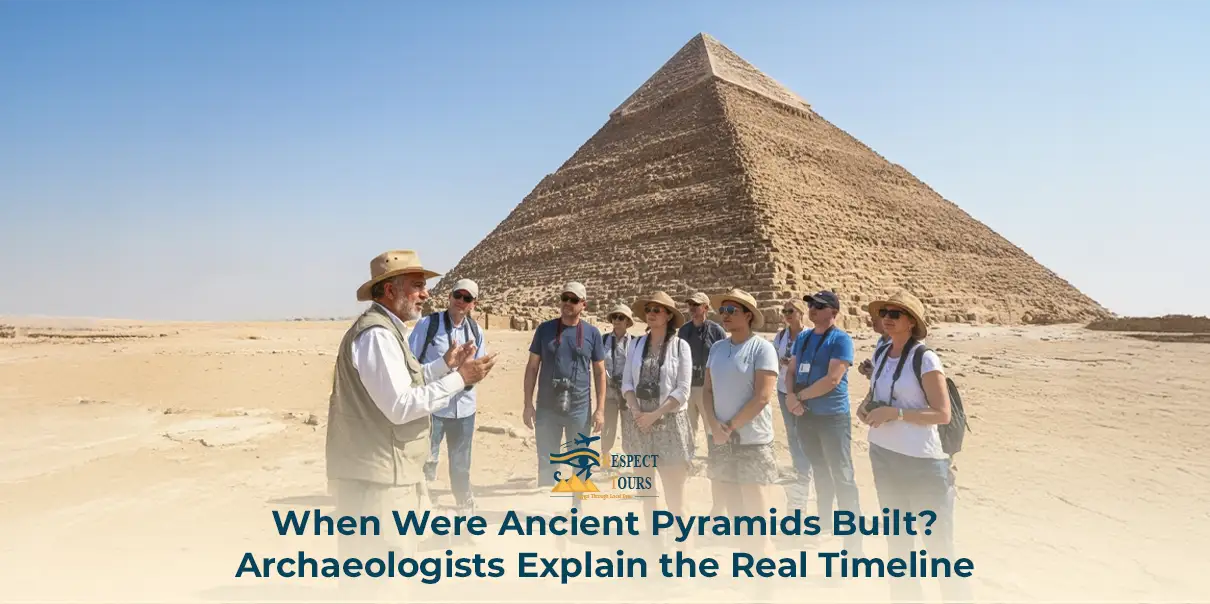
When were ancient pyramids built? Stand at the base of the Great Pyramid of Khufu, 2.3 million limestone blocks rising 146 meters into the Egyptian sky, and this question transforms from academic curiosity into visceral wonder. Were these monuments the work of Bronze Age pharaohs 4,500 years ago, or do they hide evidence of a far older, lost civilization dating back 12,000 years?
This guide breaks down the scientific timeline behind Egypt’s pyramids, showing how radiocarbon dating, worker villages, quarry marks, tools, and ancient papyri all converge on a clear answer: Egypt’s major pyramids were built between 2670 and 2520 BCE by known pharaohs like Djoser, Sneferu, and Khufu, not in 10,500 BCE.
With insights from Respect Tours’ Egyptologists, you’ll see the proof for yourself when you visit these ancient wonders.
By the time you finish this guide, you’ll understand not just when the pyramids were built, but how we know, and what debates remain.
Quick Answer: When Were Ancient Pyramids Built?

The ancient Egyptian pyramids were built between 2670-2520 BCE during the Old Kingdom period, specifically:
- 2670 BCE: Step Pyramid of Djoser (first pyramid)
- 2580-2560 BCE: Great Pyramid of Khufu
- 2558-2532 BCE: Pyramid of Khafre
- 2532-2503 BCE: Pyramid of Menkaure
Dating confidence: Confirmed through radiocarbon dating, archaeological evidence, contemporary papyri, and cross-cultural chronology. Margin of error: ±50-100 years.
When Were Ancient Pyramids Built According to Archaeological Evidence?
The Old Kingdom Timeline: Egypt’s Pyramid Era
The construction timeline of ancient Egyptian pyramids spans approximately 150 years of intensive monumental architecture development during the Old Kingdom timeline in Egypt, specifically Dynasty III through Dynasty IV.
Dynasty III: The Beginning (2670-2613 BCE)
The Step Pyramid of Djoser at Saqqara marks the revolutionary moment when ancient Egyptians transitioned from mastaba tombs to pyramid construction. Built around 2670 BCE under architect Imhotep’s direction, this structure initiated the pyramid construction period that would define Egyptian civilization.
Archaeological dating methods confirm this timeline through:
- Pottery sherds matching the Dynasty III typology
- Organic materials from construction debris
- Administrative seals bearing Djoser’s name
- Tool typology dating showing copper implement characteristics
Dynasty IV: The Golden Age (2613-2494 BCE)
When were the pyramids of Giza built? The Giza plateau dates all three major pyramids within 60 years during Dynasty IV:
- Sneferu’s Pyramids (2613-2589 BCE): The Bent Pyramid and Red Pyramid at Dahshur represent the first true smooth-sided pyramids, establishing construction techniques for Giza.
- Great Pyramid of Khufu (2580-2560 BCE): The largest pyramid ever constructed, containing 2.3 million limestone blocks. Worker graffiti and quarry marks definitively link this monument to Khufu’s reign.
- Khafre’s Pyramid (2558-2532 BCE): The second Giza pyramid, integrated with the Great Sphinx complex, demonstrates refined construction methods.
- Menkaure’s Pyramid (2532-2503 BCE): The smallest Giza pyramid marks the end of giant pyramid construction, concluding the peak pyramid construction period.
Did You Know?
The Great Pyramid of Khufu was the world’s tallest human-made structure for 3,800 years- until Lincoln Cathedral in England surpassed it in 1311 CE. No other building has held the “tallest” title for even half that long.
How Old Are the Ancient Pyramids? Scientific Dating Methods
Multiple archaeological dating techniques establish the age of the pyramids of Egypt with remarkable consistency.
Radiocarbon Dating and Calibration
Carbon-14 dating of organic materials provides scientific confirmation of the ancient construction timeline:
- Studies by Bonani, Haas, Hawass, Lehner, Nakhla, Nolan, Wenke, and Wölfli analyzed samples from multiple pyramids
- Mortar containing organic materials was tested across the Giza plateau
- Charcoal fragments from construction ramps
- Wood remnants from temporary structures
Results and Radiocarbon Calibration:
Initial radiocarbon dates showed readings approximately 374 years older than expected historical dates. However, this anomaly was explained by the “old wood effect”; ancient Egyptians often used timber that had died centuries before construction, having been preserved in Egypt’s dry climate. When calibrated for this factor, radiocarbon dates align precisely with Dynasty III-IV chronology.
The carbon-14 recalibration debate centers on whether samples were contaminated or represent genuine construction dates. Current consensus supports Old Kingdom dating after accounting for old wood and atmospheric carbon variations.
Archaeological Dating Techniques Beyond Radiocarbon
Old Kingdom Egypt dating relies on multiple converging methodologies:
- Pottery Typology: Ceramic styles evolved distinctly across dynasties, allowing precise chronological reconstruction through comparative analysis.
- Tool Typology Dating: Copper tool characteristics and manufacturing techniques changed over time, providing independent dating confirmation.
- Stratigraphy: Layer analysis at construction sites establishes relative dating sequences.
- Geological Dating of Giza Plateau: Bedrock analysis and erosion patterns confirm human activity concentrated during the Old Kingdom rather than earlier periods.
For a deeper dive into the captivating history of Egypt’s pyramids, be sure to check out the Amazing Facts About Ancient Pyramids in Egypt
The Wadi al-Jarf Papyri: Direct Evidence of When Ancient Pyramids Were Built

The most compelling archaeological evidence comes from the Merer diary, discovered at the Wadi al-Jarf harbor site on the Red Sea coast. These papyri represent the oldest known papyrus documents with substantial text.
What the Papyri Reveal:
Inspector Merer’s logbook documents daily operations during Khufu’s 27th year of reign, including:
- Transportation of limestone blocks from Tura quarries to Giza
- Workforce organization into crews (Egyptian: “izt”)
- Delivery schedules and construction logistics
- Direct mention of “The Horizon of Khufu” (the Great Pyramid’s name)
This contemporary documentation definitively answers “when were ancient pyramids actually built?”, during the exact reign periods attributed to specific pharaohs, not thousands of years earlier.
Carbon Dating Egypt’s Papyri:
The Wadi al-Jarf papyri themselves have been radiocarbon dated, with results confirming Dynasty IV origin around 2560 BCE, perfectly matching historical chronology.
Construction Methods: How Scientists Date Pyramid Building Techniques
Stone-Working Technology and Tool Dating
Archaeological excavations reveal the evolution of stone-working technology during the pyramid construction period:
Copper Tool Analysis:
- Copper chisels found at Giza quarries show distinctive Dynasty IV metallurgy
- Tool wear patterns match limestone quarrying techniques
- Copper residue analysis indicates specific alloy compositions used in the Old Kingdom
- The tool typology shows no evidence of more advanced cutting technology
Quarry Analysis and Abandonment Layers:
Modern archaeological dating techniques applied to quarry sites reveal:
- Sequential extraction patterns documenting construction phases
- Dated pottery sherds in quarry debris layers
- Organic materials (rope, wood wedges) from splitting operations
- Geological layers showing when quarrying activity stopped
Significantly, no evidence exists of quarrying activity during the period that alternative theories propose (10,500 BCE).
Worker Settlements Dating: Multiple Lines of Evidence
Excavations at worker villages near Giza provide extensive dating evidence:
Organic Materials from Barracks:
- Food remains (fish bones, cattle bones, grain) radiocarbon dated to Dynasty IV
- Cooking hearth charcoal consistently dates to the 2600-2500 BCE range
- Wooden structures and posts show construction-era dates
Ceramics and Pottery:
- Thousands of pottery fragments show Dynasty IV characteristics
- Beer jars with bakery seals matching Khufu’s reign
- Storage vessels matching Old Kingdom typology
- No ceramic evidence predating Dynasty III
Tool Assemblages:
- Copper implements consistent with Old Kingdom metallurgy
- Stone pounders and hammers showing period-specific design
- No anachronistic tools suggesting earlier or later periods
This multi-faceted archaeological evidence creates an overwhelming case for when the ancient pyramids were built, definitively during the Old Kingdom, not millennia earlier.
To further enrich your understanding of the pyramids’ origins, you can explore When Was the Great Pyramid at Giza Built?
How Were Ancient Pyramids Built? Engineering and Timeline
Construction Timeline and Phases
When were ancient pyramids actually built, and how long did construction take?
The Great Pyramid Timeline:
- Years 1-5: Site preparation, foundation leveling, quarry establishment
- Years 5-15: Core construction, ramp building, internal chamber work
- Years 15-23: Upper levels, casing stones, precision alignment
- Years 23-27: Final casing, capstone, mortuary temple completion
Total construction time: Approximately 27 years, based on Merer’s papyri, indicating work during Khufu’s 27th regnal year.
Labor Organization: Dating Through Administrative Records
The pharaonic period timeline shows sophisticated bureaucracy capable of organizing massive construction projects:
Workforce Structure:
- Crews of 40 workers (a “izt” or gang)
- Multiple gangs formed a “phyle” (division)
- Five phyles constituted a complete workforce unit
- An estimated 20,000-30,000 workers during peak construction
- Rotating labor service, not slave labor
Historical records, tomb inscriptions, and the Wadi al-Jarf papyri document this organization, providing independent confirmation of construction dates.
Are the Pyramids 10,000 Years Old? Examining Alternative Theories

The Orion Correlation and Astronomical Dating
Alternative theorists propose the ancient pyramids were built around 10,500 BCE based on:
The Alignment Hypothesis:
- Giza pyramid layout allegedly mirrors Orion’s Belt constellation position in 10,500 BCE
- Precession of the equinoxes changes star positions over a 26,000-year cycle
- Shafts in King’s Chamber aligned with specific stars
- Sphinx proposed to represent the Leo constellation during that era
Scientific Response:
Mainstream archaeology notes several problems with astronomical dating alone:
- Constellation patterns remain relatively stable over 10,000 years; the correlation also works for 2500 BCE
- Ancient Egyptian religious texts link pyramids to Orion, but don’t specify alignment dates
- Shaft alignments may be functional (ventilation) rather than purely astronomical
- No physical evidence supports pre-dynastic construction
Geological Dating and the Sphinx Water Erosion Theory
Some researchers cite erosion patterns as evidence for earlier construction:
The Geological Argument:
- The Great Sphinx shows vertical erosion patterns
- Pattern suggested to result from rainfall, not wind-sand erosion
- Heavy rainfall periods in Egypt ended around 10,000 BCE
- Therefore, Sphinx (and possibly pyramids) must be older
Geological Rebuttal:
Mainstream geologists and Egyptologists counter with
- Alternative Erosion Explanations: Weathering from dew, groundwater seepage, and periodic flooding produces similar patterns
- Giza Plateau Geological Layers: Bedrock analysis shows no evidence of human modification before 3000 BCE
- Tool Typology: Sphinx quarrying marks match Dynasty IV copper tools, not earlier technology
- Archaeological Context: Sphinx temples contain Dynasty IV architectural features and pottery
Geological Dating Egypt Consensus:
The geological dating of Giza plateau structures supports Old Kingdom construction, not pre-dynastic origins. Erosion patterns can be explained through post-construction weathering over 4,500 years.
Timeline of Pyramid Construction: Dynasty-by-Dynasty Breakdown
Complete Chronological Reconstruction of Egyptian Pyramid Building
Pre-Dynastic Period (Before 3100 BCE):
- Simple pit graves and mastaba tombs
- No evidence of monumental stone architecture
- Limited stone-working technology
Early Dynastic Period (3100-2686 BCE):
- Mastaba tomb development
- Mudbrick architecture dominates
- No pyramid construction
Dynasty III (2686-2613 BCE):
- 2670 BCE: Step Pyramid of Djoser initiates the pyramid age
- First large-scale stone monument
- Architect Imhotep’s innovations
Dynasty IV (2613-2494 BCE), Peak Pyramid Era:
- 2613-2589 BCE: Sneferu’s Bent and Red Pyramids
- 2589-2566 BCE: Great Pyramid of Khufu (when were ancient pyramids built? This is the definitive answer for Giza’s largest.)
- 2558-2532 BCE: Khafre’s Pyramid
- 2532-2503 BCE: Menkaure’s Pyramid
Dynasty V-VI (2494-2181 BCE):
- Smaller pyramids at Saqqara and Abu Sir
- Quality declines from Dynasty IV standards
- The Pyramid Texts first appear (religious inscriptions)
Middle Kingdom (2055-1650 BCE):
- Dynasty XII revival of pyramid building
- Mud-brick cores with stone casing
- Generally smaller scale
New Kingdom and Later (1550 BCE onward):
- Pyramid construction abandoned
- Shift to the hidden Valley of the Kings tombs
- Nubian pyramids built in Sudan (800 BCE-300 CE)
What This Means for Your Egypt Visit

Understanding when ancient pyramids were built transforms how you experience them:
At the Giza Plateau:
- Look for: Worker graffiti in Khufu’s relieving chambers (dates construction to his reign)
- Ask guides to show: Quarry marks indicating stone sources and transport routes
- Notice: Tool marks on interior stones reveal copper chisel technology
At Saqqara:
See: Step Pyramid’s architectural evolution from mastaba to pyramid
Understand: Why Djoser’s pyramid (2670 BCE) looks different from Giza’s (100+ years later)
At Dahshur:
Witness: Sneferu’s Bent Pyramid – the architectural “mistake” that led to Giza’s perfection
Realize: These pyramids were built within one pharaoh’s lifetime, showing rapid innovation
Book a Respect Tours expedition to see this evidence firsthand with Egyptologists who can read the hieroglyphic inscriptions and explain carbon dating on-site.
Why Respect Tours Stands Apart from Other Pyramid Tour Operators
Egyptologist-Led Experiences, Not Just Tours
While most tour operators employ general guides who memorize scripts, Respect Tours exclusively partners with credentialed Egyptologists and archaeological specialists who contributed to active research at Giza and Saqqara. Our guides don’t just recite when ancient pyramids were built; they explain:
- The latest radiocarbon dating findings and what they reveal
- How archaeological dating methods actually work in the field
- Recent discoveries like the Wadi al-Jarf papyri and their significance
- The ongoing scholarly debates about construction techniques
- Connections between pyramid construction and Egypt’s Old Kingdom timeline
You’ll learn from experts who can answer your deepest questions about Egyptian chronology, pharaonic period timelines, and the cutting-edge science behind archaeological discoveries.
Small Groups, Deep Understanding
We limit groups to 8-12 participants maximum, allowing for:
- Detailed discussions about carbon-14 recalibration debates
- Personal interaction with sites rather than rushed photo stops
Beyond the Pyramids: Complete Archaeological Context
Understanding the timeline of pyramid construction requires seeing the full picture. Respect Tours includes:
- Dynasty III sites at Saqqara: Where pyramid building began with Djoser’s Step Pyramid
- Dahshur’s evolutionary pyramids: Sneferu’s Bent and Red Pyramids showing architectural development
- Memphis archaeological zone: Capital city context for Old Kingdom civilization
- Worker settlements: See where excavations revealed food remains, ceramics, and organic materials that carbon dating places in 2600-2500 BCE
Scholarly Accuracy Without Sensationalism
While some tour operators promote “ancient mysteries” and “lost civilizations,” Respect Tours commits to archaeological integrity:
- We present both mainstream dating evidence and alternative theories fairly
- Explain why the geological dating of the Giza plateau supports the Old Kingdom construction
- Show you the actual evidence, papyri, inscriptions, and tool typology that establishes chronological reconstruction
You’ll understand not just when ancient pyramids were built, but how we know with such confidence.
Customized Itineraries Based on Your Interests
Whether you’re fascinated by
- Archaeological science: Focus on radiocarbon dating sites and laboratory methods
- Engineering: Examine quarrying technology, stone-working techniques, and construction phases
- History: Deep dive into pharaonic chronology and the Egyptian dynasty timeline
- Cultural context: Explore religious beliefs, workforce organization, and daily life
Respect Tours tailors experiences to your intellectual curiosity rather than following generic schedules.
Photography and Documentation Support
Our guides help you capture meaningful images:
- Position you for optimal photography at less-crowded times
- Share locations where specific archaeological evidence is visible
- Allow time for contemplation and personal connection with sites
Conclusion: When Were Ancient Pyramids Built?
So, when were ancient pyramids built? All real evidence shows they were built during Egypt’s Old Kingdom, between 2670 and 2520 BCE. Radiocarbon tests, the Wadi al-Jarf papyri, tool marks, quarry records, and items found in worker villages all match this timeline.
Ideas claiming the pyramids were built around 10,500 BCE sound exciting, but there is no physical proof to support them, no tools, no pottery, no quarry activity from that time.
Knowing the true dates makes the pyramids even more impressive. With simple tools, smart planning, and amazing skill, ancient Egyptians built monuments that have survived for over 4,500 years.
Want to explore the pyramids with experts who can show you the real evidence? Contact Respect Tours and let our Egyptologists bring history to life during your visit.
FAQ: Frequently Asked Questions
When were the ancient pyramids of Egypt built?
The ancient pyramids were built primarily between 2670 BCE and 2520 BCE during Egypt’s Old Kingdom period. The Step Pyramid of Djoser (2670 BCE) marks the beginning, while the Giza pyramids were constructed between 2580-2520 BCE during Dynasty IV. This timeline is confirmed through radiocarbon dating, archaeological evidence, and historical records.
The Great Pyramid of Khufu is approximately 4,580 years old (built 2580-2560 BCE). Khafre’s Pyramid dates to around 2550 BCE (4,575 years old), and Menkaure’s Pyramid to approximately 2520 BCE (4,545 years old). These dates are established through multiple archaeological dating methods, including carbon-14 analysis and historical documentation.
The pyramid construction timeline spans approximately 1,000 years:
- 2670 BCE: First pyramid (Step Pyramid of Djoser)
- 2613-2494 BCE: Peak era, including all Giza pyramids
- 2494-2181 BCE: Smaller Dynasty V-VI pyramids
- 1991-1802 BCE: Middle Kingdom revival with mud-brick pyramids
- After 1650 BCE: Pyramid construction ends
Archaeologists use multiple converging lines of evidence:
- Radiocarbon dating of organic materials
- Pottery and tool typology showing Dynasty III-IV characteristics
- Contemporary administrative records (Wadi al-Jarf papyri)
- Quarry marks and worker graffiti naming specific pharaohs
- Cross-cultural synchronisms with Mesopotamian chronology
- Astronomical records (Sothic cycle calculations)
- Stratigraphic analysis of construction sites