

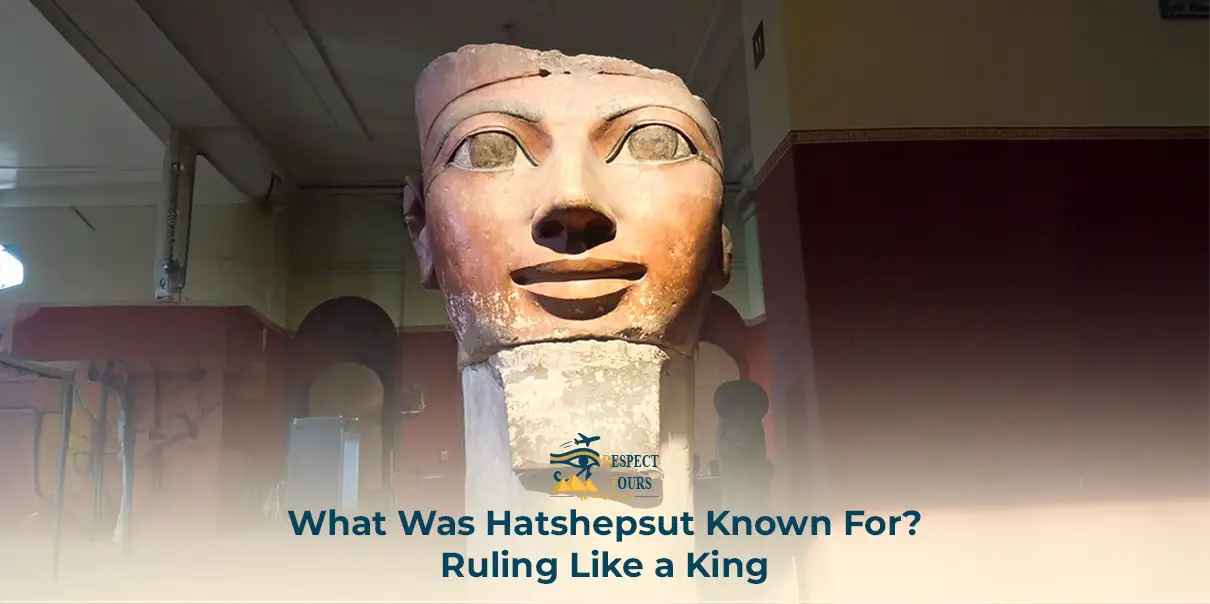
Hatshepsut is known for defying convention and rewriting the rules of power in ancient Egypt. As one of the most successful female pharaohs in Egyptian history, she transformed herself from queen consort to Egypt’s sole ruler. She governed for over two decades with unprecedented prosperity and commissioned architectural marvels at Thebes that still stand today.
What Hatshepsut is best known for extends beyond breaking gender barriers. She expanded trade networks, built monuments rivaling any male pharaoh’s achievements, and created a golden age of peace during the New Kingdom era.
At Respect Tours, we bring the famous female pharaoh Hatshepsut to life through expertly guided experiences that transform ancient history into unforgettable travel moments.
Who Was Hatshepsut? Early Life and Strategic Ascent to Power
Before exploring Hatshepsut’s achievements and facts, understanding her origins reveals how she navigated the complex politics of ancient Thebes.
Was Hatshepsut the Daughter of a Pharaoh?
Born around 1507 BCE, Hatshepsut entered the world as the daughter of Pharaoh Thutmose I and his Great Royal Wife, Ahmose.
Her lineage positioned her at the center of New Kingdom Egypt’s political machinery during one of its most powerful dynasties. Unlike many royal daughters whose names fade into obscurity, she grew up understanding the administrative sophistication required to govern Egypt from the palace at Thebes.
How Did Hatshepsut Become Queen of Egypt?
At approximately twelve years old, Hatshepsut married her half-brother Thutmose II. This followed royal custom designed to keep power concentrated within the family. As Chief Royal Wife, she became Egypt’s queen and bore a daughter, Neferure, who would later legitimize her mother’s unprecedented rule.
When Thutmose II died after a relatively brief reign, Egypt faced a succession crisis. The designated heir, Thutmose III, was still a child, possibly as young as two years old.
Learn more: The most famous facts about Thutmose III
How Did Hatshepsut Come to Power?
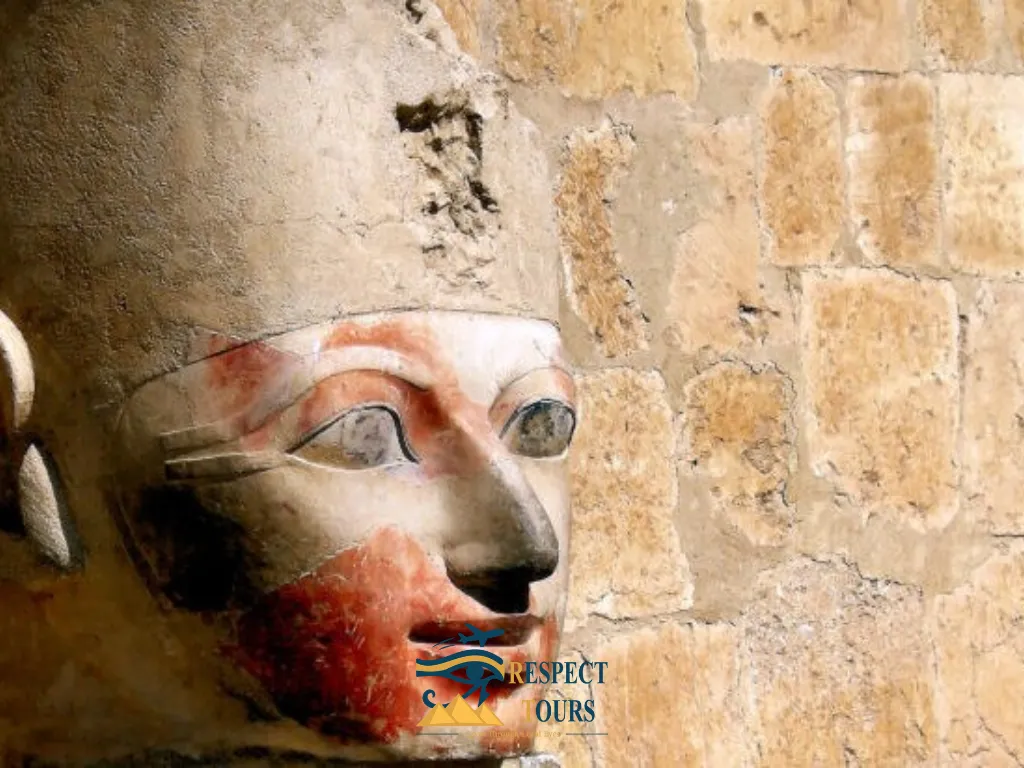
Understanding Hatshepsut’s rise to power reveals the political genius behind the famous female pharaoh Hatshepsut.
From Queen Consort to Regent
Hatshepsut initially assumed the traditional role of regent, governing Egypt on behalf of her young stepson. For approximately seven years, she fulfilled this expected function while maintaining the fiction that she served merely as a caretaker. However, something shifted dramatically.
Whether driven by ambition, political necessity, or a genuine conviction that she could rule more effectively, Hatshepsut made an extraordinary decision: she declared herself pharaoh.
Why Did Hatshepsut Claim Divine Birth?
This wasn’t a violent coup. Hatshepsut’s rise to power deployed sophisticated propaganda and religious justification.
She claimed divine birth as the daughter of the god Amun-Ra, commissioning reliefs at the Temple of Karnak showing her conception by the deity himself. These scenes depicted Amun-Ra taking the form of Thutmose I to father the future pharaoh, a powerful claim that positioned her rule as divinely ordained.
By around 1473 BCE, she had transformed from regent to co-ruler and finally to sole pharaoh. Remarkably, she achieved this while maintaining support from Egypt’s powerful priesthood of Amun-Ra at Thebes and the nobility.
What Was Hatshepsut Known For? Her Greatest Achievements
What Hatshepsut is best known for centers on three revolutionary accomplishments that defined her 21-year reign.
The Legendary Expedition to the Land of Punt
Economic Achievement: Trade expansion and diplomatic success
Unlike many pharaohs who measured success in battlefield victories, Hatshepsut’s achievements and facts center on trade, diplomacy, and strategic resource acquisition.
Her most celebrated accomplishment was the expedition to the Land of Punt, a semi-mythical trading partner located somewhere along the Red Sea coast (possibly modern-day Eritrea, Somalia, or Yemen).
What Did Hatshepsut Bring Back from Punt?
Around the ninth year of her reign, Hatshepsut dispatched five ships carrying Egyptian goods to Punt.
The expedition returned with exotic treasures:
- Myrrh trees (transplanted with roots intact)
- Frankincense (essential for temple rituals at Thebes)
- Ebony and ivory
- Gold and precious metals
- Live animals (baboons, leopards, exotic birds)
The expedition’s details were meticulously recorded on the walls of her mortuary temple at Deir el-Bahri. Travelers today can still see carved images of the boats, the goods, and even the Queen of Punt herself, depicted with unusual anatomical detail.
Why Was the Punt Expedition Important?
This wasn’t simply about luxury goods.
Myrrh and frankincense were essential for religious rituals at the Temple of Karnak and other shrines to Amun-Ra, embalming practices, and royal legitimacy. By securing direct access to these materials, Hatshepsut strengthened Egypt’s religious institutions and her own divine authority.
Moreover, she reopened mines in the Sinai Peninsula, restored trade routes disrupted by previous conflicts, and ensured Egypt’s granaries remained full. This established Hatshepsut’s legacy in New Kingdom Egypt as a peacetime ruler who enriched the nation without conquest.
What Were Hatshepsut’s Major Building Projects?
What Hatshepsut is best known for is architecturally transforming the sacred landscape of Thebes and the Temple of Karnak complex.
The Mortuary Temple at Deir el-Bahri
Architectural Innovation: Three ascending terraces carved into limestone cliffs
If the Punt expedition demonstrated economic acumen, Hatshepsut’s achievements and facts in architecture revealed her artistic vision.
She commissioned more construction projects than almost any pharaoh before her. But one structure stands above all others: the Deir el-Bahri Temple on the West Bank of Thebes.
What Makes Hatshepsut’s Temple Unique?
Designed by her architect and possible lover, Senenmut, this temple represents innovation at its finest.
Unlike the imposing pylons and enclosed courtyards of traditional ancient Egyptian temples, Deir el-Bahri features:
- Three ascending terraces connected by ramps
- Colonnaded halls that create harmony with natural limestone cliffs
- Integration with the landscape rather than domination of it
- Birth colonnade depicting divine conception by Amun-Ra
- Punt reliefs showing the famous expedition in vivid detail
The temple served multiple functions: a mortuary temple for Hatshepsut’s cult, a shrine to Amun-Ra, and visual propaganda celebrating her achievements.
Walking through these colonnaded halls today, visitors encounter history as the famous female pharaoh Hatshepsut intended it to be remembered.
Obelisks at Karnak Temple
Engineering Achievement: Tallest obelisks in ancient Egypt
Hatshepsut’s achievements and facts include her commissioning of red granite obelisks at the Temple of Karnak in Thebes.
One stood nearly 30 meters tall, capped with electrum (a gold-silver alloy) that caught the sun’s rays and announced her power to all who approached Thebes. Today, one of these obelisks still stands at Karnak, ranking among ancient Egypt’s tallest surviving monuments.
What Else Did Hatshepsut Build at Karnak?
She built the Red Chapel (Chapelle Rouge) at the Temple of Karnak, a bark shrine for the sacred boat of Amun-Ra.
This structure featured intricate reliefs depicting religious processions and offerings to Amun-Ra. She also initiated restoration projects at temples damaged during the Hyksos period, demonstrating her role as Egypt’s protector and religious steward.
Why Did Hatshepsut Portray Herself as a Man?
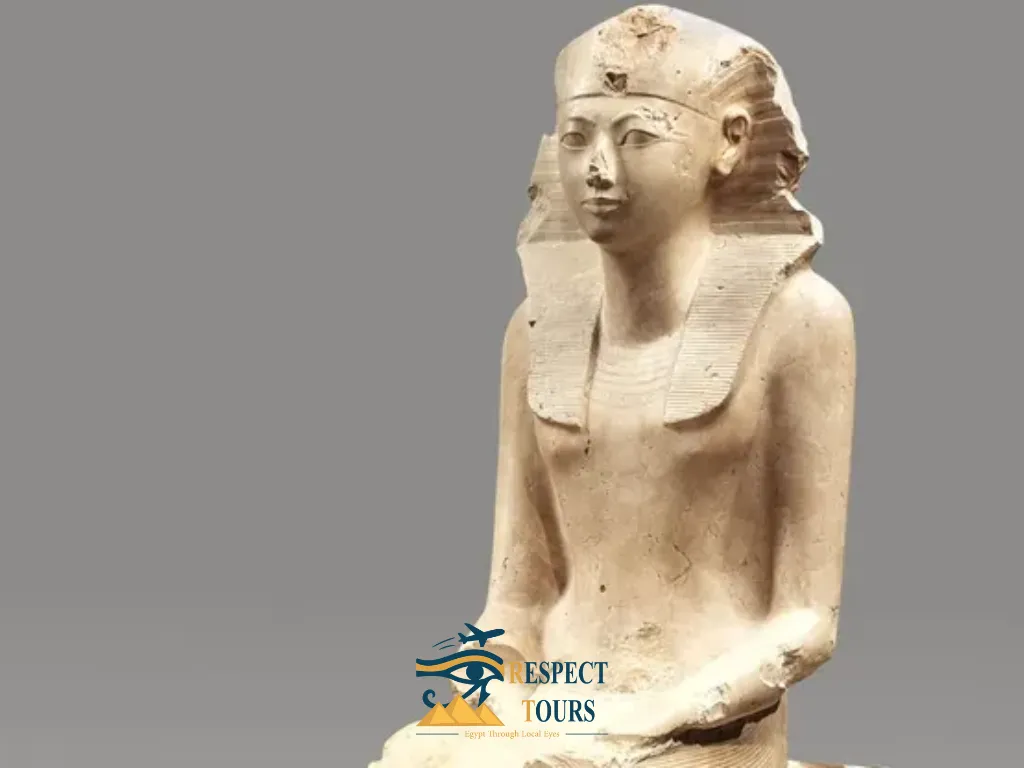
Understanding what Hatshepsut is best known for requires examining her revolutionary approach to royal iconography.
How Did Hatshepsut’s Appearance Change Over Time?
Early in her rule, she appeared in traditional queenly form, slender, feminine, and wearing elegant sheaths and wigs.
However, as she consolidated power and claimed full pharaonic authority, her iconography transformed dramatically:
Early Reign (as Queen):
- Feminine body proportions
- Traditional queen’s crown
- Elegant royal sheaths
- Depicted alongside Thutmose II
Later Reign (as Pharaoh):
- Masculine body proportions
- Broad shoulders and muscular chest
- Royal shendyt kilt
- Ceremonial false beard
- Nemes headdress
- Depicted as the sole ruler
Was Hatshepsut Pretending to Be Male?
This wasn’t delusion or deception; it was strategic political theater.
The concept of pharaoh was inherently masculine in Egyptian theology. The pharaoh embodied the living Horus, son of Ra, and husband of Egypt. By adopting male imagery, the famous female pharaoh Hatshepsut aligned herself with centuries of pharaonic tradition.
Inscriptions sometimes contradicted visual representations, using feminine pronouns even when depicting her in male form. This fascinating ambiguity suggests the complexity of her self-presentation.
She wasn’t pretending to be a man; she was embodying the office of pharaoh, which transcended physical gender.
How Did Hatshepsut Die?
The circumstances surrounding the death of the famous female pharaoh Hatshepsut remain one of ancient Egypt’s enduring mysteries.
What Happened to Hatshepsut at the End of Her Reign?
Hatshepsut ruled for approximately 21 years, dying around 1458 BCE at roughly fifty years of age.
No ancient texts describe her final days, and theories range from natural causes to politically motivated assassination.
Recent examination of Hatshepsut’s mummy (confirmed through DNA analysis in 2007) suggests she suffered from:
- Diabetes (indicated by obesity)
- Severe dental disease (infected tooth)
- Possible bone cancer (metastatic carcinoma)
- Complications from an untreated dental abscess
She likely died from cancer or complications from an infected tooth, a respectable lifespan of 50 years for ancient Egypt.
Why Was Hatshepsut Erased from History?
What happened after her death proved almost more dramatic than her life.
Twenty years later, during the later reign of Thutmose III, a systematic campaign began to erase her memory from monuments at Thebes, the Temple of Karnak, and throughout Egypt:
- Cartouches chiseled out from temple walls
- Images defaced or removed entirely
- Statues smashed and buried in pits
- Name excluded from official king lists
Why Did Thutmose III Erase Hatshepsut’s Memory?
Scholars debate whether Thutmose III acted from personal resentment, political necessity, or theological concern.
One compelling theory suggests the erasure aimed to legitimize the succession line. By removing the anomalous female pharaoh, later propagandists could present an unbroken line of male rulers from Thutmose II directly to Thutmose III.
Ironically, this attempted damnatio memoriae failed spectacularly. The sheer volume of monuments at Thebes and the Temple of Karnak meant that complete erasure proved impossible.
Was Hatshepsut’s Mummy Ever Found?
The discovery of Hatshepsut’s mummy represents one of modern Egyptology’s greatest detective stories.
Where Was Hatshepsut Originally Buried?
For over a century after Deir el-Bahri’s excavation, Hatshepsut’s mummy remained unidentified.
Egyptologists knew of her tomb in the Valley of the Kings (KV20), which she originally constructed for herself and her father. But it had been robbed in antiquity and contained no identifiable royal remains.
The tomb in the Valley of the Kings extends 213 meters into the hillside, the deepest royal tomb excavated. This ambitious engineering reveals her early intention to be buried as a pharaoh in the sacred necropolis of Thebes.
How Was Hatshepsut’s Mummy Identified?
The breakthrough came in 2007 when Dr. Zahi Hawass led a team investigating unidentified royal mummies.
Using DNA analysis, CT scanning, and forensic evidence, they identified a previously overlooked mummy from KV60 (a small tomb in the Valley of the Kings) as Hatshepsut herself.
The Identifying Evidence:
- DNA match with known Hatshepsut family members
- Missing tooth matching a molar in a canopic box inscribed with her name
- Age and physical condition are consistent with historical records
- Female mummy of appropriate royal status
This discovery added crucial Hatshepsut achievements and facts to our understanding of her life and death.
Where Can You See Hatshepsut’s Mummy Today?
Hatshepsut’s mummy now rests in the National Museum of Egyptian Civilization (NMEC) in Cairo.
How to Visit Hatshepsut’s Mummy
Visiting Information:
- Location: Al-Fustat, Old Cairo, overlooking Ain Al-Sira Lake
- Opening Hours: Daily, 9:00 AM to 5:00 PM (ticket sales until 4:00 PM)
The mummy resides in the Royal Mummies Hall, a specially designed space that maintains controlled temperature and lighting.
Interactive displays explain the 2007 identification process, showing DNA analysis results, CT scans revealing her pathologies, and the dramatic tooth-matching story. Standing before her carefully preserved remains creates a profound connection across 3,500 years of history.
What Is Hatshepsut’s Legacy in Ancient Egypt?
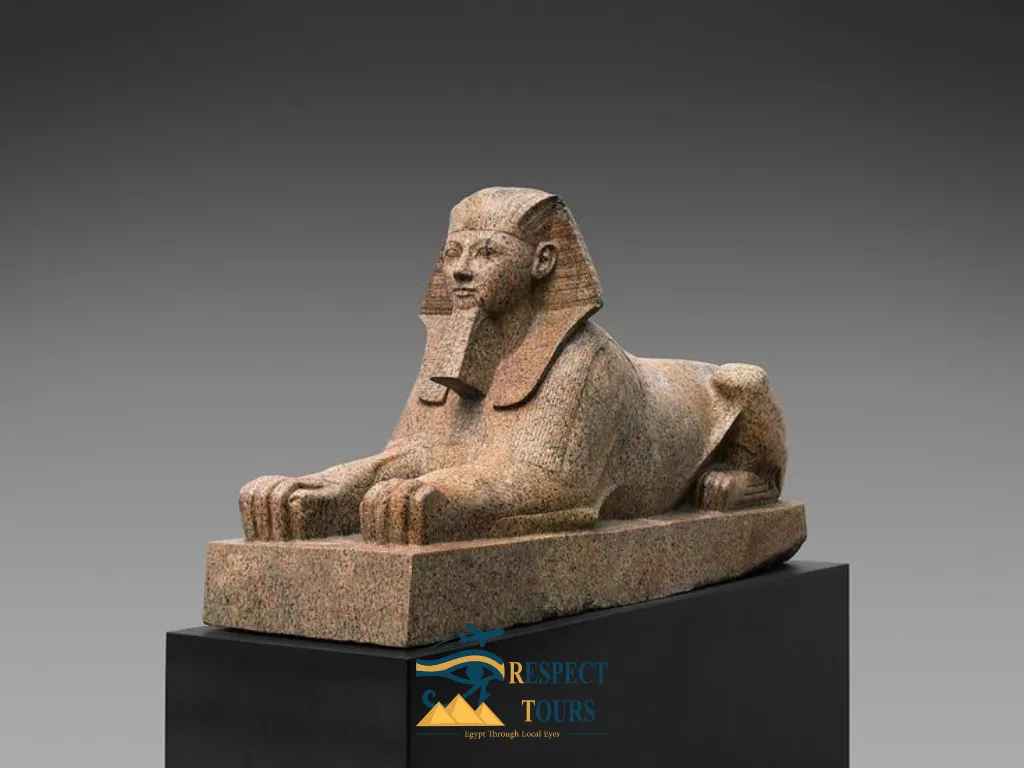
How Did Hatshepsut Change Egypt’s View of Women in Power?
While not technically Egypt’s first female ruler, she was the first to rule for an extended period with full pharaonic authority.
Egyptian culture maintained complicated attitudes toward female power. Women enjoyed significant legal rights; they could own property, conduct business, initiate divorce, and inherit wealth.
Queens wielded considerable influence, and goddesses like Isis, Hathor, and Sekhmet commanded deep reverence. Yet the position of pharaoh remained conceptually masculine.
Did Hatshepsut Expand the Definition of Pharaonic Power?
She didn’t reject femininity or claim to be male; instead, she expanded the concept of what a pharaoh could be.
Hatshepsut’s achievements and facts proved that administrative excellence, economic prosperity, and diplomatic skill could define successful rule as much as battlefield conquest.
Her reign created a template for future female rulers:
- Tawosret (19th Dynasty)
- Cleopatra VII (ruled 1,400 years after Hatshepsut)
Moreover, Hatshepsut’s legacy in New Kingdom Egypt influenced how elite families viewed royal daughters and wives. Powerful queens became increasingly common, with women like Tiye and Nefertiti wielding unprecedented influence.
Summary: What Was Hatshepsut’s Greatest Achievement?
What Hatshepsut is best known for in the broader scope of Egyptian civilization encompasses multiple revolutionary contributions.
Key Hatshepsut Achievements and Facts
Trade and Economic Prosperity:
- Established trade networks with Punt that enriched Egypt for generations
- Focused on economic stability over military conquest
- Demonstrated alternative models of successful leadership
Architectural Innovation at Thebes:
- Deir el-Bahri Temple remains one of ancient Egypt’s most sophisticated structures
- Obelisks at the Temple of Karnak showcased artistic achievement
- The Red Chapel for Amun-Ra at Karnak demonstrated religious devotion
Political Legitimacy:
- Successfully navigated gender barriers through divine birth claims
- Maintained support from the Amun-Ra priesthood at Thebes
- Created precedents for female authority within patriarchal structures
Cultural Legacy:
- Demonstrated that peace and prosperity could define a successful reign
- Challenged the military-focused model of pharaonic ideology
- Influenced Hatshepsut’s legacy in New Kingdom Egypt for centuries
Where to Experience Hatshepsut’s Legacy Today
Exploring what Hatshepsut is best known for requires visiting the monuments where the famous female pharaoh Hatshepsut left her mark.
The Mortuary Temple at Deir el-Bahri (Thebes/Luxor)
No experience captures Hatshepsut’s ambition more vividly than standing before her temple on Luxor’s West Bank at Thebes.
What Can You See at Deir el-Bahri?
- Lower Terrace: Famous Punt Expedition reliefs showing ships, exotic goods, and the Queen of Punt
- Middle Terrace: Birth colonnade depicting divine conception by Amun-Ra
- Upper Terrace: Sanctuary carved into cliff face with shrines to Amun-Ra
- The temple is best experienced early in the morning when cooler temperatures make climbing comfortable and morning light illuminates the reliefs beautifully.
Respect Tours offers guided experiences that contextualize the temple’s iconography, explaining deliberate defacement by Thutmose III and helping visitors identify original work versus later restorations.
UNESCO World Heritage Status
The temple forms part of the UNESCO World Heritage Site designation for Ancient Thebes with its Necropolis.
Ongoing preservation efforts ensure this architectural masterpiece remains accessible while protecting its delicate reliefs. The temple sits within a larger sacred landscape, offering spectacular views across the Nile Valley toward the Temple of Karnak on the East Bank.
Karnak Temple Complex (East Bank, Thebes)
While Deir el-Bahri remains her signature monument, Hatshepsut’s achievements and facts extend throughout the Temple of Karnak.
What to See:
- Red Chapel (Chapelle Rouge) for Amun-Ra’s sacred bark
- Towering obelisk (30 meters tall, 320 tons)
- Restoration inscriptions throughout the complex
The surviving obelisk at Karnak demonstrates the engineering prowess of her reign. Capped with electrum, it would have gleamed across Thebes, announcing her power to all who approached.
Valley of the Kings, Tomb KV20
Hatshepsut’s original tomb in the Valley of the Kings at Thebes extends 213 meters into the hillside.
Though rarely open and containing no decoration (artifacts moved to her mortuary temple), its ambitious engineering reveals her early intention to be buried as a pharaoh in the sacred necropolis.
Access:
- Usually closed to general visitors
- Special arrangements through tour operators
- Alternative: View the entrance and explore regularly opened tombs
Respect Tours can arrange comprehensive Hatshepsut-focused itineraries connecting Deir el-Bahri, the Temple of Karnak, the Valley of the Kings, and NMEC in Cairo into a coherent narrative.
Why Should Modern Travelers Care About Hatshepsut?
Understanding what Hatshepsut is best known for reveals why the famous female pharaoh Hatshepsut still resonates today.
A Story That Transcends Time
She offers something precious: a tangible connection to a fully realized historical figure whose ambitions feel surprisingly accessible across millennia.
Standing before her temple at Thebes, you’re not just observing ancient architecture. You’re witnessing the physical manifestation of a woman’s determination to be remembered, to matter, to leave an indelible mark on the world.
Lessons in Leadership and Innovation
Hatshepsut’s legacy in New Kingdom Egypt resonates because it demonstrates that leadership takes many forms.
While many pharaohs measured success in conquered territories, she proved that economic prosperity, architectural innovation at Thebes and the Temple of Karnak, and diplomatic skill could define a successful reign just as powerfully.
Connecting Ancient History to Modern Experience
For travelers seeking authentic connections with Egypt’s past, Hatshepsut provides a perfect entry point.
Her monuments at Thebes remain visually stunning and remarkably well-preserved. Her mummy offers the rare opportunity to see an actual pharaoh whose life story we know in detail. Her erasure and rediscovery add layers of mystery that make her narrative compellingly dramatic.
Conclusion
Hatshepsut’s legacy in New Kingdom Egypt transcends ancient history to speak directly to contemporary concerns about leadership, determination, and meaningful impact. Three and a half millennia after her death, we still speak her name, still visit her monuments at Thebes and the Temple of Karnak, and marvel at Hatshepsut’s achievements and facts; a spectacular failure of those who tried to erase her memory.
At Respect Tours, we believe the best travel experiences transform information into insight and ancient history into personal connection. Whether you’re drawn to what Hatshepsut is best known for at Deir el-Bahri, fascinated by her mummy’s identification, or curious about the famous female pharaoh Hatshepsut, who ruled from Thebes, we create experiences tailored to your interests with expert Egyptologist guides, seamless logistics, and unforgettable moments of discovery.
Ready to explore what the famous female pharaoh Hatshepsut achieved? Walk where she walked at Thebes, see her monuments at the Temple of Karnak and the Valley of the Kings, and discover why Hatshepsut’s legacy in New Kingdom Egypt still matters today.
FAQ: Frequently Asked Questions
What did Hatshepsut build?
Hatshepsut’s achievements and facts in architecture include her mortuary temple at Deir el-Bahri, two massive obelisks at the Temple of Karnak (one still standing at 30 meters), the Red Chapel at Karnak for Amun-Ra’s sacred bark, and restoration projects throughout Thebes. Her building program represented one of New Kingdom Egypt’s most productive construction periods.
Recent scientific analysis of Hatshepsut’s mummy suggests she suffered from diabetes, severe dental disease, and possibly bone cancer. She likely died around 1458 BCE at approximately 50 years of age, a respectable lifespan for ancient Egypt.
Hatshepsut’s mummy, identified through DNA analysis in 2007, now resides in the National Museum of Egyptian Civilization (NMEC) in Cairo. The Royal Mummies Hall displays her remains with dignity and an extensive educational context. Her original burial was in the Valley of the Kings at Thebes (Tomb KV20).
Hatshepsut wasn’t technically Egypt’s first female ruler; that distinction likely belongs to Sobekneferu (12th Dynasty). However, she was the first to rule for an extended period (21 years) with full authority during the New Kingdom era, making her the most successful famous female pharaoh, Hatshepsut, in Egyptian history.