
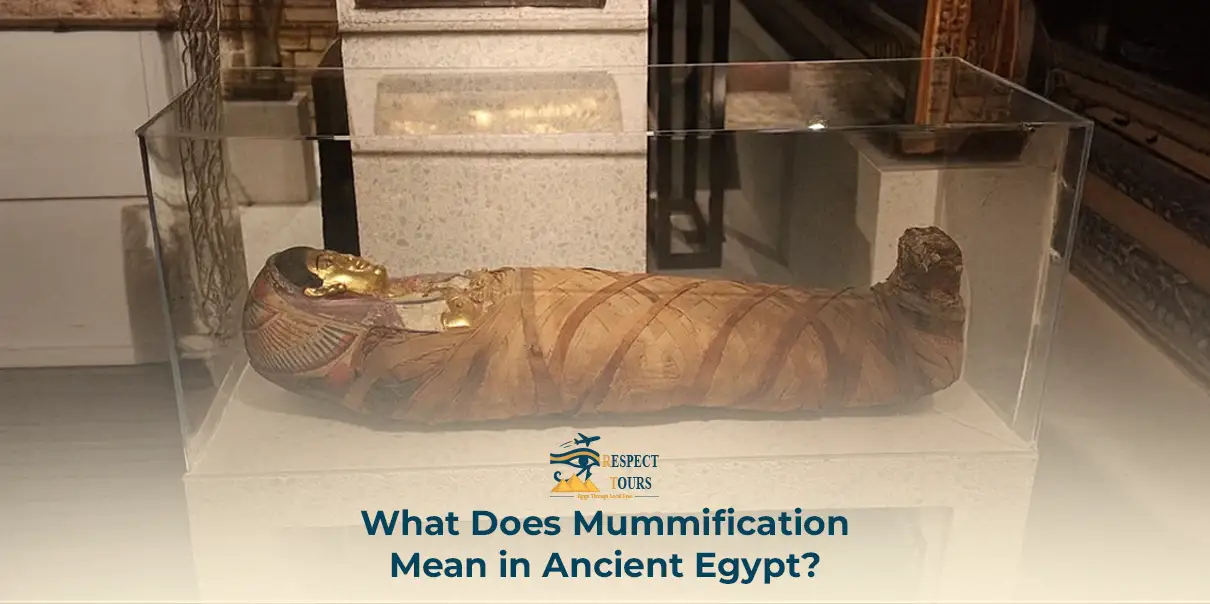
What Does Mummification Mean in Ancient Egypt? Discover the Ancient Art of Preserving Eternity
Imagine standing before a 3,000-year-old body, its skin, hair, and even fingerprints still intact. This isn’t just a relic of the past; it’s a message from a civilization that refused to let death win.
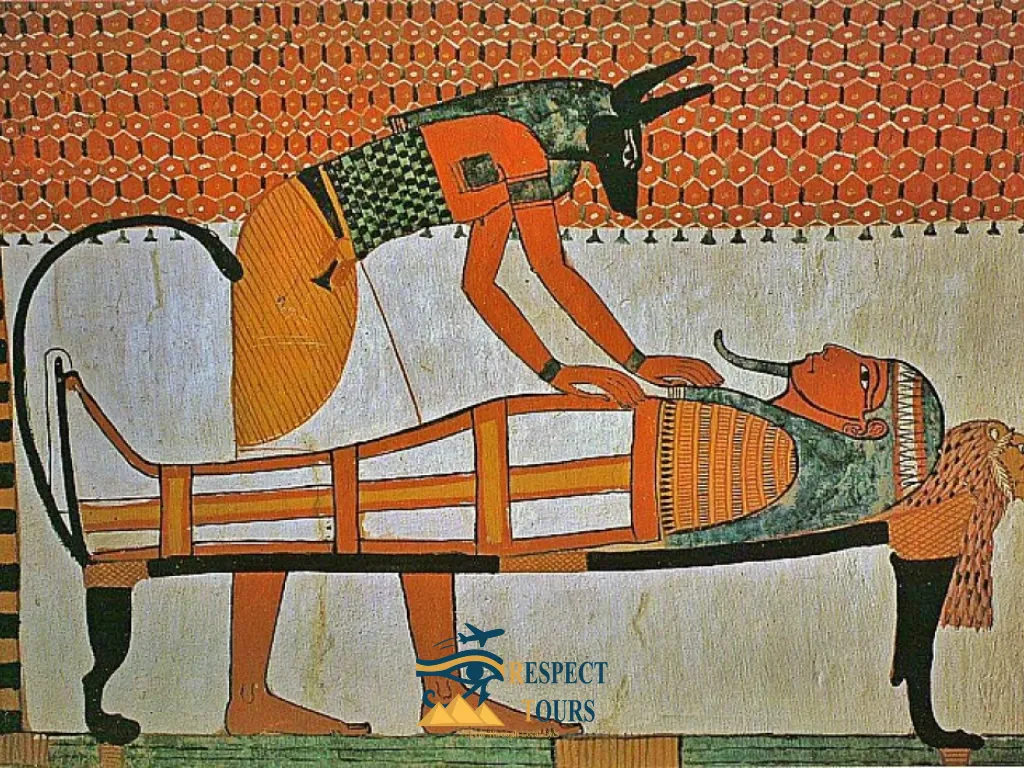
Mummification in ancient Egypt was the sacred process of preserving the body after death to ensure eternal life in the afterlife. Egyptians believed that the Ka (life force) and Ba (soul) needed to recognize the body to reunite and live forever in the Field of Reeds, their vision of paradise.
This sacred practice combined advanced preservation techniques with deep religious beliefs, transforming death into a gateway to immortality.
Today, travellers can witness this timeless promise of eternity in Cairo’s museums and Luxor’s tombs. With Respect Tours, you don’t just observe history, you walk in the footsteps of the Pharaohs and experience where humanity first learned to preserve forever.
What Does Mummification Mean in Ancient Egypt?
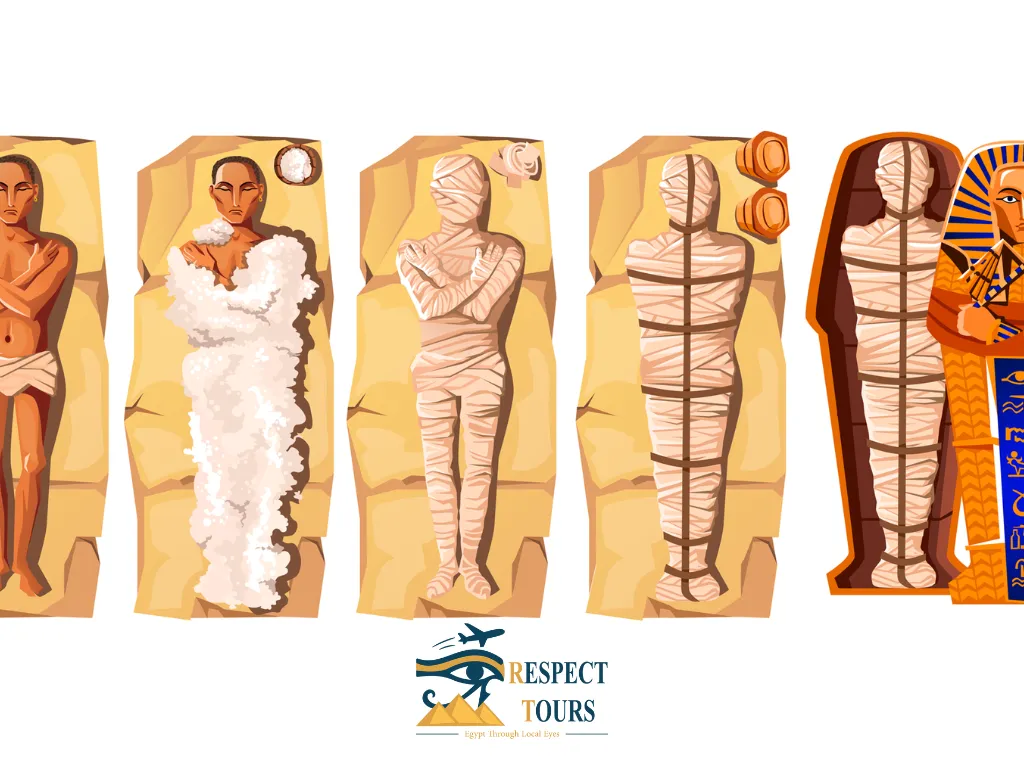
Mummification in ancient Egypt was the sacred process of preserving a body after death to prepare it for the afterlife. The ancient Egyptians believed that a person’s Ka (life force) and Ba (soul) needed to recognise the body to reunite and live forever in the Field of Reeds, an ideal version of paradise.
In essence, mummification meant transforming death into immortality, ensuring the spirit’s safe passage to the next world. It was both a scientific and spiritual act, rooted in the conviction that the soul’s journey depended on the body’s preservation.
Did You Know: Mummification in ancient Egypt was a ritual process that preserved the body so the soul could live eternally in the afterlife.
Why Did Ancient Egyptians Mummify the Dead? Religious Beliefs Explained
To the Egyptians, life was eternal. Death was not an end but a transformation—a return to the divine order of the universe.
They believed the human being was made up of several parts:
- Ka: the life force that stayed near the body.
- Ba: the soul that travelled between worlds.
- Akh: the transfigured spirit that lived in the afterlife.
Preserving the body ensured the Ka and Ba could reunite, allowing the deceased to awaken each morning in the next life.
Early burials in Egypt’s hot desert naturally preserved bodies, inspiring the idea that intentional preservation was sacred. Over centuries, this evolved into the highly sophisticated art of mummification, a bridge between the physical and spiritual realms.
Travellers today can sense this spiritual connection when exploring Saqqara, Abydos, or Thebes, sites where hieroglyphs still whisper prayers to Osiris, god of resurrection.
The Mummification Process: Step-by-Step
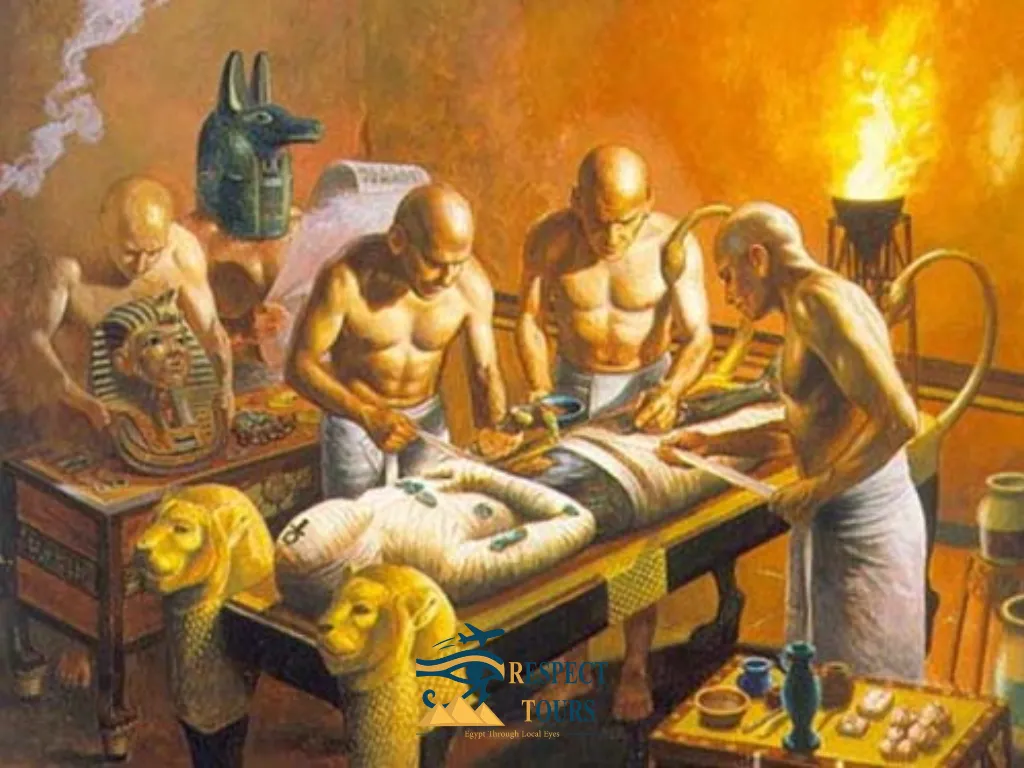
The complete process took 70 days and was performed by specially trained priests. Each step held both practical and spiritual significance.
1. Purification (Day 1)
The body was washed with palm wine and Nile water while priests recited protection prayers. This cleansed both flesh and spirit.
2. Organ Removal (Days 1-2)
Using bronze hooks, embalmers removed the brain through the nostrils. Through a small incision in the left side, they extracted the liver, lungs, stomach, and intestines.
Each organ was preserved separately in canopic jars, protected by the four sons of Horus. The heart remained inside the body, Egyptians believed it held intelligence and memory, essential for judgment in the afterlife.
Why keep the heart? During the afterlife judgment, Osiris weighed the deceased’s heart against Ma’at’s feather of truth. A heavy heart (full of sin) meant eternal death. No heart meant no chance at immortality.
3. Desiccation with Natron (Days 3-40)
The body was covered in natron, a natural salt mixture from Wadi Natrun that absorbed all moisture. After 40 days, the flesh was completely dried, preventing bacterial decay.
Why 40 days? Egyptians observed that Sirius (the “Dog Star”) disappeared from the sky for 70 days annually, a celestial death and rebirth. The 40-day drying period plus 30 days of preparation mirrored this cosmic cycle.
4. Anointing with Oils (Days 41-45)
Priests rubbed the skin with cedar oil, myrrh, and cinnamon, expensive materials symbolizing rebirth and disinfecting the body. These oils also restored some flexibility to the dried skin.
5. Wrapping in Linen (Days 46-68)
Hundreds of meters of linen bandages wrapped the body in layers. Between each layer, priests placed protective amulets:
- Eye of Horus: For healing and protection
- Scarab beetle: For rebirth
- Djed pillar: For stability in the afterlife
Each wrap was accompanied by verses from the Book of the Dead, ensuring the spirit could navigate the underworld.
6. Final Sealing (Days 69-70)
The wrapped mummy was coated with resin and placed in nested coffins or a stone sarcophagus. A funerary procession carried it to a tomb facing west, the land of the dead, where the sun sets.
Case Studies: Two Remarkable Mummies
Case Study 1: The Lady Rai (c. 1570 BCE) – Oldest Well-Preserved Mummy
Discovered in the Deir el-Bahari royal cache in 1881, the Lady Rai served as nursemaid to Queen Ahmose-Nefertari during the early 18th Dynasty. Her mummy is considered one of the oldest well-preserved examples of sophisticated embalming.
What Makes Her Special:
Her internal organs were removed through a small incision, showing advanced surgical precision for the era. Her skin retained remarkable elasticity, and her facial features remained clearly defined after 3,500 years. Modern CT scans revealed that embalmers had carefully arranged her limbs and even styled her hair, which remained intact beneath the linen wrappings.
Preservation Details:
Unlike royal mummies, Lady Rai’s mummification used minimal resin, relying instead on expert natron application and precise wrapping techniques. Her body was positioned with arms crossed over her chest, a style that would become standard for royal women. The quality of her preservation demonstrates that by 1570 BCE, embalmers had already mastered techniques that would define Egyptian mummification for the next thousand years.
Where to See Her:
The Egyptian Museum in Cairo displays Lady Rai, allowing visitors to witness the extraordinary results of early New Kingdom embalming mastery.
Case Study 2: Maiherpri (c. 1479-1425 BCE) – The Mystery Noble
Found in the Valley of the Kings in 1899, Maiherpri’s tomb (KV36) contained one of the most perfectly preserved non-royal mummies ever discovered. His identity remains debated, possibly a Nubian prince or high-ranking official with close ties to the royal family.
What Makes Him Special:
Maiherpri’s mummification rivals that of pharaohs from the same period. His skin shows deep pigmentation, preserved so well that scholars could identify his likely Nubian heritage. His internal organs were meticulously preserved in beautifully crafted canopic jars, and his body was anointed with precious oils that left a glossy sheen on the wrappings.
Unique Preservation Details:
Embalmers packed his body cavity with linen soaked in resin, a technique reserved for the highest elite. His face retained such lifelike detail that early archaeologists could distinguish his facial expression. Even his fingernails and toenails survived intact. The Book of the Dead papyrus buried with him contains vivid illustrations, suggesting he could afford the finest funerary services.
What This Reveals:
Maiherpri’s exceptional preservation, despite not being royal, demonstrates that by the 18th Dynasty, wealth and royal favor, not just royal blood, could secure immortality through superior mummification.
Where to Learn More:
The Egyptian Museum in Cairo houses Maiherpri’s mummy, along with his burial treasures, offering insight into how non-royal elites achieved eternal life.
What Materials and Tools Were Used in Mummification?
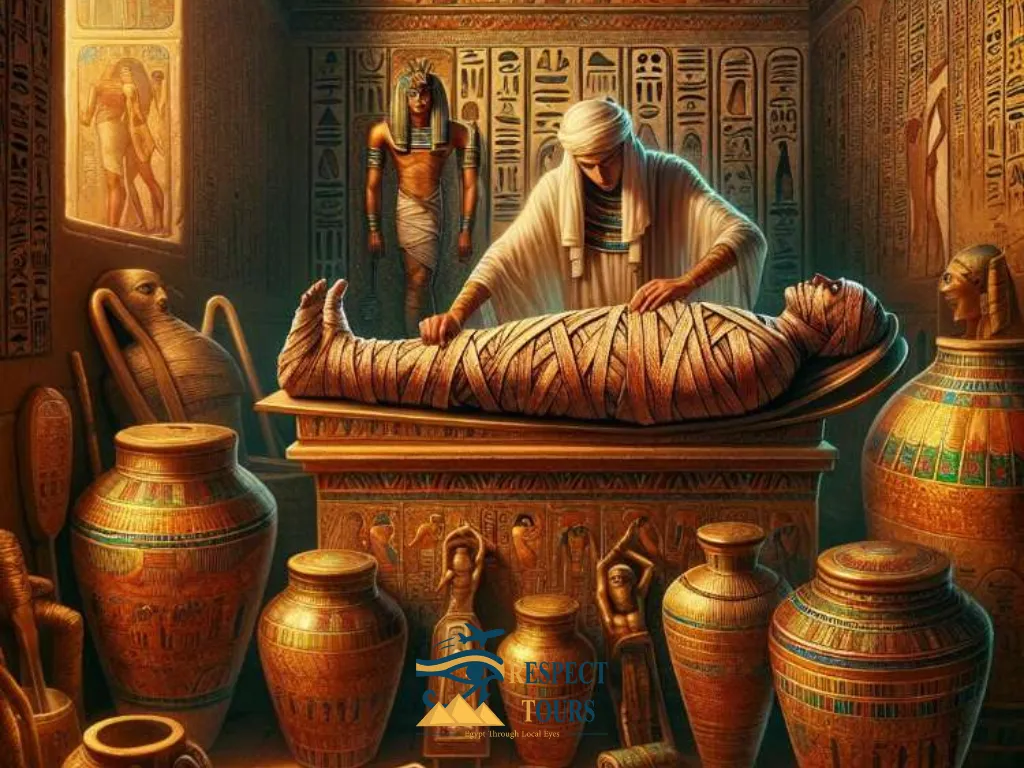
Each material held both practical and symbolic meaning:
| Material | Purpose | Symbolic Meaning |
|---|---|---|
| Natron | Drying agent | Purification, divine salt |
| Linen | Wrapping | Purity, divine order |
| Resins | Preservation | Fragrance of the gods |
| Cedar oil | Anointing | Sacred rebirth |
| Canopic jars | Organ storage | Protection by Horus’s sons |
| Bronze hooks | Brain removal | Sacred surgical tools |
| Amulets | Protection | Magical defense in the afterlife |
These objects are displayed beside real mummies in Cairo’s museums, showing how ancient Egyptians merged science with faith.
Who Got Mummified?
Initially, only pharaohs and nobles received full mummification; they were considered closest to the gods. Over time, the practice spread across social classes.
By wealth level:
- Royal mummification (Pharaohs, queens): Full 70-day process, gold masks, nested coffins, elaborate tombs
- Elite mummification (Nobles, priests): Complete process with quality materials, decorated coffins
- Middle-class mummification (Officials, merchants): Simplified 40-day process, basic wrapping, modest burial
- Poor mummification (Farmers, workers): Minimal preservation, wrapped in reed mats, shallow graves
The most famous mummies include:
- Tutankhamun: His nearly intact tomb, discovered in 1922, remains one of the world’s greatest archaeological finds.
- Ramses II: His preserved features reveal the strength of Egypt’s greatest ruler.
- Hatshepsut: The powerful female pharaoh rediscovered through modern DNA studies.
Even sacred animals received mummification; cats, crocodiles, ibises, and falcons were preserved as offerings to specific gods.
Were Animals Also Mummified?
Yes. Egyptians mummified animals as offerings to the gods or as beloved companions.
- Cats were sacred to Bastet, goddess of home and fertility.
- Crocodiles honoured Sobek, god of strength.
- Ibis and Falcons represented Thoth and Horus.
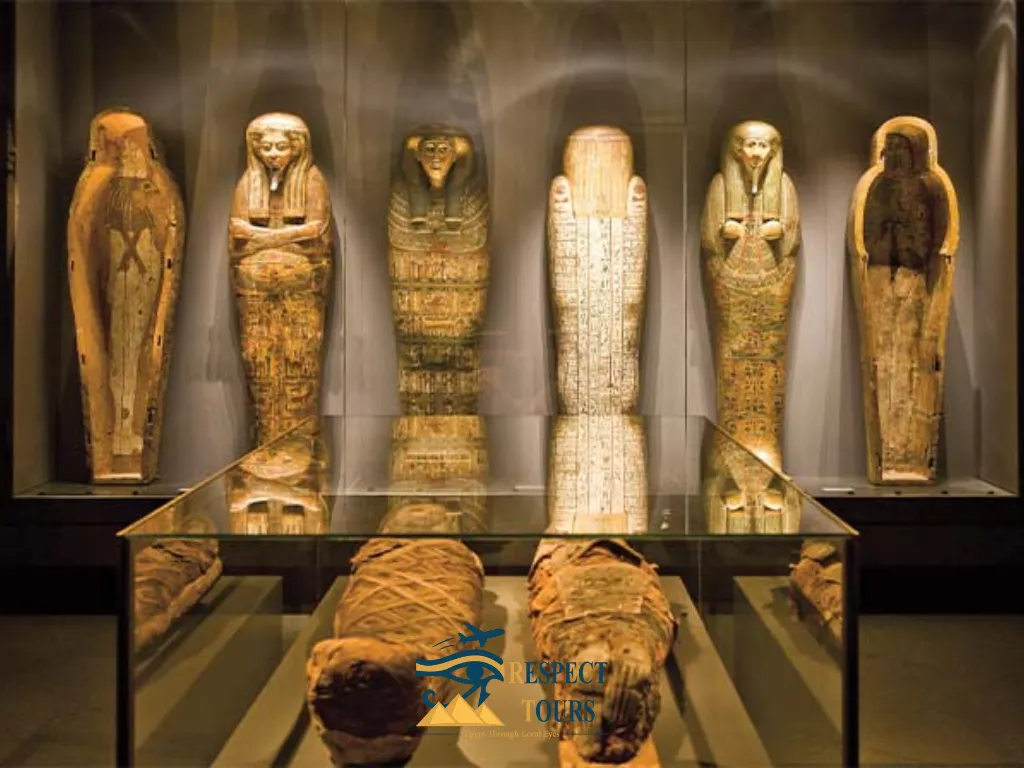
At the Mummification Museum in Luxor, visitors can view perfectly preserved animal mummies, a reminder that eternal life was not limited to humans.
How Much Did Mummification Cost?
Mummification wasn’t free; it created an entire industry.
Estimated costs (in modern equivalent):
- Royal mummification: $500,000+ (gold, precious oils, elaborate tomb construction)
- Elite mummification: $50,000-$100,000 (quality materials, decorated coffins)
- Middle-class: $5,000-$15,000 (basic process, modest burial)
- Poor: $500-$1,000 (minimal preservation, simple burial)
This economic reality meant mummification shaped Egyptian society beyond religion; it created jobs for embalmers, linen weavers, natron miners, coffin makers, and tomb builders. Entire families specialized in death preparation for generations.
Common Misconceptions About Mummification
“Did they really remove brains through the nose?”
Yes. Embalmers inserted bronze hooks through the nostrils, broke through the ethmoid bone, and extracted brain tissue in pieces. Success rate: over 95%.
“Were mummies cursed?”
No. The “mummy’s curse” is a 20th-century invention. Ancient tombs did contain warnings for robbers, but these were threats, not magical curses.
“Why didn’t all mummies survive?”
Tomb robbery, flooding, humidity, and reuse of burial chambers destroyed countless mummies. What survives today represents a tiny fraction of all ancient Egyptian burials.
“Did poor Egyptians get mummified?”
Yes, but with minimal preservation. They couldn’t afford natron, oils, or elaborate wrapping—but even a simple burial with prayers was believed to help the soul.
Famous Mummification Failures
- The Collapsed Mummy of Ramses IV (1155-1149 BCE)
Despite being a pharaoh, Ramses IV’s mummification was poorly executed. Embalmers over-packed his body cavity, causing the torso to collapse. His face was also damaged during wrapping, leaving the nose and features distorted. Modern examination revealed that workers may have rushed the process, possibly due to political instability following his sudden death.
- The “Screaming Mummy” – Unknown Man E (c. 1155 BCE)
Discovered in the Deir el-Bahari cache, this mummy’s face is frozen in an apparent scream, mouth wide open, expression agonized. For years, theories suggested he died in pain or was buried alive. Modern analysis reveals a more mundane explanation: improper head positioning during rigor mortis, combined with inadequate jaw binding, caused the mouth to naturally fall open and lock in place. The “scream” is an accident of decomposition physics, not evidence of a horrible death.
However, other details suggest punishment: he was wrapped in sheepskin (considered unclean), given no canopic jars, and buried without his name—all signs of a disgraced death. Some scholars believe he may have been Prince Pentawer, executed for plotting against his father, Ramses III.
- The Water-Damaged Royals of the Valley of the Kings
Flash flooding has periodically ravaged the Valley of the Kings, destroying or severely damaging numerous mummies. When ancient priests discovered water-damaged royal remains, they often re-wrapped them hastily and moved them to hidden caches. The Deir el-Bahari cache (discovered in 1881) contained dozens of royal mummies showing signs of ancient water damage and emergency restoration, proof that even pharaohs’ eternal rest was sometimes interrupted.
What Do Modern Discoveries Reveal About Mummification?
Modern technology has unveiled new secrets about Egypt’s ancient art. CT scans and DNA analyses have revealed hidden amulets, surgical precision, and even ancient diseases.
For example, scans of Ramses II show evidence of arthritis and dental abscesses, while studies of Tutankhamun’s remains hint at genetic conditions. These discoveries not only humanise the pharaohs but also confirm the incredible accuracy of ancient embalmers.
Travellers interested in archaeology can experience these findings firsthand at Cairo’s NMEC, where the Royal Mummies Hall showcases 22 royal mummies with interactive digital displays that bring history to life.
Expert Voices: What Egyptologists Say
- Dr. Salima Ikram, American University in Cairo
“Mummification represents one of humanity’s most sustained attempts to defeat death through both science and faith. What’s remarkable is not just the technical sophistication, which took centuries to perfect, but the unwavering belief that this preservation was essential for spiritual survival. The Egyptians weren’t simply preserving bodies; they were engineering eternity.”
Dr. Ikram, who has spent over three decades studying Egyptian mummification, notes that modern analysis continues to reveal new techniques: “Every mummy we scan teaches us something new. We’ve discovered that embalmers understand bacterial decomposition intuitively, even without microscopes. Their use of natron, timing, and resins shows empirical knowledge that rivals modern preservation chemistry.”
- Dr. Zahi Hawass, Former Egyptian Minister of Antiquities
“When you stand before a 3,000-year-old mummy, you’re not looking at death, you’re witnessing the ancient Egyptian triumph over it. These bodies were never meant to be museum displays; they were meant to house eternal souls. The fact that we can still see the faces of pharaohs today proves the embalmers succeeded in their sacred mission.”
Dr. Hawass emphasizes the spiritual dimension: “Modern people see mummification as a curiosity. Ancient Egyptians saw it as the most important event of their entire existence, more important than birth, coronation, or marriage. Everything in Egyptian life was prepared for this moment.”
- Dr. Joyce Tyldesley, University of Manchester
“We often focus on pharaohs, but the spread of mummification to ordinary Egyptians tells a profound story about the democratization of religious belief. By the Late Period, a farmer could access the same afterlife as a king, if he could afford the embalming. This shows how deeply embedded the concept of eternal life became in Egyptian society across all classes.”
Where Can You See Mummies in Egypt Today?
Egypt is the only place on Earth where visitors can witness the results in their original context. Here are the must-visit sites:
1. National Museum of Egyptian Civilisation (NMEC), Cairo
Home to the Royal Mummies Hall, featuring the mummies of Ramses II, Seti I, and Hatshepsut. Visitors walk through dimly lit corridors designed to evoke the reverence of a royal tomb.
2. Egyptian Museum, Cairo
A treasure house of ancient artefacts, including sarcophagi, funerary masks, and mummified animals. Soon, many of these exhibits will move to the Grand Egyptian Museum (GEM) near the Pyramids of Giza.
3. Valley of the Kings, Luxor
This legendary necropolis holds over sixty royal tombs, including those of Tutankhamun and Seti I. Respect Tours offers guided visits that reveal hidden hieroglyphic stories carved deep beneath the cliffs.
4. Mummification Museum, Luxor
Dedicated entirely to the embalming process, displaying tools, natron, and preserved remains. It’s the best place to understand the science behind the sacred.
Travel Tip: Combining Cairo’s museums with a Luxor tomb visit provides the full journey—from the science of mummification to the glory of eternal rest.
What Does Mummification Teach Us About Egyptian Beliefs?
Mummification reflects the Egyptians’ deep respect for life and their faith in divine order. They viewed the body as a sacred vessel that connected the mortal and the divine.
This belief shaped Egypt’s grandest creations, the pyramids, temples, and tomb paintings, each designed to ensure eternal harmony between body and soul.
Walking through these ancient halls today, travellers feel the same reverence the ancient Egyptians did thousands of years ago: that life never truly ends, it simply transforms.
Practical Tips for Exploring Ancient Mummy Sites in Egypt
To fully appreciate Egypt’s mummification heritage, a little planning goes a long way:
- Best Time to Visit: October to April offers cooler weather ideal for exploring tombs and open-air temples.
- Photography: Some museums restrict flash photography, check signage or ask your guide.
- Guided Tours: Booking a certified Egyptologist guide through Respect Tours ensures expert storytelling and priority access.
- Combine Experiences: A Nile cruise from Luxor to Aswan perfectly complements historical sightseeing with scenic relaxation.
Why Choose Respect Tours for Your Ancient Egypt Journey
Exploring Egypt’s story of eternity deserves guidance from those who truly understand its spirit. Respect Tours specialises in heritage-driven travel, combining archaeology, culture, and comfort.
Our Egyptologist guides reveal not just what you see, but why it mattered to the ancients. From the Royal Mummies Hall in Cairo to hidden tombs in Luxor, each itinerary blends scholarship with adventure.
Whether you’re a history enthusiast or a first-time visitor, Respect Tours curates experiences that connect you with Egypt’s timeless mysteries, safely, authentically, and memorably.
Book your journey into eternity today with Respect Tours, where the past is never past.
Conclusion
In the end, what mummification meant in ancient Egypt was far more than preservation; it was humanity’s oldest dream made real: the desire to live forever. Each layer of linen, each sacred prayer, and each carved symbol reflected an unshakable faith that the spirit could triumph over death.
Today, that belief still echoes through Egypt’s tombs, temples, and museums. Standing before a mummy isn’t just looking at history; it’s witnessing a civilization’s promise of eternity, preserved for thousands of years.
With Respect Tours, you can experience the answer to what mummification means in ancient Egypt firsthand. Walk through sacred burial sites, see the faces of pharaohs preserved for millennia, and feel the same reverence the ancients felt for life beyond death.
Because in Egypt, the journey never truly ends, it simply transforms, just as it did 4,000 years ago.
FAQ: Frequently Asked Questions
What does mummification mean in ancient Egypt?
Mummification was preserving bodies after death so the soul could live eternally in the afterlife. It symbolized spiritual rebirth and divine protection.
The complete process lasted 70 days: 40 days for natron drying, plus 30 days for organ removal, anointing, wrapping, and ritual preparation.
Egyptians believed the heart held intelligence and morality. It was needed for the afterlife judgment, when Osiris weighed it against Ma’at’s feather of truth.
Yes. The National Museum of Egyptian Civilisation and the Egyptian Museum in Cairo display royal mummies. The Mummification Museum in Luxor shows the preservation process.