

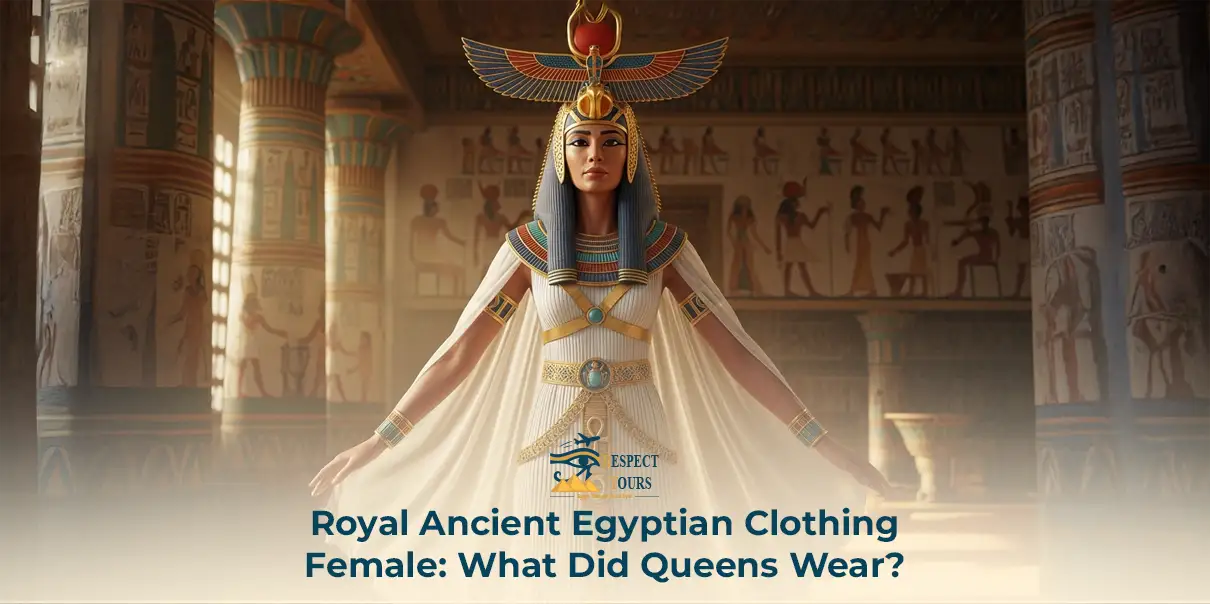
What did royal ancient Egyptian women wear? Egyptian queens wore fine linen kalasiris dresses, form-fitting sheaths extending from chest to ankles, crafted from fabric so transparent you could see skin beneath.
They layered themselves in pounds of gold: massive, broad collars covering their chests, bracelets on both arms, rings on every finger, and anklets that announced their movements with soft metallic sounds. Elaborate wigs crowned with vulture headdresses and rearing cobra symbols (uraeus) marked them as chosen by the gods.
Thick kohl lined their eyes, extending to their temples in dramatic wings. But royal ancient Egyptian clothing female wasn’t just about beauty; it was about power written in gold and linen.
This complete guide, drawing on insights from Respect Tours’ licensed Egyptologists, reveals exactly what made royal clothing different: the materials that required months to produce, the craftsmanship that demanded generational expertise, the symbolism that connected queens to divine power, and where you can see these magnificent garments today during your Egyptian journey.
What Did the Royal Ancient Egyptian Clothing Female Look Like?
Ancient Egyptian queen clothing centered on one signature garment: the kalasiris dress. This form-fitting sheath extended from chest to ankles, crafted from linen so fine it was nearly transparent.
Queens draped themselves in white linen that symbolized purity and divine connection. The fabric flowed in pleated waves, catching light like water with every movement.
Key elements of royal garments in Egypt:
- Fine linen woven from young flax fibers
- Form-fitting sheath dresses (kalasiris)
- Gold jewelry layered at the neck, wrists, and ankles
- Elaborate wigs and headdresses with royal symbols
- Kohl eye makeup and cosmetics
How Did Ancient Egyptian Women Clothing Differ by Social Class?
Social status determined everything about Egyptian fashion. Queens wore linen with thread counts exceeding 200 threads per square inch. Peasant women wore coarse fabric with 40 threads per inch.
Fabric transparency revealed wealth instantly. Royal linen was so fine you could see skin through the fabric. Common linen remained thick and opaque throughout its wearer’s lifetime.
What Is a Kalasiris Dress in Ancient Egyptian Female Clothing?
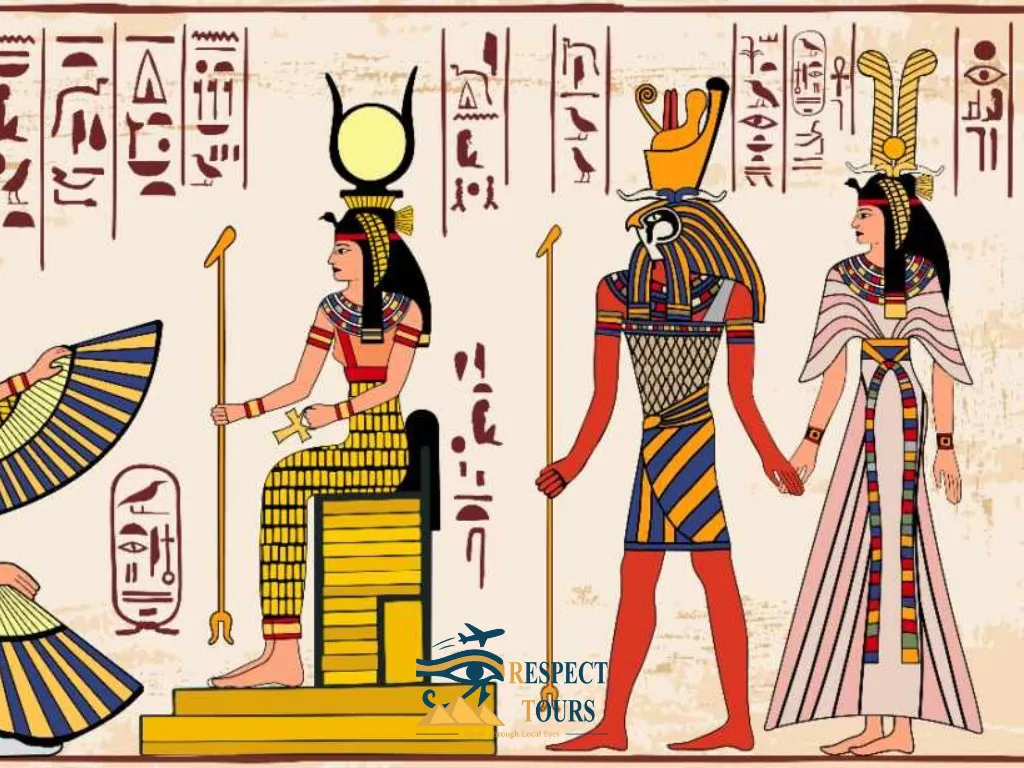
The kalasiris dress defined royal ancient Egyptian clothing female for over three millennia. This sleek sheath fitted close to the body, supported by one or two shoulder straps.
The dress didn’t hide the female form; it celebrated it. Pleating added texture and visual interest, with some royal kalasiris featuring hundreds of tiny, hand-pressed folds.
How Did Queens Wear the Kalasiris Throughout Egyptian History?
Old Kingdom (2686-2181 BCE):
Simple, straight sheaths with narrow straps. Minimal decoration. Clean lines emphasizing vertical elegance.
Middle Kingdom (2055-1650 BCE):
Introduction of wider straps and more elaborate pleating. Some dresses featured decorative borders.
New Kingdom (1550-1077 BCE):
Peak of Kalasiris’s sophistication. Sheer fabrics, complex pleating, occasional sleeves. Queens in Luxor and the Valley of the Kings wore the most elaborate versions ever created.
What Made the Royal Kalasiris Different from Common Versions?
Royal tailors custom-fitted each kalasiris to exact measurements. The dress had to drape perfectly, moving gracefully without bunching or pulling.
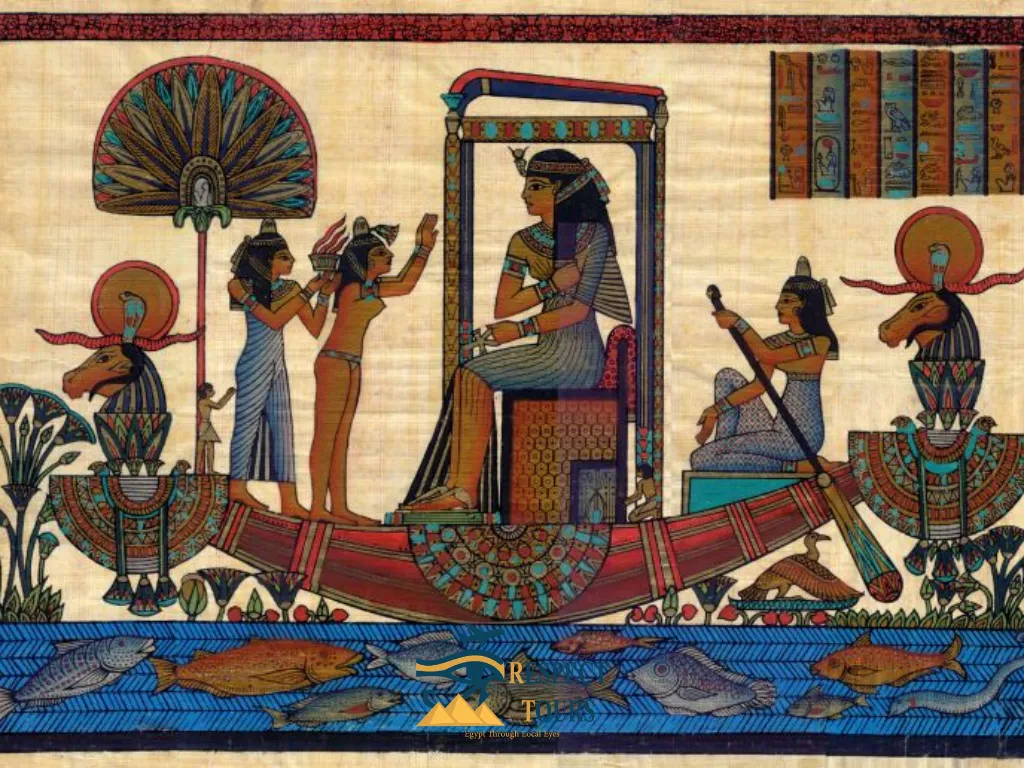
Queens often wore sheer linen overgowns layered above their kalasiris, creating dimensional effects while displaying the dress beneath. This layering technique appeared frequently in tomb paintings and temple reliefs throughout Luxor.
What Materials Were Used in Ancient Egyptian Royal Garments?
Linen dominated ancient Egyptian textile production. Woven from flax plants cultivated along the fertile Nile River banks, linen suited Egypt’s climate perfectly.
But material quality separated queens from commoners dramatically.
Why Was Linen Ancient Egypt’s Only Acceptable Fabric?
- Climate adaptation: Linen breathed, absorbed moisture, and kept wearers cool in Egypt’s intense heat.
- Religious significance: Egyptians considered linen pure and clean, essential for approaching the gods during temple ceremonies.
- Cultivation advantage: Flax grew abundantly in the Nile Valley, making linen readily available throughout Egyptian history.
- Symbolic meaning: White linen represented purity, cleanliness, and divine favor, critical attributes for royal women.
How Was Royal Linen Produced in Ancient Egypt?
Textile production in ancient Egypt was sophisticated and state-controlled. Royal workshops employed master weavers whose skills passed through generations.
- Flax cultivation:
Farmers harvested young flax plants before they fully matured. Younger plants produced finer fibers.
- Processing methods:
Workers soaked flax stems in water for weeks (retting), then beat them to separate fibers. Multiple processing stages removed impurities.
- Spinning techniques:
Spinners created thread by hand, twisting fibers on drop spindles. Royal thread was spun until it became almost invisible.
- Weaving on ancient looms:
Master weavers worked on horizontal ground looms, creating fabric with thread counts that modern machinery struggles to replicate.
What Quality Differences Existed in Ancient Egyptian Textiles?
| Quality Level | Thread Count | Transparency | Used By | Weight |
|---|---|---|---|---|
| Coarse Linen | 40–60 threads/inch | Opaque | Laborers, servants | Heavy |
| Standard Linen | 80–120 threads/inch | Semi-opaque | Middle class, officials | Medium |
| Fine Linen | 150–180 threads/inch | Semi-transparent | Nobility, priests | Light |
| Royal Linen | 200+ threads/inch | Transparent | Queens, pharaohs | Ultra-light |
The finest royal linen weighed almost nothing. Fabric so sheer it revealed skin required exceptional skill at every production stage.
Daily Wear vs. Ceremonial Jewelry: What’s the Difference?
Ancient Egyptian jewelry served two distinct purposes. Queens owned comfortable daily pieces and elaborate ceremonial jewelry reserved for religious festivals and state occasions.
| Aspect | Daily Wear Jewelry | Ceremonial Jewelry |
|---|---|---|
| Weight | Lightweight gold, comfortable for all-day palace wear | Heavy, elaborate pieces weighing several pounds |
| Materials | Gold, simple semi-precious stones | Gold, lapis lazuli, turquoise, carnelian, precious imported stones |
| Design | Simpler patterns, fewer decorative elements | Intricate designs with religious symbols, protective amulets, and multiple layers |
| Purpose | Status display, personal adornment, comfort | Religious significance, divine connection, state representation |
| Frequency | Worn daily around palace grounds | Reserved for festivals, ceremonies, temple visits, and important events |
| Examples | Simple gold bracelets, single-strand necklaces, small earrings | Multi-layered broad collars, elaborate pectorals, heavy anklets |
Queens wore daily jewelry that announced status without interfering with palace activities. Simple gold bracelets, modest necklaces, and small earrings allowed free movement while maintaining a royal appearance.
Ceremonial jewelry transformed queens into living representations of divine power. These pieces incorporated protective amulets, sacred symbols like the ankh and scarab, and precious stones believed to connect the wearer directly to specific gods.
What Ancient Egyptian Jewelry Did Queens Wear?
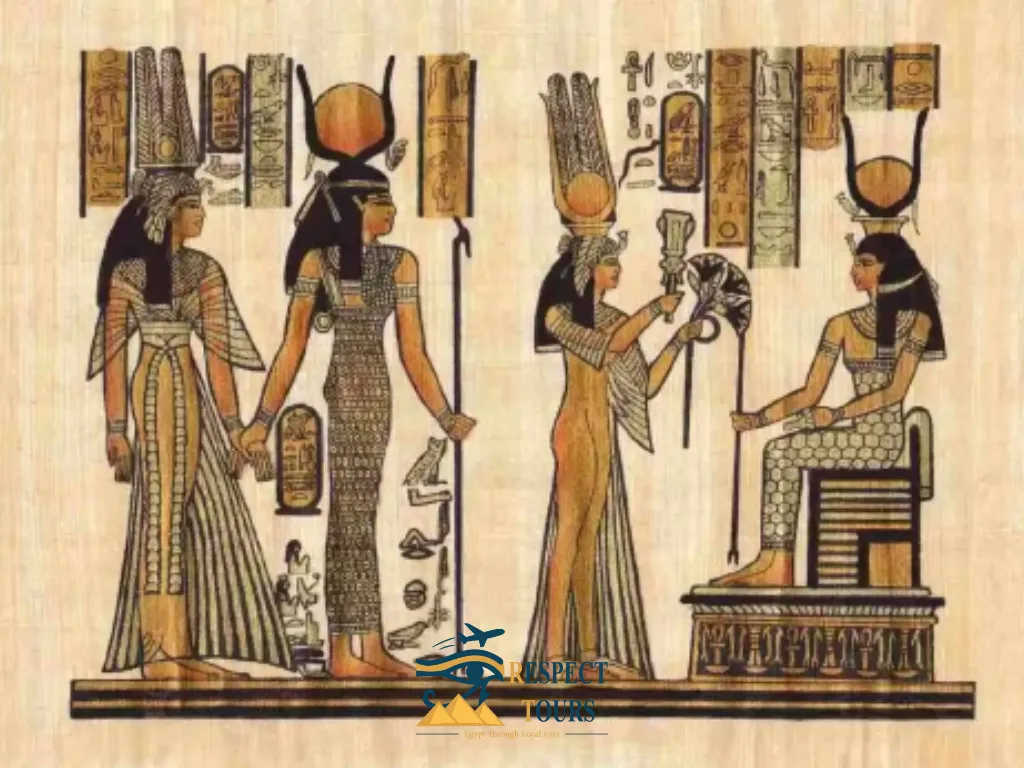
Ancient Egyptian jewelry was essential to royal female clothing. Queens never appeared publicly without gold adorning their bodies.
Jewelry demonstrated three critical things:
- Material wealth and family status
- Protection against evil through magical amulets
- Connection to the divine realm through sacred symbols
What Types of Necklaces Did Egyptian Queens Wear?
The Broad Collar (Usekh):
The most recognizable jewelry piece in ancient Egyptian queen clothing. This massive necklace covered the chest from collarbone to mid-chest, featuring rows of colorful beads arranged in semicircular patterns.
Queens owned multiple broad collars:
- Daily versions: 5-6 rows of beads
- Ceremonial versions: 12+ rows incorporating lapis lazuli, turquoise, and carnelian
String Necklaces:
Simpler designs featuring single or multiple strands of gold beads, semi-precious stones, or faience (glazed ceramic).
Pectoral Necklaces:
Large decorative pendants hung from elaborate chains, often featuring religious scenes or royal cartouches in cloisonné work.
What Bracelets and Rings Did Queens Wear?
Queens adorned their wrists with multiple bracelets—typically five or six on each arm. These ranged from simple gold bands to elaborate cuffs decorated with precious stones and religious imagery.
Bracelet styles included:
- Solid gold bangles
- Hinged cuffs with animal motifs
- Beaded bracelets with protective symbols
- Engraved bands bearing royal names
Rings decorated nearly every finger, each featuring symbolic designs or hieroglyphic inscriptions. Royal rings often bore the queen’s name, serving as both jewelry and a personal seal for official documents.
Anklets completed the jewelry ensemble, visible beneath the kalasiris hem as queens walked through palace corridors and temple courtyards.
What Earrings Did Ancient Egyptian Queens Wear?
Ear piercing was common among Egyptian royalty. Queens wore substantial earrings, much larger than modern styles.
Common earring types:
- Large gold hoops (sometimes 2-3 inches in diameter)
- Plug earrings that stretched the earlobes
- Dangling styles with precious stone inlays
- Decorative studs featuring royal symbols
What Did Egyptian Queens Wear on Their Heads?
Royal headdresses and crowns marked Egyptian queens as chosen by the gods. These elaborate headpieces combined symbolic meaning with visual magnificence.
What Headdresses Did Ancient Egyptian Female Royalty Wear?
The Vulture Headdress:
The most common crown for queens featured a vulture with spread wings, its body running along the top of the head and wings falling alongside the face. This connected queens to Nekhbet, the protective goddess of Upper Egypt.
The Double Plume Crown:
Two tall ostrich feathers mounted on a small crown base. This headdress appeared frequently in tomb paintings throughout Luxor and the Valley of the Kings, particularly during the New Kingdom.
The Modius Crown:
A flat-topped crown worn by queens associated with specific goddesses, particularly Hathor.
The Uraeus Symbol:
Every royal headdress featured the uraeus, a rearing cobra representing the goddess Wadjet. Only royal family members could wear this sacred serpent, making it the ultimate status symbol in ancient Egypt.
Did Egyptian Queens Wear Wigs?
Yes. Wigs were essential to ancient Egyptian women clothing at all social levels, but royal wigs were extraordinarily elaborate.
Rather than style their natural hair in Egypt’s heat, queens wore wigs made from human hair, sometimes supplemented with plant fibers for volume.
Royal wig styles:
- Daily wigs: Simpler shoulder-length styles allowing comfortable movement
- Ceremonial wigs: Elaborate designs extending past shoulders, featuring hundreds of thin braids or curls
- Tripartite wigs: Hair divided into three sections, one falling down the back, two sections framing the face
Wigs were held in place with beeswax and resin, then scented with perfumes and oils. Queens owned multiple wigs stored on specially carved wooden head forms.
What Makeup and Cosmetics Did Queens Use?
Ancient Egyptian cosmetics were sophisticated beauty products with practical, aesthetic, and spiritual purposes.
Queens applied makeup daily using tools and techniques that remained consistent for thousands of years. The morning beauty ritual was elaborate, sometimes requiring an hour or more.
What Eye Makeup Did Ancient Egyptian Queens Wear?
Kohl (Black Eyeliner):
The defining feature of Egyptian beauty. Made from ground galena (lead ore), kohl created thick, dark lines extending from the corners of the eyes.
Queens stored kohl in decorated containers made from alabaster, ivory, or precious metals. The application used small sticks, creating dramatic eye shapes that made the royal gaze appear more intense and spiritually powerful.
Practical benefits:
- Protected eyes from sun glare
- Prevented eye diseases
- Repelled insects
- Reduced bacterial infections
Green Eye Paint:
Made from malachite (copper ore), green eye paint was applied to the upper eyelids, particularly during the Old Kingdom period.
What Other Cosmetics Did Royal Women Use?
Ochre for Lips and Cheeks:
Red and yellow ochre mixed with oils created lip color and cheek tints. Queens applied these pigments to enhance facial features and create healthy-looking complexions.
Henna for Body Art:
Queens decorated their hands, feet, and nails with temporary henna designs. These intricate patterns served both decorative and ceremonial purposes.
Scented Oils and Perfumes:
Queens anointed their bodies with expensive imported oils:
- Myrrh from Punt (modern Somalia)
- Frankincense from Arabia
- Moringa oil from local trees
- Lotus-scented oils for hair and skin
Perfume Cones:
Queens wore decorative cones of scented wax on top of their wigs during banquets and ceremonies. As the evening progressed, body heat melted the wax, releasing fragrance and creating a visually striking effect.
What Footwear Did Egyptian Queens Wear?
Sandals were the primary footwear for royal ancient Egyptian clothing female royalty, though queens often went barefoot inside palaces and temples as a sign of respect and ritual purity.
What Types of Sandals Did Royal Women Wear?
Papyrus Sandals:
Woven from papyrus reeds, these lightweight sandals were comfortable in hot weather. Royal versions featured finer weaving and decorative elements.
Leather Sandals:
Made from fine leather with gold decoration and sometimes precious stones embedded in straps. Royal leather sandals were dyed in vibrant colors, red being particularly prestigious.
Symbolic Sole Decorations:
The soles of royal sandals bore images of Egypt’s enemies, captive foreigners bound and prostrated. Queens literally trampled Egypt’s foes with every step, symbolically maintaining cosmic order (maat).
When Did Queens Go Barefoot?
Queens removed sandals when:
- Entering temple sanctuaries
- Participating in religious ceremonies
- Walking on sacred ground
- Attending certain royal rituals
Barefoot practices demonstrated humility before the gods and maintained the ritual cleanliness required for approaching divine spaces.
What Did Colors Mean in the Royal Ancient Egyptian Clothing females?
Color symbolism was deeply important in Egyptian royal garments. Each color carried specific meanings related to gods, natural forces, and spiritual concepts.
| Color | Symbolism | Use in Royal Clothing | Associated Deity |
|---|---|---|---|
| White | Purity, cleanliness, divine favor | Primary color for linen garments | Osiris, Isis |
| Gold | Divine flesh, eternal life, sun | Jewelry, headdress decoration | Ra, Horus |
| Blue | Nile River, fertility, rebirth, sky | Ceremonial decoration, jewelry inlay | Amon, Nut |
| Red | Power, vitality, chaos (controlled) | Ceremonial elements, crown decoration | Seth, Hathor |
| Green | Vegetation, resurrection, health | Cosmetics, jewelry inlay | Osiris, Ptah |
| Black | Fertility, Nile silt, underworld | Eye makeup (kohl), wigs | Anubis, Osiris |
White dominated royal wardrobes because it symbolized purity and ritual cleanliness necessary for religious ceremonies. Queens wearing white linen declared their connection to divine order.
Gold appeared everywhere, in jewelry, headdresses, and decorative elements on clothing. Gold represented the divine, eternal life, and the sun god Ra. Wearing gold announced the queen’s semi-divine status.
Blue, made from expensive lapis lazuli imported from Afghanistan, symbolized the Nile River, fertility, and rebirth. Queens wore blue elements during ceremonies related to agricultural abundance and fertility rites.
How Did Royal Fashion Change Across Egyptian Kingdoms?
Ancient Egyptian fashion evolved significantly over three thousand years, though core elements remained remarkably consistent.
What Did Queens Wear During the Old Kingdom?
Period: 2686-2181 BCE
Capital: Memphis (near modern Cairo and Giza)
Old Kingdom queens wore simpler, more conservative clothing:
- Straight kalasiris sheaths with minimal decoration
- Narrow shoulder straps
- Less elaborate jewelry compared to later periods
- Simpler wig styles
- Minimal pleating
Fashion emphasized clean lines and vertical elegance. The aesthetic was restrained, reflecting the conservative values of early dynastic Egypt.
What Did Queens Wear During the Middle Kingdom?
Period: 2055-1650 BCE
Capitals: Thebes (Luxor) and Itjtawy
Middle Kingdom fashion introduced more variety:
- Wider shoulder straps on kalasiris dresses
- Introduction of decorative borders and bands
- More elaborate pleating techniques
- Increased jewelry complexity
- Experimentation with garment layering
This period saw growing wealth and international trade, reflected in more elaborate royal attire.
What Did Queens Wear During the New Kingdom?
Period: 1550-1077 BCE
Capital: Thebes (Luxor)
The New Kingdom represented the golden age of Egyptian fashion:
- Peak sophistication in textile production
- Extremely sheer, transparent linen
- Complex pleating requires specialized training
- Occasional sleeves and more varied necklines
- Elaborate layered garments
- Maximum jewelry weight and complexity
- Most ornate wigs and headdresses
Queens in Luxor, Aswan, and the Valley of the Kings wore the most elaborate royal ancient Egyptian clothing female ever created. International influence from conquered territories introduced new design elements while maintaining traditional Egyptian aesthetics.
How Did Female Pharaoh Clothing Differ from Queen Clothing?
Most Egyptian royal women wore traditionally feminine clothing. One remarkable exception changed history.
Which Female Pharaoh Dressed Like a Man?
Hatshepsut stands out among Egyptian queens because she became a full pharaoh and dressed the part.
Unlike other queens who maintained feminine royal ancient Egyptian clothing female, Hatshepsut deliberately adopted male pharaonic regalia:
- Royal shendyt kilt (pleated male garment)
- Bare chest or minimal chest covering
- False beard (postiche) worn attached to the chin
- Nemes headdress (striped royal headcloth)
- Male body positioning in official art
Why did Hatshepsut dress as a man?
This was a political strategy, not a personal preference. By dressing as a male pharaoh, Hatshepsut claimed full authority of Egypt’s throne rather than ruling as queen regent for her stepson.
Egyptian kingship ideology required pharaohs to be male. Hatshepsut’s masculine clothing allowed her to fulfill traditional pharaonic roles while maintaining legitimacy.
Her temple at Deir el-Bahari near Luxor shows her in both feminine and masculine forms, demonstrating how she strategically navigated gender expectations through clothing choices.
Discover more about this fascinating ruler’s reign and political genius in our detailed guide: What Was Hatshepsut Known For?
What Did Different Famous Queens Wear?
Several Egyptian queens became famous for their distinctive approaches to royal fashion, leaving images that captivate us thousands of years later.
What Did Queen Nefertiti Wear?
Period: 1353-1336 BCE (18th Dynasty)
Famous For: Painted limestone bust showing iconic beauty
Queen Nefertiti, wife of Pharaoh Akhenaten, is remembered for her tall, distinctive blue crown and elegant beauty.
Her signature look:
- Simple, form-fitting kalasiris with minimal decoration
- Streamlined aesthetic emphasizing her graceful neck
- Famous blue crown (unique to Nefertiti)
- Refined, minimal jewelry compared to other queens
- Surprisingly modern, uncluttered style
Nefertiti’s fashion reflected the artistic revolution of the Amarna period, which emphasized naturalism over traditional formality.
What Did Queen Nefertari Wear?
Period: 1279-1213 BCE (19th Dynasty)
Famous For: Beautifully preserved tomb in the Valley of the Queens
Queen Nefertari, beloved wife of Ramesses II, appears in her Aswan tomb wearing elaborate pleated linen with wide, decorated sleeves, a departure from the traditional sleeveless kalasiris.
Her distinctive style:
- Elaborate pleating creates dimensional effects
- Wide sleeves (unusual for Egyptian royal clothing)
- Massive broad collars covering the entire chest
- Elaborate headdresses combining royal symbols with goddess imagery
- Maximum jewelry weight, pounds of gold
- Vulture headdress with additional crown elements
Nefertari’s tomb paintings preserve the most detailed images of royal ancient Egyptian clothing female from any period.
What Did Cleopatra VII Wear?
Period: 51-30 BCE (Ptolemaic Dynasty)
Famous For: Last pharaoh of Egypt and relationships with Julius Caesar and Mark Antony
Cleopatra VII blended traditional Egyptian fashion with Greek and Roman influences, understanding that clothing was political power.
Her adaptive wardrobe:
- Traditional Egyptian kalasiris and headdress when addressing Egyptian subjects
- Greek chiton and himation when meeting Greek officials
- Roman-style stola when entertaining Roman dignitaries
- Isis costume during religious ceremonies (political association with the goddess)
Cleopatra’s strategic use of clothing demonstrated a sophisticated understanding of cultural diplomacy and image management.
How Did Priestess Clothing Compare to Queen Clothing?
Egyptian priestesses wore clothing similar to queens but with important distinctions reflecting their religious roles rather than political authority.
Similarities:
- Fine white linen garments
- Kalasiris-style dresses
- Ritual purity requirements
- Elaborate wigs
- Symbolic jewelry with protective amulets
Differences:
- Priestesses wore simpler headdresses without royal uraeus
- Less gold, more focus on symbolic rather than monetary value
- Specific goddess associations influenced clothing choices
- More conservative styles, less fashion experimentation
- Leopard skin garments for high priestesses (unique to religious roles)
Where Can You See Royal Egyptian Clothing Today?
Few ancient garments survive after thousands of years, but several museums preserve remarkable examples of royal ancient Egyptian clothing female.
What Museums Display Ancient Egyptian Royal Clothing?
The Egyptian Museum, Cairo:
Located in Tahrir Square, this museum houses the most extensive collection of ancient royal clothing. Collections include:
- Elaborately pleated linen dresses from multiple dynasties
- Gold sandals of Tutankhamun’s wife
- Broad collars and jewelry sets
- Royal headdresses and crowns
- Textile fragments showing weaving techniques
The National Museum of Egyptian Civilization, Cairo:
This newer museum displays textiles alongside royal mummies, giving context to how garments were actually worn. The juxtaposition of clothing and people creates an immediate connection across millennia.
Luxor Museum:
Contains beautifully preserved examples of jewelry and clothing fragments discovered in nearby Valley of the Kings tombs. The climate in Luxor helped preserve organic materials better than in more humid regions.
Conclusion
Royal ancient Egyptian clothing female wasn’t just fabric and jewelry; it was power made visible, divinity worn on human skin, and status declared with every step.
When you stand before a painted relief in Karnak Temple showing a queen in ceremonial dress, you’re not just seeing ancient art. You’re witnessing a political statement carved in stone. That transparent linen takes weeks to weave? Economic power. Those pounds of gold covering her chest? Divine connection. That uraeus cobra on her headdress? Authority granted by the gods themselves.
When you descend into Nefertari’s tomb in the Valley of the Queens, walls painted with such detail, you can count individual pleats in her kalasiris dress, identify every piece of jewelry, see exact kohl wing angles, you’re entering a time capsule preserving 3,200 years of fashion, power, and belief.
When you stand before actual royal jewelry in Cairo’s museums, gold worked by craftsmen whose names we’ll never know, still gleaming as it did when queens fastened it around their throats, you’re touching eternity through objects that outlasted empires.
These aren’t museum pieces. They’re messages from women who understood that
appearance was authority, that beauty was political, that clothing could transform
mortals into goddesses.
Let expert guides help you hear those messages.
FAQ: Frequently Asked Questions
What did ancient Egyptian queens wear?
Ancient Egyptian queens wore kalasiris dresses made from fine white linen, adorned with gold jewelry, including broad collars, bracelets, and anklets. They completed their outfits with elaborate wigs, headdresses featuring the uraeus cobra, kohl eye makeup, and leather sandals. Royal ancient Egyptian clothing for females emphasized status through fabric quality, with queens wearing nearly transparent linen that required weeks to weave.
The kalasiris was a form-fitting sheath dress worn by ancient Egyptian women, particularly royalty. It extended from the chest to the ankles, supported by one or two shoulder straps. Made from fine linen and often pleated for added elegance, the kalasiris was the signature garment of Egyptian female fashion for over three thousand years. Queens wore versions so finely woven that the fabric was nearly see-through.
Royal Egyptian women primarily wore white linen, which symbolized purity and divine connection. They also incorporated gold extensively in jewelry and decorative elements, representing the divine and eternal life. Blue appeared in accessories and ceremonial clothing, symbolizing the Nile River and fertility. Red and yellow dyes were rarer and more expensive, reserved for special ceremonial occasions.
Hatshepsut, who ruled Egypt as pharaoh rather than queen regent, deliberately adopted male pharaonic clothing, including the shendyt kilt, bare chest, and false beard worn by male rulers. This political strategy allowed her to claim full pharaonic authority. Her temple at Deir el-Bahari shows her in both feminine and masculine forms, demonstrating her strategic use of female pharaoh clothing to establish legitimacy.