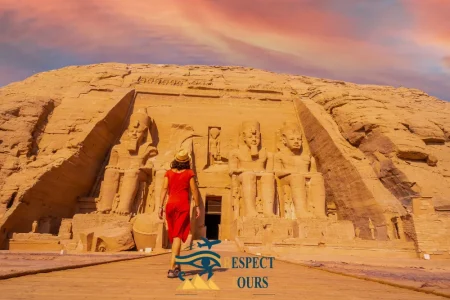


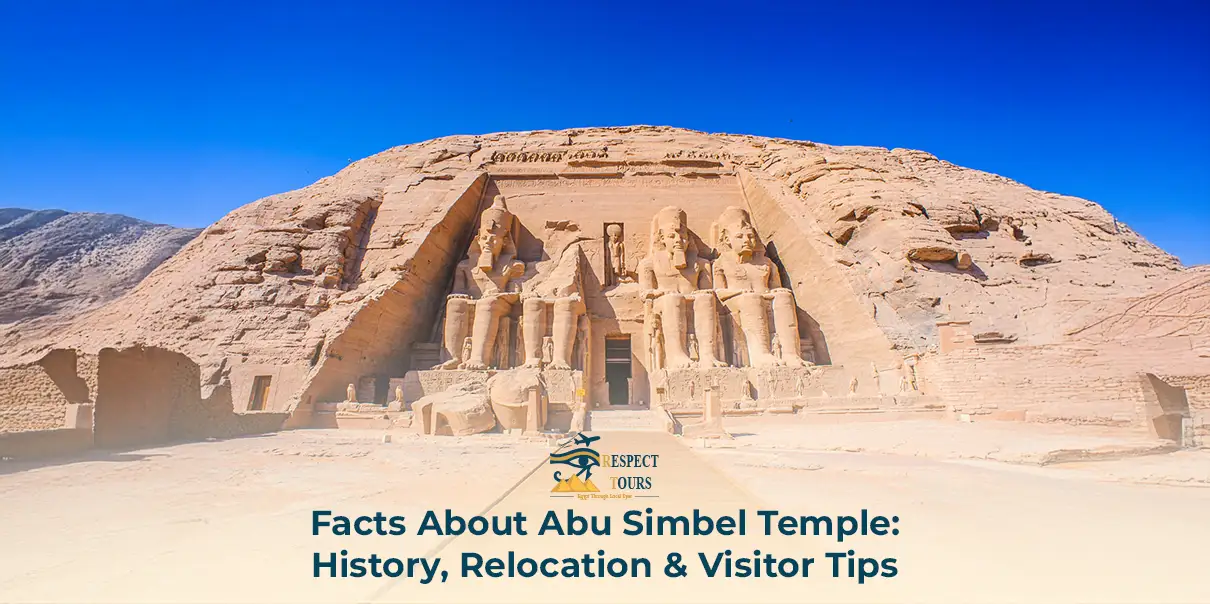
Searching for facts about Abu Simbel Temple that go beyond the basics? You’re in the right place. Carved into a sandstone cliff over 3,000 years ago by Pharaoh Ramesses II, Abu Simbel is one of Egypt’s greatest treasures, a monument that blends art, power, and science.
Located near the Sudanese border, the site features two massive temples: one honoring Ramesses himself and the gods Amun, Ra-Horakhty, and Ptah, and another dedicated to Queen Nefertari and the goddess Hathor. The colossal statues guarding the entrance still inspire awe, each over 20 meters tall.
But Abu Simbel’s true magic happens twice a year. On February 22 and October 22, sunlight travels deep into the temple to illuminate the inner sanctuary, leaving Ptah, the god of darkness, in shadow. This perfect solar alignment reveals the astronomical genius of ancient Egyptian builders.
This guide brings together everything you need to know, from the temple’s history and relocation to fascinating details, legends, and visitor tips, helping you experience Abu Simbel like an expert traveler, not just a tourist.
Quick Facts at a Glance
| Fact | Details |
|---|---|
| Built | 13th century BCE (c. 1264–1244 BCE) |
| Builder | Pharaoh Ramesses II |
| Location | 280 km south of Aswan, near the Sudan border |
| Famous For | 20-meter colossal statues, solar alignment phenomenon |
| Relocated | 1964–1968 (UNESCO rescue project) |
| UNESCO Status | World Heritage Site (1979) |
| Solar Events | February 22 & October 22 annually |
| Ticket Price | EGP 260 (adults), ~$8.50 USD |
Meaning of Abu Simbel
One of the most fascinating facts about Abu Simbel Temple begins with its name. In the Nubian language, “Abu Simbel” translates to “Father of the Leopard.” The name reflects both the region’s ancient Nubian roots and its deep connection to the natural world.
Today, that blend of Egyptian grandeur and Nubian heritage makes Abu Simbel one of the most culturally rich sites in the world, a masterpiece of symbolism carved in stone.
Where is Abu Simbel located?
Abu Simbel is located in southern Egypt, near the Sudanese border, on the western bank of Lake Nasser, about 280 km south of Aswan. The temples were originally carved along the Nile River, but the construction of the Aswan High Dam required their relocation to avoid flooding.
The site’s remote location made it strategically significant in ancient times, as it controlled trade routes between Egypt and Nubia. Today, its isolation adds to the sense of awe for visitors, as reaching Abu Simbel feels like entering a hidden world of ancient history.
Abu Simbel Before Relocation: What Really Happened?
One of the most remarkable chapters in Abu Simbel’s modern history is its relocation. During the construction of the Aswan High Dam in the 1960s, the temples were at risk of being submerged by Lake Nasser.
To save them, engineers carefully cut the temples into more than 1,000 blocks, some weighing up to 30 tons, and reassembled them on higher ground 65 meters above the original site. The project required precision engineering, international collaboration, and meticulous planning to ensure that every statue and relief was preserved in perfect alignment.
Did you know?
The Abu Simbel temples were moved block by block in a $40 million project in the 1960s, equivalent to around $300-400 million today, to save them from flooding.
Abu Simbel History of Relocation Process stands as one of the greatest achievements of modern archaeology and engineering, demonstrating humanity’s commitment to preserving cultural heritage.
When was Abu Simbel built? How old is it?
The temples date back to the 13th century BCE, built during the reign of Pharaoh Ramses II, one of Egypt’s most powerful and celebrated rulers. It Took Over 20 Years to Carve Out of a Single Cliff. The Great Temple was constructed to commemorate Ramses II’s victory at the Battle of Kadesh and to honor the gods Amun, Ra-Horakhty, and Ptah.
Abu Simbel also served as a powerful political statement, symbolizing Egypt’s dominance over Nubia and asserting the pharaoh’s divine status. Over the centuries, the temples were buried under sand and lost to history until their rediscovery in the 19th century, preserving them as one of the most significant examples of ancient Egyptian engineering and artistry.
Architectural Masterpieces: The Twin Temples
The Great Temple: Monument to Divine Kingship
The Great Temple of Abu Simbel ranks among humanity’s most audacious architectural achievements. The structure extends 63 meters into the cliff face, comprising multiple chambers culminating in the sacred sanctuary where divine statues reside.
Every element, from the entrance’s colossal statues to the innermost shrine’s arrangement, reflects sophisticated theological, political, and astronomical design.
The Façade: Four Colossal Statues
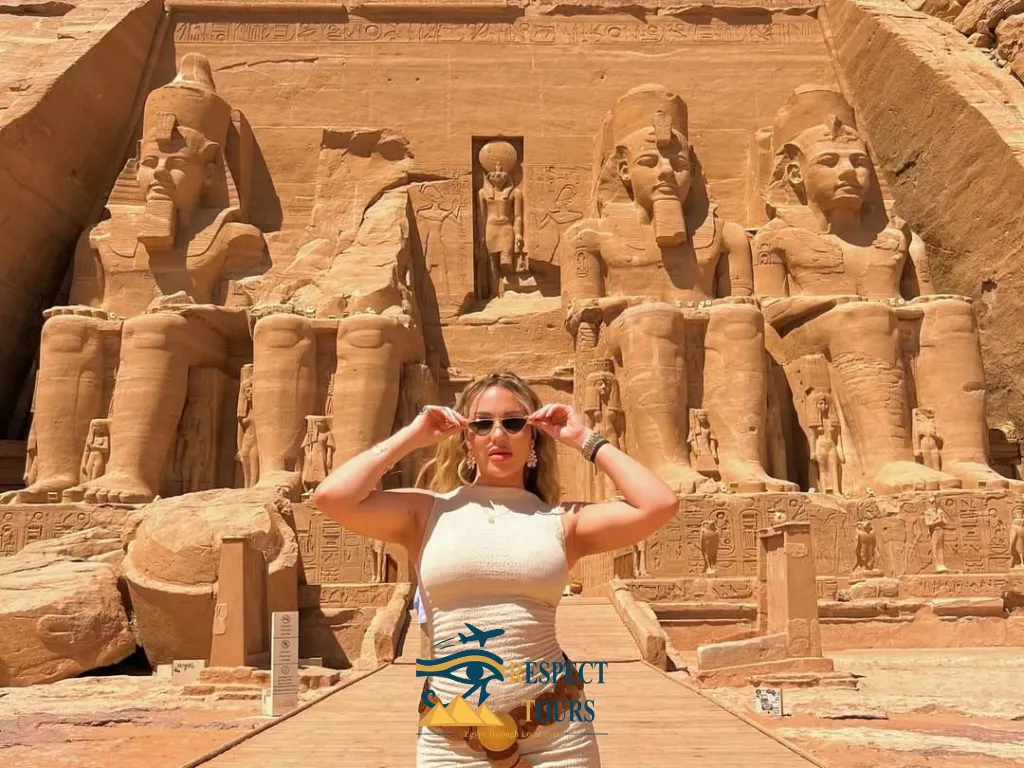
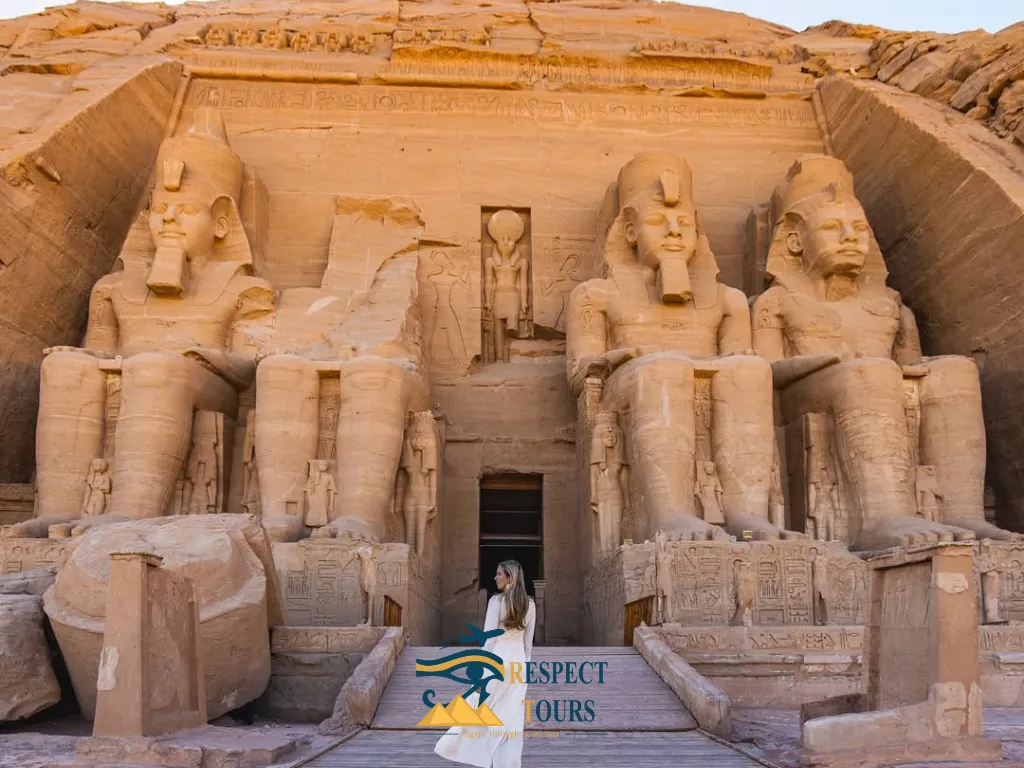
The temple’s façade features four seated statues of Ramesses II, each approximately 20 meters tall, equivalent to a six-story building. These figures represent Ramesses at different life stages, though all portray him wearing the double crown of Upper and Lower Egypt, emphasizing unified rule over all Egyptian territories.
The second statue from the left suffered catastrophic damage, likely from an earthquake during antiquity, leaving only the lower body intact. Rather than diminishing the monument’s power, this dramatic collapse paradoxically enhances it, creating a visual narrative of time’s passage and the enduring resilience of what remains.
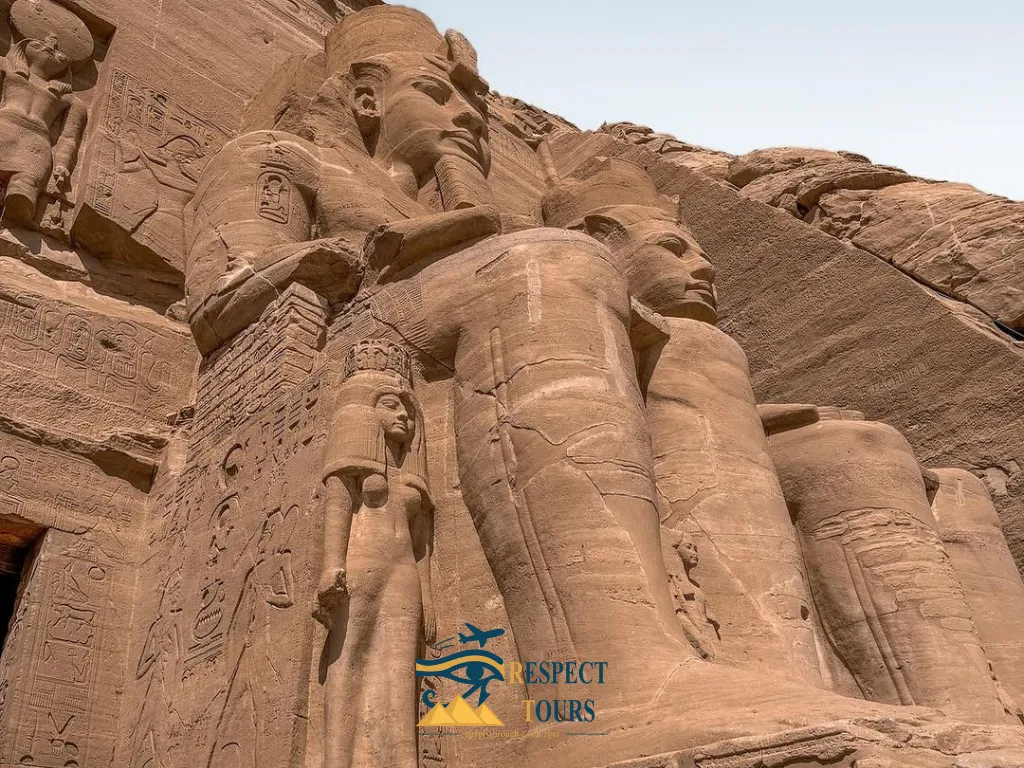
Smaller statues clustered around the colossal figures represent members of the royal family, including Ramesses’ mother Queen Tuya, his wife Nefertari, and several of his children. The deliberate size hierarchy, with Ramesses towering over his family members, visually reinforces royal supremacy and divine status.
Interior Architecture: Hypostyle Hall and Sacred Chambers
Beyond the façade, the Great Temple’s interior unfolds through a carefully choreographed spatial sequence designed to transition visitors from the earthly realm toward divine presence. The architecture follows the traditional Egyptian temple plan but is adapted for rock-cut construction:
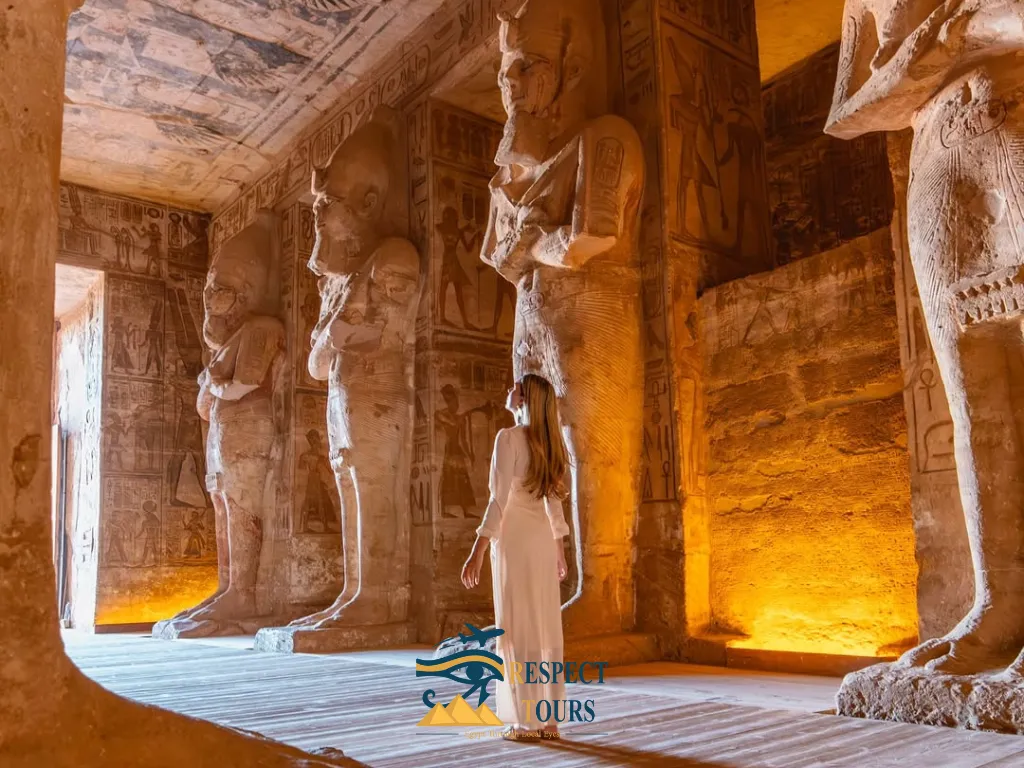
The Great Hypostyle Hall: Eight massive pillars in the form of Osiris, god of death and resurrection, line this hall, with Ramesses’ face substituted for the god’s traditional features. This architectural choice equated the living pharaoh with Osiris, promoting his deification. The walls display Egypt’s most extensive narrative battle scenes, depicting Ramesses’ Kadesh campaign with remarkable detail: individual soldiers, chariots in motion, and even the chaos of combat rendered in low relief that retains visible paint traces after 3,200 years.
Secondary Halls: Deeper into the temple, smaller chambers served ritual functions, including offering storage, priestly preparation rooms, and subsidiary shrines dedicated to various deities. The progressive narrowing and darkening of these spaces created psychological progression toward the sacred center.
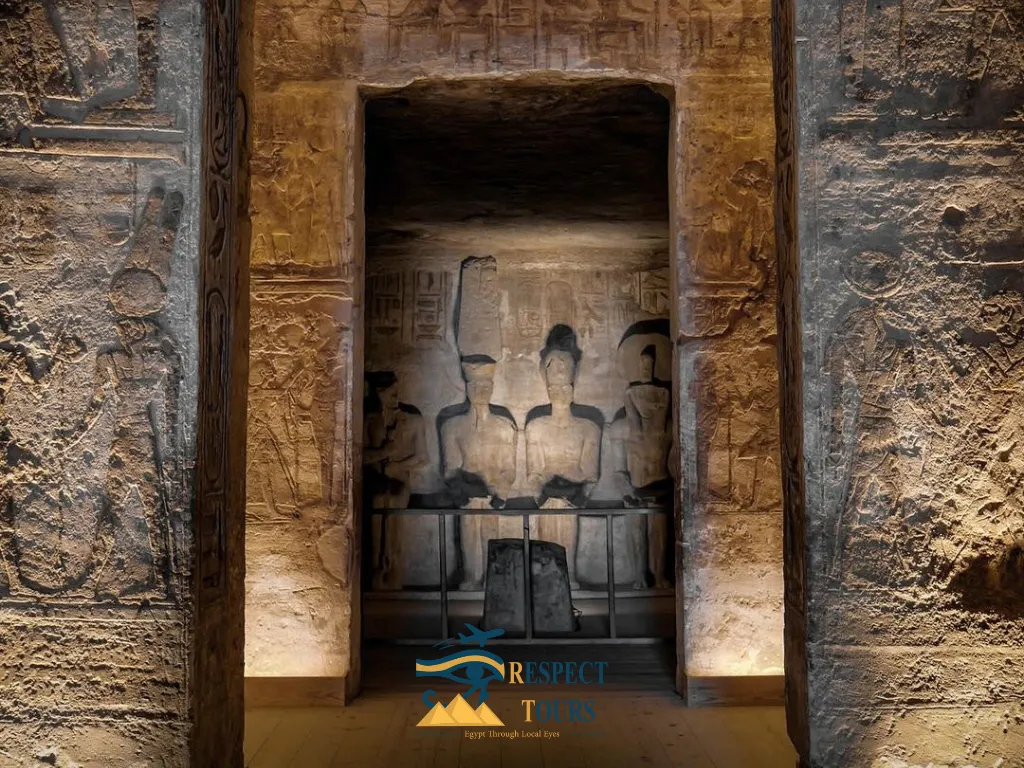
The Sanctuary: At the temple’s deepest point, 63 meters from the entrance, four statues sit against the back wall: Ra-Horakhty (sun god), Ramesses II (deified pharaoh), Amun-Ra (king of gods), and Ptah (god of creation and darkness). This alignment, with Ramesses positioned among the gods as an equal, represents the culmination of the temple’s theological program: the living king as divine intermediary between humans and cosmic powers.
The Small Temple: Nefertari and Revolutionary Royal Representation
While called the “Small Temple,” this structure, dedicated to Queen Nefertari and the goddess Hathor, represents one of ancient Egypt’s most remarkable monuments to female royal power. Its scale, though smaller than the Great Temple, remains massive by any standard, extending 30 meters into the cliff.
Unprecedented Royal Equality
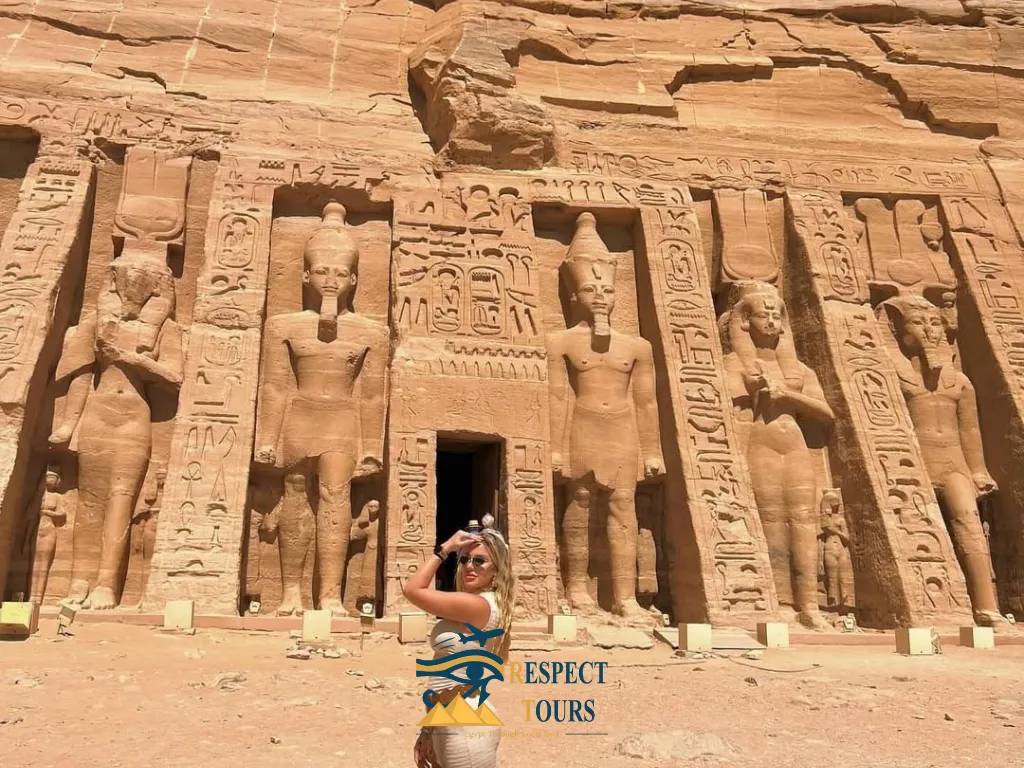
The Small Temple’s façade makes a striking statement unusual in Egyptian royal iconography: six colossal statues, alternating between Ramesses II and Nefertari, all carved at identical heights.
This equal representation was unprecedented. In traditional Egyptian art, queens appeared significantly smaller than kings, visually subordinating female royalty to male supremacy. Abu Simbel’s choice to portray Nefertari at equal scale to Ramesses signals her exceptional status, a status underscored by hieroglyphic inscriptions praising her as “the one for whom the sun shines.”
Several interpretations explain this unusual artistic choice:
Personal Devotion: Historical evidence suggests Ramesses II maintained genuine affection for Nefertari, his principal wife during the first decades of his reign. Her early death (around 1255 BCE) may have motivated this posthumous honor.
Political Alliance: Nefertari likely came from a powerful noble family, possibly with Nubian connections. Honoring her strengthened political alliances critical for maintaining control over southern territories.
Theological Role: As a priestess of Hathor, Nefertari fulfilled important religious functions. The Small Temple emphasizes her spiritual role, showing her participating in divine rituals typically reserved for the king alone.
Diplomatic Symbolism: Nefertari played documented roles in diplomatic correspondence, including with the Hittite royal family following the peace treaty that ended conflicts sparked by the Battle of Kadesh. Her prominence at Abu Simbel may reflect her diplomatic significance.
Interior Design and Hathor Worship
The Small Temple’s interior features six pillars with Hathor-headed capitals, columns topped with the goddess’s face and cow ears, representing her bovine aspect as divine nurturer and protector. Reliefs throughout show Nefertari making offerings to Hathor and other goddesses, performing rituals, and receiving divine blessings.
The sanctuary contains a statue of Hathor as a cow, the goddess’s primary animal form, emerging from the rock as though born from the cliff itself. This powerful image connects the temple to primordial creative forces, positioning Nefertari as intermediary between cosmic feminine divine power and earthly royal authority.
Advanced Engineering and Astronomy
The temples of Abu Simbel are a testament to the advanced engineering and astronomical knowledge of the ancient Egyptians. The solar alignment, which illuminates the sanctuary twice a year, required precise calculations of the sun’s path over thousands of years.
The architects accounted for seasonal shifts, temple orientation, and cliff angles to ensure the sunlight would strike the statues exactly on Ramses II’s birthday and coronation day. This level of precision remains impressive even by modern standards and highlights the Egyptians’ mastery of astronomy and geometry.
Decoration & Reliefs
The reliefs and decorations at Abu Simbel are among the most captivating facts about Abu Simbel Temple. They depict the pharaoh’s victories, religious ceremonies, offerings to the gods, and aspects of daily life.
Every scene was carefully designed to convey power, devotion, and eternal legacy. Visitors today can see how these intricate carvings have survived thousands of years, providing insight into ancient Egyptian culture, religion, and artistry.
Artistic Details
The artistic craftsmanship of Abu Simbel extends beyond the colossal statues. Walls are covered with intricate carvings and colorful paintings, many depicting Ramses II’s military victories, religious rituals, and daily life.
Symbols, hieroglyphs, and reliefs are not only decorative but also communicate messages about divine authority, loyalty, and the pharaoh’s connection with the gods. Visitors can observe the precision and detail, understanding why Abu Simbel is considered a pinnacle of ancient Egyptian artistry.
The Sun Enters the Temple Only Twice a Year: The Sun Festival Phenomenon
February 22: Likely corresponds to Ramesses II’s coronation anniversary, marking his ascension to divine kingship. The solar illumination on this date reinforces the cosmic validation of his rule, the sun god literally blessing the king at the moment commemorating his divine appointment.
October 22: Traditionally identified as Ramesses II’s birthday, though exact birth dates remain uncertain for ancient pharaohs due to different calendrical systems. The illumination on this date celebrates the king’s emergence into existence as a divinely ordained event.
These dates reflect the Egyptian concept of “jubilee” (sed festival), cyclical renewal ceremonies that reinforced pharaonic power. The solar alignment automated this renewal, with the cosmos itself perpetually validating Ramesses’ divine status without requiring human ritual.
Abu Simbel vs Other Egyptian Temples: How does it compare?
When travelers compare Egyptian temples, Abu Simbel often comes up alongside Karnak, Luxor, and Philae. The table below highlights what makes each site unique and why Abu Simbel stands apart.
| Temple | Key Features | How It Compares to Abu Simbel |
|---|---|---|
| Karnak Temple (Luxor) | The largest religious complex in Egypt, built over centuries, dedicated to Amun-Ra. | Karnak vs Abu Simbel: Karnak is vast and layered, while Abu Simbel is a single, unified masterpiece famous for its colossal statues and solar alignment. |
| Luxor Temple | Central role in the Opet Festival; beautifully lit at night. | Luxor vs Abu Simbel: Luxor reflects the continuity of kingship in the Nile Valley. Abu Simbel, isolated in the Nubian desert, symbolizes Ramesses II’s power and divine status. |
| Philae Temple (Aswan) | Dedicated to Isis; rescued from flooding by UNESCO; set on an island. | Abu Simbel also faced flooding but was relocated block by block, becoming the most famous UNESCO preservation success story. |
What Makes Abu Simbel Unique?
While all Egyptian temples demonstrate impressive architecture and religious significance, several factors distinguish Abu Simbel:
- Rock-Cut Scale: Abu Simbel represents the largest rock-cut temples ever constructed, surpassing earlier examples like Deir el-Bahari and later ones like Petra (which is Nabataean, not Egyptian).
- Astronomical Precision: While Egyptian temples often incorporated solar alignments, Abu Simbel’s twice-yearly illumination of specific interior statues represents the most celebrated and dramatic example.
- Imperial Frontier Location: Unlike Nile Valley temples serving religious communities, Abu Simbel functioned as a frontier monument combining religious, political, and military purposes.
- Double Temple Complex: The pairing of two temples—one honoring the king and male deities, another honoring the queen and female deities—with the unprecedented equal-height statuary, makes Abu Simbel unique.
- Modern Relocation Drama: Abu Simbel became the most famous UNESCO rescue project, establishing it as a symbol of international heritage protection efforts.
- Continuous Tourism Appeal: Despite extreme remoteness (280 km from the nearest city), Abu Simbel attracts more visitors than many more accessible sites, demonstrating its unique appeal.
These factors combine to make Abu Simbel not merely another impressive Egyptian temple but a monument that transcends categorization, a convergence of art, science, politics, and human achievement that continues inspiring wonder 3,200 years after its creation.
Abu Simbel Travel Guide: Tickets, Best Time & Tips
Today, Abu Simbel is one of Egypt’s most visited sites. Every year, thousands of tourists come to explore the temples and witness the solar alignment. Visitors can take guided tours, enjoy Lake Nasser cruises, and explore the surrounding Nubian villages for a complete cultural experience.
How to Get from Aswan to Abu Simbel: by flight or by road?
Abu Simbel lies about 280 km south of Aswan, near the Sudanese border. Travelers typically choose between two options:
- By Air: Daily flights from Aswan take around 45 minutes, making this the fastest and most convenient route, especially for day trips.
- By Road: Buses and private cars cover the desert highway in about 3.5–4 hours. Early morning departures are common, with convoys once being the standard but now optional. This route rewards visitors with dramatic desert landscapes along the way.
When is the best time to visit Abu Simbel temples?
The temples are open year-round, but the cooler months (October–April) are most comfortable for exploring. Summers in southern Egypt can be extremely hot, with temperatures often exceeding 40°C (104°F). For a truly unique experience, many visitors plan their trips around the Sun Festival dates, February 22 and October 22, when the solar alignment draws large, celebratory crowds.
Opening Hours and Ticket Prices in 2026
Visiting Abu Simbel Temple requires purchasing tickets, and understanding the costs helps plan your trip effectively. The ticket prices vary depending on whether you visit the Great Temple, the Small Temple, or both.
- Opening Hours: Daily from 5:00 am to 6:00 pm (seasonal variations may apply).
- Abu Simbel Ticket Prices: As of the latest updates, standard entry is around EGP 260 for adults, with reduced rates for students and locals. Additional fees may apply for photography permits inside the temples. Always check for the latest prices before traveling, as they may change.
Tickets can often be purchased on-site or through authorized tour operators, especially if you are traveling from Aswan or on a Nile cruise.
Guided tours like Ours provide not only historical context but also insights into the architecture, solar alignment, and artistic details of the temples. Planning and understanding the entry fees allows visitors to fully enjoy one of Egypt’s most iconic landmarks.
What travel tips help first-time visitors enjoy Abu Simbel?
- Arrive at Sunrise: Reaching the site early in the morning rewards you with cooler weather, softer light on the colossal statues, and a head start before tour groups arrive.
- Beat the Crowds: If flying, book the first flight from Aswan. If traveling by road, start around 4:00 am to arrive at opening time.
- Pair with Aswan Highlights: Combine Abu Simbel with attractions in Aswan such as Philae Temple, the Unfinished Obelisk, and the Nubian Museum for a fuller experience. Respect Tours and other operators often offer bundled itineraries, saving time and logistics.
- Stay Overnight if Possible: While most visitors come on a day trip, staying in Abu Simbel village offers a quieter evening experience and the chance to enjoy the temples without the rush.
- Bring a camera or smartphone to capture the colossal statues and intricate reliefs.
Fun & Lesser-Known Facts About Abu Simbel
- Built entirely from sandstone, Abu Simbel stands as one of the most impressive examples of rock-cut architecture in ancient Egypt.
- Ramses II’s colossal statues were strategically designed to intimidate Nubian visitors and display the Pharaoh’s divine power.
- One of the statues was damaged by an earthquake, leaving the upper part of the figure collapsed, a reminder of both time and resilience.
- Even after being moved during the 1960s relocation, the temple’s alignment is off by just 1°, preserving its solar phenomenon almost perfectly.
- The name “Abu Simbel” means “Father of the Leopard” in the Nubian language.
- The site was rediscovered in 1813 by Swiss explorer Johann Ludwig Burckhardt, after being buried under sand for centuries.
These fun facts show how Abu Simbel blends art, astronomy, and history in one breathtaking masterpiece.
Visiting Abu Simbel Today
Abu Simbel is accessible by plane, bus, or Lake Nasser cruises. The best time to visit is during February 22 or October 22 to witness the solar alignment. Visitors can explore both temples, admire colossal statues, view intricate reliefs, and learn about the temple’s history, architecture, and cultural significance.
Discover Abu Simbel with Respect Tours Egypt
Exploring the wonders of Abu Simbel Temple is an unforgettable experience, and Respect Tours offers expert-guided trips that make your visit seamless and enriching. With professional guides, comfortable transportation, and personalized itineraries, Respect Tours ensures you see all the highlights: the colossal statues, intricate reliefs, the Small Temple of Nefertari, and the famous solar alignment.
Whether you’re interested in history, architecture, or photography, Respect Tours provides an experience tailored to your interests. Their knowledgeable guides share fascinating facts about Abu Simbel Temple, helping visitors fully appreciate the cultural, spiritual, and artistic significance of this iconic site.
Plan your journey today with Respect Tours and experience Abu Simbel like never before, a seamless adventure into one of Egypt’s most extraordinary landmarks.
Conclusion
Abu Simbel is not just carved in stone; it’s carved into the story of human brilliance. Built by Pharaoh Ramses II over 3,000 years ago and saved from flooding in the 1960s, it stands as proof that great ideas and great teamwork can last forever.
The facts about Abu Simbel Temple show how art, science, and faith came together in perfect balance. From its colossal statues to the sunlight that still shines deep into the sanctuary twice a year, every detail tells the story of Egypt’s brilliance.
Want to see Abu Simbel for yourself?
Contact Respect Tours today, and we’ll take care of every detail so you can experience this wonder up close, just as the pharaohs once did.
FAQ: Frequently Asked Questions
What is Abu Simbel famous for?
Abu Simbel is renowned for its colossal statues of Ramesses II, the solar alignment phenomenon where sunlight illuminates the inner sanctuary twice a year, and its dramatic UNESCO relocation project in the 1960s.
As of the latest updates, entry costs around EGP 260 for adults, with discounts for students and locals. A separate fee is required for photography inside. Always check updated Abu Simbel ticket prices before your trip, as they may change.
Yes, but the best time to visit Abu Simbel is from October to April, when the weather is cooler. The highlight dates are February 22 and October 22, when the Sun Festival occurs, though these attract larger crowds.
You can reach Abu Simbel either by a 45-minute flight from Aswan or via a 3.5–4-hour drive through the desert road. Many travelers opt for guided tours that cover transportation and entry.