
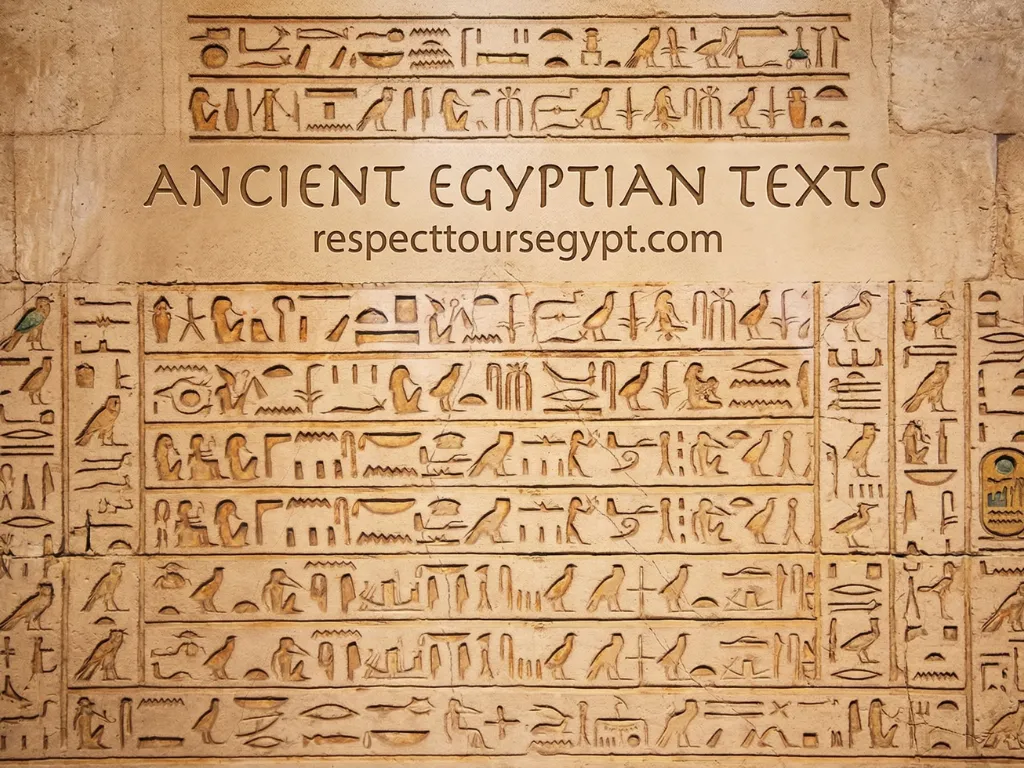
You step into a narrow stone chamber built more than 4,400 years ago. The air is cool. The walls are alive with hieroglyphs, not decoration, but spells. Every carved symbol inside the Pyramid of Unas was intended to protect a king, guide his soul through the afterlife, and carry him to the stars.
Ancient Egyptian texts are not relics behind glass. They remain exactly where they were first inscribed, on tomb walls, temple columns, papyrus scrolls, and royal monuments across Egypt. To understand them is to see Egypt differently. Temples become theological statements. Tombs become maps of eternity. Cartouches become royal signatures across time.
Written with input from Respect Tours Egypt’s licensed Egyptologist team, specialists who have guided travelers through these sites for more than 45 years, this guide explains how ancient Egyptian writing worked, what the major texts contain, why they were created, and where to encounter the finest surviving examples in person.
By the end, you will not just see Egypt’s walls. You will begin to read them.
Ancient Egyptian Writing: Three Scripts, One Civilisation
Most visitors assume all ancient Egyptian writing is hieroglyphic. In fact, three distinct scripts served different purposes across different periods; all three appear together on the Rosetta Stone, the key to their decipherment.
| Script | Period | Used For |
|---|---|---|
| Hieroglyphic | c. 3200 BCE – 394 CE | Monumental inscriptions on temple and tomb walls, royal stelae, and religious texts (700+ symbols) |
| Hieratic | Old Kingdom onward | Cursive script used on papyrus for administration, literature, religious texts, and personal letters |
| Demotic | c. 650 BCE – Greco-Roman era | Simplified script for legal, commercial, and daily writing; all appear on the Rosetta Stone |
How Hieroglyphs Were Deciphered: The Rosetta Stone
For 1,400 years after the last hieroglyphic inscription was carved in 394 CE, no one could read them. In 1799, French soldiers near Rashid (Rosetta) discovered a trilingual stone bearing a priestly decree in hieroglyphic, demotic, and Greek.
In 1822, scholar Jean-François Champollion cracked the code, realizing that oval cartouches enclosed phonetic royal names and that hieroglyphs represented sounds as well as objects. Every ancient Egyptian text readable today is readable because of that discovery.
How Hieroglyphs Work: A Traveller’s Primer
Understanding a few basics transforms what you see on temple walls:
- Logograms: A symbol depicting an object means that object; a sun drawn means ‘sun.’
- Phonograms: The same sun symbol (ra) can represent its sound in an unrelated word.
- Determinatives: Silent signs at the end of a word indicate category, and walking legs signal a verb of motion.
- Cartouches: Oval loops enclosing royal names. Spot one, and you have found a pharaoh.
- Reading direction: Follow the animal and human figures; they always face toward the beginning of the text.
The Major Ancient Egyptian Texts: A Reference Guide
Ancient Egyptian texts span three millennia and cover everything from royal theology to love poetry to medical prescriptions. The table below maps the main categories, their periods, and where to encounter them in Egypt.
| Text Category | Period | What It Contains | Where to See It |
|---|---|---|---|
| Pyramid Texts | Old Kingdom (c. 2400 BCE) | Royal funerary spells – the oldest religious writing in the world, exclusive to pharaohs | Pyramid of Unas, Saqqara |
| Coffin Texts | Middle Kingdom (c. 2055–1650 BCE) | Expanded afterlife spells for non-royals; includes early underworld maps | Egyptian Museum, Cairo; Luxor Museum |
| Book of the Dead | New Kingdom (c. 1550–1070 BCE) | ~200 spells guiding the soul; includes the Weighing of the Heart | Valley of the Kings, Luxor; Cairo Museums |
| Wisdom Texts | Old Kingdom – New Kingdom | Ethical teachings and philosophy (Ptahhotep, Amenemope) | Cairo Museums (papyri) |
| Literature Texts | Middle Kingdom onward | Stories, poetry, and myths (Sinuhe, Shipwrecked Sailor) | Cairo Museums (papyri) |
| Magical Texts | All periods | Healing spells and protective magic (Ebers & Edwin Smith papyri) | Cairo Museums |
| Temple Inscriptions | All periods | Royal decrees, hymns, and rituals carved on temple walls | Karnak, Luxor, Philae, Abydos, Edfu |
| Hermetic Texts | Greco-Roman period | Mystical and philosophical writings blending Egyptian & Greek thought | Temple of Esna; Temple of Edfu |
The Pyramid Texts: Oldest Religious Writing in the World
The Pyramid Texts are 800 hieroglyphic spells carved into the burial chambers of Old Kingdom pharaohs at Saqqara, dating to approximately 2400 BCE. They had one purpose: to protect the king’s soul and guide his ascent to join Ra among the stars.
Crucially, the Egyptians believed that carving the words imparted an active magical force; the hieroglyphs were not decorations; they did something.
They were exclusively royal. The possibility of an afterlife among the stars was, at this stage in Egyptian history, available only to the pharaoh. That exclusivity makes standing inside the Pyramid of Unas, still largely intact, one of the most charged experiences in Egyptology.
Logistics: Pyramid of Unas, Saqqara complex. Open 7:00 AM-5:00 PM (winter). Arriving at the opening, the chamber fills quickly, and the quiet is irreplaceable.
Our private Saqqara tours include an Egyptologist narration of the Pyramid Texts inside the original chamber. Explore the Saqqara tour →
The Book of the Dead: Egypt’s Most Searched Ancient Text
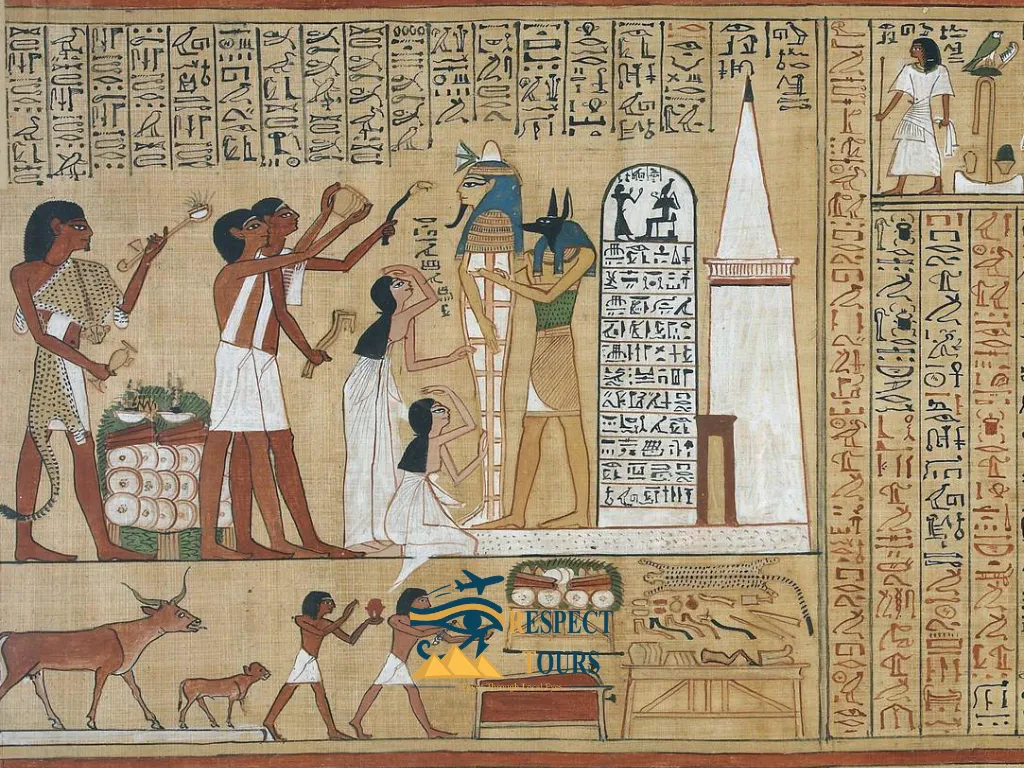
Formally the Book of Coming Forth by Day (Pert em hru), this New Kingdom collection of ~200 spells was written on personalized papyrus scrolls, sometimes over 20 meters long, and placed in tombs from c. 1550 BCE.
Its most famous scene, the Weighing of the Heart, shows the deceased’s heart balanced against the feather of Ma’at (truth) before 42 divine judges. A heart heavier than the feather, burdened by wrongdoing, was devoured by Ammit, a composite beast of lion, hippo, and crocodile. If the heart is balanced, eternity awaits.
The spells are practical, not abstract: passwords for guarded underworld gates, incantations to neutralize serpents, and declarations of innocence (the Negative Confession). They reveal a civilization that approached death with the same methodical rigor it applied to building temples.
Our Valley of the Kings private tours include panel-by-panel Egyptologist commentary on the Book of the Dead scenes that most visitors walk straight past. View the Valley of the Kings tour →
Famous Ancient Egyptian Text Discoveries
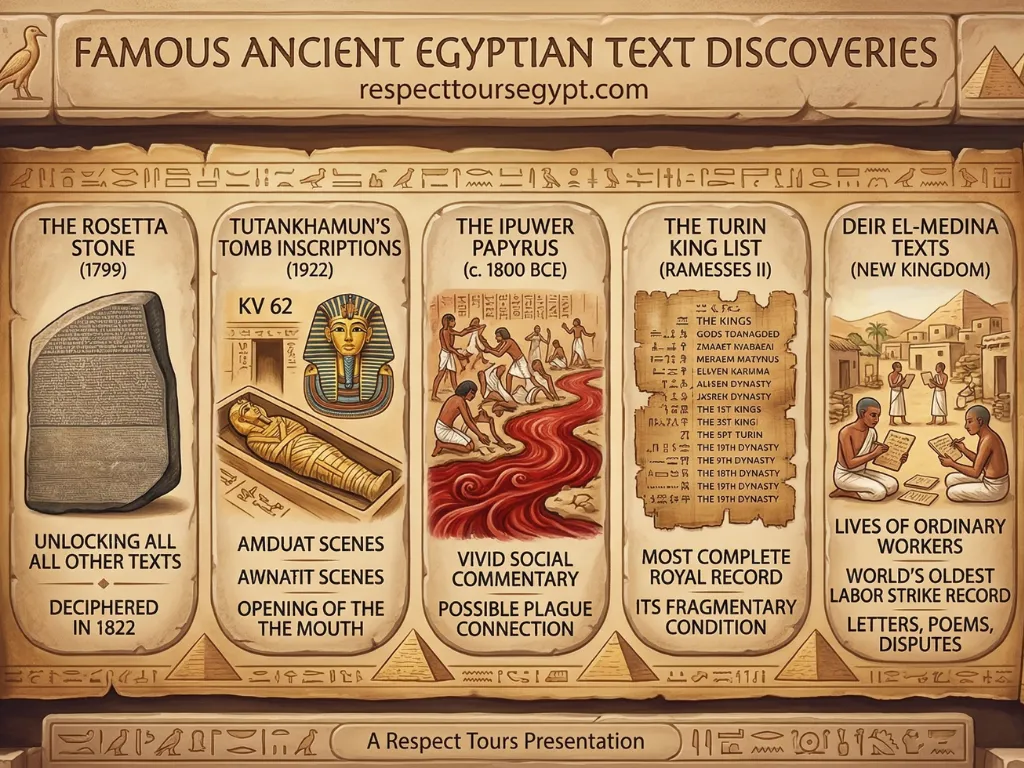
Some of the most significant moments in Egyptology have come not from excavating temples but from recovering and reading texts. These five discoveries reshaped our understanding of the ancient world:
- The Rosetta Stone (196 BCE; discovered 1799): Trilingual decree in hieroglyphic, demotic, and Greek. Now in the British Museum. Champollion’s decipherment in 1822 unlocked every other Egyptian text.
- Tutankhamun’s tomb inscriptions (KV 62, 1922): The burial chamber walls bear Amduat scenes and the Opening of the Mouth ceremony. The mummy remains in situ in the Valley of the Kings, Luxor.
- The Ipuwer Papyrus (c. 1800 BCE): A vivid social commentary describing Egyptian society in collapse, famine, inversion of order, and the Nile running with blood. Some scholars connect it to the Biblical plagues. Now in the Rijksmuseum, Leiden.
- The Turin King List (Ramesses II era): A papyrus listing every Egyptian king from the gods to the 19th Dynasty, the most complete royal record from ancient Egypt. Now in Turin, its fragmentary condition from careless handling is one of Egyptology’s great losses.
- The Deir el-Medina papyri and ostraca (New Kingdom): Letters, wage disputes, love poems, and the world’s oldest known labor strike record, left by the literate workers who built the royal tombs. The village is still accessible on the West Bank at Luxor, minutes from the Valley of the Kings.
Where to See Ancient Egyptian Texts in Egypt
Egypt is, in the most literal sense, covered in text. The question is not whether to see ancient Egyptian writing, but which sites to prioritize. Here is the essential breakdown by location:
| Location | Best For | Practical Notes |
|---|---|---|
| Pyramid of Unas, Saqqara | Pyramid Texts – the oldest writing in the world | 30 km south of Cairo (separate ticket required). Arrive at 7:00 AM for cooler weather and fewer visitors. Narrow passages—wear comfortable shoes. |
| Egyptian Museum, Cairo | Book of the Dead scrolls, Coffin Texts, stelae, ostraca | Located in Tahrir Square. Visit before 10:00 AM to avoid crowds. Allow 2–3 hours. |
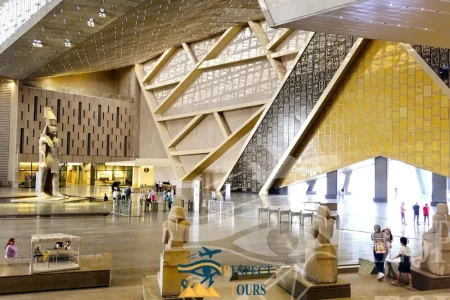
| Grand Egyptian Museum (GEM), Giza | Papyrus collection; Tutankhamun artifacts | Opened Nov 2025 near Giza Pyramids. 100,000+ artifacts. Allow 3–4 hours. |
| Valley of the Kings, Luxor | Book of the Dead, Amduat, Litany of Ra | KV17 (Seti I) & KV57 (Horemheb) are the richest in inscriptions. |
| Karnak & Luxor Temples | Royal inscriptions, hymns, battle reliefs | Best early morning or near closing. Full-day visit recommended. Egyptologist guide advised. |
| Tombs of the Nobles & Deir el-Medina, Luxor | Biographical texts, workers’ records, love poetry | Less crowded than royal tombs—more intimate experience. |
| Temple of Philae, Aswan | Isis hymns; last hieroglyphic inscription (394 CE) | Boat access to Agilkia Island. Evening sound & light show available. |
| Temple of Seti I, Abydos | Abydos King List; finest New Kingdom inscriptions | 3 hours north of Luxor. Often combined with Dendera Temple. |
Conclusion: Why Ancient Egyptian Texts Are a Must-See
Standing before a 4,400-year-old hieroglyph is more than a history lesson; it’s a direct conversation with the past. Ancient Egyptian texts aren’t just inscriptions; they are spells, stories, and records that shaped a civilization and still speak to us today.
From the Pyramid Texts at Saqqara to the Book of the Dead in Luxor and the treasures at the Grand Egyptian Museum, each site offers a unique glimpse into the mind of an ancient world. The difference is guidance: a trained Egyptologist can show you not just what the symbols say, but what they meant, how they were used, and why they mattered.
Respect Tours Egypt’s licensed Egyptologist team has been doing this for over 45 years, translating hieroglyphs on-site, explaining the significance of every scene, and revealing what most visitors walk straight past. Every site in this guide is available as a private, Egyptologist-led experience: Saqqara, the Valley of the Kings, Karnak, Philae, Abydos, or a full itinerary covering them all.
You came to Egypt to see history. Come and read it.
📍 View all itineraries:respecttoursegypt.com
📞 Call or WhatsApp: +201004482045
✉️ Email: info@respecttours.com
Frequently Asked Questions
What are ancient Egyptian texts?
Ancient Egyptian texts are written records spanning more than 3,000 years – from religious spells on tomb walls to literary works on papyrus. Categories include funerary texts, wisdom literature, magical incantations, medical documents, royal inscriptions, and administrative records, together offering the most complete picture of any pre-modern civilization.
What is the Book of the Dead?
Formally the Book of Coming Forth by Day, it is a New Kingdom collection of ~200 spells on personalized papyrus scrolls placed in tombs from c. 1550 BCE. It guided the soul through the afterlife’s dangers and culminated in the Weighing of the Heart – the deceased’s judgment before 42 divine judges. Scenes appear throughout the royal tombs of the Valley of the Kings in Luxor.
What are the Pyramid Texts, and where can you see them?
The oldest surviving religious writing in the world – 800 hieroglyphic spells carved into Old Kingdom royal pyramids at Saqqara from c. 2400 BCE. Designed to protect the pharaoh’s soul and guide his ascent to the sun god Ra. The best-preserved examples are in the Pyramid of Unas at the Saqqara complex, approximately 30km south of Cairo.
What is the difference between hieroglyphic, hieratic, and demotic script?
Hieroglyphic: formal pictorial script for stone monuments. Hieratic: a cursive scribal form on papyrus for administrative and literary documents. Demotic: simplified everyday script for legal and commercial use from c. 650 BCE. All three appear on the Rosetta Stone – the key to their decipherment by Champollion in 1822.
How were Egyptian hieroglyphs deciphered?
By French scholar Jean-François Champollion in 1822, using the Rosetta Stone discovered near Rashid in 1799. The stone bore a priestly decree in three scripts, including the readable ancient Greek. Champollion identified royal cartouches as phonetic entry points and cracked the code after 1,400 years of unreadability.
What is the oldest written text in ancient Egypt?
The Pyramid Texts of Saqqara, c. 2400 BCE, are the oldest surviving body of religious writing in the world. The earliest complete examples are in the pyramid of Pharaoh Unas (Fifth Dynasty, c. 2375 BCE). Some administrative labels predate them by centuries, but the Pyramid Texts represent the oldest sustained corpus.