

The pyramids of Egypt aren’t just ancient tombs; they’re living symbols of human brilliance, mystery, and faith. Rising from the golden sands for more than 4,500 years, these wonders continue to inspire architects, historians, and travelers from every corner of the world.
Built during Egypt’s Old Kingdom (2686-2181 BCE), the pyramids served as elaborate resurrection machines for pharaohs, protected vessels designed to launch their souls into eternity. The Great Pyramid of Giza alone contains 2.3 million limestone blocks, each placed with astronomical precision that modern engineers still struggle to explain.
But statistics don’t capture the moment you first see them rising from the desert, their massive stones glowing amber in the Egyptian sun. That’s when numbers transform into wonder.
This guide reveals 30 fascinating Facts About Ancient Pyramids in Egypt, from construction secrets and hidden chambers to spiritual meanings, preparing you for an experience far beyond ordinary sightseeing.
30 Quick Facts About Ancient Pyramids in Egypt

For travelers who want essential information at a glance, here’s a comprehensive fact list covering the most important details:
Size and Construction
- The Great Pyramid originally stood 481 feet tall, the world’s tallest structure for 3,800 years
- Its base covers 13 acres, large enough to fit eight football fields
- Approximately 2.3 million stone blocks comprise the Great Pyramid
- Individual blocks weigh between 2.5 and 15 tons; the largest exceed 80 tons
- Construction took approximately 20 years with 20,000-30,000 workers
- Workers were paid laborers and seasonal farmers, not slaves
- Stone came from local quarries, Tura (across the Nile), and Aswan (500+ miles south)
Precision and Engineering
- The base is level to within 2.1 centimeters
- Four sides align with cardinal directions to within 3/60th of a degree
- The pyramid’s perimeter-to-height ratio approximates 2π
- The pyramid has 8 sides, not 4, a subtle concavity visible only from the air
- Mortar used between blocks remains stronger than the blocks themselves
- Workers placed roughly 12 blocks per hour during construction
Interior Features
- Three main chambers: Subterranean, Queen’s, and King’s chambers
- The Grand Gallery is a 153-foot ascending corridor with corbelled walls
- Narrow shafts from chambers align with specific stars for spiritual purposes
- A mysterious void discovered in 2017 remains unexplored
- Interior temperature stays constant at 68°F (20°C) year-round
The Pharaohs and Timeline
- Khufu (Cheops) commissioned the Great Pyramid around 2560 BCE
- Khafre built the second pyramid and the Great Sphinx around 2540 BCE
- Menkaure’s smaller pyramid featured expensive red granite casing around 2510 BCE
- Djoser’s Step Pyramid at Saqqara (2630 BCE) was the first pyramid
- The Bent Pyramid shows mid-construction problem-solving
Spiritual and Cultural Significance
- Pyramids served as resurrection machines for the pharaoh’s afterlife journey
- The pyramid shape symbolized sun rays creating a stairway to heaven
- Pyramid complexes included temples, causeways, and smaller queen pyramids
- Daily rituals at mortuary temples were believed to sustain the pharaoh’s spirit
Original Appearance
- Originally covered in 144,000 polished casing stones that reflected sunlight
- Most casing stones were removed for medieval Cairo building projects
- The capstone (pyramidion) was possibly covered in gold or electrum
Why Were the Pyramids Built? Understanding Their Purpose
The pyramids served a purpose far more profound than impressive architecture. Ancient Egyptians believed the pharaoh was a living god who would continue his divine role in the afterlife. The pyramid functioned as a resurrection machine, a protected vessel for the pharaoh’s body, and a launching point for his soul’s journey to join the sun god Ra.
These architectural and spiritual elements make the Facts About Ancient Pyramids in Egypt
far more complex than simple tomb structures. Each pyramid was the centerpiece of an
elaborate complex designed to transform a mortal pharaoh into an eternal god, a
transformation ancient Egyptians believed was essential for cosmic order itself.
Key fact: Pyramids weren’t simply tombs. They were part of elaborate mortuary complexes, including temples, causeways, and smaller pyramids for queens. Each element played a role in the pharaoh’s transformation into an eternal being.
The pyramid shape itself held deep religious significance. Its sloping sides represented the rays of the sun descending to earth, creating a stairway the pharaoh could climb to reach the heavens. This solar connection explains why pyramids were typically built on the Nile’s western bank, where the sun sets, symbolizing the realm of the dead.
The Great Pyramids of Giza: Size, Height, and Measurements
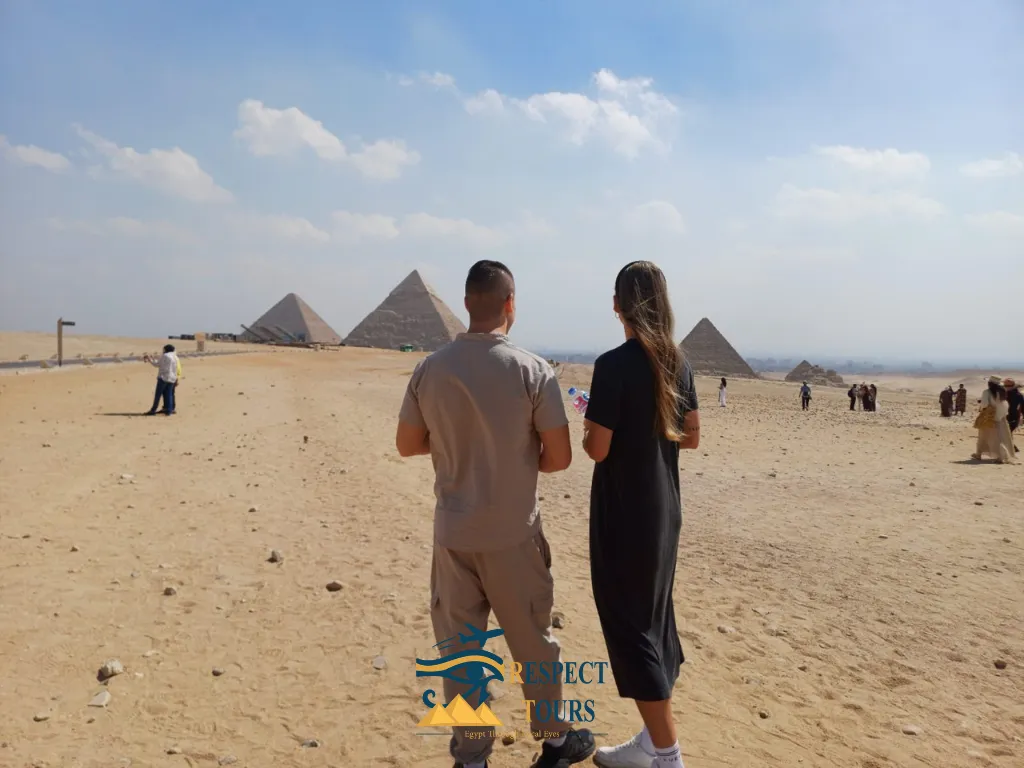
The Giza Plateau hosts three primary pyramids, each built by successive pharaohs during Egypt’s Old Kingdom:
- The Great Pyramid of Khufu (Cheops): Constructed around 2560 BCE, this is the oldest and largest of the three. Originally standing at 481 feet with a base covering 13 acres, it remained the world’s tallest man-made structure for over 3,800 years. Approximately 2.3 million limestone blocks, each weighing between 2.5 and 15 tons, were precisely positioned to create this architectural marvel.
- The Pyramid of Khafre – Built by Khufu’s son around 2540 BCE, this pyramid appears taller than its neighbor due to its elevated position and steeper angle. Though slightly smaller at 448 feet, it retains much of its original smooth limestone casing at the apex, offering visitors a glimpse of how all three pyramids once gleamed like polished mirrors under the desert sun.
- The Pyramid of Menkaure – The smallest of the trio at 213 feet, completed around 2510 BCE. Don’t let its relative size fool you, this pyramid contains some of the finest stonework and was originally sheathed in expensive red granite for its lower courses, demonstrating the continuing evolution of pyramid construction techniques.
| Feature | Khufu | Khafre | Menkaure |
|---|---|---|---|
| Height | 481 ft | 448 ft | 213 ft |
| Base | 756 ft | 706 ft | 356 ft |
| Built | 2560 BCE | 2540 BCE | 2510 BCE |
| Blocks | 2.3M | ~2M | ~200K |
| Casing | Tura limestone | Partial at top | Red granite |
| Interior Access | Yes | Yes | Limited |
What Are the Pyramids Made Of? Materials and Construction
Limestone, Granite, and Casing Stones: Understanding what the pyramids are made of reveals the logistical miracle of their construction. The core structure consists primarily of locally quarried limestone blocks from the Giza Plateau itself. Workers extracted an estimated 5.5 million tons of limestone for the Great Pyramid alone.
The exterior casing stones, most now removed, were premium Tura limestone quarried from across the Nile River. This fine-grained, white limestone could be polished to a brilliant shine, making the pyramids visible from miles away. The ancient Greek historian Herodotus described them as gleaming “like snow.”
For the internal chambers and passages, builders used massive granite blocks transported over 500 miles from Aswan in southern Egypt. Some of these granite slabs weigh up to 80 tons; imagine moving an object the weight of 10 elephants using only Bronze Age technology.
How Were the Pyramids Built? Construction Techniques Explained
The Workers: Not Slaves, But Skilled Laborers
Contrary to popular myth, enslaved people didn’t build the pyramids. Archaeological discoveries of workers’ villages near Giza reveal that skilled laborers and seasonal workers, likely farmers during the Nile’s flood season, constructed these monuments. Evidence suggests a workforce of approximately 20,000 to 30,000 people, including quarrymen, haulers, masons, and support staff.
The workers’ cemetery near Giza contains bodies buried with honor, and medical care evidence shows these weren’t oppressed slaves but valued contributors to a national project. Graffiti left by work gangs shows team pride, with names like “Friends of Khufu” and “Drunkards of Menkaure.”
Moving the Massive Stone Blocks: Ramps and Ancient Engineering
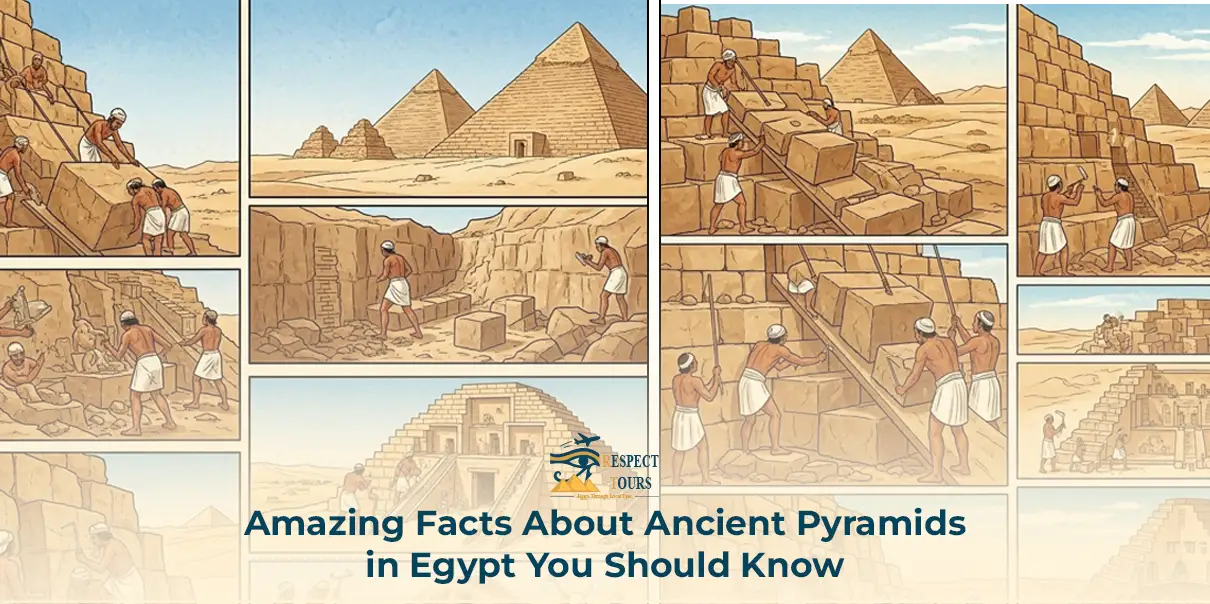
Recent experiments demonstrate that wetting the sand in front of sledges reduced friction by up to 50%, allowing teams to haul multi-ton blocks more efficiently. Workers likely used a combination of techniques, including:
- Straight ramps for the initial courses
- Spiral ramps wrapping around the pyramid
- Internal ramps within the structure itself
- Levers and rockers for fine positioning
For a deeper exploration of the competing theories, including the internal ramp hypothesis and the external spiral ramp model, discover 3 theories on how the pyramids were built.
How Long Did It Take to Build the Great Pyramid?
The Great Pyramid of Giza took approximately 20 years to complete, according to most Egyptologists. That means workers placed roughly 12 blocks per hour during a 10-hour workday for two decades, a pace that seems impossible until you understand the level of organization involved.
Mathematical Precision and Alignment of the Pyramids
The Facts About Ancient Pyramids in Egypt become even more impressive when examining their mathematical accuracy:
- The Great Pyramid’s base is level to within 2.1 centimeters, an error margin of less than 0.015%
- The four sides align almost perfectly with the cardinal directions (north, south, east, west), with an error of only 3/60th of a degree
- The ratio of the pyramid’s perimeter to its height approximates 2π (6.28), suggesting a sophisticated understanding of geometry
- The pyramid’s latitude (29.9792458°N) nearly matches the speed of light (299,792,458 m/s), though this is likely coincidental
These precise alignments required sophisticated astronomical observations. Ancient Egyptian astronomers likely used the stars, particularly circumpolar stars that never set, to establish true north with remarkable accuracy.
What’s Inside the Great Pyramid of Giza?
The King’s Chamber, Queen’s Chamber, and Hidden Passages
The Great Pyramid’s interior reveals three main chambers connected by narrow passages that challenge modern visitors with their tight spaces and steep angles:
- The Subterranean Chamber: Cut into the bedrock beneath the pyramid, this unfinished chamber may represent an abandoned design or possibly a deliberate misdirection for tomb robbers.
- The Queen’s Chamber: Despite its name, this mid-level room wasn’t intended for Khufu’s wife. Its purpose remains debated, possibly a repository for the pharaoh’s ka (spiritual double) or an abandoned burial chamber before plans changed.
- The King’s Chamber: This granite-lined room houses an empty sarcophagus carved from a single piece of red granite. The chamber’s dimensions incorporate the golden ratio, and its roof consists of nine granite slabs weighing approximately 400 tons, protected by five relieving chambers above to distribute the pyramid’s immense weight.
Hidden Chambers and Recent Discoveries
In 2017, scientists using cosmic-ray imaging discovered a previously unknown void within the Great Pyramid, a space approximately 98 feet long located above the Grand Gallery. This finding reminds us that after 4,500 years, the pyramids still hold secrets.
Other discoveries include narrow shafts extending from both the King’s and Queen’s chambers. Long thought to be “air shafts,” these passages align with specific stars and likely served a religious purpose, creating channels for the pharaoh’s soul to ascend to the heavens.
In 2023, archaeologists exploring these shafts with miniature robots discovered hidden markings and chambers that had been sealed since the pyramid’s construction, demonstrating that modern technology continues to reveal new Facts About Ancient Pyramids in Egypt.
Pharaohs Who Built the Pyramids: Khufu, Khafre, and Menkaure
Pharaoh Khufu (Cheops):
Khufu ruled Egypt for approximately 23 years during the Fourth Dynasty. While his pyramid immortalized his name, surprisingly little is known about the man himself. The only confirmed image of Khufu is a tiny ivory statue just 7.5 centimeters tall, a stark contrast to his colossal monument.
Ancient Greek historian Herodotus portrayed Khufu as a tyrant who enslaved his people, but this account was written 2,000 years after Khufu’s death and contradicts archaeological evidence showing organized, compensated labor.
Pharaoh Khafre:
Khufu’s son built the second pyramid around 2540 BCE and also commissioned the Great Sphinx, the iconic limestone statue with a lion’s body and a pharaoh’s head guarding the Giza Plateau.
At 240 feet long and 66 feet high, the Sphinx is carved from bedrock itself. Khafre’s pyramid, though slightly smaller than his father’s, retains much of its original limestone casing at the apex, offering a glimpse of the pyramids’ original gleaming appearance.
Pharaoh Menkaure:
The builder of Giza’s smallest pyramid (213 feet tall, completed around 2510 BCE), Menkaure’s monument demonstrates evolving priorities, shifting from pure size toward craftsmanship and material luxury.
His pyramid was originally sheathed in expensive red granite for its lower courses, showcasing the finest stonework of the three great pyramids and representing the pinnacle of Fourth Dynasty construction quality.
The Step Pyramid of Djoser: The First Pyramid Ever Built

Before the smooth-sided pyramids of Giza, there was the Step Pyramid of Djoser at Saqqara, built around 2630 BCE, making it approximately 200 years older than the Great Pyramid. This six-tiered structure, designed by the architect Imhotep, stands as the world’s oldest substantial stone building.
The Step Pyramid represents a revolutionary leap in architecture. Previous royal tombs were low, flat-topped structures called mastabas. Djoser’s architect essentially stacked six progressively smaller mastabas on top of each other, creating a 203-foot-tall stairway to the heavens.
The Bent Pyramid: Ancient Engineering Mistakes
At Dahshur, the Bent Pyramid built by Pharaoh Sneferu (Khufu’s father) tells a fascinating story of architectural problem-solving. The pyramid begins at a 54-degree angle but suddenly shifts to a shallower 43-degree slope partway up. Engineers likely realized the original angle was too steep and would cause structural instability.
This “mistake” taught Egyptian architects crucial lessons about weight distribution and angle calculations, knowledge that was directly applied to the Red Pyramid (Egypt’s first successful smooth-sided pyramid) and ultimately contributed to the geometric perfection of the Giza complex.
Religious Significance and Symbolism of the Pyramids
The Pyramids and the Afterlife
For ancient Egyptians, death wasn’t an ending but a transformation. The pyramid complex functioned as a complete spiritual ecosystem designed to facilitate this transformation. The Valley Temple at the pyramid’s base served for the mummification process. The Causeway, a covered corridor ascending from the Valley Temple, connected the earthly realm to the divine.
The Mortuary Temple, attached to the pyramid’s eastern face, was where priests performed daily rituals to nourish the pharaoh’s ka (spirit). These weren’t simply symbolic gestures; Egyptians believed that without these offerings of food, incense, and prayers, the pharaoh couldn’t survive in the afterlife.
The Pyramid Texts, religious inscriptions found in later Old Kingdom pyramids, reveal complex beliefs about the afterlife journey. They describe the deceased pharaoh climbing the pyramid’s sides as if ascending a ladder or riding on the sun god Ra’s boat across the sky.
Pyramid Meaning: Connection to the Sun God Ra
The relationship between pyramids and solar worship runs deeper than architectural symbolism. The ancient Egyptian word for pyramid was “mer,” but the structure was also known as “ikhet,” meaning “glorious” or “luminous,” a reference to how the polished casing stones reflected sunlight.
At noon, when the sun reached its zenith, the Great Pyramid would have created an extraordinary sight: a massive beacon of reflected light visible across the Nile Valley, literally connecting earth to sky through pure radiance.
Pyramid Mysteries and Conspiracy Theories: Aliens vs. Reality
Did Aliens Build the Pyramids?
Perhaps no question about the pyramids appears more frequently than “Did aliens build them?” This theory, popularized by fringe authors and television shows, fundamentally underestimates human ingenuity while simultaneously requiring more complex explanations than the actual archaeological evidence suggests.
The Facts About Ancient Pyramids in Egypt reveal a clear developmental progression: from simple mastaba tombs to step pyramids to bent pyramids to smooth true pyramids. This evolution, complete with visible trial-and-error, demonstrates human learning, not sudden extraterrestrial intervention.
Moreover, we’ve found the tools, the workers’ villages, the quarries, the transport roads, the administrative papyri organizing work crews, and even the error corrections. The pyramids are thoroughly documented human achievements.
The Orion’s Belt Alignment Theory
A more intriguing hypothesis suggests that the three pyramids of Giza align with the three stars of Orion’s Belt. While this correlation isn’t perfect, it’s worth noting that Orion held deep significance in Egyptian religion; the constellation represented Osiris, god of death and rebirth.
Whether intentional or coincidental, this alignment reminds us that ancient Egyptian builders were sophisticated astronomers who incorporated celestial observations into their sacred architecture.
Real Unexplained Mysteries of the Pyramids
Instead of aliens, consider these genuine mysteries still puzzling researchers:
- The void discovered in 2017: What is its purpose? Could it contain artifacts or simply serve structural functions?
- The mysterious “door” in the Queen’s Chamber shaft: Robot explorations revealed a copper-handled stone door. What lies beyond?
- The missing capstone: Did the Great Pyramid ever have a golden pyramidion (capstone) at its apex, or was it left intentionally incomplete?
- Construction timeline discrepancies: Some blocks show signs of precision cutting that challenge our understanding of Bronze Age tool capabilities
These real mysteries offer far more fascinating exploration than extraterrestrial theories ever could.
Pyramids Around the World: Egypt vs. Other Ancient Civilizations
While Egypt’s pyramids reign as the most famous, pyramid-building appeared independently across multiple ancient civilizations, from the ziggurats of Mesopotamia to the pyramids of Mesoamerica.
What Makes Egypt’s Pyramids Unique
Egyptian pyramids stand apart in their precision engineering, their specific religious purpose as royal tombs, and the concentrated period of pyramid-building during the Old Kingdom (approximately 2686-2181 BCE). The Giza pyramids particularly represent the absolute pinnacle of this building tradition; later attempts never matched their scale or precision.
Visiting the Pyramids of Giza: Tours, Tickets, and Travel Tips
Standing before the pyramids transforms your relationship with history. Suddenly, these aren’t just Facts About Ancient Pyramids in Egypt; they’re massive realities that dwarf everything around them, imposing their presence on your senses and imagination.
- Best Time to Visit the Pyramids: Egypt’s winter months (November through February) offer the most comfortable temperatures for exploring the Giza Plateau. Summer visits are possible but require early morning arrival to avoid midday heat that can exceed 100°F (38°C).
- Bring: Comfortable walking shoes, sun protection (hat, sunscreen, sunglasses), water bottles, and modest clothing (shoulders and knees covered)
- The Camel Touts and Vendors: Be prepared for persistent vendors offering camel rides, souvenirs, and guide services. A firm but polite “no, thank you” works best.
- Photography: External photos are encouraged; interior photography may require additional permits
- Accessibility: Interior spaces are narrow and steep, and can trigger claustrophobia, making it unsuitable for mobility issues
For a seamless and safe experience, consider booking a guided trip through a trusted local operator. You can tour the Pyramids of Giza with Respect Tours, complete with expert Egyptologist guides, skip-the-line access, and authentic cultural insights that bring ancient history to life.
Beyond Giza: Saqqara and Dahshur Pyramids
- Saqqara: Located about 30 kilometers south of Giza, the Step Pyramid of Djoser provides context for pyramid evolution with far fewer crowds and recent pristine tomb discoveries.
- Dahshur: Home to the Bent Pyramid and Red Pyramid, this site offers unique opportunities to explore pyramid interiors virtually alone.
- Memphis: Ancient Egypt’s capital features colossal statues and open-air museums showcasing Old Kingdom artifacts from when the pyramids were constructed.
Want to explore all three sites in one unforgettable day?
Check out our Cairo City Tour to the Pyramids of Dahshur, Saqqara & Memphis, guided by expert Egyptologists and crafted for travelers who want to see Egypt’s history beyond Giza.
Conclusion
The pyramids aren’t just ancient stones; they’re 4,500-year-old proof of what human vision and determination can achieve. Every precisely placed block, every astronomical alignment, and every hidden chamber tells the story of a civilization that believed in eternity and built accordingly.
Reading about the pyramids is fascinating. Standing before them is unforgettable.
When you see the Great Pyramid towering 481 feet above the desert, when you climb through narrow passages into chambers sealed for millennia, when you touch stones laid before recorded history began, that’s when facts become experience and tourism becomes transformation.
Respect Tours brings this experience to life with expert Egyptologist guides who reveal stories the stones alone can’t tell. Our tours combine skip-the-line access, insider knowledge, and authentic encounters that turn your Egyptian journey into something extraordinary.
Ready to begin? Contact Respect Tours today; your pyramid adventure awaits.
FAQ: Frequently Asked Questions
How were the pyramids built without modern technology?
Ancient Egyptians combined sophisticated organization, simple machines (levers, ramps, and sleds), massive labor forces, and ingenious techniques like wetting sand to reduce friction. Archaeological evidence shows a gradual evolution of building methods over centuries, with each pyramid teaching lessons applied to the next. While debates continue about specific methods, no credible evidence suggests anything beyond human ingenuity and Bronze Age technology.
Estimates vary dramatically depending on methodology, but most range from $1 billion to $5 billion using modern construction methods. Using ancient techniques with modern labor costs could push estimates much higher. However, these calculations are somewhat meaningless; we possess technologies that would make pyramid construction entirely different today. The more interesting question is whether we could match the precision and longevity with modern materials.