
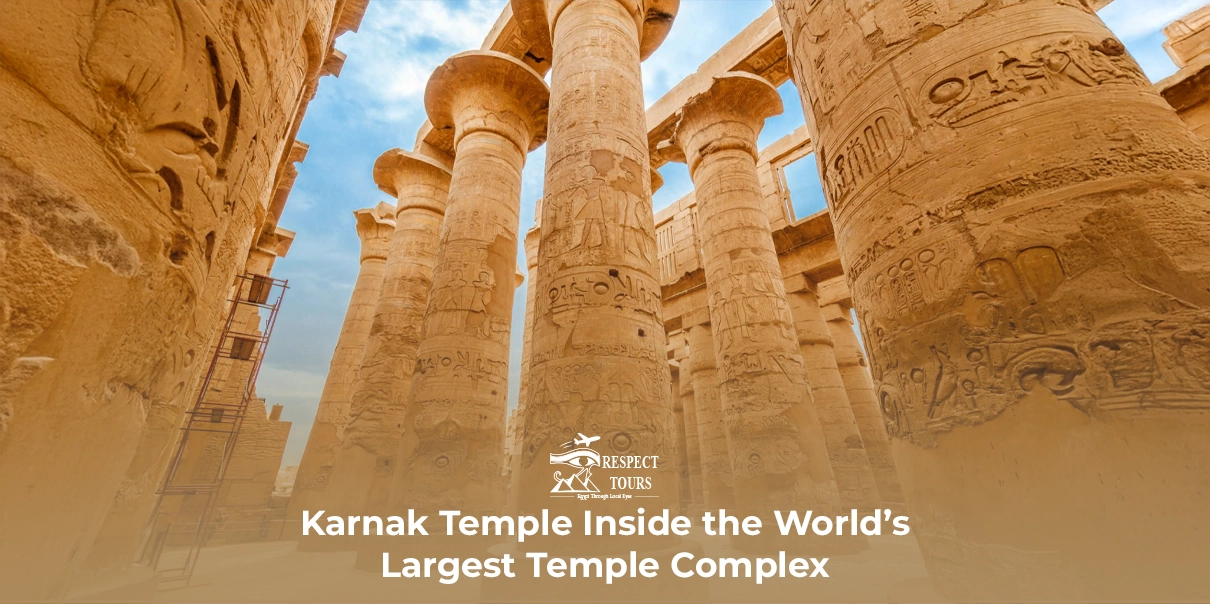
Stand inside Karnak Temple, and you immediately feel the scale of something extraordinary. Towering columns rise high above you, while walls covered in hieroglyphs tell stories carved more than 3,000 years ago. Everywhere you look, history surrounds you.
But Karnak is more than a temple. It’s an entire sacred city.
Covering over 200 acres on Luxor’s East Bank, Karnak served as the religious heart of ancient Egypt for more than 2,000 years. Generation after generation of pharaohs expanded the complex, creating one of the most impressive architectural achievements in human history.
At Respect Tours Egypt, our senior travel experts have guided countless travelers through these ancient halls, and the reaction is always the same: awe. In this complete 2026 guide, you’ll discover Karnak’s history, its must-see highlights, practical visiting tips, and how to make the most of your time there.
If Karnak is on your Egypt itinerary, here’s everything you need to know before you go.
Karnak Temple Quick Facts
- Official Name: Karnak Temple Complex (Ipet-isut: “The Most Select of Places” in ancient Egyptian)
- Location: East Bank, Luxor, Egypt (25.7187°N, 32.6573°E) | 3 km north of Luxor city center
- Total Area: 200+ acres (81 hectares), larger than many ancient cities
- Construction Period: Over 2,000 years (c. 2055 BC – 100 AD)
- Main Sections:
- Precinct of Amun-Ra: 61 acres (main visitor area)
- Precinct of Mut: 23 acres (goddess consort of Amun)
- Precinct of Montu: Northern section (war god)
- Precinct of Aten: Dismantled after Akhenaten’s reign
- Primary Deity: Amun-Ra (King of the Gods)
- Great Hypostyle Hall:
- Total area: 50,000 square feet (5,000 m²)
- Total columns: 134
- Central columns: 12 (23 meters/75 feet tall)
- Side columns: 122 (15 meters/49 feet tall)
- Built by: Seti I (begun 1290 BC), completed by Ramesses II
- Notable Features:
- Avenue of Sphinxes: 2.7 km long, 1,057 sphinx statues (reopened 2021)
- Sacred Lake: 130 x 77 meters
- Tallest obelisk: Hatshepsut’s, 29.5 meters (97 feet), 323 tons
- First Pylon: 43 meters high, 113 meters wide (unfinished)
- UNESCO Status: World Heritage Site (inscribed 1979)
- Annual Visitors: 2+ million
- Current Management: Egyptian Ministry of Tourism & Antiquities; French-Egyptian Centre for Karnak Studies
- Nearest Airport: Luxor International Airport (LXR), 8 km away
Why Visit Karnak Temple?
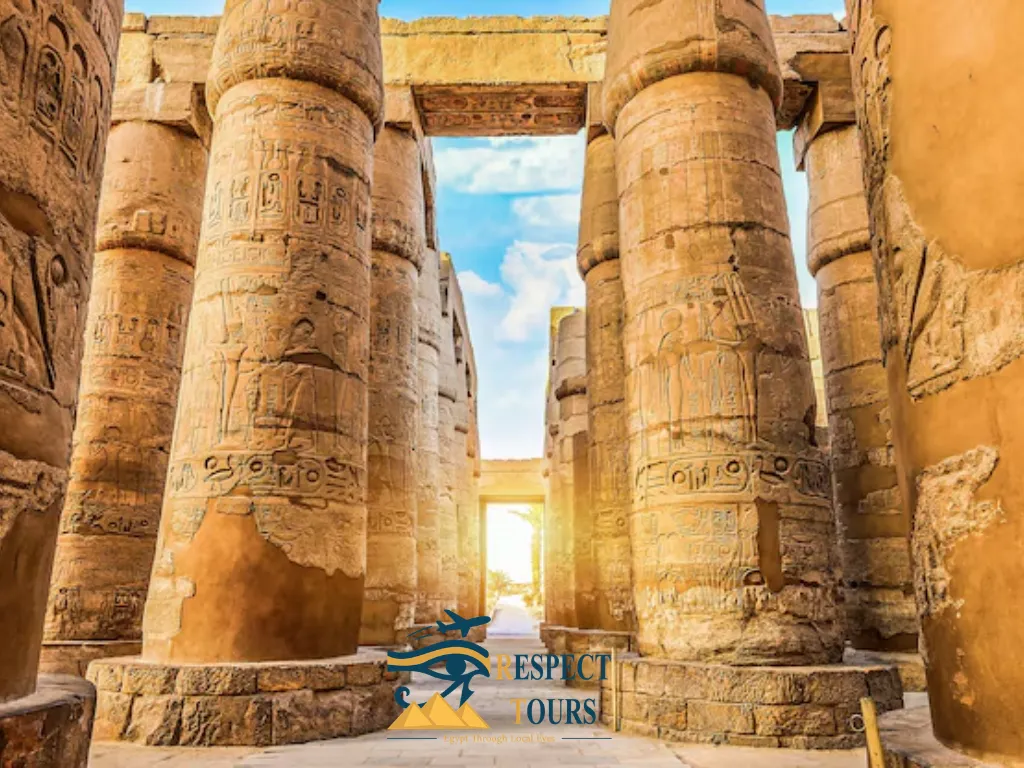
After 40 years of guiding travelers through Karnak, our guides still get chills watching first-time visitors enter the Hypostyle Hall. Someone always whispers, (How did they do this?)
Welcome to Ancient Thebes’ Greatest Monument
When you arrive at Karnak, you’re not just stepping into an archaeological site; you’re stepping back into ancient Thebes, the glorious capital of Egypt during the New Kingdom.
For over 2,000 years, pharaohs, priests, and common folk alike worshipped here, making offerings to the gods and shaping the destiny of one of the world’s greatest civilizations. It’s an experience that resonates deep within you, a connection to a past both grand and mysterious.
Is Karnak Worth Visiting?
Many travelers ask me, “Is Karnak Temple worth visiting?” My answer is always an emphatic yes. Karnak delivers an experience the pyramids can’t, you’re not just looking at ancient Egypt, you’re standing inside it.
It’s a place where you can truly grasp the ambition and artistry of the pharaohs. From the awe-inspiring Great Hypostyle Hall to the serene Sacred Lake, every corner tells a story. It’s a cornerstone of any comprehensive Egypt itinerary, especially for those seeking to understand the heart of ancient Egyptian religion and power.
What makes Karnak unique:
- Walk where pharaohs walked, and priests chanted
- Touch hieroglyphs carved 3,000+ years ago
- Stand beneath 75-foot columns that still soar overhead
- Explore 200 acres of largely intact structures
- Witness 2,000 years of architectural evolution in one location
The History of Karnak Temple
Over 2,000 Years of Construction
The history of Karnak is a tapestry woven over two millennia, from the Middle Kingdom (2055-1650 BC) right through to the Ptolemaic period.
It wasn’t built by one pharaoh, but by dozens, each adding their mark, expanding, renovating, and sometimes even dismantling earlier structures to build their own.
This layered history is what makes exploring Karnak so fascinating; you’re literally walking through centuries of architectural evolution.
The Temple City of Amun-Ra
At its heart, Karnak was dedicated to the Theban Triad: Amun-Ra (the king of gods), his consort Mut, and their son Khonsu. Amun-Ra, in particular, was the supreme deity, and Karnak became the most important religious center in ancient Egypt.
It wasn’t just a place of worship; it was a powerful economic and political hub, controlling vast lands, wealth, and a massive priestly bureaucracy. The temples here were the conduits between the human and divine worlds.
Karnak Through the Ages
| Period | Years | Key Developments |
|---|---|---|
| Middle Kingdom | 2055–1650 BC | Foundation era; Mentuhotep II builds the earliest structures; Amun elevated to state deity. |
| New Kingdom | 1550–1070 BC | Golden age; Hatshepsut’s obelisks; Thutmose III’s Festival Hall; Great Hypostyle Hall begun. |
| Akhenaten Era | 1353–1336 BC | Aten temples built (later dismantled); monotheism experiment. |
| Ramesses II | 1279–1213 BC | Completes Hypostyle Hall; adds Battle of Kadesh reliefs; massive expansion. |
| Third Intermediate Period | 1070–664 BC | Construction slows; priestly power peaks; High Priests rule as theocratic kings. |
| Ptolemaic Period | 332–30 BC | Greek rulers add final structures; Temple of Opet constructed. |
| Roman–Byzantine Period | 30 BC–641 AD | Christianization; portions converted to churches; traditional worship ends. |
| Islamic–Modern Period | 641–1799 | Abandonment; sand burial preserves structures; local stone quarrying. |
| Rediscovery & Modern Era | 1799–Present | Napoleon’s expedition (1799); excavation begins (1895); UNESCO designation (1979). |
Key Pharaohs Who Built Karnak
Hatshepsut (1479-1458 BC)
- Erected two 29.5-meter obelisks (one still standing)
- Used monuments to assert divine right to rule as a female pharaoh
- Inscriptions declare her legitimacy
Thutmose III (1479-1425 BC)
- Built Festival Hall with unique tent-pole columns
- Created Botanical Garden reliefs from 17 military campaigns
- Egypt’s “Napoleon”, the greatest military pharaoh
Seti I (1290-1279 BC)
- Began Great Hypostyle Hall construction
- Died before completion
Ramesses II (1279-1213 BC)
- Completed father’s Hypostyle Hall
- Added 134 colossal columns
- Covered surfaces with Battle of Kadesh propaganda
- Most prolific builder in Egyptian history
Architecture & Symbolism
Ancient Engineering Methods:
- Copper/bronze chisels to split granite
- Wooden sledges and rollers for 323-ton obelisk transport
- Sand ramps were gradually removed as structures rose
- Astronomical alignments for precise orientations
Symbolic Design:
- East-west axis: Sun’s daily journey across the sky
- Progression outer→inner: Mundane world → divine realm
- Column styles: Papyrus (Lower Egypt), Lotus (Upper Egypt)
- Painted ceilings: Star-studded night sky representing the universe
Every element carried religious meaning; the temple interior became a microcosm of creation itself.
Religious Significance
- The Cult of Amun-Ra
Amun evolved from a local Theban deity to Egypt’s supreme god during the New Kingdom. His name means “The Hidden One”, invisible yet omnipresent. Merger with the sun god Ra created Amun-Ra, whose worship dominated for 1,500 years.
The temple wasn’t just religious; it was Egypt’s wealthiest institution:
- 2,400 km² agricultural land
- 421,000 livestock
- 83 ships
- 81,000 employees
The High Priest of Amun wielded power rivaling the pharaoh’s.
- The Opet Festival
Egypt’s grandest celebration lasted 2-4 weeks during the Nile’s flood season. Priests carried gold shrines with cult statues from Karnak to Luxor Temple via the Avenue of Sphinxes.
This festival renewed the pharaoh’s divine kingship. He entered Luxor Temple’s inner sanctuary and emerged “reborn” with legitimacy refreshed. The state provided free food and beer, ancient Egypt’s Super Bowl.
- Daily Rituals
Priests performed three rituals daily (dawn, noon, dusk):
Dawn Ritual:
- Break sealed door (sealed nightly to protect god’s rest)
- Light lamps, burn kyphi incense (16-ingredient blend)
- Unwrap yesterday’s linen, wash the statue
- Anoint with cedar oil, paint eyes with malachite
- Dress in fresh pleated linen (500 folds per garment)
- Present offerings: bread, beer, duck, fruit
The god’s ka (spirit) consumed the essence; physical offerings became temple worker wages. This continued for 2,000 years.
Karnak Temple Complex Layout
The Four Precincts
- Precinct of Amun-Ra (61 acres) – Main Visitor Area
- Contains: Great Hypostyle Hall, Sacred Lake, Festival Hall, obelisks
- Accessibility: Fully open to tourists
- Precinct of Mut (23 acres)
- Dedicated to: Amun’s consort goddess
- Features: Crescent-shaped sacred lake, 600+ Sekhmet statues
- Accessibility: Limited/restricted for restoration work
- Precinct of Montu (Northern Section)
- Dedicated to: Theban war god (predates Amun)
- Accessibility: Generally closed to tourists
- Precinct of Aten (Dismantled)
- Built by: Akhenaten (1353-1336 BC)
- Status: Dismantled after his death; stones reused in later construction
Navigating Karnak: Recommended Route
Main Axis (East-West):
First Pylon → Great Court → Second Pylon → Great Hypostyle Hall → Obelisks → Inner Sanctuaries
Optimal Walking Route (3-4 hours):
- Enter through First Pylon (10 min)
- Cross Great Court, examine Ramesses II columns (15 min)
- Great Hypostyle Hall, spend substantial time here (45-60 min)
- Hatshepsut’s Obelisk (15 min)
- Thutmose III’s Festival Hall (20 min, northeast corner)
- Sacred Lake with rest break (20 min)
- Temple of Khonsu (20 min, southwest corner)
- Cachette Court (10 min)
- Exit via Avenue of Sphinxes if open (20 min)
Navigation Tip:
Our licensed Egyptologist guides follow an optimized route developed over 40 years of experience, ensuring you see highlights in the most logical sequence while avoiding backtracking across the massive 200-acre complex.
Independent travelers often waste 30-45 minutes retracing their steps or missing hidden gems, such as the Festival Hall Botanical Garden.
Top 10 Must-See Highlights at Karnak
1. The Great Hypostyle Hall
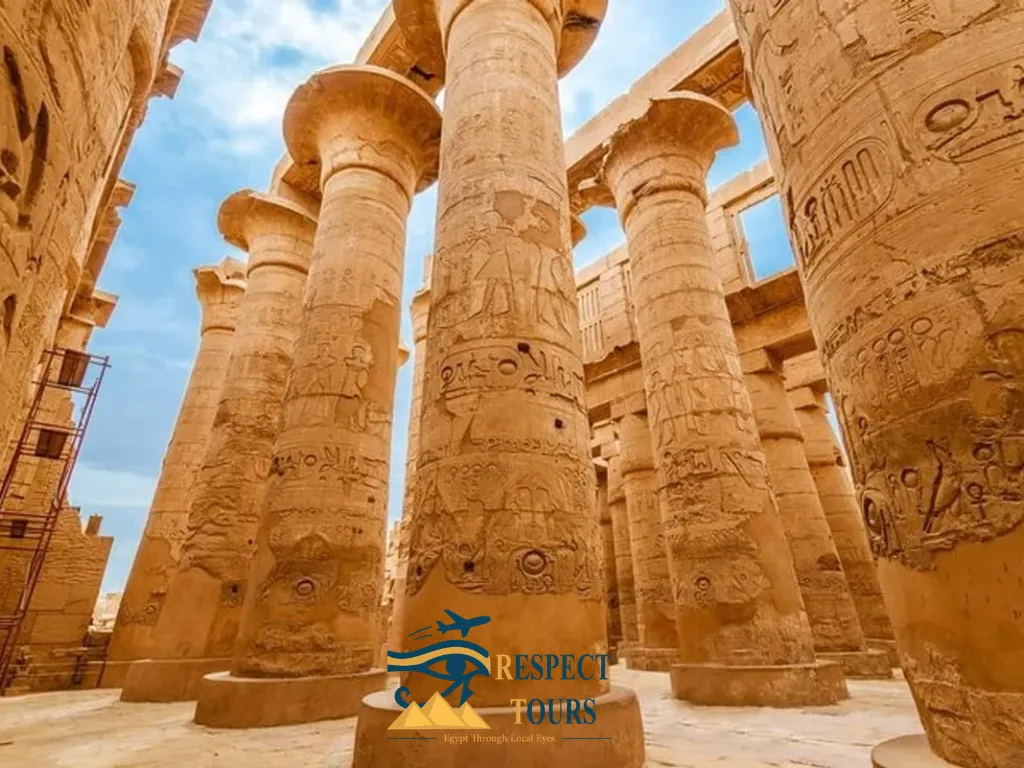
Step through the Second Pylon, and the temperature drops. You’ve entered the Great Hypostyle Hall, 134 columns creating their own microclimate.
The 12 central columns soar 23 meters (75 feet), every 3.5 meters in diameter. Their capitals bloom like massive stone papyrus flowers.
Run your hand along a column. The hieroglyphs are carved deep enough to fit your fingertips inside, chiseled with bronze tools across decades of work. In the early morning, the low sun reveals traces of original paint, ochre reds, and deep blues clinging stubbornly after 3,200 years.
This stone forest covers 50,000 square feet. Seti I began construction in 1290 BC; his son Ramesses II completed it, adding his cartouche everywhere.
2. Avenue of Sphinxes
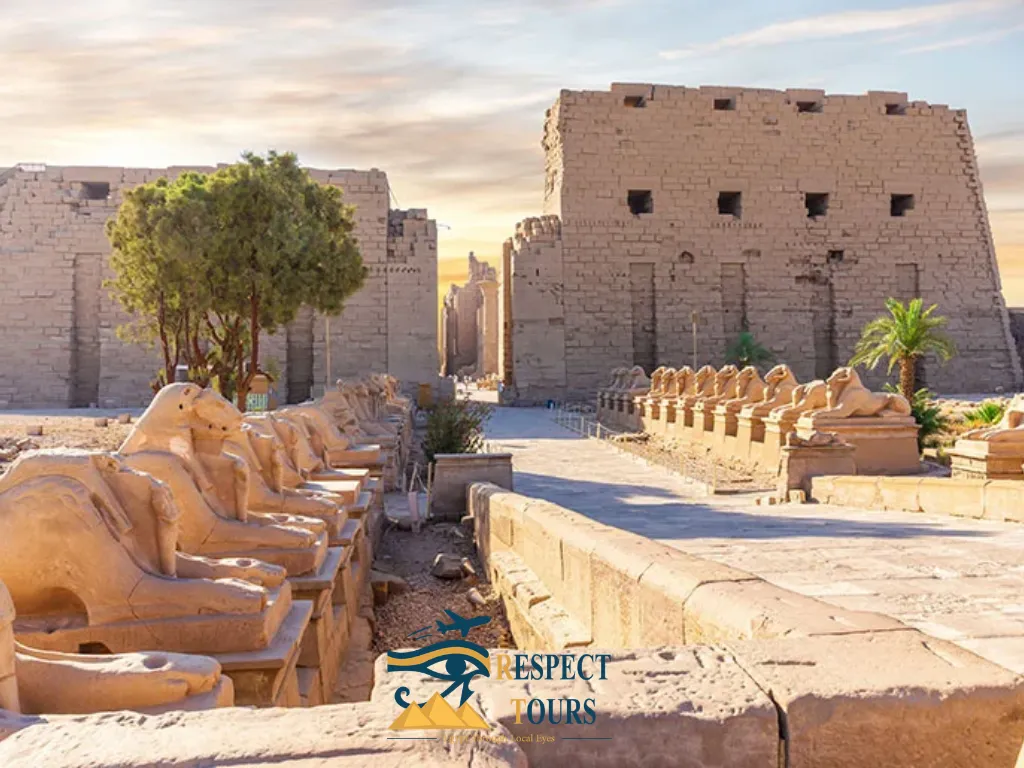
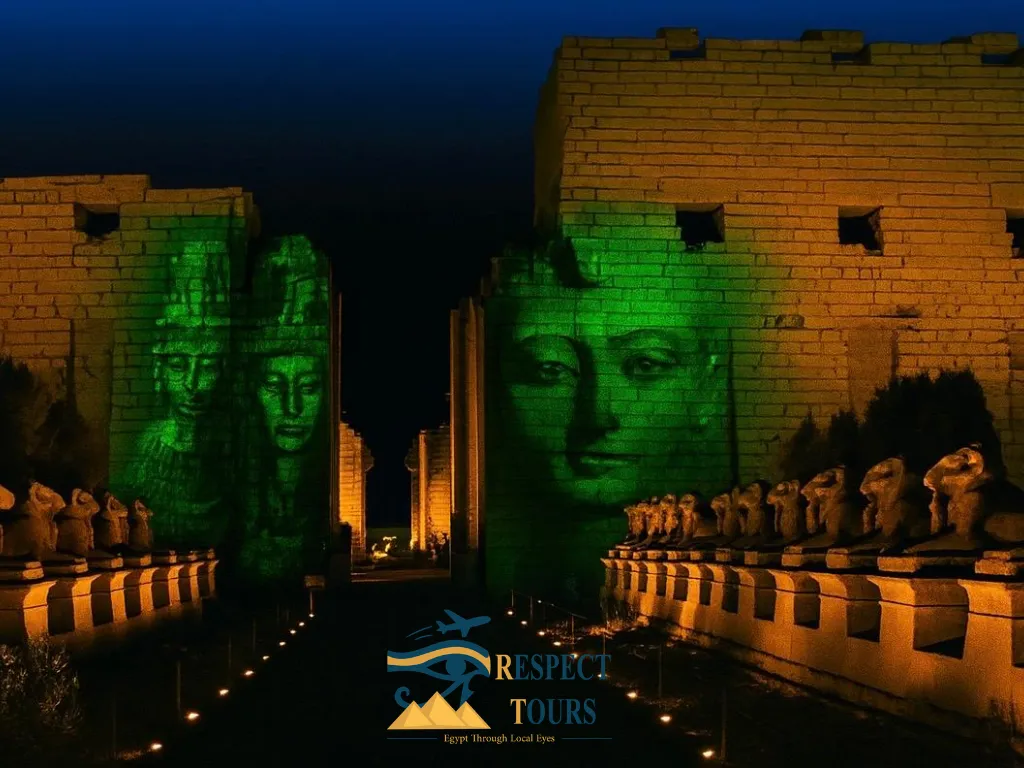
This 2.7-kilometer processional route connects Karnak to Luxor Temple, lined with 1,057 ram-headed sphinxes. After 70 years of restoration, it fully reopened on November 25, 2021.
You’re walking the exact path used during the Opet Festival 3,300 years ago, priests carrying golden shrines, musicians playing sistrums, the pharaoh leading processions while crowds threw flower petals.
Best Photo: Stand at midpoint looking toward Karnak’s First Pylon with sphinx heads in foreground. Time it for golden hour (4:30-5:30 PM).
Note: The full avenue is 2.7 km; most visitors walk 400-500 meters. Go early morning or late afternoon; there’s no shade.
3. Sacred Lake
The 130 x 77-meter lake lies mirror-still at dawn, reflecting Karnak’s columns in perfect symmetry. This is where priests washed before entering inner sanctuaries and floated offerings to Amun on papyrus boats.
Archaeologists found evidence that sacred geese lived here, their honking interpreted as Amun’s voice. Stand here at sunrise and imagine that soundscape: geese calling across still water while incense drifted from temples.
4. Hatshepsut’s Obelisk
At 29.5 meters (97 feet) and weighing 323 tons, this single granite piece was quarried at Aswan, 200 kilometers away, transported down the Nile on massive barges, then raised using sand ramps and wooden levers.
The inscriptions proclaim Hatshepsut’s divine birth and legitimate right to rule as pharaoh. The obelisk was originally capped with electrum (gold-silver alloy), catching the first dawn rays, announcing the sun god’s arrival to all of Thebes.
Photography: Shoot from the base with a wide-angle lens, including surrounding columns for scale. Midday sun lights the hieroglyphs best.
5. First Pylon
This massive gateway stands unfinished at 43 meters high and 113 meters wide. You can still see remnants of mud-brick construction ramps on exterior walls, a rare glimpse into ancient building techniques.
The gateway was never completed, likely because the commissioning pharaoh died before work finished. Even incomplete, it dwarfs everything around it.
6. Avenue of Sphinxes Ram Heads
Each sphinx features a ram’s head (sacred to Amun) with a small statue of Ramesses II protected between the paws. The ram symbolized Amun’s creative force; these weren’t mere decorations but protective deities lining the sacred route.
7. Temple of Khonsu
Located in the southwest corner, this temple dedicated to the moon god (son of Amun and Mut) is remarkably well-preserved. It features an intact roof structure and detailed wall scenes showing religious rituals.
The temple’s smaller scale makes architectural details easier to appreciate than in the overwhelming main complex.
8. Festival Hall of Thutmose III
Often skipped because it requires extra walking, this hall features unique tent-pole style columns. The real treasure is the Botanical Garden, wall reliefs depicting exotic plants and animals Thutmose III encountered during 17 military campaigns in Syria and Palestine.
This is ancient Egypt’s first illustrated natural history catalog, showing remarkable Bronze Age scientific observation.
Location: Eastern part of the Amun precinct
9. Sacred Scarab Statue
Near the Sacred Lake sits a giant granite beetle, the scarab, symbol of Khepri (god of the rising sun and transformation). Local tradition claims walking around it seven times counterclockwise brings good luck.
Whether you believe the legend or not, it’s a fun ritual connecting you to thousands of years of symbolic meaning. The scarab represented rebirth and the eternal cycle of the sun.
10. Cachette Court
In 1903, French archaeologist Georges Legrain discovered over 17,000 bronze objects and 800 stone sculptures buried here by priests around 300 BC, one of Egyptology’s most significant finds.
Standing in this courtyard, you’re at ground zero of that incredible discovery. Most artifacts now reside in the Egyptian Museum (Cairo) and Luxor Museum, but the site itself resonates with that history.
Hidden Gems at Karnak
Temple of Ptah
Located in the northern corner, often overlooked. This small temple dedicated to Ptah (creator god and patron of craftsmen) offers an intimate scale after the Hypostyle Hall’s overwhelming grandeur.
Contains some of the best-preserved reliefs in the complex. Worth the 10-minute walk for a quieter experience.
Chapel of Osiris
Near the Sacred Lake, small chapels dedicated to Osiris (god of the afterlife) feature unique Osirid columns, shaped as Osiris wrapped in mummy bindings.
The intimate scale and intact decorations offer a different perspective from the overwhelming grandeur elsewhere.
Understanding Karnak’s Hieroglyphics
The walls of Karnak are a library of ancient knowledge.
What the Walls Tell Us
The hieroglyphics at Karnak are not just pretty pictures; they are historical records, religious texts, and royal propaganda. They narrate battles, depict rituals, list pharaohs, and praise the gods.
Famous Inscriptions
Look for the detailed accounts of the Battle of Kadesh (fought by Ramesses II) and the King Lists that chronicle the pharaohs. Your guide can also point out scenes of the pharaohs’ divine birth, reinforcing their legitimacy.
Learning to Read Basic Symbols
With a good guide, you can learn to identify common hieroglyphs and even recognize the cartouches (oval frames) that enclose the names of pharaohs. It adds an incredible layer of understanding to your visit.
Fascinating Facts About Karnak
- Construction spanned 2,000+ years, one of history’s longest construction projects
- 30+ pharaohs contributed, each adding their architectural stamp
- Covers 200+ acres (81 hectares), larger than most ancient cities
- The Great Hypostyle Hall could contain Notre-Dame Cathedral within its footprint
- Central columns stand 23 meters (75 feet) tall, equivalent to a 7-story building
- Hatshepsut’s obelisk weighs 323 tons, carved from a single granite block
- The Avenue of Sphinxes reopened in 2021 after a 70-year restoration project
- At its peak, controlled 2,400 km² of agricultural land
- Employed up to 81,000 people, including priests, guards, craftsmen, farmers
- Most visited Egyptian site after the Giza Pyramids, 2+ million annual visitors
- Sacred Lake measures 130 x 77 meters, fed by groundwater
- 1,057 sphinx statues line the Avenue of Sphinxes to Luxor Temple
- Karnak Cachette discovery (1903) yielded 17,000+ artifacts buried by priests
- Hieroglyphic inscriptions total over 100,000 individual symbols
- UNESCO World Heritage Site since 1979
Karnak Temple Hours & Entrance Fees 2026
Opening Hours
- Winter (October-April): 6:00 AM – 5:30 PM daily
- Summer (May-September): 6:00 AM – 6:00 PM daily
- Sound and Light Show: Evening performances (times vary by season)
Entrance Fees (February 2026)
| Visitor Type | Price | Notes |
|---|---|---|
| Foreign Adults | 400 EGP (~$13–15 USD) | Cash only |
| Students (with ISIC card) | 200 EGP | 50% discount |
| Egyptian Nationals | 40 EGP | Valid ID required |
What’s Included:
- Access to Precinct of Amun-Ra (main complex)
- Great Hypostyle Hall
- Sacred Lake
- Avenue of Sphinxes (when open)
- Personal photography (no additional fee)
Not Included:
- Sound and Light Show: 350-450 EGP (separate ticket)
- Professional photography permits: Apply through the Ministry of Tourism
- Audio guides: 30-50 EGP rental at the entrance
The Sound and Light Show at Karnak
Evening Spectacular
As dusk falls, Karnak takes on a different, magical aura. The Sound and Light Show at Karnak illuminates the temples with dramatic lighting, accompanied by a narrated story of ancient Thebes and the temple’s history. It’s a captivating way to experience the complex after dark.
Ticket Information
- Prices: Tickets typically cost around EGP 350-450 (approx. $11-$15 USD).
- Booking: You can purchase tickets at the gate or through your hotel/tour operator. Shows usually run multiple times a week, often in different languages.
Is the Sound and Light Show Worth It?
- Pros: It offers a unique perspective of Karnak at night, with beautiful lighting and an engaging historical narrative. It’s a relaxed way to absorb some history.
- Cons: Some find the narration a bit dated, and it doesn’t replace a daytime visit.
- Our take: If you have the time and budget, it’s a lovely addition to your Karnak experience, especially if you enjoy evening spectacles. However, if you’re short on time, prioritize the daytime visit.
Best Time to Visit Karnak Temple
Seasonal Recommendations
Best Months: October – April
- Weather: (21-29°C)
- Comfortable multi-hour exploration
- Peak tourist season: November-February (larger crowds but perfect weather)
Summer Months: May – September
- Weather: 95-110°F (35-43°C)
- Early morning arrival essential for safety and comfort
- Fewer tourists but intense heat
Best Time of Day
- 6:00 AM (Opening Time) – BEST
What you get:
- 90 minutes of near-private access before tour buses arrive (7:30 AM)
- Magical golden light slicing through the Hypostyle Hall columns
- The temperature is 15°F cooler than midday
- Best photography conditions
- You can actually hear yourself think
- 4:00-5:30 PM – Second Best
Benefits:
- Tour groups have departed
- Golden hour photography window
- Cooling temperatures
Drawbacks:
- Less time before closing (5:30 PM winter, 6:00 PM summer)
- Some areas in shadow
- 10:00 AM – 2:00 PM – WORST
Problems:
- Maximum crowds (tour bus peak)
- Maximum heat (dangerous in summer)
- Harsh overhead lighting washes out photos
- Difficult to find quiet moments
How to Get to Karnak Temple
Karnak Temple is located on the East Bank of Luxor, approximtely 3 kilometers (1.8 miles) north of Luxor city center.
- From your hotel in Luxor: A taxi or an Uber is the easiest way to get there. The ride is short, usually 10-15 minutes.
- From a Nile cruise: Most Nile cruises dock on the East Bank, and it’s a quick taxi ride.
- By felucca (traditional sailboat): For a more scenic approach, you can arrange a felucca ride along the Nile to a nearby dock, then a short walk or taxi.
Respect Tours Pro Tip:
We coordinate all transportation logistics for our guests, including reliable early morning (6:00 AM) pickups from hotels, cruise docks, or Luxor Airport.
10 Facts About King Menes: The Founder of Ancient Egypt
Practical Tips for Visiting Karnak
Dress Code
While there’s no strict dress code for tourists at Karnak, we always recommend modest clothing. This means covering your shoulders and knees.
It’s a sign of respect for the religious heritage of the site and the local culture. Loose, light cotton or linen clothing is ideal for comfort in the heat.
Accessibility
- Wheelchair access: While some main pathways are relatively flat, much of Karnak involves uneven ground, sand, and steps. Wheelchair access is limited, and navigating the entire complex can be challenging.
- Elderly visitor considerations: Pace yourself. Take frequent breaks in shaded areas. Consider a private tour with a vehicle that can drop you closer to certain sections.
Staying Hydrated and Safe
- Heat precautions: Always prioritize staying hydrated. Seek shade whenever possible. If you feel dizzy or unwell, inform your guide immediately.
- Shade areas: The Hypostyle Hall offers significant shade, as do some of the smaller temples.
- First aid: There are usually first aid stations or personnel available near the main entrance.
What to Bring to Karnak Temple
Preparation is key to a comfortable visit.
Essential Items
- Sun protection: A wide-brimmed hat, high SPF sunscreen, and sunglasses are non-negotiable. The Egyptian sun is intense, even in winter.
- Comfortable walking shoes: You’ll be doing a lot of walking on uneven surfaces. Leave the sandals for the hotel pool.
- Light, modest clothing: Breathable fabrics are best. For cultural respect, cover shoulders and knees.
- Portable fan: A lifesaver in warmer months.
- Snacks: Energy bars or fruit can be helpful, though there are small shops for drinks and basic snacks.
Karnak vs Other Egyptian Temples
| Feature | Karnak | Luxor Temple | Abu Simbel | Valley of the Kings |
|---|---|---|---|---|
| Size | 200 acres | 25 acres | Rock-cut façade | Underground tombs |
| Construction | 2055 BC–100 AD | 1400–1000 BC | 1264–1244 BC | 1539–1075 BC |
| Main Feature | Hypostyle Hall (134 columns) | Night illumination | 4 colossal 20m statues | Royal burial chambers |
| Time Needed | 3–4 hours | 1–2 hours | 1–2 hours | 2–3 hours |
| Best Time | Early morning (6–9 AM) | Sunset / Evening | Early morning | Early morning |
| Crowd Level | High | Medium | Medium | Very High |
| Temperature | Hot, some shade | Hot, less shade | Extremely hot | Cool underground |
Karnak vs Valley of the Kings: Which Should I Visit First?
If you can only choose one, choose based on your interests.
Choose Karnak if you want:
- Massive architectural scale
- Walking through standing structures
- Visible hieroglyphs and reliefs
- Photography opportunities
- Above-ground exploration
Choose Valley of the Kings if you want:
- Underground royal tombs
- Intact burial chambers
- Painted tomb ceilings
- Connection to specific pharaohs (Tutankhamun, Ramesses VI, Seti I)
- Cooler temperatures (underground)
Ideal scenario: Visit both over 2 days.
- Day 1: Karnak (early morning) + Luxor Temple (evening)
- Day 2: Valley of the Kings (early morning) + Hatshepsut Temple
Don’t attempt: Both Karnak and the complete West Bank in one day. You’ll be exhausted and won’t appreciate either properly.
Karnak vs Abu Simbel: Which Should I Visit First?
Visit Karnak first for most travelers.
Reasons:
- Karnak is more accessible (central Luxor vs. 280 km south of Aswan)
- Karnak offers more diverse experiences (multiple temples, a lake, an avenue)
- Karnak has better infrastructure for first-time Egypt visitors
- Abu Simbel requires a flight or a 3-hour drive, better as a planned excursion
Visit Abu Simbel if:
- You’re already in Aswan
- You want to see the iconic colossal statues
- You’re interested in the UNESCO rescue operation story
- You have limited time and want one spectacular facade photo
Ideal: Visit Karnak during your Luxor stay, then Abu Simbel as a day trip from Aswan.
When to Visit Each
Same-Day Combinations:
- Do:
- Karnak + Luxor Temple (works well)
- Valley of Kings + Hatshepsut Temple (West Bank day)
- Don’t
- Karnak + Valley of Kings (too much, requires 2 days)
- Karnak + Abu Simbel (impossible same-day)
Why Karnak Stands Out
Karnak truly stands out because it is:
- The largest temple complex in the world.
- The site of the longest construction period, spanning over 2,000 years.
- Showcases the most diverse architecture, reflecting contributions from dozens of pharaohs.
Photography at Karnak Temple
Best Photo Spots:
- Hypostyle Hall Central Aisle
- Stand at the entrance, shoot down the main axis with columns receding to the vanishing point.
- Best time: 6:00-7:00 AM (soft backlight) or 4:00 PM (golden hour)
- Sacred Lake Reflections
- Dawn mirror shots (6:00-7:00 AM when water is perfectly still)
- Include a scarab statue in the foreground with temples reflected behind
- Use a polarizing filter to reduce glare and deepen sky color
- Avenue of Sphinxes Linear Perspective
- Stand at the midpoint, shoot toward the First Pylon
- Ram heads in foreground, temple complex in background
- Late afternoon creates warm tones and long shadows
- Hatshepsut’s Obelisk
- Shoot from base looking up with a wide-angle lens (16-24mm)
- Include surrounding columns for scale
- Midday sun illuminates the hieroglyphs best
- The Shot Nobody Thinks Of
- Stand on the western side of the Hypostyle Hall at 4:00-4:30 PM.
- Shoot east through columns toward the light.
- Backlighting creates dramatic silhouettes of hieroglyphs and makes columns glow.
Golden Hour Lighting:
- Early morning (6:00-8:00 AM): Soft, warm side-lighting reveals carved depth
- Late afternoon (4:00-5:30 PM): Rich golden light, columns appear to glow
- Midday (10:00 AM-2:00 PM): Harsh overhead light, avoid for serious photography
Photography Rules
Allowed:
- Personal photography with phones, cameras, and DSLRs
- Video recording for personal use
- Taking photos of other visitors in your group
Prohibited:
- Drones (strictly forbidden, will be confiscated)
- Professional tripods without permits
- Flash photography near delicate painted reliefs
- Commercial photography without Ministry of Tourism permits
Dining Near Karnak
Restaurants Within Walking Distance
You’ll find several local eateries and cafes near the temple entrance, offering quick bites and refreshments.
Traditional Egyptian Cuisine
Don’t miss trying local specialties like koshary, ful medames, or fresh grilled fish from the Nile. Many restaurants offer outdoor seating with views.
International Options
Most hotels and some standalone restaurants offer international menus if you’re craving something familiar.
Shopping Around Karnak
Souvenir Shops
Near the entrance, you’ll find numerous shops selling papyrus, alabaster carvings, replica statues, and other souvenirs. Remember that bargaining is expected!
Local Markets
For a more authentic experience, explore the Luxor Souk, a bustling local market where you can find spices, textiles, and everyday goods.
Plan Your Karnak Temple Visit with Respect Tours Egypt
If Karnak Temple is now at the top of your Luxor itinerary, the next step is planning your visit the right way.
At Respect Tours Egypt, we design Luxor experiences that go beyond a standard temple stop. Our licensed Egyptologist guides, early-morning access coordination, and seamless transportation ensure you experience Karnak at its best, without stress, crowds, or wasted time.
Explore Our Most Popular Luxor Tours:
- Luxor Day Tours
Flexible private tours covering Karnak, Luxor Temple, and West Bank highlights. - Luxor East & West Banks Full-Day Tour
Visit Karnak Temple, Luxor Temple, Valley of the Kings, and Hatshepsut Temple in one professionally guided experience. - Karnak Sound & Light Show Experience
Discover Karnak from a different perspective with an evening light and sound performance.
If you’re planning a longer Egypt journey, we also offer fully customized multi-day Egypt packages that include Luxor, Aswan, Cairo, and beyond, all designed around your schedule, travel style, and comfort level.
Let us handle the logistics while you focus on the experience.
Why Book with Respect Tours
At Respect Tours Egypt, we understand that visiting a place like Karnak is a once-in-a-lifetime experience. We’re dedicated to making it seamless, enriching, and unforgettable for our discerning travelers.
Expert Egyptologist Guides
Our guides aren’t just tour leaders; they’re passionate, licensed Egyptologists who bring the ancient world to life with their deep knowledge and engaging storytelling.
They’re adept at answering every question, from the grandest historical query to the smallest detail about a specific hieroglyph.
Skip-the-Line Access
Time is precious when you’re exploring Egypt. We arrange for skip-the-line access at major sites like Karnak, ensuring you spend less time waiting and more time marveling.
Customized Karnak Experiences
Whether you’re a history enthusiast seeking an in-depth exploration or a family looking for a fun, engaging visit, we tailor your Karnak experience to your interests and pace.
All-Inclusive Packages
From airport transfers to accommodation, expert guides, and comfortable transportation, our luxury and adventure tours handle all the logistics.
You simply relax and immerse yourself in the magic of Egypt. We pride ourselves on transparent pricing and no hidden fees, offering peace of mind for our US, UK, and Canadian guests.
Experience Karnak Temple
Standing in the Hypostyle Hall at dawn, surrounded by 134 towering columns carved with hieroglyphs that survived 3,200 years, you’ll understand why Karnak is called the greatest temple complex ever built.
You’ll feel the weight of history, the ambition of pharaohs, the devotion of priests, and the genius of Bronze Age engineers who accomplished what seems impossible even today.
Let Respect Tours Egypt be your trusted partner in discovering Karnak Temple. With 40 years of experience guiding travelers from the US, UK, Canada, and Australia, we know how to make your visit seamless, enriching, and unforgettable.
Our licensed Egyptologist guides, early morning access coordination, and optimized routing ensure you experience Karnak at its absolute best.
Karnak delivers an experience unlike any other ancient site on Earth. It’s not just history, it’s a visceral connection to one of humanity’s greatest civilizations.
Let your Egyptian adventure begin at Karnak Temple: the largest ancient religious complex in the world. Start planning your extraordinary journey today.
FAQs
How long does it take to visit Karnak Temple?
We recommend 3-4 hours for a comprehensive visit, though you can do a quick tour in 2 hours.
Are there bathrooms at Karnak?
Yes, there are public restrooms available near the main entrance and within the complex.
Is Karnak suitable for children?
Yes, it can be very engaging for children, especially with a good guide who can make history fun. Just ensure they stay hydrated and take breaks.
Is the Sound and Light Show worth it?
It’s a pleasant evening experience, but it doesn’t replace a daytime visit. Consider it an optional extra if you have time.
How much does it cost to enter Karnak?
The standard adult ticket is around EGP 400 (approx. $13-$15 USD).
Is Karnak Temple wheelchair accessible?
The site has limited accessibility. Main pathways to the First Pylon and Great Hypostyle Hall are relatively flat and suitable for wheelchairs with assistance. However, approximately 60% of the complex includes uneven ground, steps, raised thresholds, and sand patches.
The Sacred Lake area and inner sanctuaries present significant challenges. Visitors should focus on accessible highlights: First Pylon, Great Court, and Hypostyle Hall main aisles.
How far is Karnak Temple from Luxor?
Karnak is located 3 kilometers (1.8 miles) north of Luxor city center on the East Bank. Travel time by taxi or Uber is 10-15 minutes, costing 50-80 EGP ($1.60-$2.60 USD). From Luxor International Airport, it’s 8 km (15-20 minutes, 150-200 EGP). Most hotels can arrange transport.
What’s the difference between Karnak and Luxor Temple?
Karnak is vastly larger (200 acres vs. 25 acres) and was built over 2,000+ years by 30+ pharaohs. It served as the primary religious complex for Amun-Ra worship.
Luxor Temple, built over 400 years, focused on royal legitimacy rituals during the Opet Festival. The 2.7 km Avenue of Sphinxes connected both temples; they functioned as complementary parts of one religious complex. Visit both: Karnak in the early morning, Luxor Temple at sunset.