
How Ancient Egyptians Wrote ‘I Love You’: Hieroglyphics for Love
When archaeologists translated the Cairo Love Songs in 1852, they uncovered something timeless. The ancient Egyptians expressed love with the same passion, longing, and vulnerability we feel today. One verse reads:
“My heart remembers your love, my breath catches when I speak your name.”
Written more than 3,200 years ago, yet it could have been whispered yesterday.
Egyptian Hieroglyphics For Love reveals a civilization that believed affection was sacred, powerful enough to cross worlds and endure eternity. Respect Tours helps travelers uncover these emotional treasures across Egypt, where gods and mortals once carved their feelings into stone.
Each Egyptian Hieroglyphics For Love symbol carries divine meaning, transforming human emotion into eternal devotion. Every stroke was both art and prayer, a declaration meant to last beyond life itself.
What You’ll Learn in This Guide
- How to read and write authentic Egyptian hieroglyphic love symbols
- 15+ real love phrases from ancient papyri with English meanings
- The difference between romantic passion (mrwt) and eternal devotion (hesep-ib)
- Where to see the most beautiful hieroglyphic love inscriptions in Egypt today
- How modern couples use these ancient symbols (and the mistakes to avoid)
Let’s begin by exploring the origins of this divine language, the Egyptian hieroglyphics of love.
Understanding Egyptian Hieroglyphics: The Foundation
What Are Hieroglyphics?
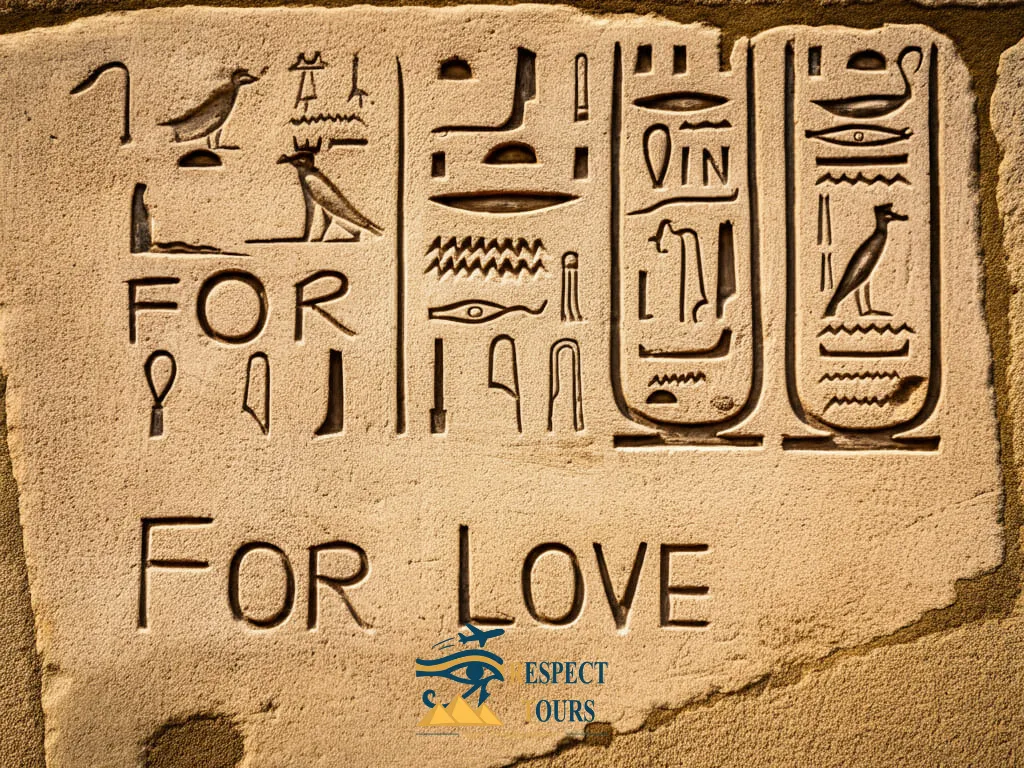
The word hieroglyphics combines Greek hieros (sacred) and glyphos (carving), literally, “sacred carvings.” Egyptians called their writing medu netjer, or “words of the gods,” reflecting their belief that writing was a divine creation of Thoth, god of wisdom.
Timeline Snapshot:
- 3200 BCE: Hieroglyphics emerge during the Early Dynastic Period
- 2600–2100 BCE: Old Kingdom: peak pyramid inscriptions
- 1550–1077 BCE: New Kingdom: golden age of love poetry
- 394 CE: Final inscription at Philae Temple
Hieroglyphics thrived for over 3,500 years, blending art, language, and spirituality.
Deciphering Hieroglyphics: The Writing and Reading Process
The Hieroglyphic Writing System
Understanding hieroglyphic expressions of love requires grasping the system’s fundamental principles. Hieroglyphs functioned as:
- Logograms: Symbols representing entire words or concepts
- Phonograms: Symbols representing sounds
- Determinatives: Symbols clarifying meaning or category
Love-related hieroglyphs often combined all three types, creating rich, multilayered expressions that could convey subtle emotional nuances impossible in simpler writing systems.
The Rosetta Stone: A Key to Deciphering Hieroglyphs
The discovery of the Rosetta Stone in 1799 proved crucial for understanding hieroglyphic love poetry and romantic inscriptions. This trilingual decree, written in hieroglyphic, demotic, and Greek scripts, provided the key that allowed scholars to unlock the secrets of ancient Egyptian emotional expression.
Through the Rosetta Stone, researchers could finally understand the complex interplay between symbols, sounds, and meanings in hieroglyphic love texts, revealing the sophisticated emotional vocabulary of ancient Egyptians.
The Role of Scholars in Deciphering Hieroglyphics
Pioneering Egyptologists like Jean-François Champollion, Thomas Young, and later scholars dedicated their careers to understanding hieroglyphic texts, including the wealth of love poetry and romantic inscriptions found throughout Egypt. Their work revealed that ancient Egyptians possessed one of history’s most nuanced languages for expressing romantic emotion.
Modern scholars continue this work, using advanced digital tools and archaeological discoveries to uncover new hieroglyphic love texts, expanding our understanding of ancient Egyptian romantic culture.
The Hieroglyphic Symbols of Love: Visual Guide
Core Love Symbols (With Descriptions)
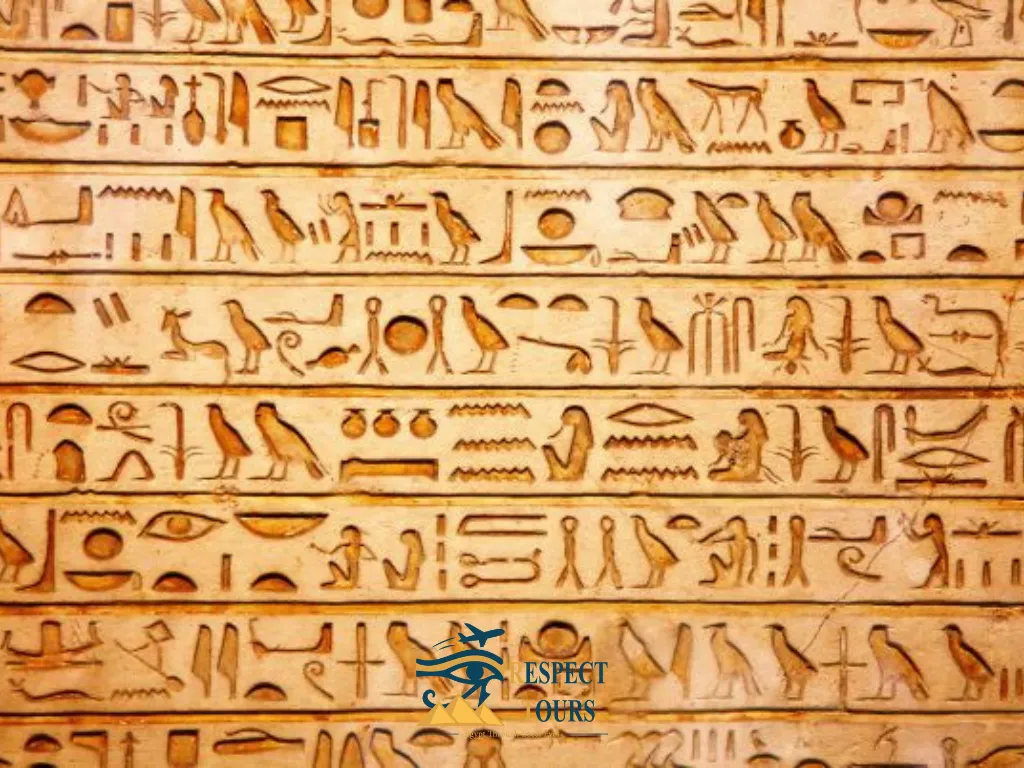
- The Heart — IB (𓇋𓃀)
Appearance: Not the modern heart shape, but an actual anatomical heart rendering—a vessel with vascular extensions
Meaning: The seat of emotion, thought, memory, and soul. In love contexts: “my heart,” “heart’s desire,” “one who possesses my heart”
Usage:
- “Mery-ib” = beloved of the heart
- “Ib-i” = my heart (possessive, intimate)
- “Dmi-ib” = united in heart (marriage phrase)
Found: Tomb inscriptions, marriage contracts, love letters
Modern application: Popular in Egyptian-themed jewelry, often combined with names
- The Ankh — Life Symbol (𓋹)
Appearance: Cross with a loop on top, resembling a key
Meaning: Life, breath, vitality. In romantic contexts: “you are my life,” “life-giving love,” “eternal life together”
Usage:
- God’s offering of ankh to couples = divine blessing on marriage
- Paired ankhs = two lives joined as one
- Ankh near heart = love that gives life
Found: Temple walls, royal marriage scenes, tomb paintings of devoted couples
Romantic interpretation: “You breathe life into me” or “My life only has meaning with you”
- The Shen Ring — Eternity (𓍶)
Appearance: Circular or oval rope loop with no beginning or end
Meaning: Infinity, eternal protection, unbreakable bonds
Usage:
- Surrounding names = eternal protection of the beloved
- “Shen her ren-k” = eternity around your name
- Double shen = infinite love between two souls
Found: Cartouches (royal name enclosures), wedding jewelry designs, protective amulets
Why it’s powerful: Egyptians believed writing someone’s name inside a shen literally protected them forever
- The Lotus Flower — Seshen (𓆸)
Appearance: Stylized flower with distinctive petals, shown opening or closed
Meaning: Rebirth, purity, awakening, intoxicating beauty
Colors matter:
- Blue lotus = romantic intoxication, overwhelming desire
- White lotus = spiritual purity, divine love
- Pink lotus = awakening sexuality, new love
Usage:
- “Seshen nefer” = beautiful/perfect lotus (high compliment for beloved)
- Offering lotus = declaration of romantic interest
- Two intertwined lotuses = souls joined in love
Found: Love poetry, tomb scenes of couples, perfume vessels
Famous example: Queen Nefertari’s tomb shows her receiving a lotus from Ramesses II, an intimate gesture symbolizing eternal devotion
- The Clasped Hands — United (𓂧)
Appearance: Two hands grasping each other
Meaning: Partnership, agreement, unity, mutual commitment
Usage:
- “Dmi deret” = united hands (marriage ceremony phrase)
- Appears in contracts = binding agreement
- In tomb art = eternal companionship
Archaeological note: The famous statue of Menkaure and his queen shows their hands joined; they’ve been holding hands for 4,500 years.
Writing Love in Hieroglyphics: Real Phrases
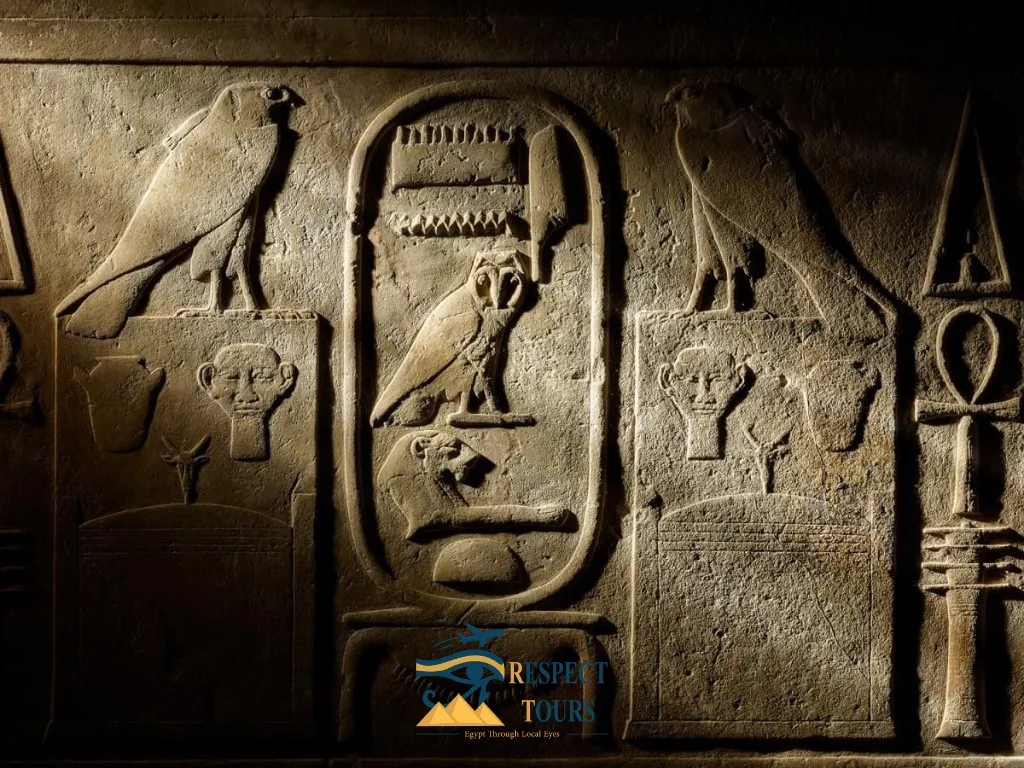
“Beloved of My Heart” — Mery-ib-i
Symbol sequence:
- Mery (beloved): shown as a basket with a mouth symbol
- Ib (heart): the heart hieroglyph
- -i (possessive “my”): reed leaf
Context: The most common term of endearment in love letters and tomb inscriptions
Grammatical note: Word order matters! “Ib-i-mery” would mean “my heart loves” (verb form)
“Sweet of Love” — Nedjem-en-merut
Symbol sequence:
- Nedjem (sweet): flag or cloth symbol
- En (of): connecting genitive
- Merut (love/s): basket-mouth-plural
Usage: Describing the beloved’s nature, often in poetry
Example from Turin Songs: “Sweet of love is her voice when she speaks”
“Two Hearts Bound Together” — Senewy-ib-seny
Symbol sequence:
- Senewy (two/double)
- Ib (heart)
- Seny (bound/joined)
Found in: Marriage contracts, tomb inscriptions of devoted spouses
Legal significance: This phrase in a contract had binding force—you promised your hearts were joined “for millions of years”
Symbol-by-Symbol Guide to Writing Your Own Love Message
Step 1: Choose Your Message Type
Option A: Simple Declaration
“I love you” equivalent: Mery-wi-tw.
Literally: “I am loving you” (continuous tense, always loving, not just now)
Option B: Poetic Description
“You are beautiful”: Nefer-ti (to woman) or Nefer-ki (to man)
Add “very”: Nefer-ti-aa = “You are very beautiful”
Option C: Eternal Vow
“Forever yours”: En-k djet (to man) or En-t djet (to woman)
Literally: “For you eternally”
Step 2: Add Personal Names
Egyptian names inside cartouches (oval enclosures with a horizontal line at the bottom) indicated royalty or importance. For love messages, putting beloved’s name in cartouche = “You’re royalty to me”
Example:
The modern name “Sarah” could be phonetically written:
- S = folded cloth symbol
- A = vulture symbol
- R = mouth symbol
- Ah = reed shelter symbol
Then enclose in a cartouche shape to show importance.
Step 3: Add Protective or Eternity Symbols
Surround with Shen ring = Eternal protection
Add ankh symbol = Life/vitality to the relationship.
Include lotus = Beautiful awakenin.g
Use clasped hands = Partnership
Complete Example: Modern Love Message in Hieroglyphics
Message: “Sarah, beloved of my heart, forever”
Hieroglyphic construction:
- Cartouche containing: S-A-R-Ah symbols (Sarah’s name)
- Followed by: Mery-ib-i (beloved of my heart)
- Enclosed by: Shen ring (for eternal protection)
- With: Ankh symbol below (giving life)
- Ending with: Djet (forever/eternity symbol)
Reading direction: Right to left (traditional), with human figures facing right
Where to use this:
- Jewelry engraving
- Tattoo design
- Wedding invitation border
- Anniversary gift inscription
Where to See the Most Beautiful Love Hieroglyphs in Egypt Today
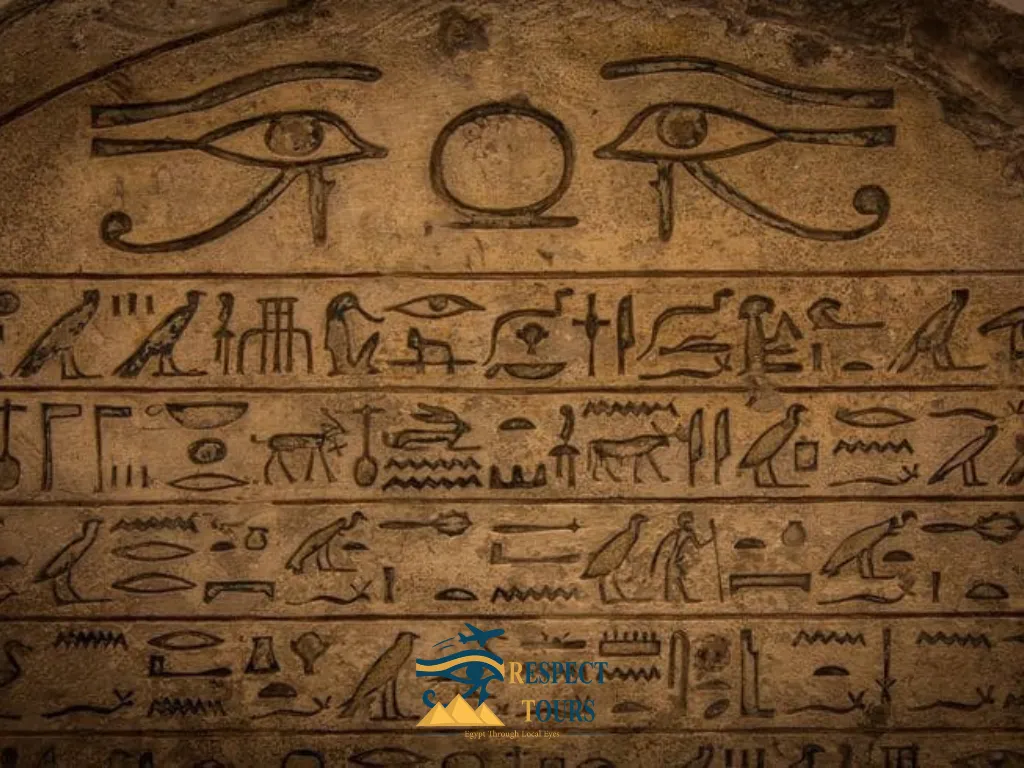
- Philae Temple (Island of Philae, Aswan)
Why visit: Called “Island of Love,” this temple of Isis preserves Egypt’s most romantic hieroglyphic inscriptions
Must-see hieroglyphs:
- Mammisi (Birth House): Isis and Osiris’ love story in 43 detailed panels
- Western Colonnade: Couples’ pilgrimage inscriptions from Greek and Roman periods
- Inner Sanctuary: “Love is stronger than death” is inscribed above the Osiris shrine
Visitor tip: Visit at sunset, hieroglyphs catch golden light, making them easier to photograph
Getting there: Boat required (10-minute ride from Philae dock). Temple was relocated in the 1960s to save it from Lake Nasser flooding, a romantic rescue mission for the love temple.
- Nefertari’s Tomb (Valley of the Queens, Luxor)
Why visit: Most beautifully preserved New Kingdom tomb, created by Ramesses II for his beloved wife
Must-see hieroglyphs:
- Burial chamber: Ramesses’ personal poems to Nefertari (incredibly rare for a pharaoh)
- North wall: “She for whom the sun shines” in brilliant blue and gold hieroglyphs
- Ceiling: Star-map with intertwined cartouches (Ramesses + Nefertari names joined forever)
Visitor restrictions:
- Only 150 visitors daily (book months ahead)
- 10-minute viewing limit (humidity control)
- No photography (protect pigments)
- Worth it: Colors preserved so well, looks freshly painted after 3,200 years
Alternative: Visit Abu Simbel’s small temple (dedicated to Nefertari), easier access, also has beautiful love inscriptions
- Deir el-Medina (Theban West Bank, Luxor)
Why visit: The Village of workers who built the Valley of Kings, ordinary people’s love hieroglyphs
Must-see hieroglyphs:
- Tomb of Sennedjem: A Married couple shown farming paradise together, surrounded by love poems
- Tomb of Inherkhau: Wife’s prayer for husband: “May we drink from the same cup in the afterlife”
- Ostraca Museum: Actual love letters on pottery shards (remarkably intimate)
Why this matters: Proves hieroglyphic love expression wasn’t just royal propaganda, regular people wrote tender messages too
Visitor tip: Hire a guide from the local village (descendants of ancient workers), they know family stories passed down for centuries
- Karnak Temple Complex (Luxor East Bank)
Why visit: The Largest religious complex in Egypt, which contains marriage celebration inscriptions from many dynasties
Must-see hieroglyphs:
- Sacred Lake: The North wall has private marriage dedications from nobles
- Festival Hall of Thutmose III: Botanical garden walls with flower symbolism explained in hieroglyphs
- Mut Precinct: Goddess of motherhood temple, couples wrote prayers for fertility
Hidden gem: Small shrine behind 7th pylon, Seti II inscribed a love poem to his wife, Twosret (later became pharaoh herself)
Visitor tip: Go early morning (6-8 AM), fewer crowds, better light for reading hieroglyphs
- Egyptian Museum, Cairo (Tahrir Square)
Why visit: World’s best collection of hieroglyphic love letters, jewelry, and artifacts
Must-see items:
- Room 17: Papyrus Chester Beatty I (under glass, but translation provided)
- Room 34: Marriage contracts with elaborate hieroglyphs
- Jewelry Wing: Amulets inscribed with lovers’ names, worn for protection
Special collection: Deir el-Medina ostraca, filing cabinets full of pottery-shard love notes
Pro tip: The Museum is moving to the Grand Egyptian Museum (GEM) near the pyramids. Check the current location before visiting.
Egyptian Love Symbol: The Lotus Flower
Among all hieroglyphic love symbols, the lotus flower holds special significance. This sacred bloom, which emerges pristine from muddy waters each dawn, represented rebirth, purity, and the triumph of love over adversity. In hieroglyphic love poetry, lotus flowers symbolized:
- Romantic awakening: Like the lotus emerging at sunrise
- Spiritual purity: Love that elevates and purifies the soul
- Eternal renewal: Relationships that grow stronger over time
- Divine blessing: Love sanctified by the gods
Couples often exchanged lotus flowers as tokens of affection, and hieroglyphic inscriptions frequently compared beloved partners to lotus blossoms. The blue lotus, in particular, was associated with romantic intoxication and the overwhelming nature of passionate love.
Conclusion
The story of Egyptian Hieroglyphics For Love isn’t just written in stone; it lives in the very soul of Egypt. Every heart, lotus, and ankh carved by ancient hands tells a story of devotion that defied death and bridged the divine with the human. These symbols were more than art; they were vows, blessings, and promises that love would endure through eternity.
Walk among the temples and tombs where love was first written in stone. With Respect Tours, you can uncover the real Egyptian Hieroglyphics For Love, tracing the footsteps of pharaohs, poets, and lovers who believed that affection could last forever.
FAQ: Frequently Asked Questions
How did ancient Egyptians express love in hieroglyphics?
Ancient Egyptians had a rich vocabulary for expressing love through hieroglyphics. Common expressions included symbols meaning “beloved of the heart” (mery-ib), “sweet of love” (nedjm-mrwt), and “united in heart” (dmj-ib). They often combined heart symbols with names or used protective symbols around a beloved’s name to express care and devotion.
The word “hieroglyphics” comes from ancient Greek, combining “hieros” (sacred) and “glyphos” (carving), literally meaning “sacred carvings.” The ancient Egyptians themselves called their writing system “medu netjer,” which translates to “words of the gods,” reflecting their belief that this writing system was divinely inspired.
Egyptian hieroglyphics date back approximately 5,200 years to around 3200 BCE. The system evolved over more than 3,000 years, with the latest known hieroglyphic inscription dating to 394 CE at the Temple of Philae. This makes it one of the longest-used writing systems in human history.
While we don’t have many formal marriage proposals in hieroglyphic texts, marriage contracts were often inscribed with hieroglyphic symbols expressing mutual love and commitment. These contracts emphasized partnership, loyalty, and the intention to remain together in both life and the afterlife.